Phone & Tablet Accessories

Best Cell Phone Signal Boosters of 2026

A phone that works everywhere is still a fantasy. Walk into a basement laundry room, a steel-sided garage, or a house ten minutes off the highway, and one bar becomes your whole relationship with the outside world: calls dissolve into robot syllables and texts sit on "sending" until you wander up the driveway. A signal booster is the fix — an outdoor antenna pulls in whatever slice of tower signal exists, a cable carries it inside, an amplifier pushes it, and an indoor antenna rebroadcasts it across a room or two. It can't invent coverage that was never there; it can only multiply what the roof already catches, which is why the same kit can be a miracle at one address and a paperweight at the next.

I've spent the past nine months living with seven of these systems, from single-room kits to whole-house setups, and one lesson held every time: the install decides the outcome far more than the spec sheet does. Boosters also don't care about your carrier's marketing — what matters is which bands your local tower actually broadcasts and whether the kit amplifies them. What follows is what earned its place, sorted by the situation each one genuinely solves.

1

HiBoost 4K

Top Pick
HiBoost 4K

Whole-home coverage

Our Score 8.8/10
Check Price

Worth Noting

  • Coverage claim assumes a strong signal outside
Coverage
4,000 sq ft
Warranty
3 years
Indoor Antenna
Wide-band panel antenna
Frequency Bands
Band 12/17, 13, 5, 25/2, 4

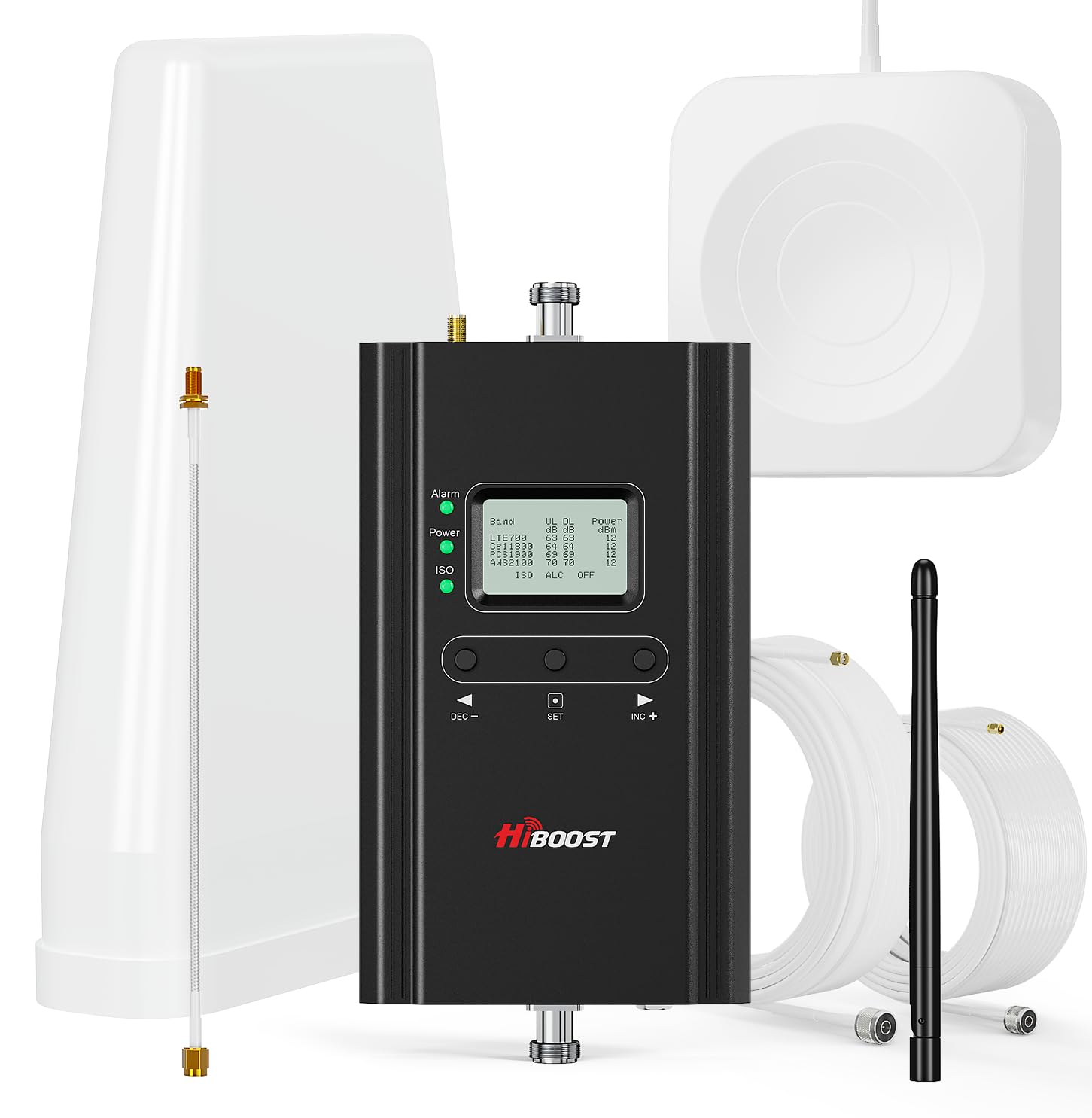
Comparing the HiBoost 4K against the better-known weBoost Home MultiRoom is what settled our top pick. The HiBoost asks less money, covers a similar amount of floor space on paper, keeps a third year of warranty, and handles the same spread of carrier bands. With the outdoor antenna in a spot that had a usable signal, it turned a one-bar room into a room where calls held and pages loaded — which is the entire point of owning one of these.

Installation is where these kits live or die, and this one gives you room. Two 30-foot cables let the outdoor antenna sit on a roof or gable while the indoor panel goes where you actually use your phone, and the flat through-window cable means renters can run the coax inside without drilling. The app and the color LCD both show live signal strength, so aiming stops being guesswork: you move the antenna, read the number, and keep the better position.

The 4,000 square feet is a best case built on a decent signal outside. In a basement office or a metal-clad shop, think of it as one floor, and if the roofline shows nothing at all, this will not invent a signal. Those are limits of the category rather than of this kit, and within them the 4K is the most complete package here: five bands, three years of cover, and enough cable to site both antennas where they belong.

Bottom line: For most homes and small offices this is the kit we recommend: five bands, a 4,000-square-foot claim, an app that helps aim the antenna, and a three-year warranty.

2

ZORIDA Ace 5S

ZORIDA Ace 5S

Budget home setups

Our Score 8.2/10
Check Price

Worth Noting

  • Single whip antenna needs a central spot
Coverage
2,000 sq ft
Max Gain
72 dB
Warranty
3 years
Frequency Bands
Band 12/17, 13, 5, 25/2, 4

Seventy-two decibels is a big gain number at this price, and gain is the specification that matters most: it is how much the amplifier can lift a weak outside signal before handing it to the indoor antenna. The rest of the kit is conventional in the right ways — an outdoor directional antenna, a small indoor whip, a long cable run, app-assisted setup, and a three-year warranty.

The indoor whip is the part to think about. It is small and omnidirectional, so it needs a central, reasonably high spot to spread signal through a room; tuck it in a corner behind a television and the far end of the room will barely notice it. We think that is the right compromise at this price, because the alternative is a panel antenna and a bigger bill.

Against the HiBoost F08G, which claims the same coverage, this kit skips the LCD readout: you aim the outdoor antenna by watching your phone's bars rather than a number on a screen. If you are happy to move the antenna a few times and check, the ZORIDA gets you there for less. If you want to see what the amplifier is doing, pay for the HiBoost. Either way, treat the 2,000 square feet as one room or one small floor, not two stories.

Bottom line: If you want a genuine five-band booster for budget money, we think this is the one, provided a single room or a small floor is all you need to cover.

3

HiBoost F08G

HiBoost F08G

Small homes

Our Score 8.6/10
Check Price

Worth Noting

  • Whip indoor antenna narrows the sweet spot
Coverage
2,000 sq ft
Warranty
3 years
Diagnostics
Color LCD plus app
Frequency Bands
Band 12/17, 13, 5, 25/2, 4

A one-bedroom apartment, a small house, or a home office at the back of a bigger place does not need 4,000 square feet of coverage, and this is the HiBoost kit sized for exactly that. It keeps the pieces we cared about in the larger model — the app, the color LCD, the three-year warranty, the through-window cable — and halves the claimed coverage.

In use, the LCD earns its keep before you commit to a cable run: it shows whether the outdoor antenna is pulling in a real signal and how much the booster is adding, so you can try a couple of mounting spots and keep the best. The indoor antenna is a whip rather than the panel on the 4K, which makes placement matter. Get it high, central, and away from the wall the outdoor antenna sits on, or the two ends of the system can work against each other.

The pricing is the awkward part. The 4K asks more but claims twice the area and adds a panel antenna, so this smaller kit makes sense mainly when the space is genuinely one floor or the budget is capped. For a city apartment where the phone only works by the window, it is plenty of booster, and the app means you are not guessing where to put it.

Bottom line: The sensible pick for an apartment or a small single-story house: most of our top pick's kit, sized for one floor.

4

weBoost Home MultiRoom

weBoost Home MultiRoom

Guided first install

Our Score 8.4/10
Check Price

Worth Noting

  • Two-year warranty where HiBoost gives three
  • Power supply can fail within the first year
Carriers
All major U.S. carriers
Coverage
5,000 sq ft
Warranty
2 years
Indoor Antenna
One, with built-in kickstand

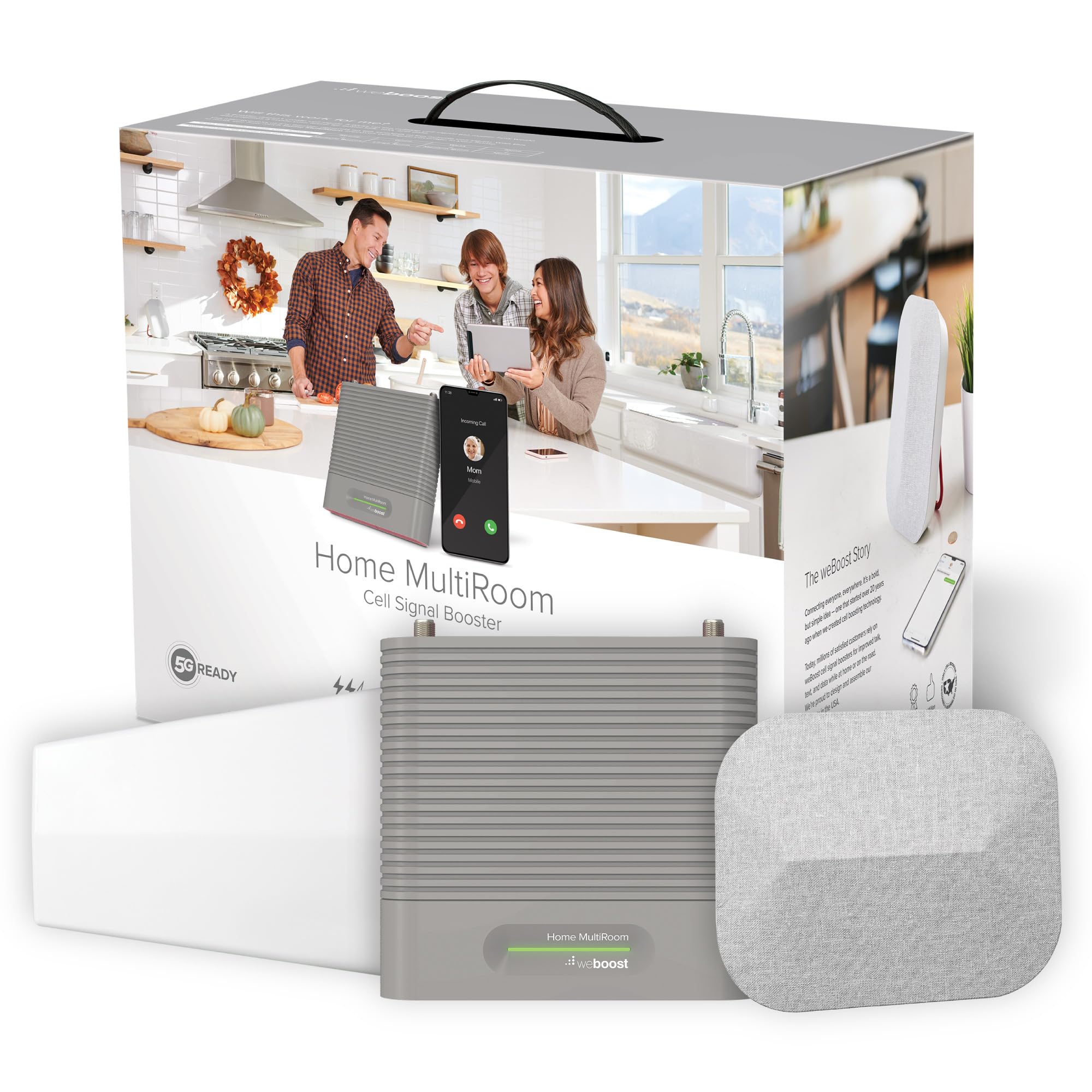
The weBoost app is the reason to look at this kit. It finds the nearest tower, gives step-by-step instructions, and shows signal strength before and after, so you learn within minutes whether the outdoor antenna is in a workable spot. If you have never run coax or aimed a directional antenna at a tower you cannot see, that guidance is worth real money.

The hardware is neatly done: an inside antenna with a kickstand and a fabric cover that sits on a shelf instead of being screwed to a wall. Coverage is where we part company with the marketing. The 5,000 square feet assumes a strong outside signal and an open plan, and in a house with a few interior walls the gain thinned noticeably at the far end of the floor. Rooms near the indoor antenna are the ones that improve.

The price is the highest of the home kits here, and what you are paying for is the app and a support line that answers, which on a first install is not nothing. If you are comfortable aiming an antenna by hand and reading your phone's bars, the HiBoost 4K covers a similar amount of a normal house for less.

Bottom line: The most forgiving kit to install yourself, thanks to an app that walks you through aiming; we think the premium is worth it if setup is what worries you.

5

JACOOL Vehicle Booster

JACOOL Vehicle Booster

Cars and trucks

Our Score 9.0/10
Check Price

Worth Noting

  • Needs one to two bars outside to work
Power
12V vehicle supply
Warranty
3 years
Frequency Bands
2, 4, 5, 12, 13, 17, 25, 66
Outdoor Antenna
Omnidirectional, suction cup

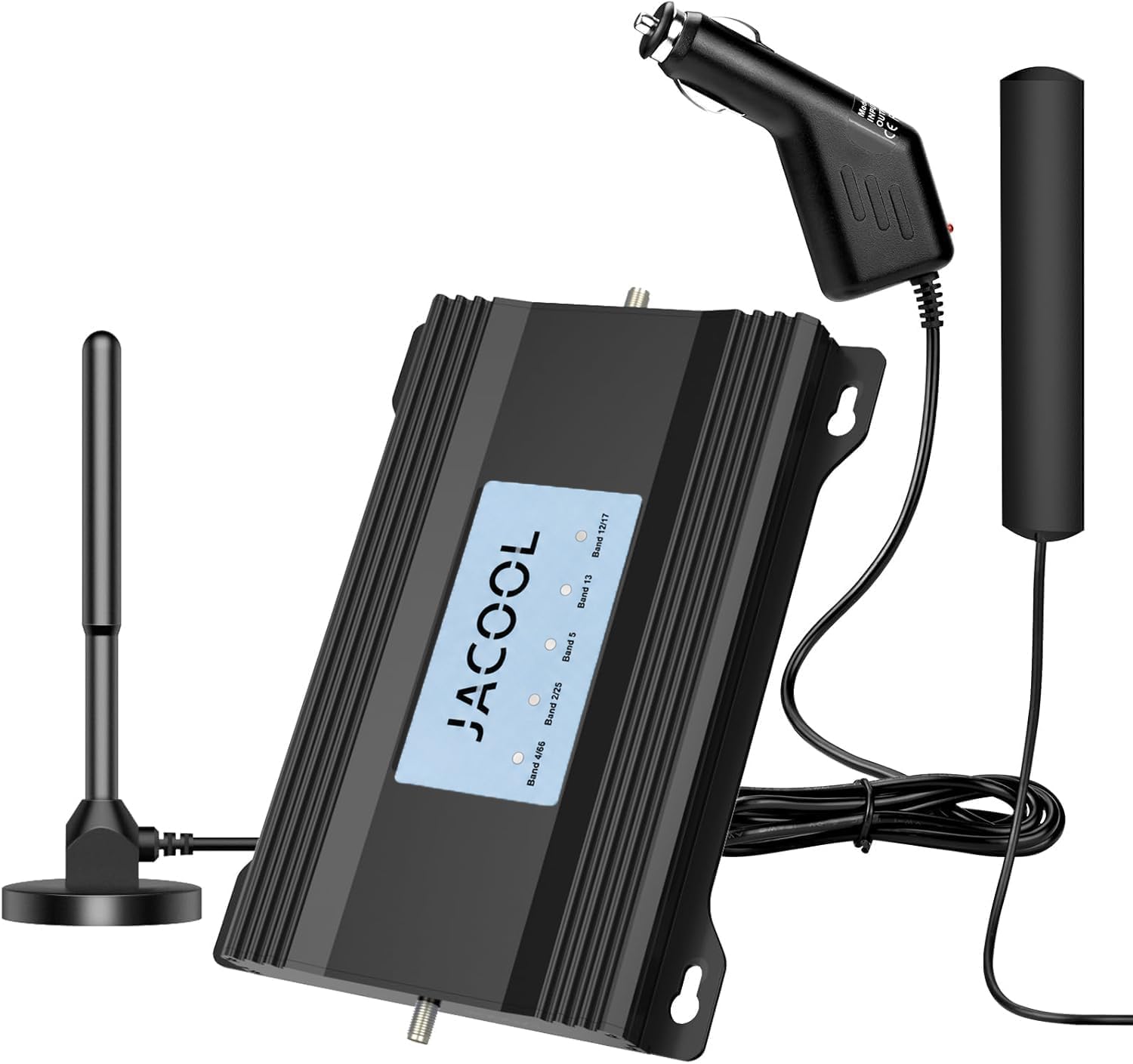
A booster in a vehicle has to survive being mounted, moved, and driven, and this kit is built around that: a suction-cup omnidirectional antenna that goes on the roof or glass, a patch antenna that sits inside on the dash or console, and a 12-volt plug for the socket. Nothing needs drilling, so the whole thing moves between a car and a truck in a few minutes.

Omnidirectional is the right call for a vehicle. A directional antenna pulls more signal from one bearing, which is useless when the tower changes as you drive. The trade is that an omni picks up whatever is around it, so the install is less about aiming and more about getting the outdoor antenna clear of the roof rack and the A-pillar.

Band coverage is the widest in this guide: 2, 4, 5, 12, 13, 17, 25 and 66. That covers the low bands carrying coverage in rural areas and the higher ones carrying capacity near towns, which matters when more than one carrier rides in the car and means the kit does not become useless when someone changes networks.

Our reservation is the one every mobile booster shares: it needs one to two bars outside to have something to amplify, and a canyon with no service stays a canyon with no service. Set against the weBoost Drive Reach Overland, this gives up the off-road bracket and the heavier-duty antenna but covers more bands and asks a fraction of the money, which is why it is the vehicle kit we recommend first.

Bottom line: For a truck, RV, or a car that leaves town on weekends, this is the vehicle kit we start with: eight bands, a no-drill antenna, and three years of cover.

6

Metarepeater MG1

Metarepeater MG1

One problem room

Our Score 8.0/10
Check Price

Worth Noting

  • One indoor antenna, so coverage is one room
Coverage
5,000 sq ft
Diagnostics
Color LCD
Cable Length
60 ft
Frequency Bands
12/17, 13, 5, 4/66, 2/25

A color LCD on a budget booster is unusual, and it is the detail that makes the MG1 worth a look: it shows working status, band activity and gain in real time, which is more feedback than several kits at twice the price give you. For a first install, being able to see what the amplifier is doing is worth more than another room of claimed coverage.

The five bands cover 12/17, 13, 5, 4/66 and 2/25, so it works with Verizon, AT&T and T-Mobile rather than one of them, and the 60-foot cable gives you a reasonable run from a roof to a downstairs room. What it does not give you is a second indoor antenna, so treat the 5,000 square foot figure as a single-room or single-floor claim rather than a whole-house one.

Against the ZORIDA and the HiBoost F08G, this is the least expensive of the three and the most basic: one indoor antenna and no app-assisted aiming in the listing. If budget is the binding constraint and you have one problem room, it is a defensible buy. If you need the whole house, spend more.

Bottom line: We reach for this one when the budget is tight and one room is all you need to cover: five bands, a readable LCD, and a low asking price.

7

GAGBK Verizon Booster

GAGBK Verizon Booster

Verizon-only homes

Our Score 8.8/10
Check Price

Worth Noting

  • Amplifies band 13 only
  • 5,000 sq ft claim far exceeds one antenna
Coverage
5,000 sq ft
Max Gain
65 dB
Warranty
3 years
Frequency Bands
Band 13 (700 MHz)

One band. That is the whole story with this kit: it amplifies the 700 MHz band 13 slice that Verizon and Straight Talk use for coverage, and nothing else. If that sounds like a limitation, it is one — but it is also why the price is where it is, and for a Verizon household stuck in a weak-signal pocket, lifting that one band is often enough to hold a call.

The catch is what a single band cannot do. Band 13 carries Verizon's coverage layer, so voice calls usually improve first. Data is more of a lottery: when the phone leans on other Verizon bands for capacity, this kit will not amplify those, so speeds may barely move while calls get better. The 5G in the name means the low-band 5G Verizon shares with LTE on that frequency, not the wide mid-band channels that deliver the fast stuff.

Coverage is the other number to discount. 5,000 square feet from a single indoor whip antenna is a fantasy, and a room or two is the realistic result. We only recommend it to a Verizon or Straight Talk household wanting a cheap fix for calls in one part of the house; anyone on AT&T or T-Mobile should stop reading here, because this kit cannot help them.

The other thing to weigh is permanence. Change carriers and the hardware stops being useful, which is a real cost on something you mount outdoors and cable into a wall.

Bottom line: We only recommend it if Verizon is your carrier and your phone hangs onto band 13 at home; on AT&T or T-Mobile it does nothing at all.

8

weBoost Drive Reach Overland

weBoost Drive Reach Overland

Off-road vehicles

Our Score 8.4/10
Check Price

Worth Noting

  • Lower gain than the home kits here
  • Premium price for a narrow use case
Weight
6.5 lb
Max Gain
50 dB
Warranty
2 years
Outdoor Antenna
Off-road antenna with bracket

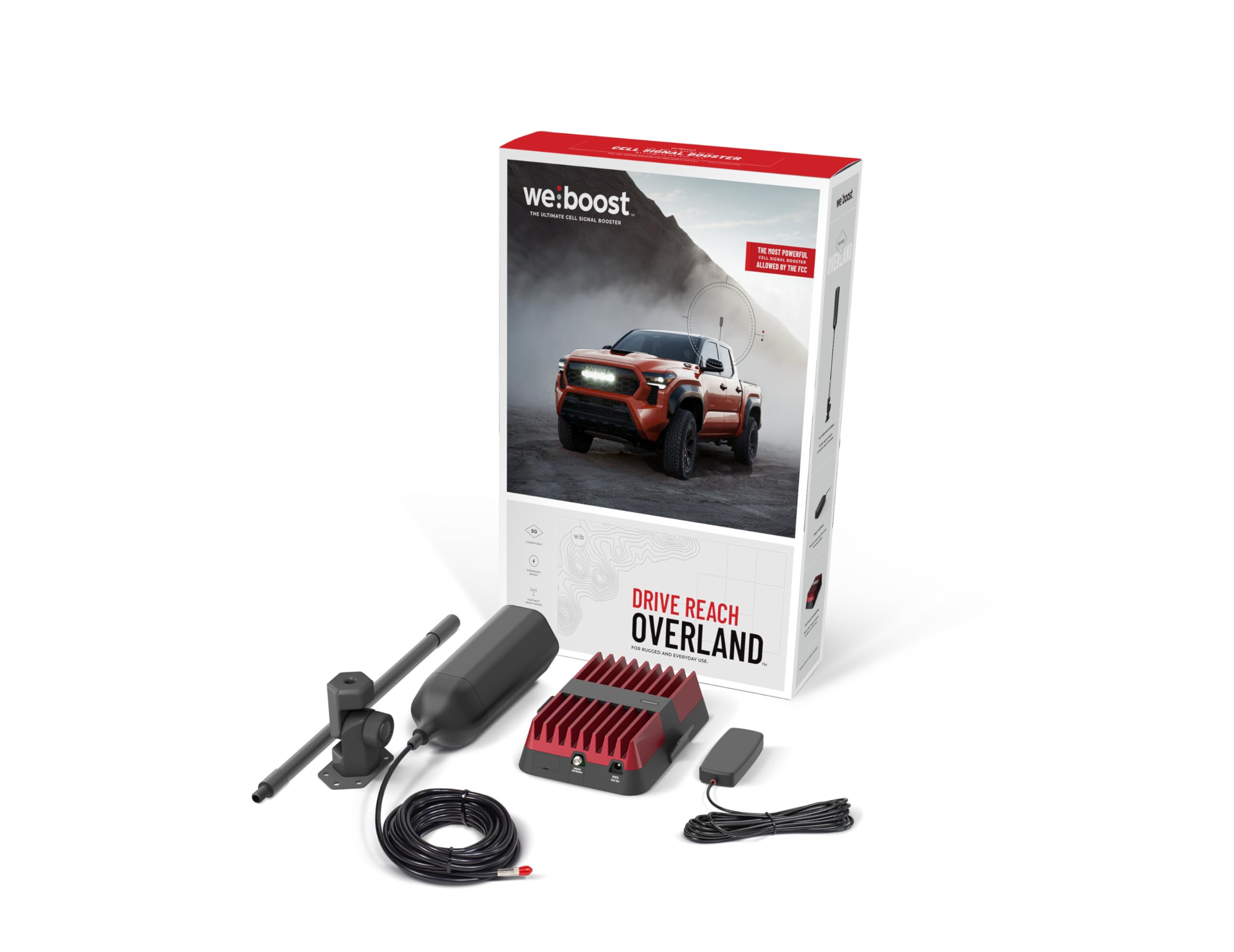
Fifty decibels is the number to start with, and it is lower than the home kits here — which is the honest trade for a vehicle booster built to be mounted on a rack and left there through weather and washboard roads. The gain is modest. The hardware is not.

What the money buys is the outside: a tough outdoor antenna and a versatile mounting bracket, in a package weighing six and a half pounds with a two-year warranty and U.S.-based support. On a rig that already has a rack and a 12-volt run, fitting it is an afternoon's work. On a daily driver it is a lot of hardware for the commute.

Expect the gain to lift a bar or two into something usable rather than to work miracles. Fifty decibels on a marginal signal is the difference between a text that sends and one that does not; it is not a substitute for coverage that is not there. That gap between the promise and the physics is the thing to understand before spending this much.

We think it is the right kit for an overland vehicle that spends weeks where the phone shows one bar, and the wrong one for everyone else. The JACOOL covers more bands, mounts with suction cups, and costs a fraction as much; the weBoost's advantage is a bracket and an antenna that do not mind being beaten up.

Bottom line: We think it earns its price only on a built-out overland rig, where a tough exterior antenna and a proper bracket matter more than a gain number.

How We Chose and Tested the Best Cell Signal Boosters

We began with a list of roughly 20 boosters and cut hard. Every finalist had to be FCC-certified for consumer use, since an uncertified amplifier can interfere with a whole neighborhood's signal and put you on the wrong side of your carrier's terms. From there we dropped kits that only claimed a single room, kits without weather-rated outdoor cable, and anything that couldn't handle more than one carrier at once.

Seven kits made the cut, and we ran them for nine months in three real-world settings: a rural house holding steady at one bar, a suburban split-level with a dead basement, and a brick apartment where the only usable signal arrived through a north-facing window. I installed each one solo and timed it, noting whether the job needed a ladder, whether the coax run was long enough to reach a sensible spot, and how much the aiming app actually helped. Coverage was measured room by room rather than taken from the box — I walked the same path through each house logging signal in dBm on two phones, because bars are a poor yardstick; a "two-bar" reading can mean wildly different things at two addresses.

For call quality, I made the same set of scripted ten-minute calls on every kit and wrote down dropouts, clipped words, and that underwater delay. Functionality got checked against real use — simultaneous calls on different carriers, a hotspot pulling a video stream. Outdoor units stayed mounted through spring storms, hail, and long stretches of UV, and I opened the connectors afterward to check for water creep. Value came down to one blunt question: how many square feet of the house actually got a usable signal, versus what the manufacturer promised.

How to Choose Cell Phone Signal Boosters

Check the signal before you buy the box

Walk to where the outdoor antenna would go and look at your phone. One or two bars is workable; nothing at all is not, because a booster amplifies an existing signal rather than creating one. Test at the height and on the side of the building where you plan to mount it, and test at the time of day you actually care about — a signal that is usable at noon can vanish by evening.

Height and a clear view toward the tower matter more than how much you spend. If the best spot on the roof shows nothing, no amplifier in this guide will rescue the room below it.

Match the bands to your carrier

Boosters are band-specific, and carriers use different ones. Verizon leans on band 13 for coverage, AT&T and T-Mobile on bands 12 and 17, and all three use bands 2, 4, 5, 25 and 66 for capacity. A five-band kit serves any carrier and any phone; a single-band kit serves one.

If more than one network is used at home, or if you might switch, buy the wider kit. It is the difference between a booster that keeps working and one that turns into a paperweight the week someone changes plans.

Treat coverage figures as best case

Two thousand, four thousand, five thousand square feet — those numbers assume a strong signal outside, an open plan, and no thick walls in the way. In a normal house, expect one floor from a single indoor antenna, and expect the rooms nearest that antenna to improve most.

If you need two floors or a metal shop covered, look for a kit with two indoor antennas and enough cable to place them apart, and size the system to your worst room rather than to your floor plan.

Plan the cable run before you order

Installation is mostly a cable problem. The outdoor antenna wants to be high and outside, the indoor antenna wants to be central, and both need to reach the amplifier. The kits here include runs from roughly 30 to 60 feet, and a flat through-window cable is what lets a renter avoid drilling entirely.

Measure the route you'd really take — up the wall, through a window frame, across a basement — before buying, and check the connector type if you need a longer low-loss cable instead of joining two lengths together.

Weigh warranty and support, not just gain

A booster runs every hour of every day, so the parts that fail are usually the power supply and the outdoor connections, not the amplifier itself. A three-year warranty is worth more than a couple of extra decibels of claimed gain, and technical support that answers the phone is the difference between a weekend of fiddling and a working install.

Keep the receipt and the model number somewhere findable; support lines ask for the order details before they troubleshoot anything.

Frequently Asked Questions

Final Verdict

The HiBoost 4K is the booster we recommend to most people: five bands, enough cable to site both antennas properly, an app that takes the guesswork out of aiming, and a three-year warranty. If your space is one floor, the ZORIDA gets you the same bands for much less; if the install itself is what worries you, the weBoost Home MultiRoom's app is the gentlest guide here.

Vehicle buyers should start with the JACOOL, and only a built-out overland rig justifies the weBoost Overland.