Office Electronics

Best Cordless Phones of 2026

A cordless phone is something you don't think about until the power flickers, the cell signal drops to a single bar, or a robocall wakes the house at 7 a.m. I keep a handset in the kitchen for exactly that reason, and I've learned that the gap between a phone you tolerate and one you actually like comes down to unglamorous things: how clearly voices come through, how long the battery truly holds, whether you can read the display without hunting for your glasses. A good one keeps you reachable when the cell grid doesn't.

For six months, my team and I lived with 12 cordless phone systems — single handsets, multi-handset bundles, models with answering machines built in. We set each one up from scratch, programmed contacts, let robocalls ring through on purpose, and drained batteries to see what a charge really delivers. A few made me want to toss them across the room; the keepers earned a permanent spot on the counter, and they're what's below.

1

Panasonic KX-TGD864W

Top Pick
Panasonic KX-TGD864W

All-around home use

Our Score 8.6/10
Check Price

Worth Noting

  • Included batteries need frequent charging
Battery
10 hr talk, 120 hr standby
Handsets
4
Call Blocking
Pre-block plus 1,000 numbers
Answering Machine
Digital, 18 min

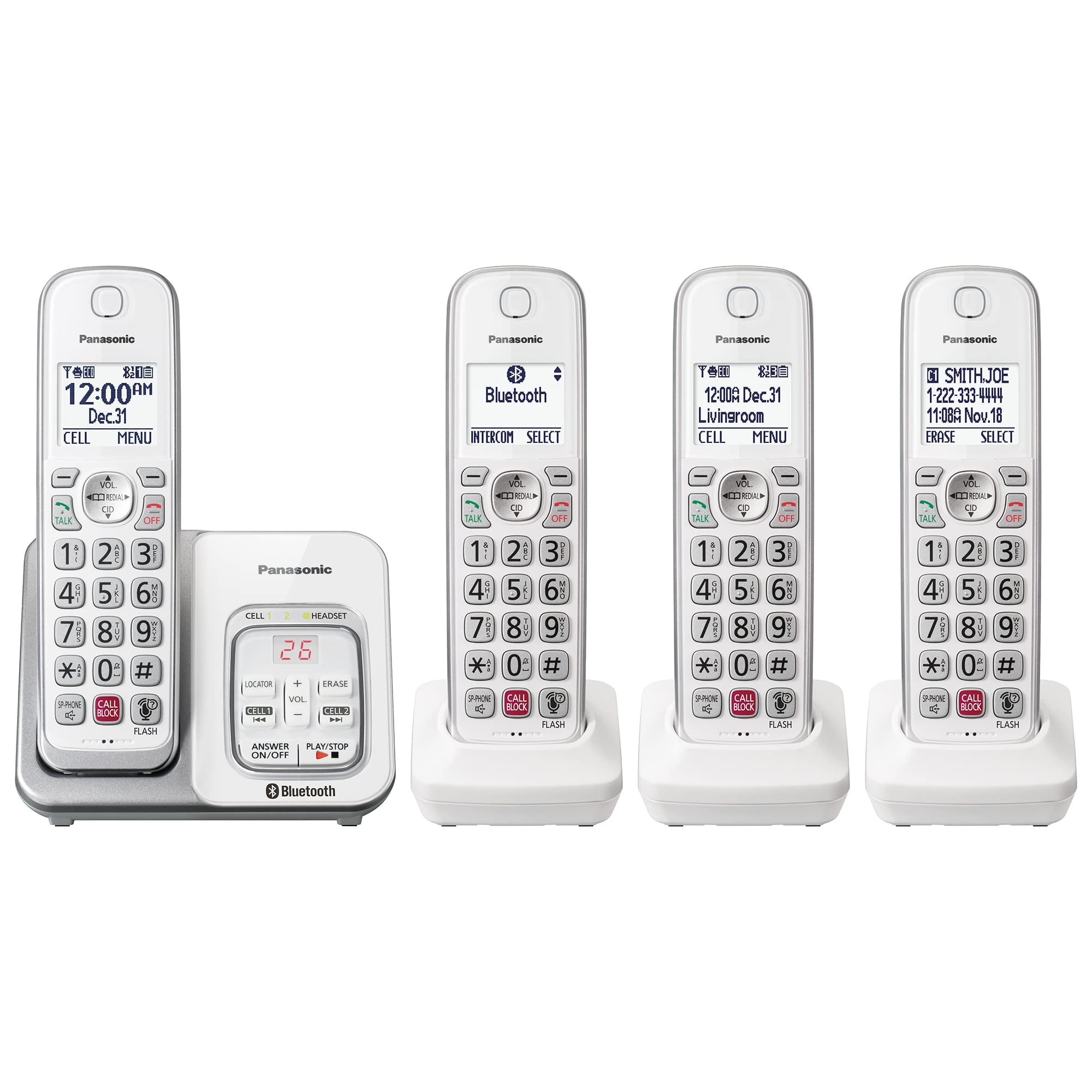
Four handsets is the number that makes the KX-TGD864W feel like a whole-home phone rather than a kitchen gadget. The base handles a digital answering machine with 18 minutes of recording, and each handset gets a backlit keypad and large characters. The feature we kept coming back to is call blocking: it pre-blocks robocalls and lets you add up to 1,000 numbers. Link2Cell Bluetooth is a bonus for anyone whose cell signal dies in one room.

We recommend it as the default because it covers the daily jobs without the complexity of a five-handset office system. The call-blocking setup is straightforward, and the one-ring scam alert is a small but thoughtful touch. Sound quality is the area to watch: some voices can come through thin or uneven, so keep the packaging until you have made a few calls from the rooms where you usually talk. The 18-minute answering machine is enough for most households, though it is not the largest here.

It sits in the middle of this group on price and gives you most of the premium features without the top-tier model's menus. The handsets are light enough to carry from room to room, and the base is compact enough for a hallway table.

Bottom line: The KX-TGD864W is the cordless system we recommend first for most homes: four handsets, strong call blocking, and a usable answering machine.

2

VTech IS8151-5

VTech IS8151-5

Large homes

Our Score 8.4/10
Check Price

Worth Noting

  • Handsets need careful seating to charge
  • Bluetooth pairing can be inconsistent
Range
Up to 2,300 ft
Handsets
5
Call Blocking
Smart call blocker
Answering Machine
Digital, 22 min

Range is the reason to look here. VTech claims up to 2,300 feet, the longest figure in this group, and the five handsets mean you can leave one in the garage, one upstairs, and one at the back door without carrying a phone around. The base also supports Bluetooth pairing for two cell phones, a headset jack, and a power-backup feature. Those are real conveniences for a household that still uses a landline because cell coverage drops in parts of the house.

We found the call-blocking side just as useful: smart call blocking screens robocalls, and the one-touch block is easy to reach. Sound quality is the trade-off. Voices can be clear on one call and thin on the next, so test it on the calls you make most before you commit.

It is not the simplest system here; the menus take a few passes, and the range advantage only matters if your home actually has dead spots. In a smaller apartment, the extra handsets are more clutter than coverage. For a long house, a detached garage, or a property with a metal building, those extra handsets earn their place.

Bottom line: Our pick for a big property, the IS8151-5 backs five handsets with the longest claimed range here and call blocking that is easy to use.

3

AT&T DLP73590

AT&T DLP73590

Shared home office

Our Score 8.4/10
Check Price

Worth Noting

  • Sound quality can be uneven
Handsets
5
Base Display
5 in color
Call Blocking
Smart call blocker
Answering Machine
Digital, 40 min

A five-inch color screen on the base is the first thing you notice, and it changes how the system feels. Instead of squinting at a handset to block a call or listen to a message, you work from a screen with soft keys and one-touch shortcuts. With five handsets, a 40-minute answering machine, and conference calling between an outside line and up to four handsets, this AT&T is built for a household that shares one line with a home office.

The call-blocking tools are easy to reach from the base, and the intercom and conference functions are useful when someone is working upstairs and someone else is taking calls downstairs. The 40-minute message capacity is the largest in this group, which matters if you screen calls instead of answering them. The handsets are plain by comparison, but they do the job.

That mix makes it our pick for a shared home office. The base is a piece of furniture, not a small charger, so give it a real spot. The menu system has more layers than a simple phone, which is the price of the shortcuts and conference controls. If you want a bare-bones handset, this is more system than you need.

Bottom line: This is our pick for a busy shared line: the five-inch color base makes a five-handset system easier to run, and the 40-minute answering machine gives you room.

4

Panasonic KX-TGF975B

Panasonic KX-TGF975B

Cell-first households

Our Score 8.4/10
Check Price

Worth Noting

  • Battery life can fall short
Handsets
5
Cell Pairing
Link2Cell, 2 phones
Call Blocking
Up to 2,000 numbers
Answering Machine
Digital, 18 min

The KX-TGF975B is the most expensive system here, and the reason is the cell-first feature set. Link2Cell pairs two smartphones, so calls to your mobile ring on five handsets. It also records calls, blocks up to 2,000 numbers, and includes an 18-minute answering machine. For a household where cell reception is patchy in the basement or garage, that pairing is the feature that matters.

We liked the call-blocking depth: pre-blocking, telemarketing block, and a 2,000-number list give you more room than the 1,000-number Panasonic. Call recording is useful for work calls or family logistics, though everyone on the call should know it is happening. Setup is straightforward for a system this feature-heavy, and the five handsets make the cell pairing useful throughout the house rather than in one room.

The trade-off is that the extra features only pay off if you actually pair a cell phone. Bluetooth pairing can be inconsistent, so set it up before you rely on it. If you do not need Link2Cell, the KX-TGD864W gives you the same call-blocking foundation for less. This is a premium system for a specific job, not the default for every home.

Bottom line: Our premium pick for a cell-first household, the KX-TGF975B puts mobile calls on five handsets and gives you the longest call-block list here.

5

VTech CS6529-4B

VTech CS6529-4B

Color-coded families

Our Score 8.4/10
Check Price

Worth Noting

  • Sound volume can run low
Handsets
4
Color Coding
4 colors
Expandable To
5 handsets
Answering Machine
Digital, 14 min

Four handsets in four colors is a simple idea that solves a real household problem: you can tell at a glance which phone belongs in the kitchen, the bedroom, the office, or the basement. The color coding also carries through to the chargers, so a handset is less likely to migrate. We liked that more than we expected, especially in a busy house where phones tend to wander.

The rest is a sensible budget package: a 14-minute digital answering machine, caller ID with 50-name history, a backlit keypad, quiet mode, and ECO power saving. It expands to five handsets, so you can add one more room later. Setup is straightforward, and the four-handset coverage is the main reason to choose it over a two-phone set.

The display is the weak spot. It is small and dim, and the backlight does little to help in a bright room; if you need large, high-contrast text, this is not the set to buy. The answering machine is also on the short side at 14 minutes. For a family that mostly wants room-to-room coverage and a place for messages, those are acceptable trade-offs.

Bottom line: The CS6529-4B is the family set we point to when color-coded handsets and a built-in answering machine matter more than a bright screen.

6

AT&T GL2101-31

AT&T GL2101-31

Simple multi-handset

Our Score 8.8/10
Check Price

Worth Noting

  • Call-block list limited to 20 numbers
Display
2 in high-contrast
Handsets
3
Talk Time
10 hours
Call Blocking
20 numbers

The first thing to know about the GL2101-31 is what it leaves out: there is no answering machine. That is not a flaw if you use carrier voicemail, and it keeps the handset menu shorter than the feature-heavy systems here. You get three handsets, a two-inch high-contrast display, an orange backlit keypad, and a full-duplex speakerphone.

We liked the display and keypad for everyday use. The white screen with high-contrast text is easy to read, and the large buttons are a better fit for someone who does not want to hunt for the right key. Call blocking is on board, and the 10-hour talk time is competitive with the bigger systems. Setup is simple enough for basic calls.

The trade-off is the missing answering machine, not call quality: voices can sound clear on one call and thin on another, as with most phones here. If you want a built-in message recorder, step up to the Panasonic or the AT&T DLP73590. If your voicemail lives with your carrier, this is a clean, readable three-handset set with fewer menus to learn.

Bottom line: The GL2101-31 is the straightforward three-handset set we recommend when you already use voicemail and do not want to pay for an answering machine.

How We Tested the Best Cordless Phones

We built the shortlist from the specs people actually compare: call-block capacity, handset count, backlit displays, answering-machine storage. Anything that couldn't block at least 100 numbers, or that buried basic controls in a menu, got cut before testing began. That left 12 systems, from single handsets up through four-handset bundles, and we ran them for six months across two households — including one with a finished basement where cell service goes to die.

Setup came first, since that's where most of the frustration lives. I unboxed each phone, plugged it in, and set the date, time, and greeting without opening the manual for as long as I could stand it, timing the whole thing and noting the moment I had to reach for the booklet. Readability got judged from across a dim kitchen at night — could I tell who was calling without my glasses? — and by dialing one-handed with the handset pressed to my ear.

Then the calls. Each handset went through weeks of real conversations, with sound quality rated on both ends, a walk to the far corner of the yard to find where the signal quit, and speakerphone tested while the dishwasher ran. Batteries were drained flat and recharged over and over to see which ones died mid-call. For blocking, I let every unknown number ring and logged how many got through and how quickly I could add a repeat offender to the list.

Features, color, and value were judged last, only once the fundamentals held up. I compared how many handsets you get for the money, whether the finish options went past basic black, and whether extras like intercom or a baby-monitor mode were things a household would genuinely use. Six months of daily handling also separated the solid builds from the hollow plastic with mushy buttons, which no spec sheet will ever tell you.

How to Choose Cordless Phones

Start with handsets, not features

Count the places you answer calls: kitchen, bedroom, home office, basement, garage. We treat one handset per main stopping point as the useful rule, which is why four- and five-handset systems dominate this group. A DECT base sends the signal, so placement matters more than the handset count. Put the base as central as your phone jack allows, off the floor and away from a metal cabinet or a Wi-Fi router. The 2,300-foot range claim on the VTech IS8151-5 is a best-case number, not a promise through three walls; buy for your floor plan, not the largest figure.

Answering machine or carrier voicemail

An answering machine is convenient, but it is not automatically the right choice. A built-in machine holds messages locally, lets you screen calls from the base, and keeps working if your carrier voicemail is awkward to reach. Capacity varies from 14 minutes on the VTech CS6529-4B to 40 minutes on the AT&T DLP73590. We prefer a built-in machine only if you actually screen calls; if you already use carrier voicemail and never check a home machine, skip it. The AT&T GL2101-31 is simpler without one.

Call blocking is the feature that earns its keep

Robocalls are the reason many people still want a home phone with a block list. Pre-blocking catches known nuisance numbers before the first ring; a one-touch block handles the rest. The practical question is list size and access. A 20-number list on the AT&T GL2101-31 is fine for occasional nuisance calls, while 1,000 or 2,000 numbers on the Panasonic systems suits a line that gets hit constantly. Make sure the block button is on the handset or base you actually use, not buried three menus deep.

Sound and battery are the daily tests

DECT cuts interference, but it does not guarantee a voice that sounds natural to you. Sound quality is the most split issue in this category, and the same model can sound clear on one call and thin on the next. Keep the packaging until you have made a few calls from the rooms where you usually talk. Battery figures are similarly optimistic: a 10-hour talk time does not mean a handset left off the cradle will last a week. If a handset lives on a couch instead of a charger, choose a model with a larger standby figure and plan to replace the cells eventually.

When cell pairing and office features are worth it

Bluetooth pairing puts your mobile calls on the home handsets, which is useful in a basement, garage, or steel-framed building where cell service drops. The Panasonic Link2Cell models pair up to two phones, and the VTech IS8151-5 does the same. It is not worth paying for if your cell phone already works everywhere in the house. Conference calling, call recording, and a large base display are similar: valuable on a shared home-office line, overkill for a single user who just wants to dial out.

Frequently Asked Questions

Final Verdict

The Panasonic KX-TGD864W is the cordless system we recommend first for most homes. Four handsets, a built-in answering machine, and a 1,000-number call-block list cover the daily jobs without the complexity of a five-handset office system.

If your house is long or your phone jack is stuck in a corner, the VTech IS8151-5 is the better buy for its five handsets and longer claimed range. For a shared home office, the AT&T DLP73590's five-inch base screen is the feature that earns the upgrade.