Phone & Tablet Accessories

Best Phone Stands of 2026

A phone propped against a coffee mug works until the first video call, the recipe step you need to re-read, or the notification that sends the whole thing sliding. A good stand keeps the screen visible and steady—angled for typing, upright for a call, or lifted above the kitchen counter. The catch is that adjustable and sturdy don't always travel together: extra joints add useful angles, but they can also introduce a wobble you feel with every tap.

I've lived with 16 stands for four months—on a desk, by the stove, and on a nightstand—and the keepers share a heavy-enough base, a hinge that stays where you put it, and an angle you can change one-handed. Value is part of that: a cheap stand stops being a bargain the moment it tips during a call. Build quality shows up in small ways, like pads that stay glued and joints that don't droop. The picks below are the ones that stayed useful without making me think about them.

1

Lamicall DP13 Phone Stand

Top Pick
Lamicall DP13 Phone Stand

Everyday desk use

Our Score 9.6/10
Check Price

Worth Noting

  • No way to tighten the arm if it loosens
Base
Weighted metal
Device Range
4-8 inches
Case Clearance
Up to 0.71 inches
Height Adjustment
Up to 3.2 inches

Of the stands here, the Lamicall does the most for a desk you sit at all day, and it comes down to one part: an arm that extends up to 3.2 inches. Most cheap stands only tilt, which leaves the phone exactly where the desk put it and you doing the leaning. This one lifts the screen toward eye level and still lets you set the angle once it's up there. That's why it's our pick.

Lifting a phone only works if the base can take the leverage, and here the mass sits in the base and the telescopic rod rather than in the cradle — the right way round, because the stand gets harder to tip as the arm goes up, not easier. The silicone mats under the base and on the backrest do the rest of the holding, and the hook takes cases up to 0.71 inches thick, as generous as anything in this group and enough for a chunky case.

Two details we appreciated once it was set up. The base leaves a channel at the front so a charging cable runs out cleanly instead of pushing the phone sideways, and the shallow well in front of the cradle turns out to be where small things land — an earbud case, a key, a pair of glasses. Minor, but it's the difference between a stand that lives on a desk and one that gets pushed into a drawer.

It folds as well, though this isn't the stand we reach for as a travel piece — the arm is one more thing to protect than a solid slab of aluminum. The open question is hinge tension: there's no way to tighten the arm if it starts to droop, and that is the one thing missing. For a stand that stays on a desk, it's a fair trade for the adjustment you get every day.

Bottom line: Buy it if you want the screen at eye level without paying more than the plain tilting stands: the arm lifts, the weighted base holds, and thick cases stay on.

2

Nulaxy A4 Aluminum Stand

Nulaxy A4 Aluminum Stand

Travel and bags

Our Score 9.4/10
Check Price

Worth Noting

  • Landscape-only for phones from 6 to 8 inches
Weight
3.84 oz
Material
Aluminum
Hook Width
18 mm
Device Range
4-8 inches

The Nulaxy is the one that folds into a flat aluminum slab, cradle and all, so there's nothing sticking out to catch on the inside of a bag. That's the brief it was designed for: a desk stand that expects to leave the desk. Two hinges drop the cradle and the backrest flat, and the whole thing weighs 3.84 ounces.

Aluminum earns its keep on something that travels. The hinges feel like metal working against metal rather than plastic cams, and the body takes being knocked around in a bag without complaint. The hook is 18 mm, as wide as any here, so a cased phone drops in without being undressed first. It's the travel stand we rate highest in this group, and it costs no more than the fixed ones.

The limitation is orientation, and the listing is unusually upfront about it: phones from 6 to 8 inches are meant to sit in landscape, portrait only for the smaller ones. If you watch video and navigate, that's no hardship. If you want a big phone standing upright for reading or a call, the Lamicall holds it the way you expect. The Nulaxy is the better object to carry; it just asks a big phone to lie on its side.

Bottom line: The folding stand we take on trips: aluminum, an 18 mm hook for thick cases, and a flat fold — provided a big phone can live in landscape.

3

OMOTON C2 Aluminum Stand

OMOTON C2 Aluminum Stand

Solid desk base

Our Score 9.6/10
Check Price

Worth Noting

  • No height adjustment
Base
3 mm aluminum
Weight
6.35 oz
Device Range
4-8 inches
Cradle Rotation
270 degrees

The base is where the OMOTON spends its money: a 3 mm aluminum plate, 180 grams of stand in total, and a low center of gravity you notice the moment you set it down. The hook is cut long enough to swallow a heavy case, the silicone pads are larger than most, and the edges are machined rather than rolled — you can feel the difference running a thumb along the side.

That heft is the whole recommendation. A stand earns its place by staying still while you jab at the screen, and this is the most planted stand in the group. The cradle also rotates through 270 degrees, so you can turn the phone toward you or lay it back for a video without lifting it out. We kept coming back to it for the desk that doesn't move.

What it does not do is go up. There's no arm and no lift, so the phone sits roughly where a stack of books would put it, just at a better angle and without the sliding. It's also the best-finished stand here — polished aluminum with cut edges rather than painted plastic, which counts for something on a desk you look at all day.

Bottom line: For a phone that never leaves the desk, this is the one to buy: a 3 mm aluminum base, 180 grams of it, and a rotating cradle that doesn't budge.

4

OCYCLONE Adjustable Stand

OCYCLONE Adjustable Stand

Eye-level video calls

Our Score 9.2/10
Check Price

Worth Noting

  • Rocks when tapped at full extension
  • The most expensive pick here
Weight
7.05 oz
Foldable
Yes
Device Range
4-13 inches
Adjustment Points
4

It looks like more stand than a phone needs: a tower on a folding arm, four separate adjustment points, and a price above everything else in this group. Then you spend an hour on video calls with the phone propped at monitor height and the extra hardware stops looking excessive.

Four joints is generous for a phone stand, and the range is what justifies them — OCYCLONE rates this for devices from 4 to 13 inches, the widest claim here, which covers small tablets as well as phones. The joints hold their settings, so the position you set in the morning is the position you get in the afternoon.

The taller you go, the more work the base has to do, and the base is where this one comes up short: there isn't much weight in it, so at full extension a tap on the screen sets the whole tower rocking. Keep the arm low and it's steady enough. Run it all the way up and treat the phone as a display you look at rather than a screen you poke.

It also folds into a flat bundle, so it goes in a drawer when the workday ends instead of becoming furniture. Taken together — height, tablet range and a fold — it's the pick for a desk built around a monitor, where the phone's camera wants to sit beside the webcam rather than underneath it.

Bottom line: Buy it if the phone is your second screen at eye level: four joints, room for a small tablet, and a base that wants the arm kept low.

5

UGREEN Foldable Stand

UGREEN Foldable Stand

Budget travel

Our Score 9.2/10
Check Price

Worth Noting

  • Sits at desk level
Hinge
Automatic angle lock
Material
ABS plastic
Angle Range
0° to 100°
Device Range
4-7.9 inches

The hinge is the reason to buy this one. Instead of a wing nut or a friction joint you tighten and guess at, the UGREEN's arm is a ratchet with an automatic lock: tilt the cradle and it clicks, and that's the angle until you move it again. It's a small mechanical choice that changes how often you actually bother adjusting the screen.

The rest is a compact folding stand that does the basics without fuss. It runs from flat to 100 degrees, which covers leaning back for a video and standing up for a recipe, and it folds down small enough for a bag pocket. The 4-to-7.9-inch range takes big phones, e-readers and a Switch, and the silicone mats under the base keep it from skating on a desk.

Where it lands is the second-stand market — the kitchen counter, the work bag, the hotel room — and at the lowest price here it's the easy answer for that job. What you give up is height, since the cradle never leaves desk level, and a bit of substance: the plastic body is light, and light is not what you want holding a tablet. For a phone you glance at, neither matters. For a phone you work on all day, the Lamicall is worth the step up.

Bottom line: The second stand to buy: a ratcheting hinge that clicks and holds, a flat fold for a bag, and the smallest outlay in this guide.

6

Meetuo 2-Pack Stands

Meetuo 2-Pack Stands

Two desks

Our Score 9.2/10
Check Price

Worth Noting

  • Rated only for phones up to 6.4 inches
Material
Aluminum
Pack Count
2
Device Range
4-6.4 inches
Height Range
5 to 6.4 inches

Two stands come in the box, one black and one white, and that's the pitch. It sounds like filler until you're setting up a desk at home and one at the office from a single order: the black goes to work, the white stays by the kitchen, and you stop carrying a stand between rooms. For a household with two phones, it's the obvious buy.

Each one is an aluminum arm with a silicone-lined cradle and enough height adjustment to be useful — it extends from 5 to 6.4 inches, which lifts the screen off the desk without putting it at eye level. The hinges arrive stiff and loosen with use, which is the right way round; a joint that starts loose is the one that ends up useless.

The limit is the phone it was built for. Meetuo rates these for handsets from 4 to 6.4 inches, and that's the honest boundary: a big phone in a thick case is what ends up sliding in the cradle, because the gap is cut for the smaller device. Buy the pair for two normal-sized phones and you've kitted out a house for less than one stand elsewhere on this list. Buy it for two Ultras and you'll be disappointed.

Bottom line: The two-pack for normal-sized phones: one for the desk, one for the kitchen, with enough height adjustment to be worth having.

7

CreaDream Acrylic Stand

CreaDream Acrylic Stand

Bedside and vanity

Our Score 9.2/10
Check Price

Worth Noting

  • One fixed angle
Finish
Glitter pink
Material
Acrylic
Base Pads
4 silicone feet
Device Range
4-8 inches

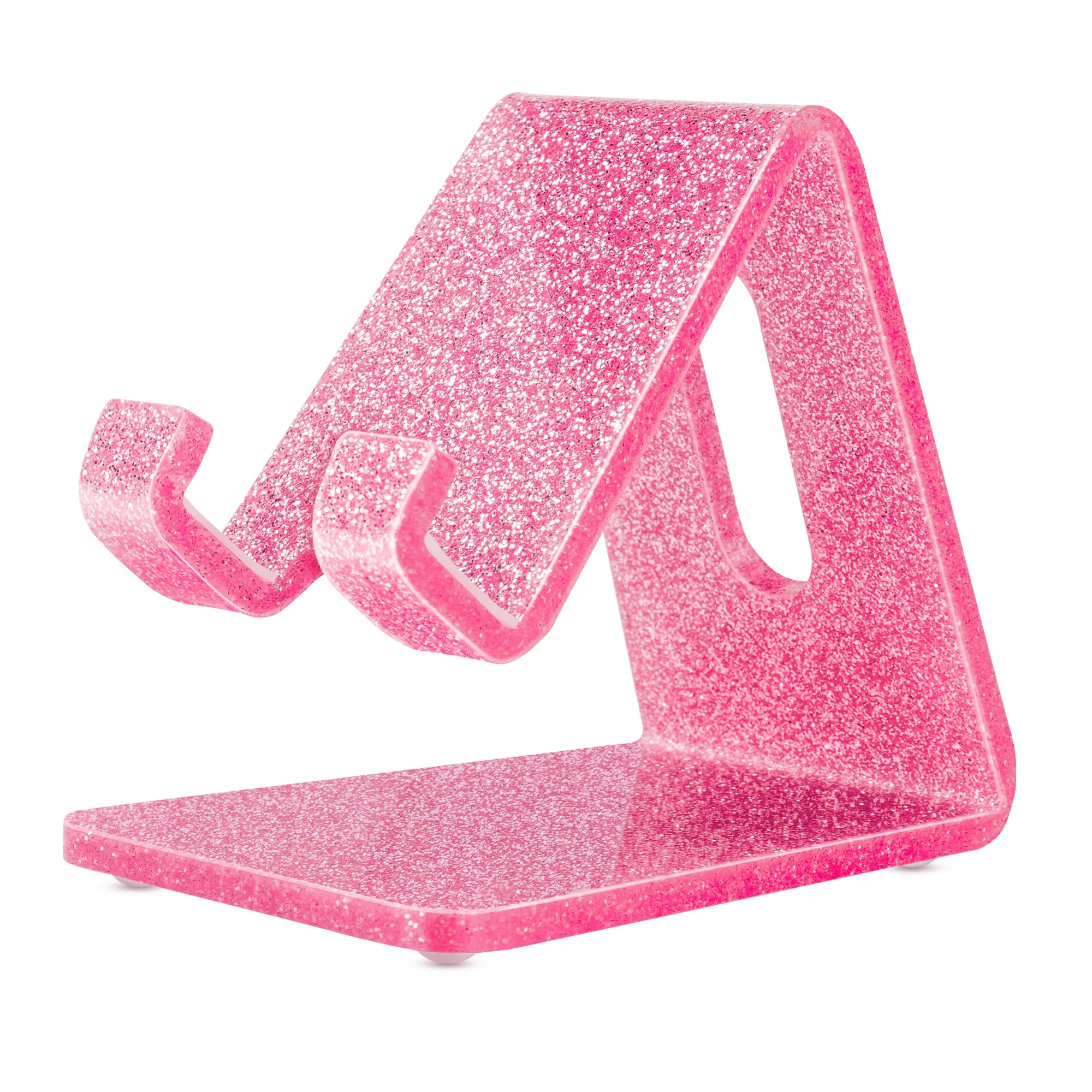
Everything else here is black, grey or silver and disappears into the desk. This one is thick acrylic with glitter through it, and it does the opposite: it's the stand you leave out because it looks like it belongs in the room rather than on a spec sheet.

Underneath the finish it's a straightforward cradle: one acrylic piece that takes a cased phone from 4 to 8 inches, four silicone pads under the base and two more at the hook, and edges polished enough that you won't find a sharp corner with your wrist. The two-year warranty is longer than we expected on something at this end of the range.

There's no adjustment at all — one molded viewing angle, no tilt and no lift — so it suits a bedside table, a vanity or a counter where you always look from the same spot, and it's the wrong stand for anyone who wants the screen to move. Buy it because you want the thing on show; for everything else, the plain aluminum stands here are more useful.

Bottom line: Buy this one when the desk is on show: a glitter acrylic body, a silicone-padded cradle for a cased phone, and a single viewing angle.

How We Tested Phone Stands

We began by building a shortlist from the main stand shapes—folding, weighted-base, clamp-on, and gooseneck—then narrowed it by phone-size compatibility, footprint, cable access, and price band.

Over four months, we tested 16 stands in the places a phone actually rests: a work desk during video calls and note-taking, a kitchen counter while following recipes, and a nightstand for alarms and podcast queuing. We tapped and swiped on the screen, plugged in charging cables, switched between portrait and landscape, and nudged the surface to see whether the base slid or tipped.

Build quality showed in the seams, hinge stiffness, and whether rubber pads stayed put after weeks of use. For stability, we set phones on vibrate and pressed the top corners; stands that lifted at the front or walked across the desk got marked down. We adjusted height and angle one-handed, counted how many steps it took, and checked whether the joint held after repeated changes. Functionality came down to case fit, cable clearance, and whether the stand folded or packed away without loosening. At the end, we asked whether each stand earned its counter space and price relative to how often we reached for it.

How to Choose Phone Stands

Height first, angle second

Most inexpensive stands tilt and stop there, and for a phone you glance at, that's enough. The moment you're on a call, following a recipe, or reading anything longer than a notification, the question becomes whether the screen comes up to meet you: an arm that lifts the cradle a few inches does more for your posture than any amount of angle adjustment, and it's the feature worth paying for.

If you want that lift, the Lamicall and the OCYCLONE are the two picks here that raise the screen. If the phone is glance-only, a plain tilting cradle does the job, and the OMOTON does it more solidly than most.

What stops a stand walking

Every stand here sits on silicone, and those pads aren't cosmetic — they're the only thing between a tapped screen and a stand sliding backwards across the desk. Weight is the other half of the story. A heavy base sitting low shrugs off a jab at the screen; a light base under a long arm does not, which is why the tallest stand in this group is also the one that rocks when you push it.

Picture your real use before you buy. Prodding at a screen during a call is a far harder test than watching a video, and it's the test that separates a stand you keep from one you put in a drawer.

Cases, hooks and the landscape rule

Universal in a listing means almost nothing. What you want to check is the gap at the hook against the phone you actually carry: the picks here that quote a figure allow roughly 0.7 inches of thickness, which takes a chunky case but not a wallet folio with cards still in it. Slide your cased phone into whatever you buy before the return window closes.

Orientation is the other trap. At least one stand here asks for landscape on anything from 6 to 8 inches, so a big phone you want standing upright for reading may not sit the way you expect.

Folding or fixed

If the stand lives on one desk, buy the solid thing: a heavy base, no arm to wobble and no hinge to work loose. The OMOTON is the obvious example, and it's the better object for a desk that never moves.

If the stand travels, folding changes the calculation — the Nulaxy collapses into a flat aluminum slab and the UGREEN into something smaller still. What you give up is usually height and a little steadiness, which is a fair trade for a stand that's with you when you need one.

Frequently Asked Questions

Final Verdict

If you want one stand and no further reading, buy the Lamicall. The arm lifts the screen to eye level, the weighted base keeps a raised phone steady, and the hook swallows a thick case — the three things that decide whether a stand gets used or ignored.

Choose the OCYCLONE instead if the phone doubles as a meeting camera at monitor height, and keep its arm low. If the stand has to leave the house, the Nulaxy's flat aluminum fold is the better companion.