Phone & Tablet Accessories

Best Phone Tripods of 2026

A phone tripod has one job, and it's harder than it sounds: hold a heavy rectangle of glass perfectly still while you do something else. The two things you want most — legs light enough to toss in a bag, a frame rigid enough to trust in a gust of wind — pull against each other, and inexpensive models tend to pick one and quietly fail at the other. I've propped a phone on cookbooks for a recipe video and balanced one on a stack of towels for a family call, which is how I came to care about this category. A good tripod replaces all that improvisation with something you set down once and forget about.

My team and I spent four months with 14 of them, from pocket-size flexible legs to full-height aluminum stands, filming school concerts from the back row, hauling them up hiking trails, and running the bundled remotes until the batteries died. The thing first-time buyers don't expect: the remote and the clamp matter nearly as much as the legs. A tripod you have to walk back to in order to hit record, or one that lets your phone creep downward mid-shot, is one you'll stop carrying.

1

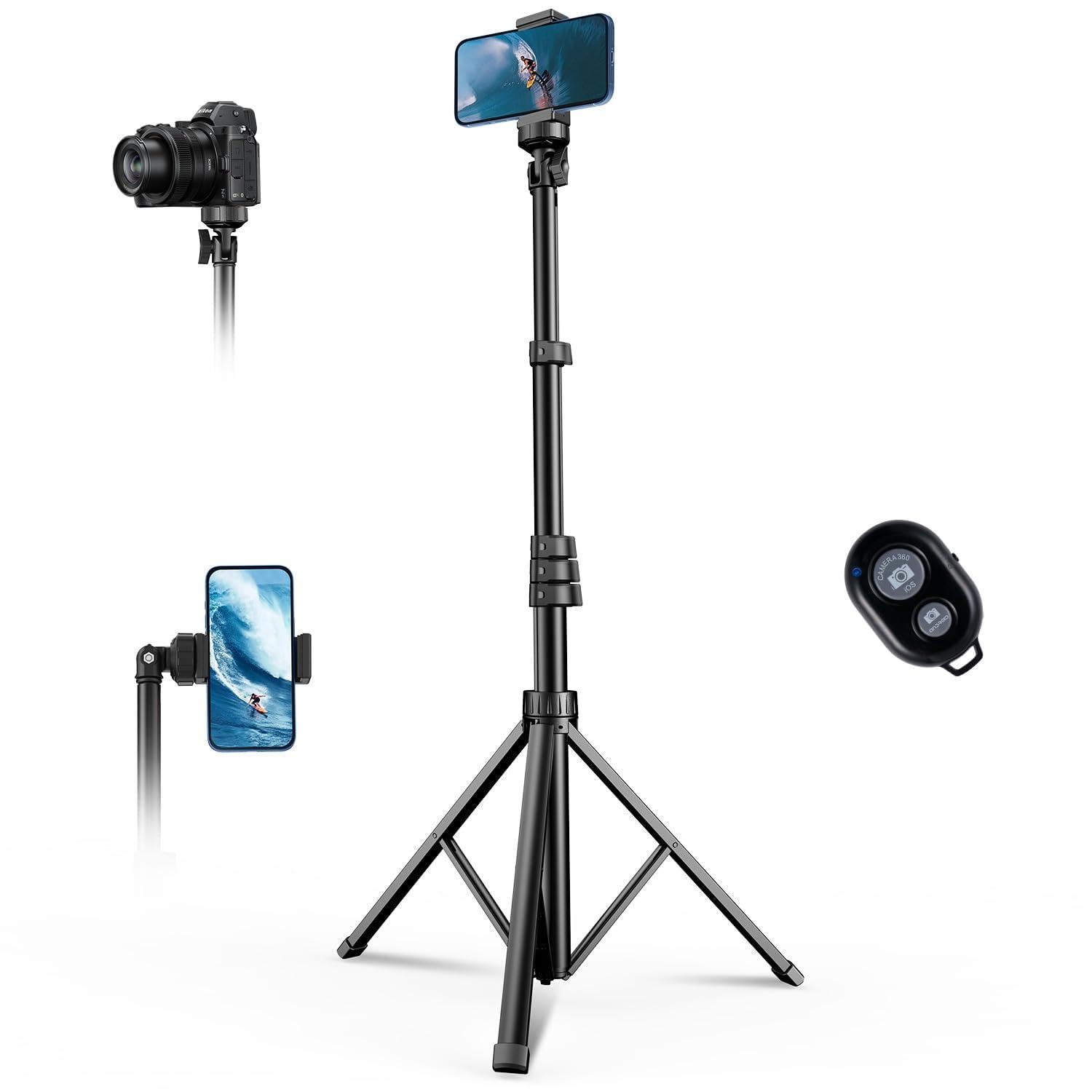
EUCOS 62-Inch Tripod

Top Pick
EUCOS 62-Inch Tripod

Everyday carry

Our Score 9.2/10
Check Price

Worth Noting

  • Clamp maxes out at 3.6 inches wide
Weight
12.8 oz
Max Height
62 inches
Folded Size
2 x 1.5 x 12 inches
Phone Width
2.2 to 3.6 inches

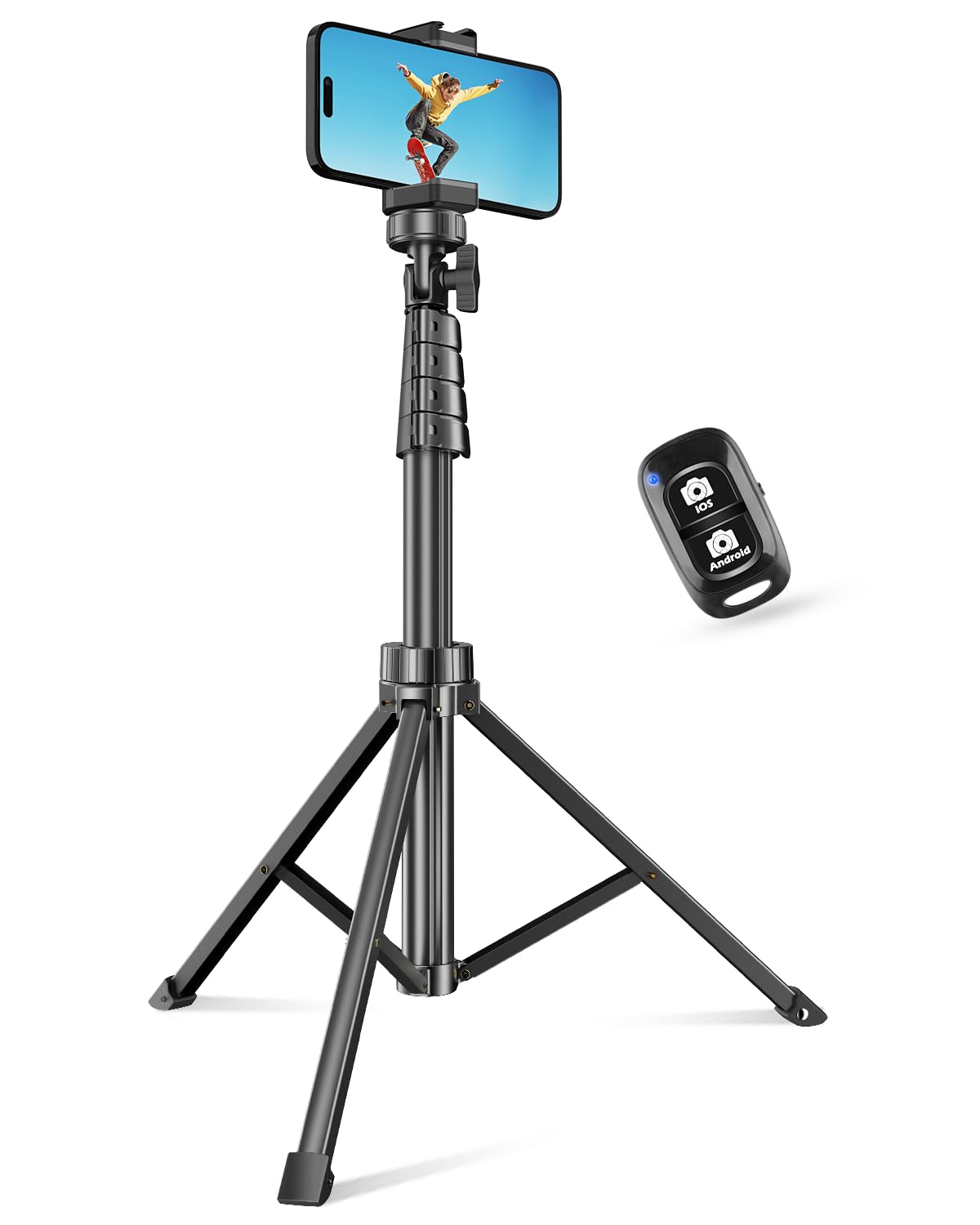
Twelve point eight ounces is the number that decides this one. That is what the EUCOS adds to a bag, roughly half what the SENSYNE and the Vimose weigh at a similar height, and it is why this is the tripod that actually leaves the house with us. It still opens to 62 inches, high enough to put the phone above your eyeline for a standing shot.

The clamp handles phones 2.2 to 3.6 inches wide and rotates between portrait and landscape without a second bracket to lose. It is not the widest cradle here, but it closes squarely. The detail we did not expect to care about is the cold shoe on the side: it takes a small LED or a shotgun mic, which turns a phone on a stick into something you can shoot a talking-head video with.

Setup is a single pull rather than section by section, and the remote paired first time in our testing, with 33 feet of range that covers any group shot you can arrange. There is a notch on the rig for the remote, so it does not end up loose in a bag. EUCOS backs the whole thing with lifetime coverage, which is more than most of this group offers.

Tall and light is still a trade. With the pole near its top, the phone has real leverage over a base that weighs less than a paperback, and a hard floor plus someone walking past will show you that. We keep full extension for still air and put a hand on the grip outdoors; for indoor framing, desk work, and group shots in a living room, it is the one we reach for.

Bottom line: We point most people to the EUCOS: 62 inches of reach at 12.8 ounces, a clamp that holds its angle, and a cold shoe for a light.
2

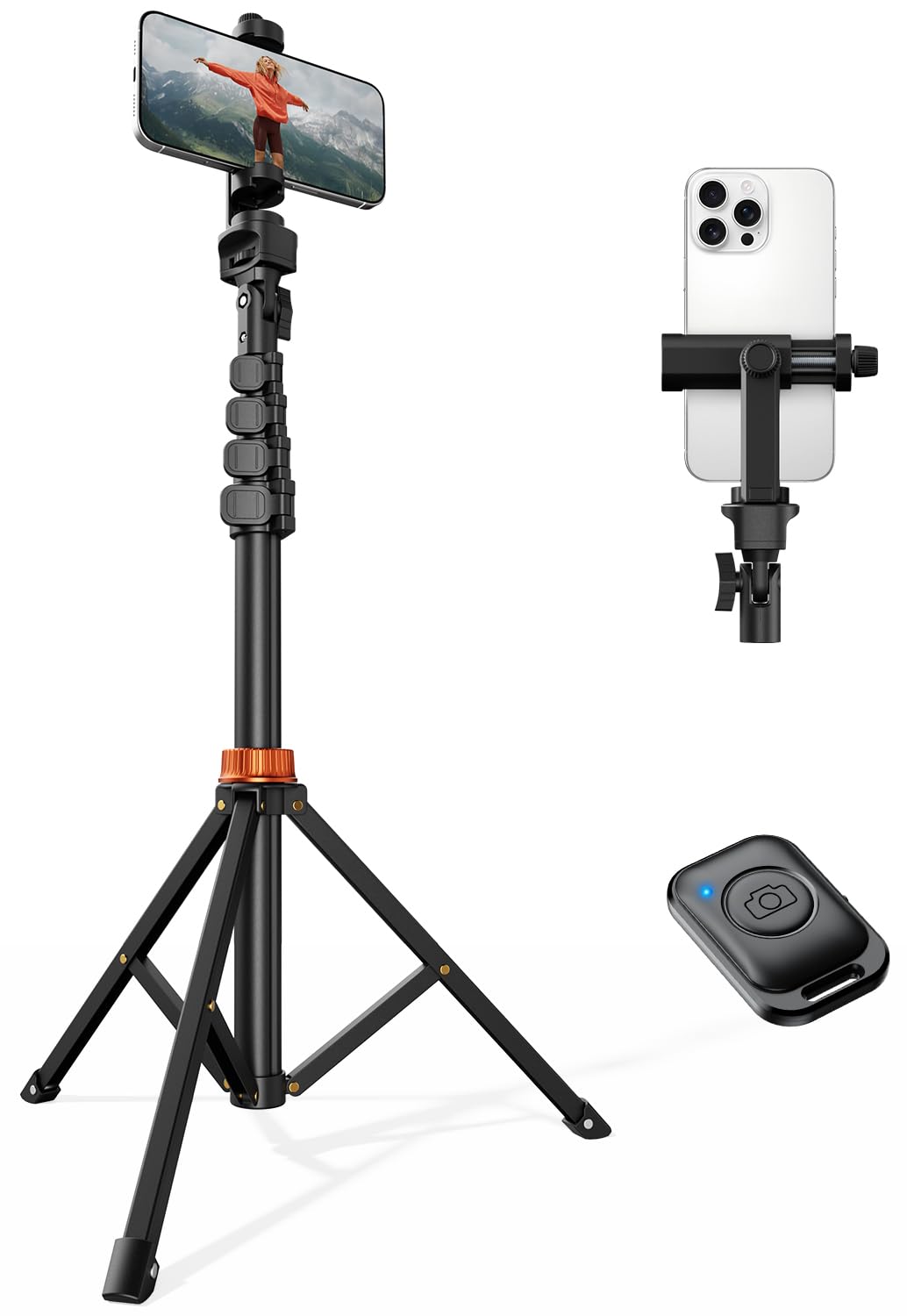
SENSYNE 62-Inch Tripod

SENSYNE 62-Inch Tripod

Large phones

Our Score 9.0/10
Check Price

Worth Noting

  • Head can lock a degree or two off level
Mount
1/4-inch screw
Weight
1.43 lb
Max Height
62 inches
Phone Width
2.8 to 5.7 inches

A cradle that opens to 5.7 inches wide is the outlier in this group, and it is the whole reason the SENSYNE earns a place: a big phone in a chunky case, or a phone with a battery clipped to the back, fits without a fight. Everything else here tops out around 3.6 inches.

There is a standard 1/4-inch screw on the head as well, so an action camera, a small point-and-shoot, or a webcam can share the same stand. At 650 grams it is among the heavier 62-inch sticks here, which is a feature rather than a flaw — the mass sits low and the rig feels settled at chest height in a way the featherweights do not.

Past about two feet of extension it starts to sway, the same complaint every light stick in this guide attracts. For a standing full-body shot, keep the phone at eye level and step back rather than pushing the pole higher; you get a cleaner frame and nothing to apologise for in the edit. The remote is one of the more dependable ones here, pairing without fuss.

Bottom line: For a big phone in a thick case, the SENSYNE's 5.7-inch clamp and 1/4-inch screw make it the safer buy of the two full-height sticks.

3

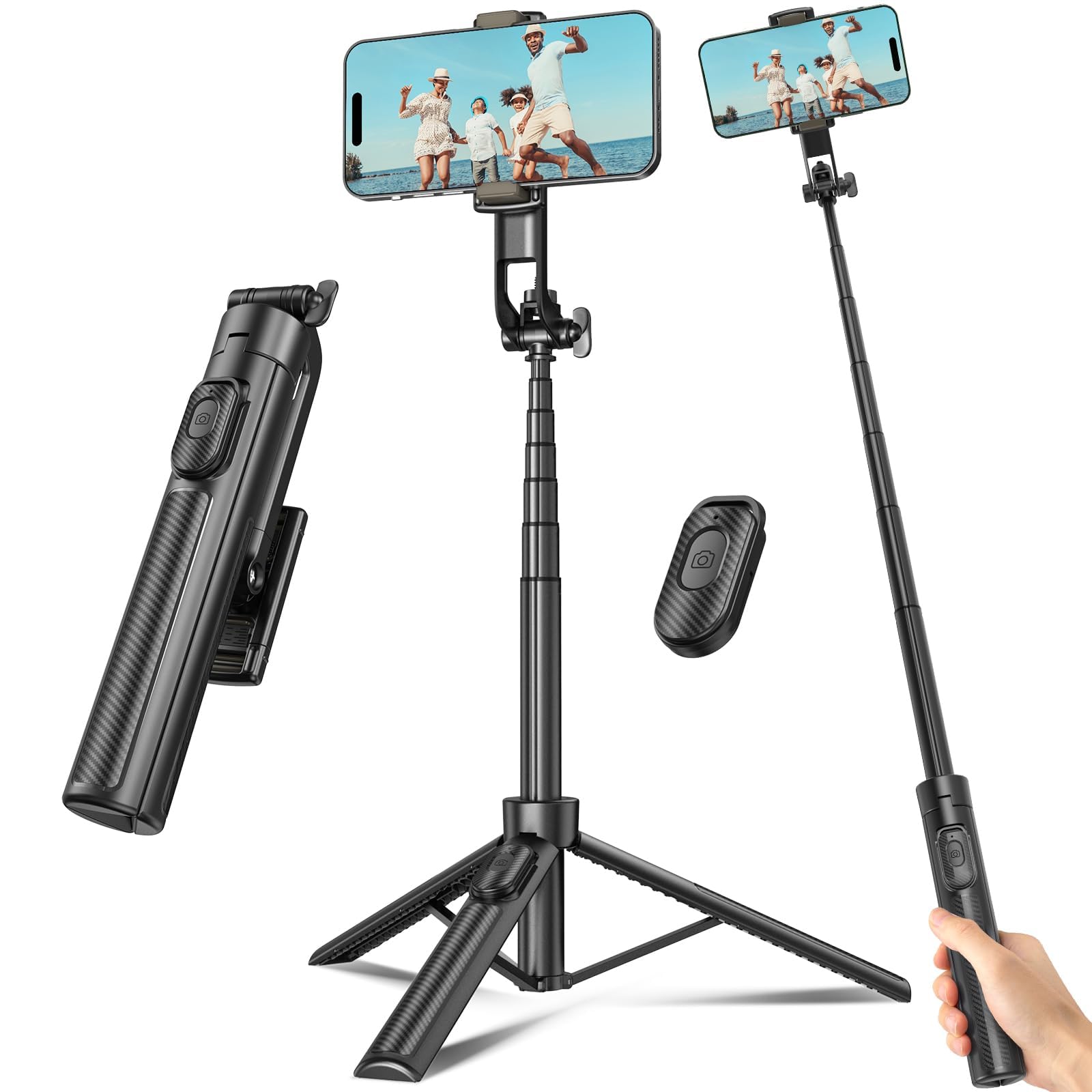
Liphisy 64-Inch Tripod

Liphisy 64-Inch Tripod

Phone and camera

Our Score 9.2/10
Check Price

Worth Noting

  • Folds to 17.7 inches, needs a laptop sleeve
  • Remote pairing is the least dependable part
Mount
1/4-inch screw
Weight
1.61 lb
Max Height
64 inches
Min Height
17 inches

The Liphisy is the one here that feels like camera gear rather than a phone accessory: aluminum and stainless steel, a ball head on top, and a 1/4-inch screw that takes a small camera or an action-cam adapter without hunting for a plate.

Height runs from 17 inches to 64, with a locking collar at each section, so you can set it on a table for a product shot or stand it behind a chair for a two-person interview. Setting up takes longer than flicking out a selfie stick — three legs to splay, collars to twist — and that is a fair trade for a base that does not wander.

At 0.73 kg it is the heaviest thing in this guide, and the weight is doing exactly what you want: the Liphisy sits still on a hard floor while a lighter stick would be shivering. It folds to 17.7 inches, laptop-sleeve territory rather than pocket.

What you give up is speed. This is not the tripod you keep in a jacket, and it is not the one you extend one-handed while holding a coffee. What you get is a stand that holds an angle and does not drift, and a head you can put a real camera on. As the single tripod in a small kit that has to do both jobs, that is the trade we took.

Bottom line: We recommend the Liphisy to anyone who wants one tripod for a phone and a small camera; the ball head and heavier legs earn the bulk.

4

RISEOFLE 71-Inch Tripod

RISEOFLE 71-Inch Tripod

High angles

Our Score 8.8/10
Check Price

Worth Noting

  • Plastic phone cradle feels like the weak point
Weight
9.31 oz
Max Height
71 inches
Min Height
12.2 inches
Weight Limit
4.41 lb

The first time we ran the RISEOFLE all the way up in a living room, the framing changed. At 71 inches the phone sits above your eyeline, which is the angle that makes a standing video look shot by a person rather than a laptop. Nothing else here reaches that high.

Getting there costs stiffness. Seven telescoping sections is a lot of joints between the floor and the phone, and near the top the pole moves when you touch it. We treat the last few inches as a special-occasion setting and do most of our shooting at around five feet, where the 264-gram build feels far more composed than its weight suggests.

The other trade is in the cradle, which is plastic next to the aluminum pole. It is the piece to inspect when the box arrives and to handle gently when you are clipping a phone in one-handed. The 360-degree holder, the wireless remote, and the 2 kg load rating are all present and accounted for; at this weight, the pole is where the engineering went.

Bottom line: Buy the RISEOFLE when height is the whole point: it reaches 71 inches at 264 grams, and we keep it below full extension for anything unattended.

5

MIIASI 62-Inch Tripod

MIIASI 62-Inch Tripod

Indoor shooting

Our Score 9.0/10
Check Price

Worth Noting

  • Clamp holds a bare phone better than a cased one
Max Height
170 cm
Folded Size
11.8 inches
Remote Range
33 feet
Weight Limit
2.2 lb

We expected the base to be the weak point on a tripod this light, and the silicone pads under the feet are what changed our mind: on a hardwood floor it stayed where we set it instead of creeping between takes. That is the whole case for the MIIASI in a category where everything wobbles a little.

It folds to 11.8 inches, stands to 170 cm, and the remote works out to 33 feet, enough to get yourself into a group shot without sprinting. Three leg sections and anti-slip feet make it quick to set on a table or the floor, and the head swivels through the angles you need for a desk setup or a standing interview.

The ceiling is worth knowing about. The listed limit is 1 kg — a phone and a small light, not a camera and lens — and the spring cradle grips a bare phone more surely than one in a thick case, so take the case off when the shot allows. Indoors, on a flat surface, with the phone at eye level, that is a set of compromises we can live with.

Bottom line: For filming indoors where the tripod sits still for an hour, the MIIASI's grip on a hard floor is why we pick it over the cheaper sticks.

6

Vimose 66-Inch Tripod

Vimose 66-Inch Tripod

Light and mic rigs

Our Score 9.2/10
Check Price

Worth Noting

  • Portrait framing can sit slightly off vertical
Mount
Cold shoe
Weight
1.28 lb
Max Height
66 inches
Weight Limit
8.8 lb

The closest comparison here is the EUCOS, and the Vimose wins one number outright: a listed limit of 8.8 pounds, four times what the EUCOS is rated for. If your rig is a phone plus a light plus a battery, that headroom is the reason to look here rather than at the lighter sticks.

What it gives up is freedom of movement. The head locks into portrait, landscape, and a 45-degree position rather than swinging on a loose ball, and when we wanted a small tilt for a low angle we had to work for it. For set-and-forget framing that is arguably better, since nothing drifts, but it is not the tripod for chasing angles.

At 0.58 kg it is light for a 66-inch pole, and the cold shoe takes a small light or a microphone without an adapter. The remote is rated to 10 metres, more range than a group shot needs, and the whole rig locks down solidly enough that we stopped worrying about it at desk height.

Bottom line: Choose the Vimose when you hang a light or a mic off the same head; its 8.8-pound load rating is the highest on this page.

7

Liphisy 50-Inch Selfie Stick

Liphisy 50-Inch Selfie Stick

Travel and tote bags

Our Score 9.0/10
Check Price

Worth Noting

  • Plastic joints are the weak point
Mount
1/4-inch screw
Max Height
50 inches
Min Height
9 inches
Head Rotation
300° head, 360° holder

Nine inches is where the Liphisy starts, short enough to use as a hand-held selfie stick before you ever open the legs. For a particular kind of buyer — the one who wants a stick in the tote and a stand for the occasional family photo — that flexibility is the whole product.

Extended, it reaches 50 inches, and the head turns through 300 degrees with a 360-degree holder plus a 1/4-inch screw for a small camera. That is enough for a tabletop product shot, a video call, or a group photo at chest height. It will not put the camera above a standing adult's head, and for a full-length shot you want something taller.

The build is why it sits here rather than higher up the list. The cradle lets a heavy phone tip forward, and the whole thing feels its weight class in a breeze. With a bare phone or a small one and no wind, it does the job quietly and folds away without a second thought.

Bottom line: A good bag tripod: the Liphisy collapses to 9 inches and stands to 50, and it is happiest with a small phone on a still day.

8

SelfieShow 26-Inch Selfie Stick

SelfieShow 26-Inch Selfie Stick

Pocket carry

Our Score 8.6/10
Check Price

Worth Noting

  • Topples with a large phone on the short legs
Weight
4.27 oz
Max Height
67.2 cm
Min Height
18.5 cm
Phone Width
2.5 to 3.7 inches

Twenty-six inches at full stretch is the giveaway: this is a selfie stick that happens to have legs, not a tripod that happens to fold small. Held in the hand it is comfortable, and at 121 grams you forget it is in a coat pocket until you want it.

What it does well is the pocket job. The shaft is stainless steel, the holder turns through 360 degrees with 225 degrees of tilt for overhead shots, and the remote detaches and stows in a notch on the stick so it does not go missing. On a desk or a windowsill the little legs hold a phone for a call or a short clip.

Where it stops is anything tall. There is no height here for a standing shot, and the legs are too short to trust with a walk-away take in company. As the stick you keep in a bag for the two or three times a month you want everyone in the frame, it earns its place; as the tripod you set up and cross the room from, it does not.

Bottom line: Buy it as a pocket selfie stick with a tabletop stand built in, not as a tripod you leave standing with a big phone on top.

How We Tested the Best Phone Tripods

We started with more than 40 models and narrowed the field by spec sheet first: maximum height, folded length, head type, and whether a remote was included or sold as an add-on. Anything whose clamp couldn't grip a phone without stripping the case off was cut, and so was anything that topped out below chest height.

That left 14 tripods, which we used for four months in the places a tripod actually lives — a kitchen counter for recipe videos, a back-row seat at a school concert, a windy overlook on a weekend hike, and a coffee table for family video calls.

Setup was timed, one-handed, from bag opened to phone mounted. We shook the center column with a phone attached and watched how much the frame moved, then clamped each one around a thick case, turned it upside down, and jiggled it to see whether the phone shifted in the jaws. Every Bluetooth remote was paired and carried away from the tripod until the signal dropped, and we noted how long the shutter took to fire after the press. For durability, each tripod spent a week packed loose in a tote bag — after which we checked what had loosened — and the legs were dropped onto pavement from waist height.

Adjustability got the same treatment: we ran each tripod from its lowest to highest position and counted how many locks it took to get there, then swung the head between portrait and landscape to see if the phone held level without re-tightening. The ones that came out ahead shared a pattern — fewer locks, thicker legs, and a clamp that never needed a second look.

How to Choose Phone Tripods

A Stick or a Stand

Nearly every tripod here collapses into one slim pole, which means the legs that deploy at the bottom are short and the whole rig is light. That is the right tool if you mostly shoot hand-held and occasionally prop the phone on a table. If you want to set the phone down and walk into the frame, lean toward the models with a wider leg spread and more mass low down — the Liphisy 64 is the clearest example here.

The tell is leg length, not pole length. A 62-inch pole on four-inch legs is a selfie stick that can stand up; a 64-inch tripod with splayed legs and locking collars is furniture.

Height and the Base That Has to Hold It

Every tripod here quotes a maximum height, and on all of them the last section of pole is the least useful. The higher the phone goes, the more leverage it has over a base weighing a couple of hundred grams. Treat about two-thirds of the quoted maximum as your unattended height and save the top of the range for a hand on the grip or a windless room.

If a standing full-body shot is the goal, buy weight and leg spread rather than another foot of aluminum. The Liphisy 64 and the SENSYNE put more mass down low than the 71-inch RISEOFLE, and on a hard floor you can feel the difference within seconds.

The Clamp and the Mounts

The spring cradle decides whether your phone survives the day. Width ranges here run from 2.2 to 3.6 inches on the EUCOS up to 2.8 to 5.7 on the SENSYNE, and those numbers matter most with a case and a grip attached — measure the phone as you will mount it, not bare. A cradle that is slightly loose will let a heavy phone droop the moment you tilt the head down.

Above the cradle, a cold shoe on the EUCOS and the Vimose takes a small light or a microphone; a 1/4-inch screw on the SENSYNE and both Liphisy models takes a camera. If you plan to add a light, buy the cold shoe rather than improvising with tape.

The Remote and the Bag

Range is rarely the problem with these shutters — most are rated to 30 or 33 feet, which covers any group shot you can arrange — and pairing is. A remote with a notch on the rig to live in is worth more than a few extra feet of range, because the one that rolls to the bottom of a bag gets left at home.

Then look at folded length. The EUCOS and the MIIASI collapse to around 12 inches and disappear into a daypack's side pocket; the Liphisy 64 folds to 17.7 inches and wants a laptop sleeve or a car trunk.

Frequently Asked Questions

Final Verdict

The EUCOS is the one we hand to most people: 62 inches of reach at 12.8 ounces, a clamp that holds its angle, a remote that paired without drama, and a cold shoe for a light when the room is dim.

Buy the SENSYNE instead if your phone is large or lives in a thick case — its 5.7-inch clamp is the widest here — and the Liphisy 64 if one tripod has to take a small camera too. For a bag you barely notice, the RISEOFLE's 71 inches at 264 grams is the specialist's choice; just do not leave it standing at full stretch.