Phone & Tablet Accessories

Best Wall Charger of 2026

The brick in your bag has quietly gotten smarter. Gallium nitride replaced the old silicon guts in most of these, which is why something the size of a matchbox can now run a laptop — and why the spec sheet has become the hard part. A charger advertised at 65 watts rarely hands 65 watts to every port at once, and that footnote decides whether you're replacing four plugs or just moving the mess around.

I've carried a two-port charger in my backpack for years; the ones that stick around are the ones I never think about. Over four months, my team and I ran 14 through ordinary life — on the nightstand overnight, at the desk all day, zipped in a carry-on for a week — timing how fast each refilled my phone and my laptop. What first-time buyers miss is that the cable is half the equation: a fast brick with a slow cable charges like a slow brick, and some don't come with one at all. The picks below are the ones I'd plug in without hesitating.

1

Anker 735 65W

Top Pick
Anker 735 65W

Most devices

Our Score 9.4/10
Check Price

Worth Noting

  • Long body can sit loose in worn outlets
Plug
Foldable
Ports
2 USB-C + 1 USB-A
Warranty
18 months
Max Output
65W

The 65W figure is the reason this Anker earns the top spot. It is enough to run a 2020 13-inch MacBook Pro at full speed from one USB-C port, and the body is about the size of an AirPods Pro case. We reach for it first when one charger has to cover a laptop and a phone, because it replaces two bricks without taking over a bag.

The port layout is two USB-C and one USB-A. With a single device connected, you get the full 65W; with three, the power is shared, so the laptop belongs on a USB-C port and the phone can take what is left. The USB-A port is there for an older cable or a watch charger, not as a second fast lane.

We appreciate the foldable plug more than we expected: it keeps the prongs out of the way in a backpack and makes the charger feel smaller than its footprint suggests. The 18-month warranty is also a useful cushion for a charger that lives in a bag. It is not the smallest charger here, but it is the most capable of the compact ones.

Bottom line: For one charger that covers a laptop, phone, and tablet without a bag full of bricks, this is the Anker we reach for.
2

Anker Zolo 50W

Anker Zolo 50W

Families and travel

Our Score 9.6/10
Check Price

Worth Noting

  • No cables in the box
Pack
2 chargers
Plug
Foldable
Ports
2 USB-C + 2 USB-A
Max Output
50W

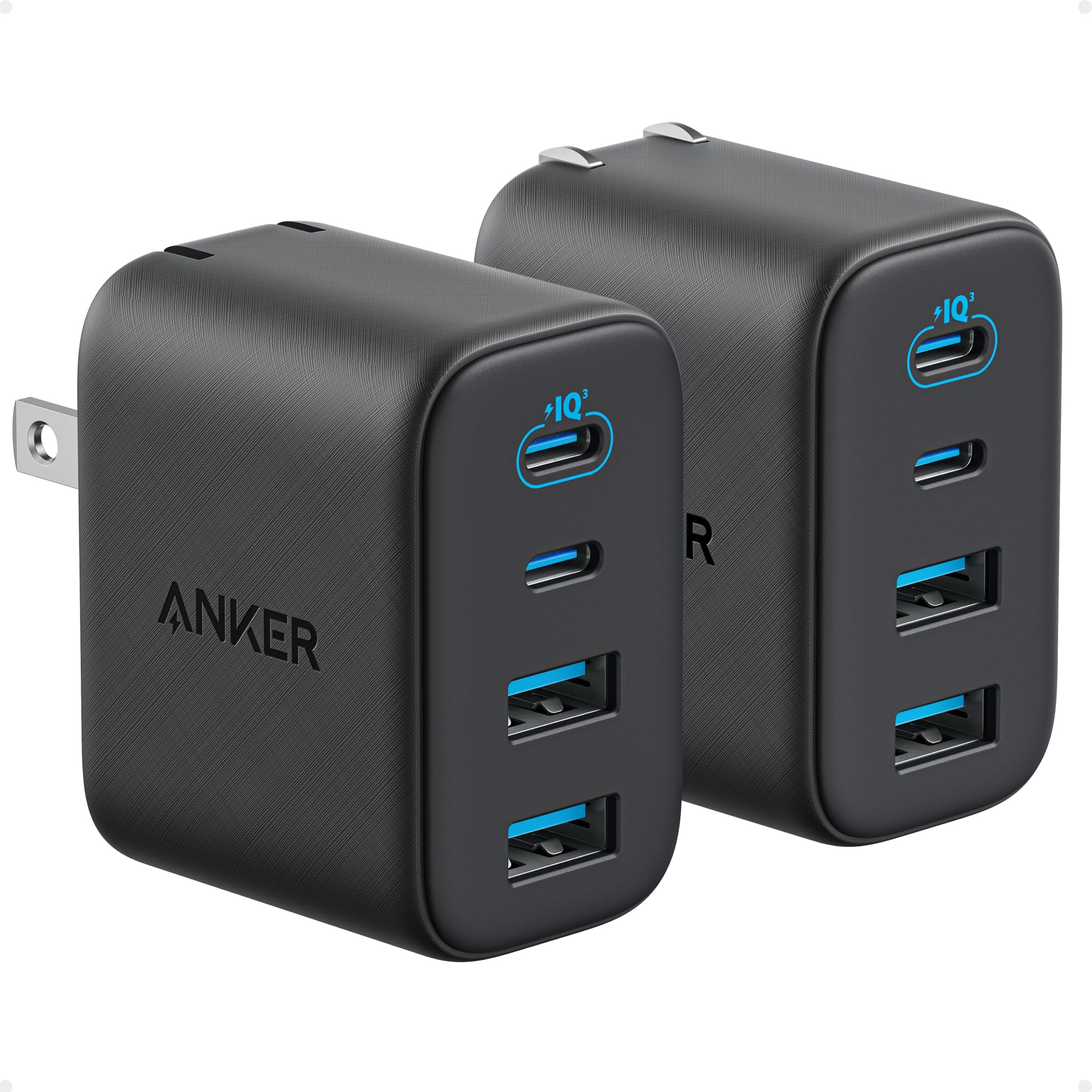
Two chargers, four ports each: that is the pitch, and it is the right one for a household that keeps misplacing the brick. The Zolo is small enough to disappear into a pocket, and the foldable plug means it does not leave a prong sticking out in a bag. We keep one in the kitchen drawer and one in the travel pouch.

The useful detail is how it splits power. With both USB-C ports in use, one holds 30W and the other 20W, so a phone can fast-charge while a tablet or earbuds case tops up beside it. The two USB-A ports are there for older cables and travel gadgets. We like that balance better than a four-port charger that makes every port slow as soon as you use more than one.

What it is not is a laptop charger. The 50W total is plenty for phones, tablets, watches, and earbuds, but a power-hungry laptop will want the 735. If your travel kit is a phone, tablet, and headphones, the two-pack means you can leave one plugged in at home and keep one ready to go.

Bottom line: We hand this two-pack to families and frequent packers: four ports each, foldable plugs, and enough power for phones and tablets.

3

UGREEN Nexode Pro 160W

UGREEN Nexode Pro 160W

High-power desks

Our Score 9.4/10
Check Price

Worth Noting

  • Bulkier than a phone charger
Ports
4 USB-C + 1 USB-A
Display
Touch screen
Max Output
160W
Single-port Max
140W

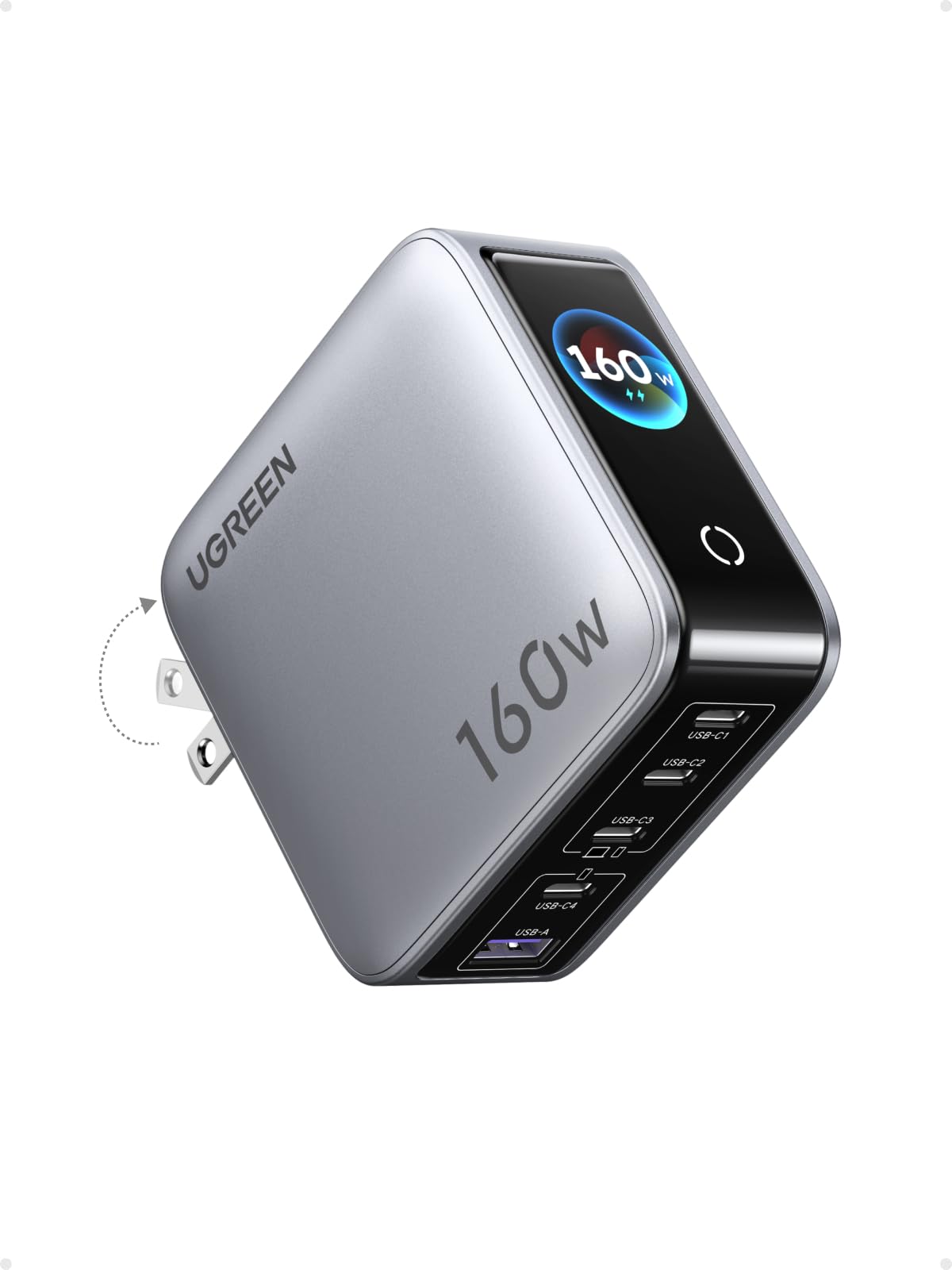
A charger with a screen sounds like a gadget in search of a problem until you are sharing 160W across a laptop, tablet, and two phones. The Nexode Pro shows the wattage moving around its five ports, so you can see when the laptop has dropped to a trickle because the budget is split.

We appreciate the display for exactly that reason: it turns a black box into something you can diagnose. The port layout is four USB-C plus one USB-A, and the first two USB-C ports can carry up to 140W each when used alone, which is enough for a 16-inch MacBook Pro. The single USB-A is the odd one out, but it is the right concession for a travel mouse or older cable. The display also earns its keep with a power bank: you can see when it has topped out and move the cable to a device that needs the watts.

For a desk or a work trip where one brick replaces three, the extra capacity is the point. It has become the charger we take when the trip includes a laptop, and the display makes it easy to see which device is getting the most.

Bottom line: We choose the Nexode Pro when one charger has to power a laptop and a pile of smaller devices, and we want to see where the watts are going.

4

Apple 20W USB-C

Apple 20W USB-C

iPhone minimalists

Our Score 9.6/10
Check Price

Worth Noting

  • No cable included
Ports
1 USB-C
Output
20W
Dimensions
1.04 x 0.5 x 1.29 in
Cable Included
No

The single 20W port is the whole story, and that is exactly why it earns a place. If you charge one iPhone and nothing else, the small cube disappears into a bag and does not ask you to think about power sharing.

Apple rates it for fast charging on iPhone 8 and later, and the 20W output is enough to take a modern iPhone to a useful level without the bulk of a laptop brick. We keep it in a travel pouch because there is nothing to configure and no display to worry about. It is also the charger we hand to someone who just wants a spare for the kitchen. The compact body is easy to grip when you pull it out of a tight outlet, and the finish is plain, which is fine.

If your drawer also has an iPad or a second phone, the Zolo or 735 makes more sense; the Apple block is the one to keep for the phone you carry every day. It is also the one we trust to sit in a hotel outlet without a second thought. That is a narrow job, but it is the job most spare chargers actually do.

Bottom line: We keep this Apple block for the iPhone-only drawer: it is small, simple, and happy to do one job without extra ports.

5

LUOATIP 3-Pack

LUOATIP 3-Pack

Legacy USB-A setups

Our Score 9.4/10
Check Price

Worth Noting

  • No USB-C ports
  • 2.1A output is slow for modern phones
Pack
3 chargers
Ports
2 USB-A
Output
5V/2.1A
Warranty
1 year

Three cubes, two USB-A ports each: this is the charger for the drawer full of older USB-A cables. The dual ports are the practical part—one for a phone, one for a tablet, earbuds, or a bedside lamp—and the small size means you can leave one in several rooms.

We noticed quickly that the 2.1A rating is the charger's output ceiling, not a per-port promise. Plug in two devices and they share it. The upside is that the cubes are small, light, and easy to leave in several rooms; the fireproof enclosure and basic protection circuitry are the right minimum for a budget charger.

For a guest room, a kid's bedside, or a box of older cables, three simple cubes solve the outlet problem without asking you to buy new cables. We keep one in a guest room and one by a reading chair, which is exactly the kind of low-demand use it handles well. The 1-year warranty is a modest cushion, but it is there. The cubes do not crowd a strip the way a laptop brick can.

Bottom line: We recommend this three-pack for a drawer of USB-A cables and spare outlets, as long as fast USB-C charging is not the goal.

6

DENGWENQIANG 2-Pack

DENGWENQIANG 2-Pack

Bedside spares

Our Score 9.2/10
Check Price

Worth Noting

  • 20W output is modest for modern phones
Pack
2 chargers
Ports
1 USB-C + 1 USB-A
Output
20W
Weight
2.12 oz

The two-pack is the appeal: one for the bedside, one for the office, both small enough to leave plugged in. Each cube has a USB-C and a USB-A port, which covers a modern phone cable and an older accessory without an adapter.

This is an overnight charger, not a top-up charger. With both ports in use, each device gets a smaller share of the output, so it suits a phone that can sit for hours, a smart speaker, or earbuds. We treat it as a convenience charger, not the one we pack for a trip.

The other thing to check is the USB-C port itself; a dead C port is the failure to watch for, so test both ports as soon as the pair arrives and return it if either one is inert. That caveat aside, the pair is a sensible low-cost way to put charging in two spots without buying two separate bricks. We keep one by the bed and one on a home-office desk, where slow overnight charging is not a problem. The 1-year warranty is a small plus.

Bottom line: We suggest testing both ports early; if they work, this two-pack is a cheap bedside and office charging pair.

How We Tested the Best Wall Chargers

We started with a long list of roughly 50 chargers, then cut anything without a stated USB Power Delivery rating, anything whose multi-port wattage we couldn't verify from the manufacturer's own documentation, and anything with a pattern of complaints about running hot. That left 14, spread across single-port bricks, folding two-port travel chargers, and desktop-style blocks with three or more ports.

Each one lived with us for four months, moving between a nightstand, a kitchen counter, a desk, and a carry-on. For charging speed, we drained the same phone and the same 13-inch laptop to zero and timed how long each took to reach 50 percent, then did it again with a second device plugged in to see whether the first slowed down. Compatibility got checked the same way — iPhone, older Android, tablet, earbuds, a handheld console — because plenty of bricks charge one device quickly and negotiate badly with the next. Ports were counted and then used, since three ports sharing one output is not the same as three ports that each hold their rating.

Quality and reliability were slower to show. We plugged and unplugged each charger about 50 times, folded the prongs where they folded, dropped each from counter height onto a wood floor, and felt the case after an hour of charging a laptop — warm is expected, uncomfortable to hold is not. Size got judged against a crowded power strip and a jacket pocket: we plugged each in beside a neighbor to see what it blocked, then weighed it and checked whether it folded flat enough to disappear into a bag. At purchase we logged what came in the box, because a brick bundled with a cable rated below its own wattage charges slower than the label promises.

How to Choose the Right Wall Charger

Match Wattage to Your Biggest Device

Buy for the largest thing you need to charge, not the biggest number on the box. A 20W USB-C charger is enough for a phone; a tablet or a small laptop wants 30W to 65W; a 16-inch laptop can use 140W. A higher-wattage charger does not force power into a phone—the device negotiates what it can take—so a 65W brick is safe for a phone and useful for a laptop. The trap is total versus per-port: a 50W four-port charger is not 50W to every port, and a 160W charger may reserve most of that for one USB-C port.

Choose the Port Mix You Will Actually Use

USB-C is the default now, but USB-A has not disappeared from drawers. A two USB-C plus one USB-A layout covers a phone, a tablet, and an older cable without an adapter; four USB-C ports suit a desk full of newer gear. There is no reason to pay for four ports if you only ever charge one phone, but we do like having one USB-A for a travel mouse or a watch cable. Count your cables before you count the ports.

Check the Plug and the Outlet

Foldable prongs are a travel convenience, not a voltage converter. A compact cube is easier to leave in a strip; a longer body can crowd the next outlet or sit loosely in a worn socket. Before you buy, picture where it will live: a bedside outlet shared with a lamp, a desk strip behind a monitor, or a bag pocket. If the charger will stay in one place, size matters less than a firm grip and enough clearance.

Treat Heat and Cheap Multi-Packs With Care

Every charger warms up under load; a charger that becomes uncomfortably hot, buzzes, or smells is a stop sign. Budget multi-packs are tempting because they put a charger in every room, but the savings disappear if one or two units fail early. Test each one in the return window, check both ports, and prefer a pack with a real warranty. A low-cost pair can be a fine bedside solution; just do not expect it to be the one you take on a laptop trip.

Frequently Asked Questions

Final Verdict

The Anker 735 is the charger we recommend first because it covers the widest set of everyday devices: 65W for a laptop, two USB-C ports, a USB-A spare, and a body small enough to travel. If you mostly charge phones, tablets, and earbuds, the Anker Zolo two-pack is the better shape for a household—two chargers, four ports each, and no laptop-sized brick to lose. Step up to the UGREEN Nexode Pro only if a desk full of high-power gear needs 160W and the display.