Home Appliances & Robots

Best Air Purifiers of 2026

An air purifier is one of the few home purchases where you genuinely can't tell by looking whether it's doing anything. The air looks identical on day thirty to how it looked on day one, which is how so many of these machines end up humming faithfully in a corner with a filter nobody has checked since spring. What a good one actually fixes is specific: the pet dander that wakes you up congested, the smell of last night's salmon, the fine dust that reappears on a dark shelf a day after you wipe it. The box tells you about airflow, not about what living with the thing is like.

My team has spent the past seven months running 11 air purifiers through ordinary life in ordinary homes, and the gap between the best and the rest comes down to a few things you only notice after a couple of weeks. Noise is the big one — nearly every unit is pleasant on low, and the ones that stay tolerable on medium and high are rarer than their airflow ratings suggest. Filters quietly decide the real cost of ownership, too: a modest sticker price with pricey annual replacements is not the same as good value. Below are the ones worth the floor space.

1

Levoit Core 300-P

Top Pick
Levoit Core 300-P

Bedrooms and offices

Our Score 9.4/10
Check Price

Worth Noting

  • No auto mode or air-quality sensor
  • Odors clear more slowly than dust and smoke
Weight
7.9 lb
Stated Coverage
Up to 1,073 sq ft
Sleep Mode Noise
24 dB
CADR (smoke/dust/pollen)
143 / 153 / 167 CFM

Three published airflow numbers is unusual at this price. Levoit lists the Core 300-P at 143 CFM for smoke, 153 for dust, and 167 for pollen, verified through AHAM's certification program, which means the claim has a test behind it rather than a square-footage sticker chosen for the box.

That is the main reason this is the purifier we recommend to most people, and everything around it holds up. The 24 dB sleep setting is quiet enough that we left it running beside the bed without thinking about it, the 7.9-pound body moves from bedroom to living room one-handed, and the roughly 8.7-by-8.7-inch footprint is smaller than most nightstands. The filter arrives pre-installed as a single cartridge and comes out in one piece, and the touch panel includes a filter-change light and a timer.

The 1,073 square feet on the listing needs context, because it is measured at one air change an hour. At the four or five changes an hour an allergy household wants, this is a bedroom or small living-room machine, and in that role it does what the numbers promise: dust on the dresser dropped and the air stopped feeling stale. What it will not do is think for itself, since there is no particulate sensor and no auto mode.

Where it quietly wins is in the boring parts. Replacement filters are easy to find and inexpensive enough that you will actually change them on schedule, which is more than we can say for some of the larger machines here. If you want a screen telling you the air improved, the MOOKA does that for less; if you need one unit to cover an open-plan room, go up to the Coway.

Bottom line: For most homes we point people here first: verified airflow, a genuinely quiet night mode, and a small body that fits where the air actually is.
2

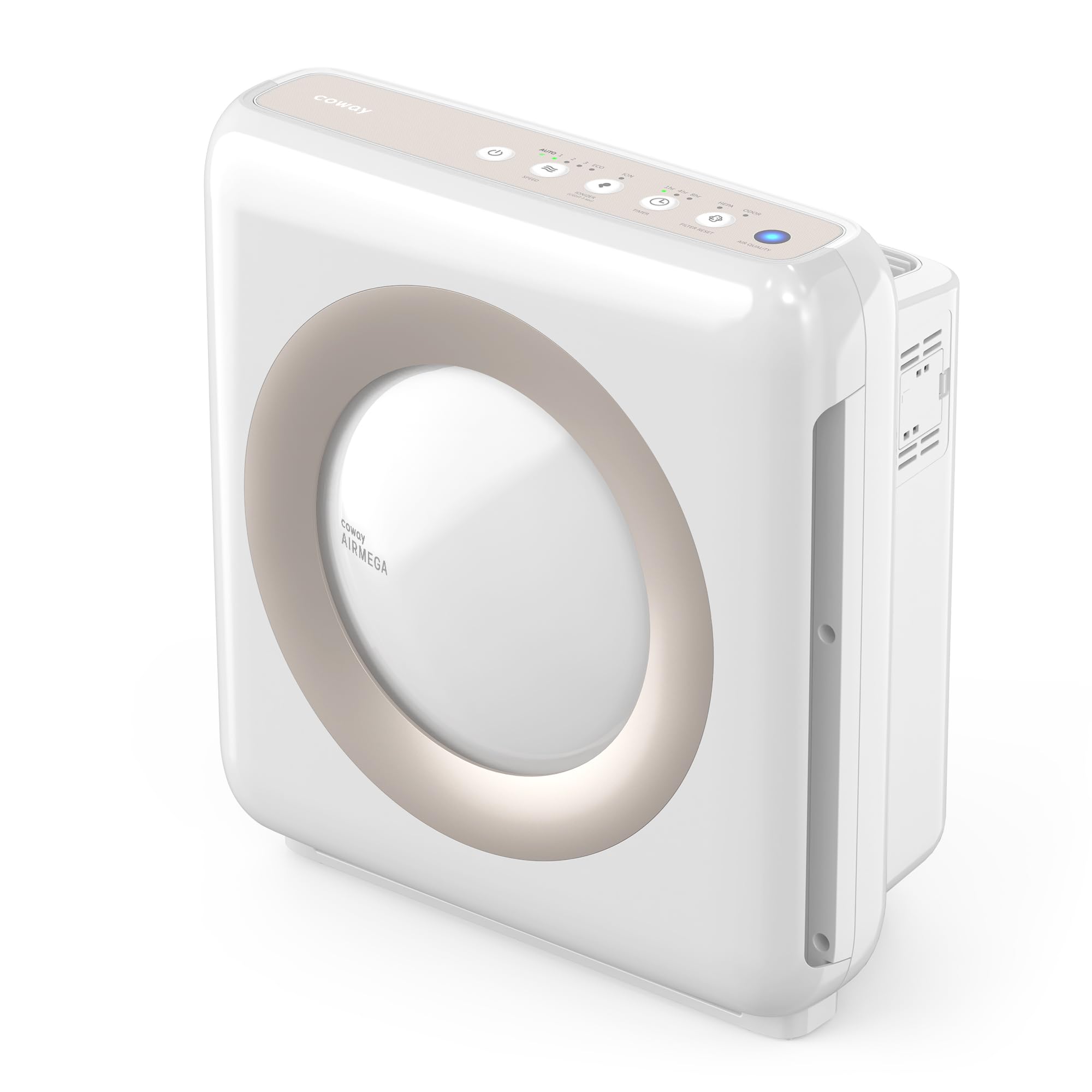
Coway AP-1512HH Mighty

Coway AP-1512HH Mighty

Large rooms

Our Score 9.2/10
Check Price

Worth Noting

  • Odor control trails its particle performance
Weight
12.5 lb
Warranty
3 years
Filtration
Four-stage with HEPA
Stated Coverage
Up to 1,748 sq ft

A three-year warranty is the longest of any pick here, and on a machine that runs every hour of every day, that is the part of the purchase you actually feel. Coway has sold the Mighty in essentially this form since 2015, and the design has the settled look of something that has not needed fixing.

The numbers are serious: 1,748 square feet of stated coverage, a four-stage stack that starts with a washable pre-filter and includes a dedicated deodorization layer ahead of the HEPA filter, an auto mode tied to a real pollution sensor, and separate alerts for the pre-filter and the main cartridge. It weighs 12.5 pounds and stands about 18 inches tall, so plan a floor corner rather than a shelf.

We keep coming back to it for big rooms and for people who do not want to fiddle with an app. Speeds one and two are close to inaudible; turbo is loud enough that you schedule it for when you are out of the room. What you are buying is reach, a proven design, and a warranty that outlasts most of the machines on this page. If app control and a pet-hair inlet matter more to you, and you want to spend less, the Vital 200S-P is the better fit.

Bottom line: Buy it for a large room you want handled for years with almost no thought; the warranty and the settled design are the reasons to spend up.

3

Levoit Vital 200S-P

Levoit Vital 200S-P

Pet households

Our Score 9.4/10
Check Price

Worth Noting

  • Tall and heavy, so it stays put
Weight
13.2 lb
Air Intakes
Front plus U-shaped inlet
App Control
Yes
Stated Coverage
Up to 1,875 sq ft

The second air inlet is the reason to look at this one. Alongside the usual front grille, the Vital 200S-P pulls air through a U-shaped intake, which gives it more intake area for the same footprint, and in a house with a shedding dog that extra path gives loose hair more places to be caught before it reaches the main filter.

Everything else is sized for a large room: 1,875 square feet of stated coverage, 13.2 pounds, and a 19.7-inch height that wants floor space or a low shelf rather than a nightstand. The app handles scheduling and fan speed, sleep mode is quiet enough that noise is not the reason to move it, and the controls work from the unit itself if you never pair it.

This is our pick for pet households and open-plan living, and it is the one to choose if you want the machine to respond to the room rather than run on a fixed speed. The trade is bulk: at 13.2 pounds with that height it stays where you put it, and it is more purifier than a single bedroom needs. If you want similar reach without the app, the Coway is the simpler, longer-warranted alternative.

Bottom line: For a home with a shedding pet or a big open room, this is the one: the extra inlet earns its keep and the app makes it easy to live with.

4

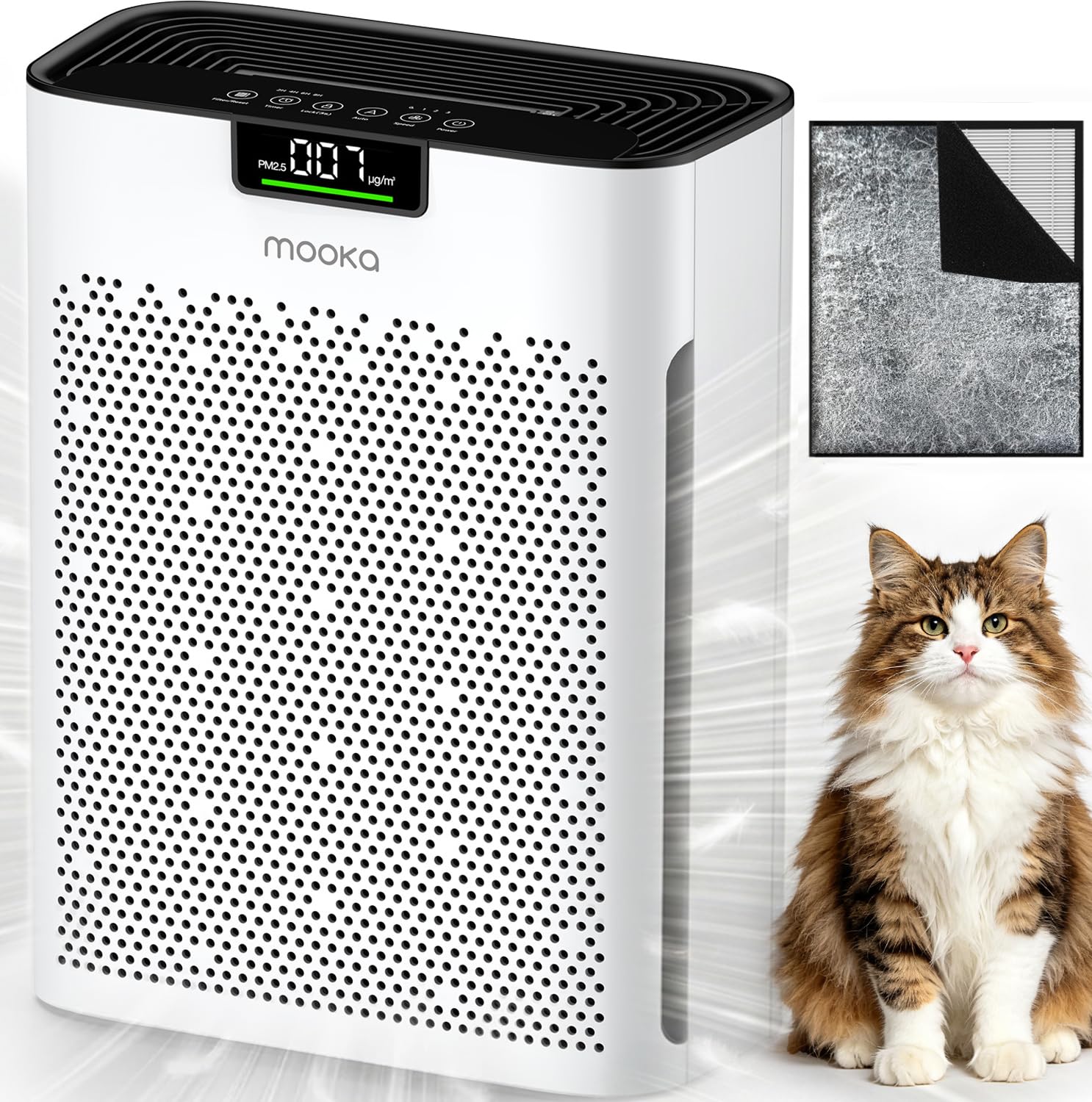
MOOKA KJ190H

MOOKA KJ190H

Air-quality tracking

Our Score 9.0/10
Check Price

Worth Noting

  • Audible on the top two speeds
Weight
6.7 lb
Stated Coverage
Up to 2,200 sq ft
Sleep Mode Noise
20 dB
Air Quality Display
PM2.5 readout

A live PM2.5 number on the front panel changes how you use a purifier, because you can see the fan react when you open a window or start searing something, instead of taking the machine's word for it. The MOOKA gives you that readout with an auto mode tied to it, four speeds, and a timer, and it is the least expensive way here to get a sensor and auto mode in one box.

Coverage is stated at 2,200 square feet, which is the usual one-air-change arithmetic, so treat it as a large living room rather than a whole floor. In that room the auto mode is genuinely useful, the fan stepping up as the reading climbs and settling after. The washable pre-filter is the feature we appreciate most over a year of ownership: the layer that catches the most hair and dust is the layer you rinse instead of replace.

One quirk worth knowing before you pick it up: the front grille is only clipped on, so lift the unit from its base when you move it or the panel pops off in your hands. For a living space where cooking and foot traffic keep the reading moving, the display is worth more than an app you will open twice, and the 6.7-pound body is light enough to shift between rooms. It belongs in a living space rather than a bedroom.

Bottom line: If you want to watch the numbers move, this is the value pick: a real PM2.5 readout and auto mode for living-room money.

5

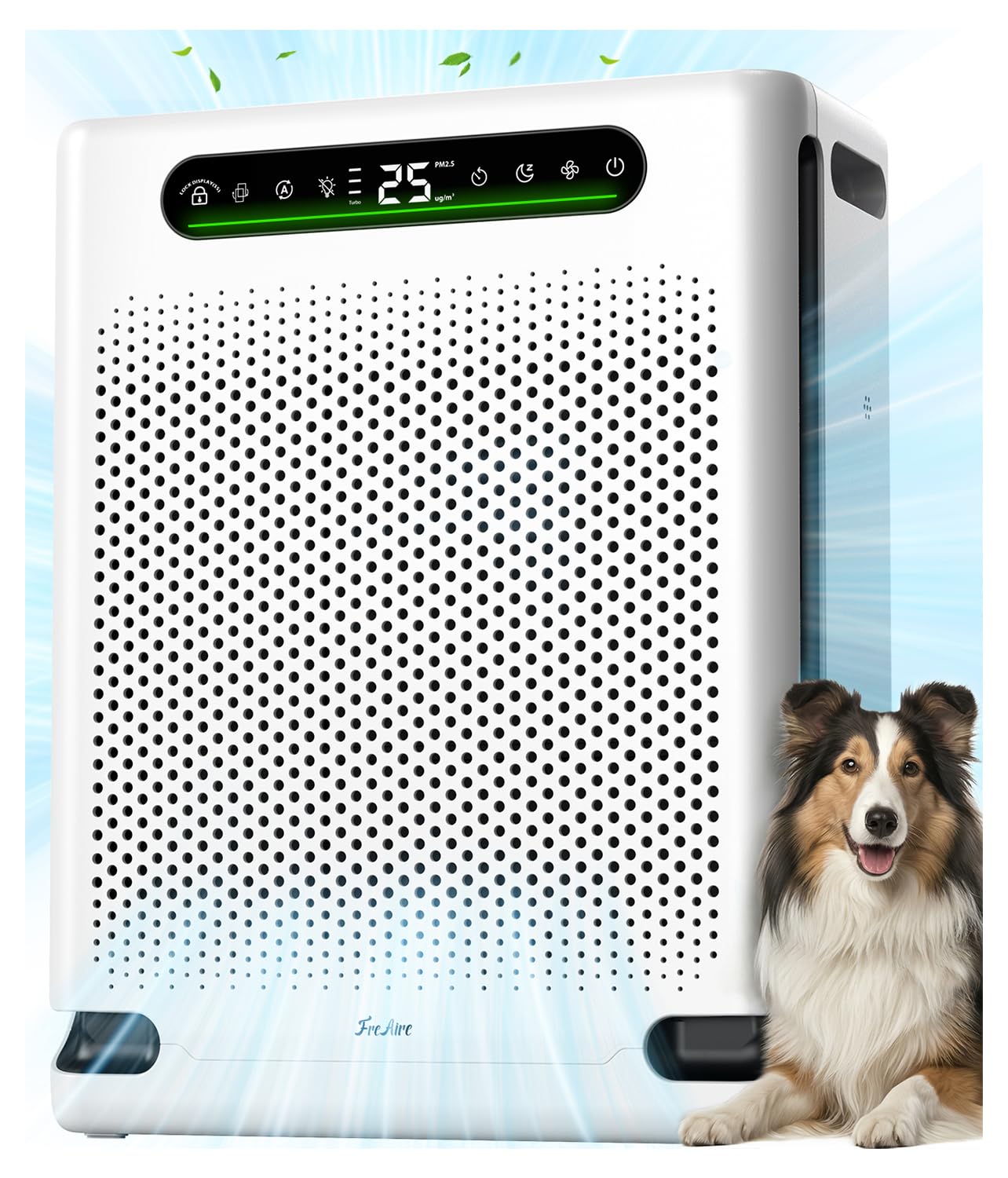
FreAire HAP605

FreAire HAP605

Kitchens and pets

Our Score 9.4/10
Check Price

Worth Noting

  • Pre-filter has to dry fully before reinstall
Pre-filter
Washable
Air Intakes
One front, two side
Stated Coverage
Up to 2,600 sq ft
Sleep Mode Noise
20 dB

Turbo Pet is the setting that makes this one different. Most purifiers give you three speeds and a sleep mode; the FreAire adds a mode that pushes the fan harder for faster room turnover, and with air drawn through one front inlet and two side inlets at the same time, it recovers a room faster than its size suggests.

The rest of the package is aimed at kitchens and pet rooms: a PM2.5 sensor with a real-time display, an auto mode that follows it, and a 20 dB sleep setting that also kills the display lights after three seconds. That last detail is the one we appreciated most in a bedroom, because nothing is worse than a bright panel at two in the morning.

Maintenance is where it saves money over time. The pre-filter comes out, rinses clean, and goes back in, so the hair and cooking grease that would otherwise load the main cartridge go down the sink instead. It weighs 6.73 pounds and stands 16 inches tall on a narrow base, so it tucks beside a counter or the end of a sofa without much fuss.

We like this one for the room where the smells start: an open kitchen, a mudroom, a living room with a dog bed in it. What tempers the recommendation is history, since this is a newer design with a much shorter record than the Coway or the Core 300-P, so buy it for the feature set rather than a decade of proof. If you want a bedroom unit with a longer track record, spend the same money on the Core 300-P.

Bottom line: For cooking smoke, pet odors, and a room that needs to recover fast, this is the pick, as long as you go in knowing it is a newer design.

6

VOOPNU Air Purifier

VOOPNU Air Purifier

Tiny rooms

Our Score 8.8/10
Check Price

Worth Noting

  • Small filter loads fast in a smoky room
Dimensions
6.69 x 6.69 x 9.84 in
Stated Coverage
Up to 1,076 sq ft
Sleep Mode Noise
22 dB
Essential Oil Tray
Built in

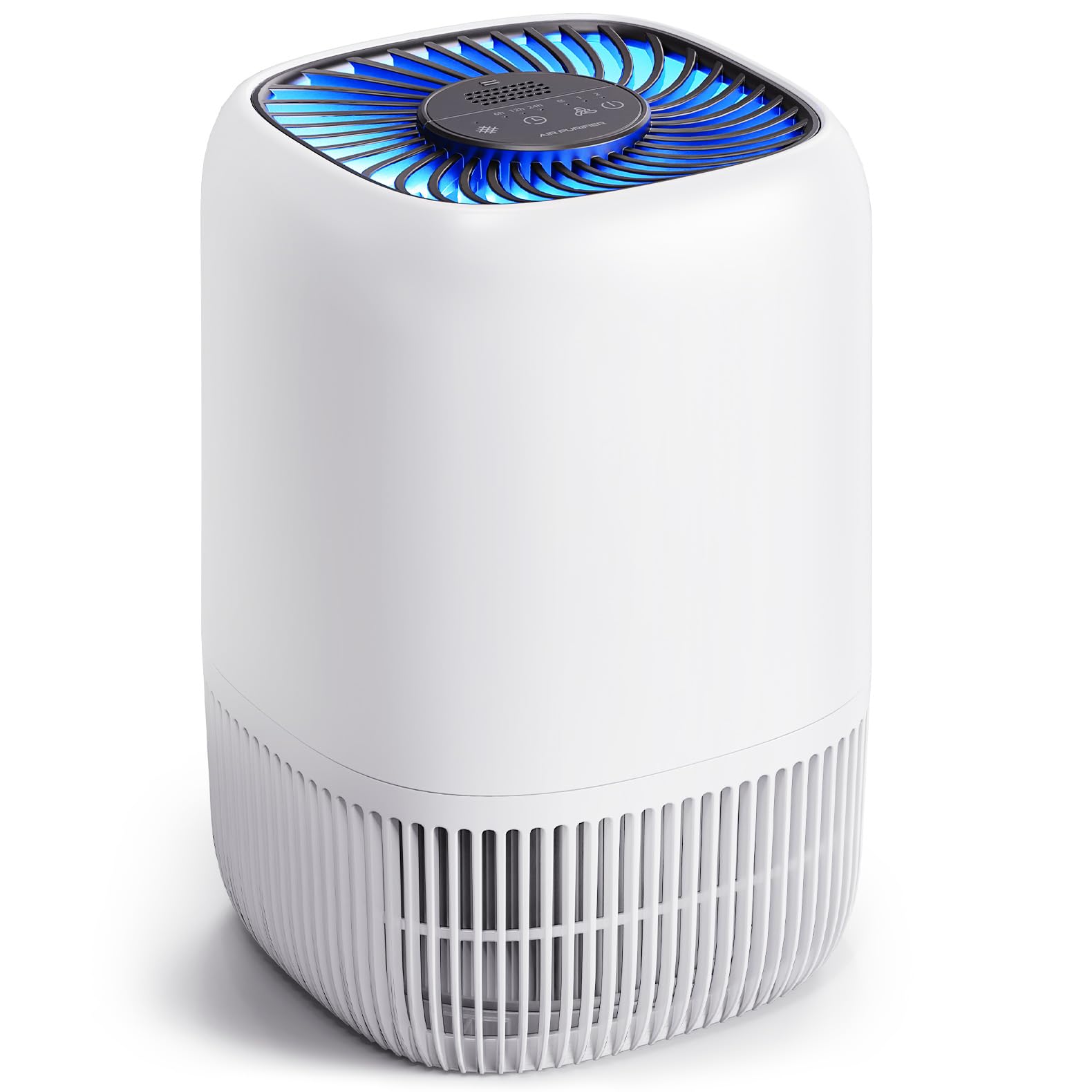
This is the least expensive purifier here, and it is the one we reach for when the room is small and the budget is real: a kid's room, a dorm, a home office, a bathroom that never stops smelling of litter. It is a 6.69-inch-square tower standing under ten inches tall and weighing about two and a half pounds, so it disappears on a dresser. The 360-degree intake and three-layer filter are honest small-room equipment, sleep mode is rated at 22 dB, and there is an essential oil tray if you want the room to smell of something. We left ours empty.

Two things to know before you order. The power cord ships tucked inside the base, so the box looks empty until you open the filter compartment, which is where it lives. And the filter is small: in a smoky or hairy room it loads up quickly, which makes this a machine for a single small space rather than a floor of a house. Two of them, one per bedroom, make more sense than one bigger unit you have to carry up the stairs.

Bottom line: The budget pick: tiny, quiet, and cheap enough to put one in every small room, as long as the room really is small.

7

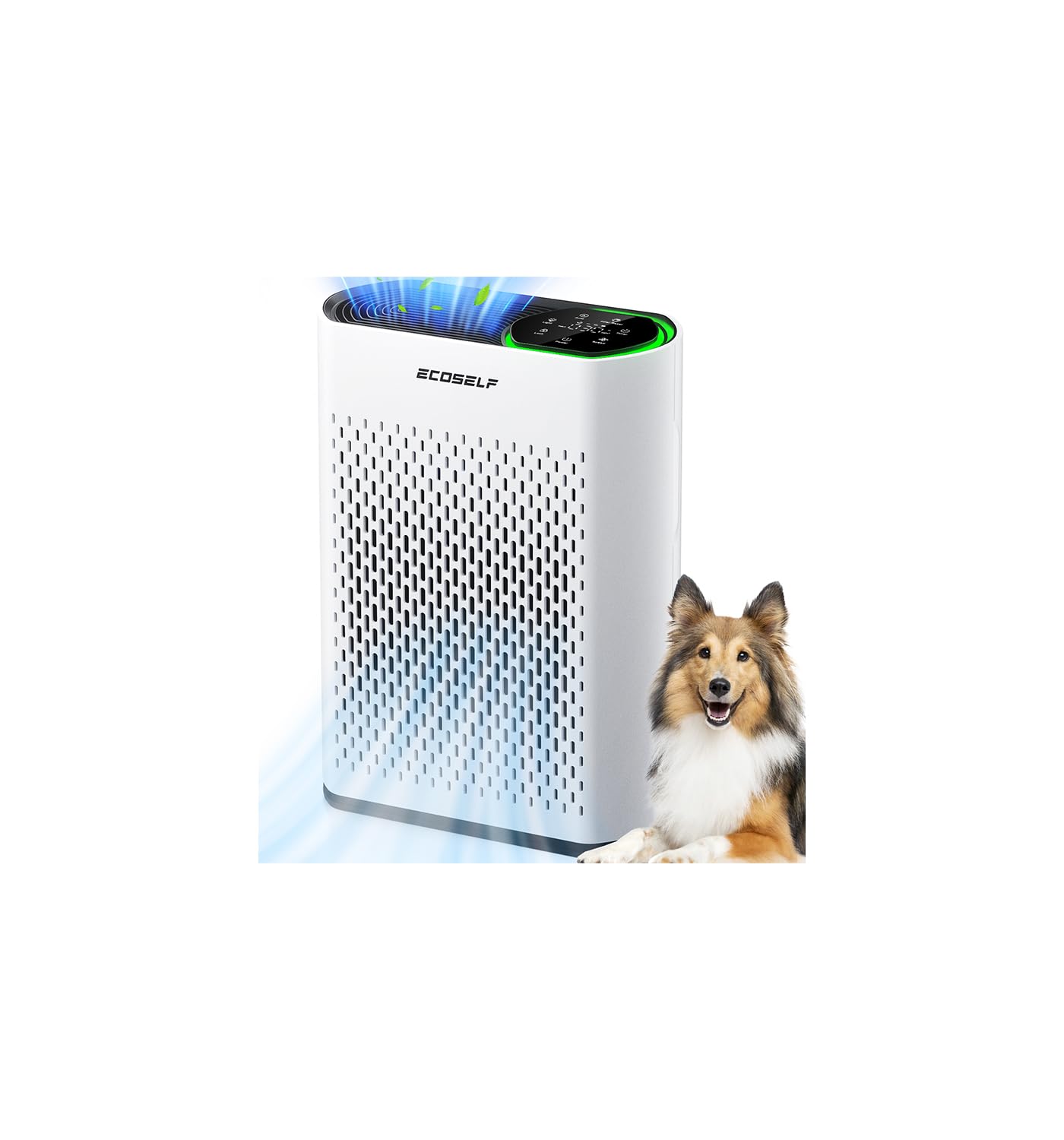
ECOSELF HAP602

ECOSELF HAP602

Open living areas

Our Score 9.6/10
Check Price

Worth Noting

  • No track record to judge longevity
Weight
6.6 lb
Stated Coverage
Up to 2,400 sq ft
Sleep Mode Noise
20 dB
Air Quality Display
PM2.5 readout

This is the newest design in the group and the one without a long service history behind it. What it brings is a real-time PM2.5 display with an auto mode that follows the reading, three fan speeds, a three-stage filter the listing calls True HEPA, and a 20 dB sleep mode, all in a body 15.75 inches wide and under six inches deep, so it sits flat against a wall instead of jutting into the room.

On paper it is the most feature-complete purifier here for the money, and the shallow body solves a problem most towers create. We are simply not in a position to tell you how one behaves in year three, and with a purifier that is part of the decision, because the fan runs constantly and the sensor has to keep working. Buy it for a secondary room or a home office where an unproven machine is low-risk, not as the only purifier in a house full of allergy sufferers.

The details are thoughtful. The display can be dimmed or switched off, the auto mode reacts within a few seconds of the air changing, and the stated 2,400 square feet is the usual one-air-change figure, meaning a large living room in practice. If you want the same display and auto mode with a longer track record, the MOOKA costs less and has been around longer.

Bottom line: A feature-complete purifier with a lovely slim body, worth buying for a secondary room where an unproven machine carries little risk.

How We Tested the Best Air Purifiers

We started with a list of about 40 models and cut anything without a published clean air delivery rate, anything whose replacement filters were hard to source or unusually expensive to keep up with year after year, and anything rated for a room smaller than the one it was marketed for. That left 11 units, which we ran for seven months across homes with a shedding dog, a finished basement that smells like a finished basement, and a kitchen that cooks fish more often than anyone here would like to admit.

Each purifier spent at least a week in a bedroom running overnight on auto with a tester sleeping a few feet away, and a week in an open living room through a stretch of wildfire smoke. We took decibel readings on low, medium, and high from three feet off the front of the unit — roughly where a nightstand or couch cushion sits — and noted the character of the sound as well as the number: a hum you stop hearing by the second night versus a whine that keeps you awake.

We also seared steak and fried fish under each one, then tracked how long the smell lingered in the room and whether it drifted down the hall. A handheld particle counter gave us before-and-after readings during dusting, vacuuming, and pollen season, so we could see whether counts fell in ten minutes or two hours and whether they stayed down. Finally, we priced a year of filters for every unit, checked how easily the housing came apart for cleaning, and listened for rattles and buzzy seams that show up after a few weeks of vibration.

How to Choose Air Purifiers

Cleaning power: read the CADR, not the sticker

A square-footage figure is almost always calculated at one air change an hour, which is roughly what a room gets with the windows open. Allergy, dust, and smoke removal wants four or five. At an eight-foot ceiling, a purifier rated at 150 CFM holds five air changes in a room of about 225 square feet, so a quick rule is to multiply the CADR by 1.5 and treat that as your realistic room size.

That arithmetic turns most of these into bedroom or living-room machines, which is fine. The Core 300-P publishes 143 to 167 CFM depending on the pollutant, and we would rather see it sized honestly for one room than advertised for a whole floor. If the sticker says 2,200 square feet, plan on a quarter of it.

Noise: the number that decides where it lives

Decibels are quoted at the lowest speed, so a 20 dB or 24 dB figure tells you about sleep mode and nothing about the setting you'll use when someone burns toast. A bedroom unit needs a genuinely quiet low speed and a display you can switch off; a living-room unit will spend real time on high, where most of these are audible across the room.

Watch for the shape of the fan curve rather than one number. Several picks here are near-silent on their first two speeds and loud on turbo, which is a workable compromise if you run turbo on a timer while you're out. The Coway is the clearest example: gentle at the bottom, jet engine at the top.

Filters: the bill that keeps arriving

Every purifier here needs a new cartridge eventually, and that is where a cheap machine stops being cheap. Three things to check: whether the listing says True HEPA or the vaguer HEPA-grade; whether a washable pre-filter sits in front of the main cartridge; and what a replacement costs before you commit.

The pre-filter is the feature we care about most. It catches the hair and dust that would otherwise load the expensive layer, and rinsing it takes five minutes. The MOOKA, Coway, and FreAire all have one. A HEPA-grade filter is not a scandal, but if certified HEPA is what you're after, read the filter description rather than the marketing line.

Sensors, auto mode, and the rest

A PM2.5 sensor and auto mode are pleasant, and they are not the same thing as better filtration. The sensor reads particles, so it speeds the fan up for smoke and dust and stays quiet for gases and odors, which need carbon rather than a sensor. If you run the unit overnight in one room, a timer and a quiet low speed do most of what auto mode does.

Where the display earns its money is a living space where cooking and foot traffic keep the numbers moving; that is most of the case for the MOOKA and the ECOSELF. For a bedroom, spend the difference on a quieter fan instead.

Frequently Asked Questions

Final Verdict

Most people should buy the Levoit Core 300-P. It is the pick with verified airflow behind its claims, a sleep mode quiet enough for a nightstand, and a body small enough to put where the air actually is, all at midrange money rather than premium. If the room is genuinely large, or you want the longest warranty here, the Coway AP-1512HH is the upgrade. If it's a child's room and the budget is tight, the VOOPNU does the job.

The one thing we would not do is buy on the square-footage sticker alone. Divide it by four, and every choice on this page gets easier.