Home Appliances & Robots

Best Robotic Pool Cleaners of 2026

A pool is a luxury right up until the afternoon you spend forty minutes wrestling a vacuum head and a kinked hose around the deep end. The bigger the pool, the more of your weekend it eats. A robotic cleaner is the one piece of pool equipment that hands that time back: it scrubs the floor, climbs the walls, and filters the water while you're doing something else. What it won't do is come cheap, and the gap between a robot that earns its price and one that just stirs the dirt back up is wider than the spec sheets let on.

We spent a full swim season with seven of them — corded and battery-powered, on an in-ground pool and an above-ground one — and the differences showed up fast. Wall climbing is the claim I trust least: plenty of robots say they climb, but reaching the waterline tile and actually scrubbing it are two different things. First-time buyers also underestimate filtration, and a coarse basket lets sand and sunscreen film blow straight back into the water. The picks below are the ones that held up, sorted by the pool they suit and the budget they fit.

1

Beatbot Sora 10

Top Pick
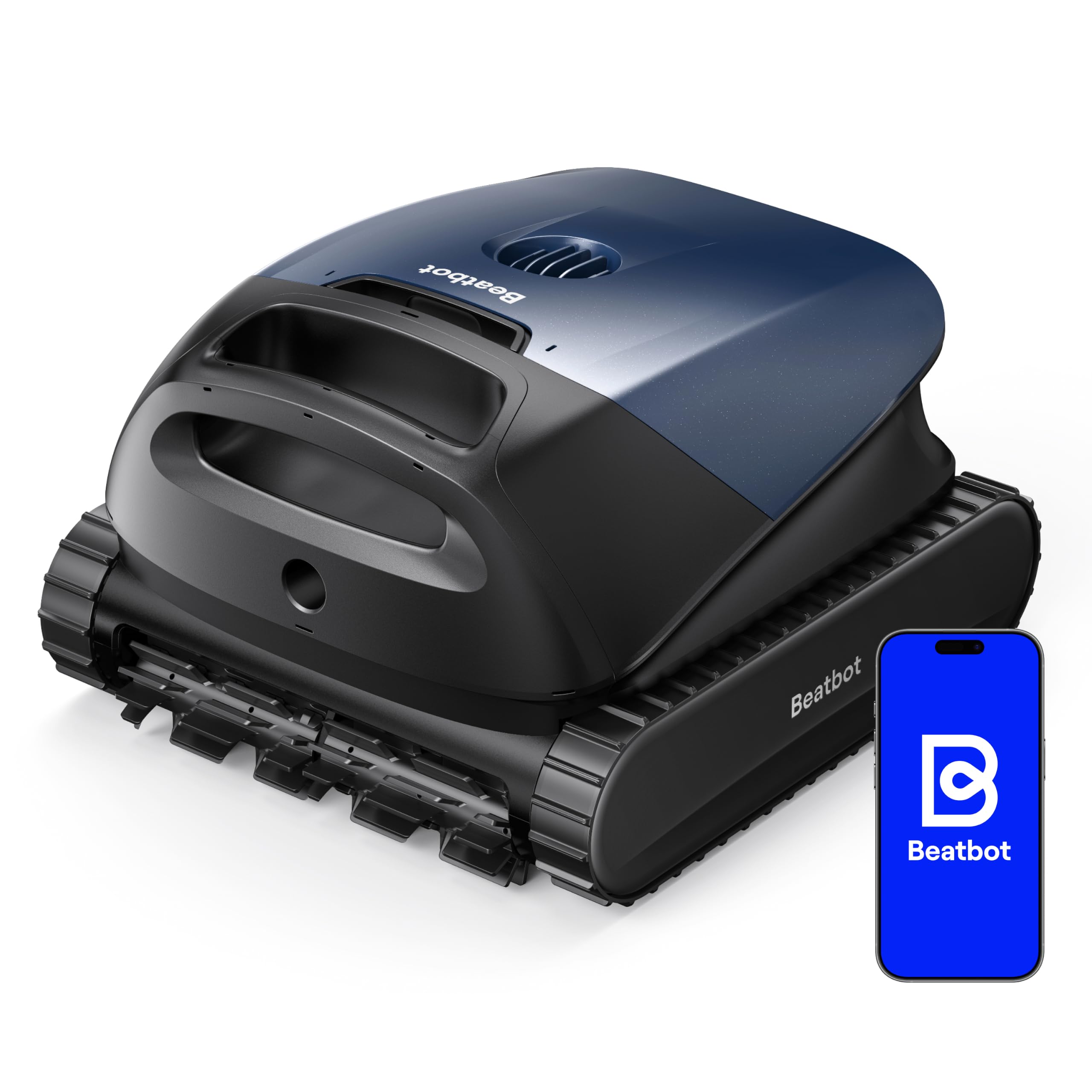
Beatbot Sora 10

Most in-ground pools

Our Score 9.2/10
Check Price

Worth Noting

  • Heavy at 10.5 kg to lift out
Runtime
Up to 300 mins
Suction
6,800 GPH
Debris Capacity
5 liters
Shallowest Cleaning
12 inches

The end of a cleaning cycle is where most pool robots get annoying: they sit on the bottom and wait for you to fish them out with a pole. The Sora 10 climbs to the waterline instead and holds there for ten minutes, which turns retrieval into a reach rather than a rescue. That single behavior is much of why it became our default recommendation.

The hardware backs it up. The 7,310 mAh battery runs up to 300 minutes, and Beatbot rates coverage at 3,229 square feet per session — enough for most residential in-ground pools to finish in one pass rather than two. The 5-liter basket is the largest here apart from the Sora 70's, so you empty it weekly rather than after every run, and 6,800 GPH of suction is rated to take leaves, sand, and debris without clogging the inlet.

What we appreciated in use is how little the app asks of you: a cycle starts from the button, and the app is there for schedules and modes rather than as a gate. Expect patience on vertical surfaces — it climbs slowly, and it can rear up on its back wheels before settling and sucking back down.

Against the Scuba S1 it wins on endurance and basket volume rather than cleaning hardware; both are rated to work shallow areas at 12 inches. Five hours and 5 liters is the difference between a robot that keeps up with a leaf drop and one you re-run the next morning.

Bottom line: We recommend the Sora 10 to most in-ground pool owners: five hours of runtime, a 5-liter basket, and waterline parking make it the least fussy cleaner here.

2

Aiper Scuba S1

Aiper Scuba S1

Silty, cloudy water

Our Score 8.6/10
Check Price

Worth Noting

  • Replaceable fine filter adds a running cost
Runtime
Up to 270 mins in Eco
Warranty
2 years
Filtration
3-micron plus 180-micron
Cleaning Zones
Floor, walls, waterline, shallow areas

The Scuba S1 asks about the same money as our top pick, so the decision comes down to what each one gives you. Aiper's answer is filtration: a 180-micron basket paired with a replaceable 3-micron insert that catches the silt and fine dust a coarse screen passes straight through.

That makes it the pick for pools that look clear and still cloud up when you brush — the fine debris a mesh filter simply recirculates. The rest of the package is competitive rather than class-leading: up to 270 minutes in Eco mode and 180 in Auto, coverage of floor, walls, waterline, and shallow areas above 12 inches, a two-year warranty, and eleven sensors driving a systematic dual-path pattern across the floor.

The insert is a part you buy again, and in a heavy leaf fall the fine layer loads up fast, so rinse both stages after every cycle in autumn. The 270-minute Eco run is what we keep coming back to, though: it is enough for a daily maintenance schedule without the second charge that turns a chore into an afternoon.

Bottom line: We point anyone chasing fine silt at the Scuba S1: its 3-micron second stage is the best filtration story in this group.

3

Beatbot Sora 70

Beatbot Sora 70

Leafy, tree-lined yards

Our Score 8.6/10
Check Price

Worth Noting

  • Heaviest unit here at 22.9 pounds
  • Long recharge between cycles
Runtime
Up to 5 hours
Suction
6,800 GPH
Warranty
3 years
Debris Capacity
6 liters

Every cleaner here starts at the tile line; the Sora 70 starts at the surface. Its JetPulse system uses dual water jets to create four streams that push floating leaves and pollen toward the suction inlet before the robot drops to the floor, and in a yard with trees that is a job you otherwise do with a net. We think it justifies the premium for exactly that reason, and for very little else.

Below the waterline it is essentially the Sora 10's hardware with more of everything: 6,800 GPH, a 6-liter basket, five hours on floor cleaning, and coverage rated at 3,200 square feet. It also reaches shallower — 8 inches, against 12 on most of this list — so a sun shelf or a top step is inside its range. The three-year warranty is the longest here.

The cost is weight and charging. At 22.9 pounds it is the heaviest unit in this guide, and the drain-and-park routine exists precisely because hauling it out wet is unpleasant. Plan on most of a morning between cycles; a full charge takes about four and a half hours.

Bottom line: We recommend the Sora 70 for pools under trees: it is the only cleaner here that skims the surface, and the three-year warranty backs the price.

4

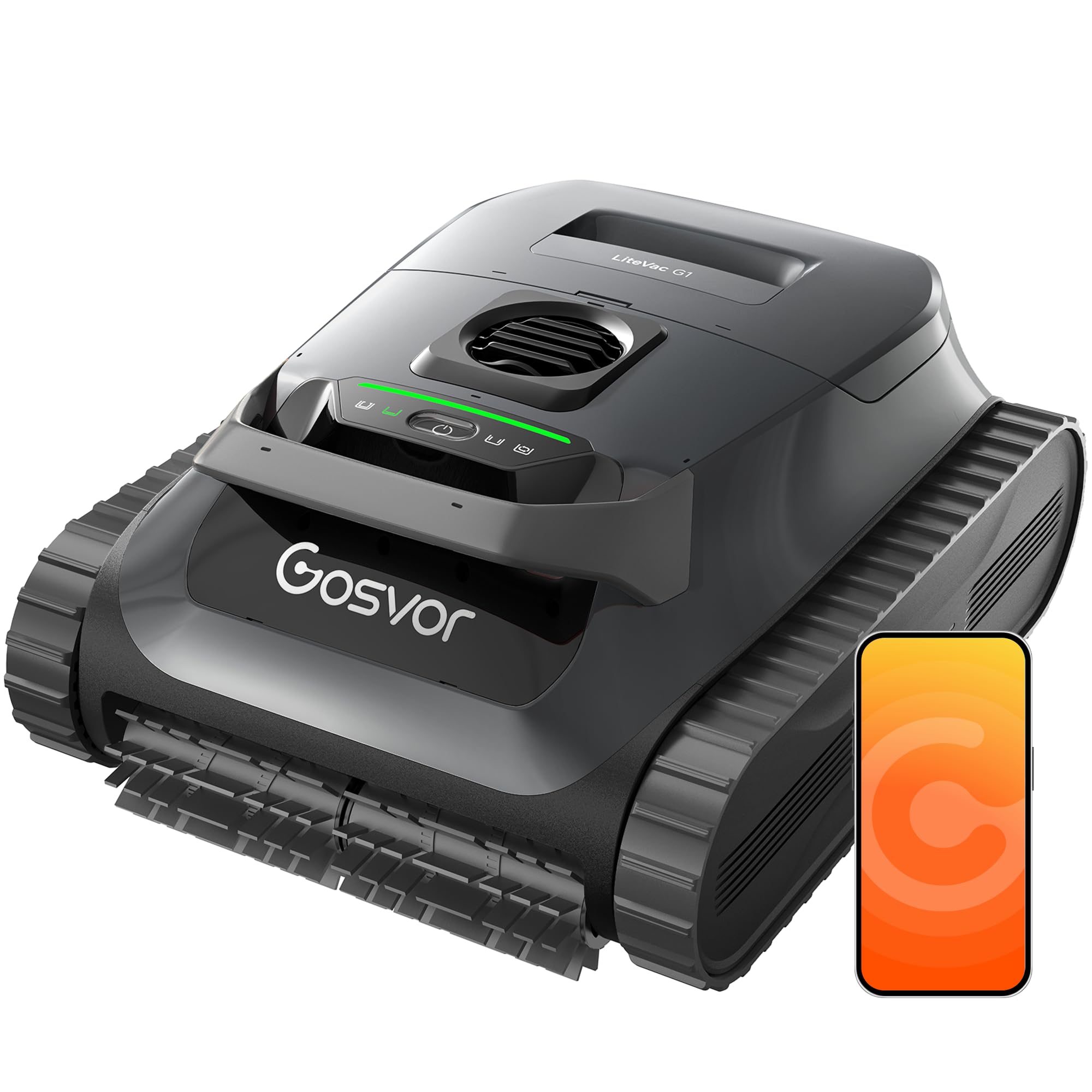
Gosvor LiteVac G1

Gosvor LiteVac G1

Above-ground pools

Our Score 8.6/10
Check Price

Worth Noting

  • Lowest suction here at 3,960 GPH
  • Fine filter replaced every 30 cycles
Weight
15.2 lb
Runtime
Up to 200 mins
Suction
3,960 GPH
Debris Capacity
3.6 liters

Fifteen pounds is the number that matters on an above-ground pool, where every cycle ends with someone lifting the robot over the rail. The LiteVac G1 is the lightest cleaner in this guide at 15.2 pounds, and the 3.6-liter top-load basket comes off without a fight.

It gives up suction to get there. 3,960 GPH is the lowest figure in this group, against 6,800 on both Beatbot models, and you notice it on heavy sand after a storm far more than on routine leaves. Runtime is a claimed 200 minutes, filtration goes down to 3 microns through a second fine layer, the caterpillar treads take the slope between a shallow and deep end without launching off the floor, and that fine filter is a consumable — Gosvor suggests a replacement every 30 cycles.

For an above-ground pool, or a small in-ground one where the cleaner lives on a shelf in the garage, the trade makes sense: you give up raw suction and get back a machine you can carry with one hand and drain in seconds. That is the version of pool cleaning that actually gets done.

Bottom line: We recommend the LiteVac G1 for above-ground pools, where 15.2 pounds and a simple basket matter more than the group's lowest suction.

5

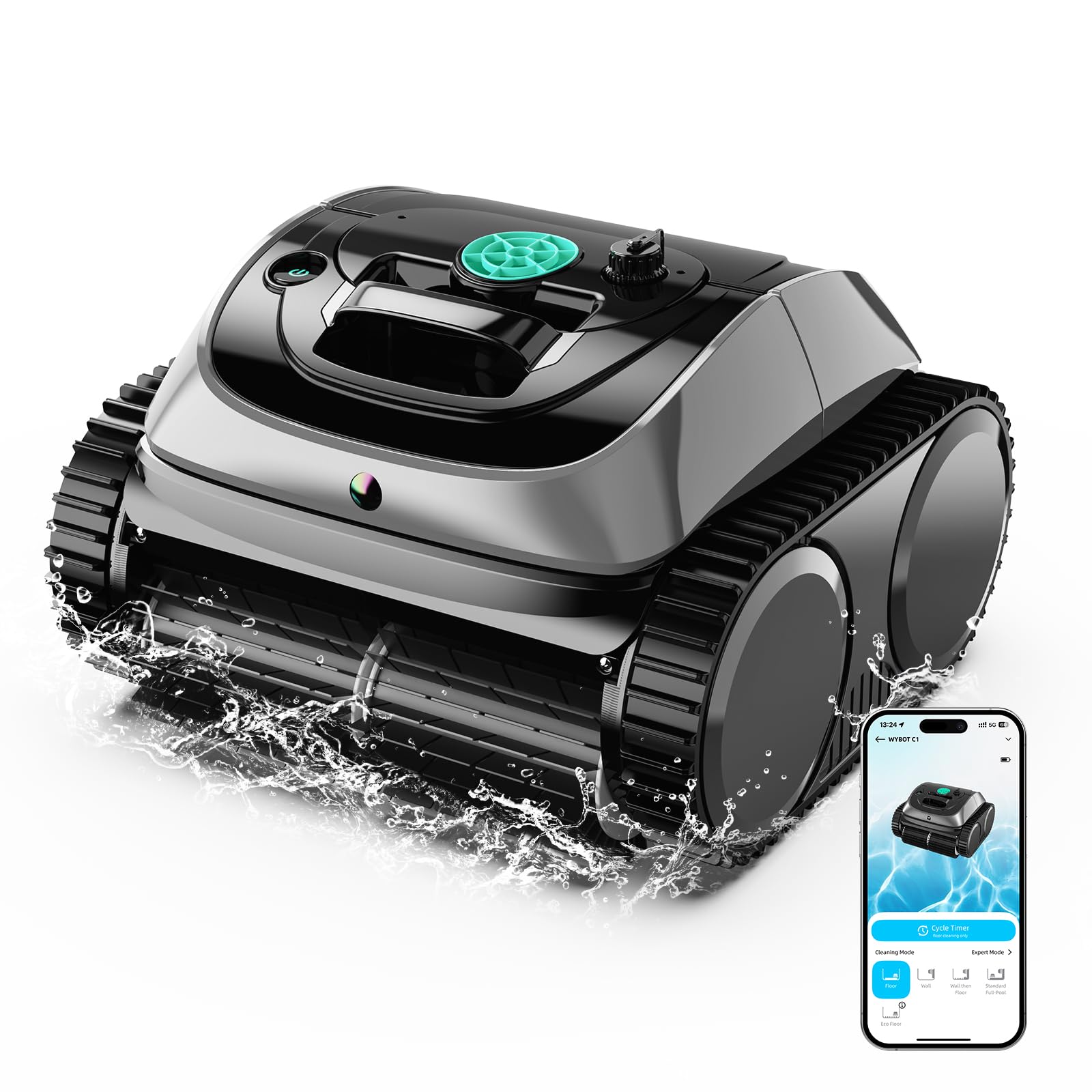
WYBOT C1

WYBOT C1

Small pools

Our Score 8.0/10
Check Price

Worth Noting

  • 160-minute runtime is the shortest here
Battery
99.34 watt-hours
Control
App with OTA updates
Runtime
Up to 160 mins
Navigation
Gyroscope, N-path and S-path

A hundred and sixty minutes is the whole story here. That is the C1's maximum run, the shortest in this guide, and it is why we recommend it for small pools and not big ones: in a compact in-ground or above-ground pool it finishes with time to spare, and in a large one you are running a second cycle to reach the deep end.

The rest of the package is more sophisticated than the price suggests. A gyroscope steers it through N-pattern and S-pattern routes instead of the random wander of cheap robots, the app handles schedules and over-the-air firmware updates, and the whole thing is cordless — no cable dragged across the deck and no separate power supply sitting out in the weather.

Plan around the battery rather than the brochure figure: runs can come up short of the maximum, and a recharge takes a few hours, so a big pool needs scheduling. For a first robot, a small pool, or a second cleaner for the shallow end, it is a lot of machine for modest money.

Bottom line: We recommend the C1 for small pools: the shortest runtime here is still enough for a compact pool, and it is one of the least expensive cordless cleaners here.

6

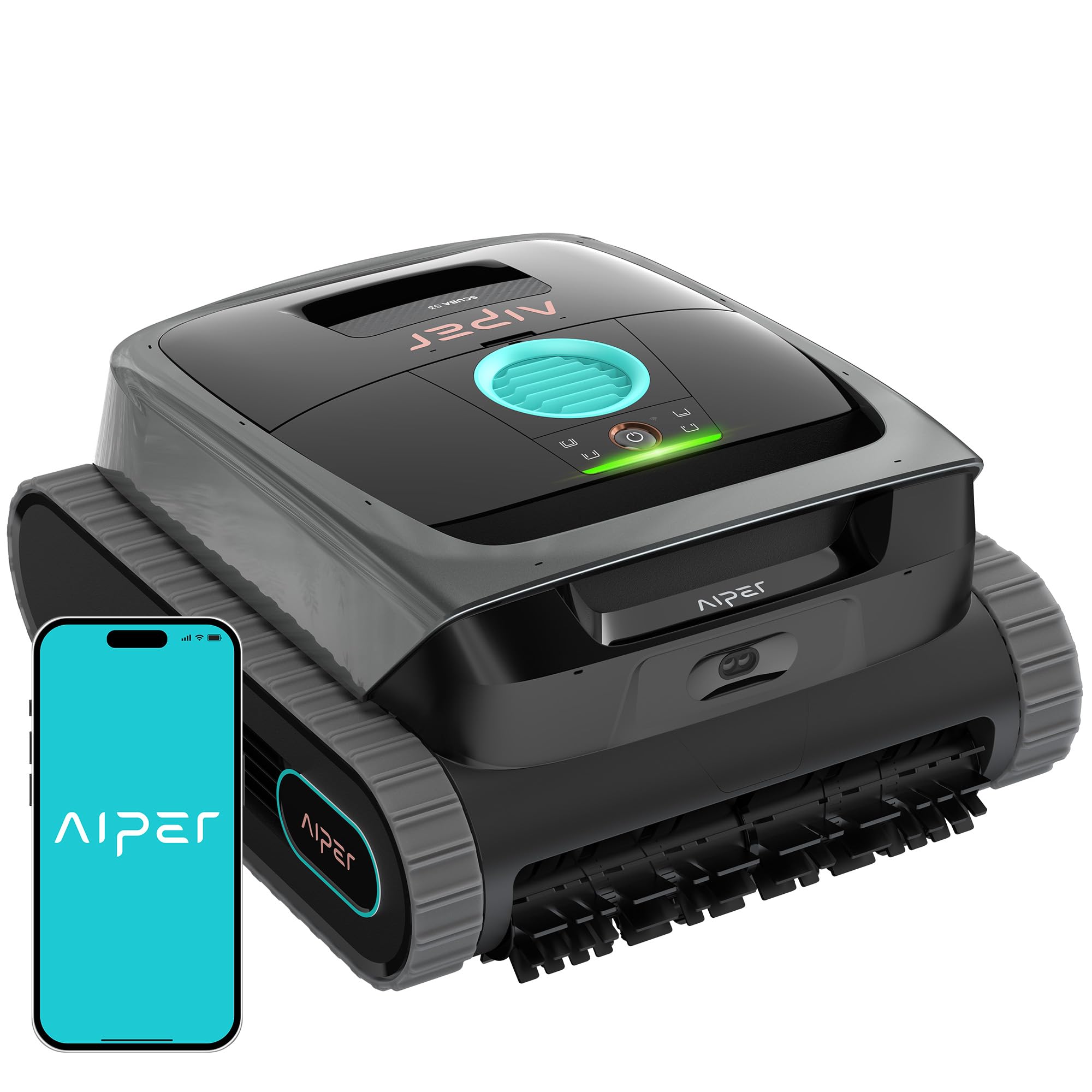
Aiper Scuba S3

Aiper Scuba S3

Scummy tile lines

Our Score 9.0/10
Check Price

Worth Noting

Weight
18 lb
Warranty
2 years
Filtration
180-micron mesh and 3-micron insert
Waterline Scrub
Lateral at 5 ft/min

Most robots touch the waterline on the way past. The Scuba S3 runs along it, tracking sideways at a steady 5 feet per minute and scrubbing two inches higher than a normal climb, which is the difference between a tile line that looks better and one that stops feeling slick. When it finishes it ascends, waits at the surface for ten minutes, and pings your phone so you know it is ready to lift.

Eighteen pounds makes that lift a one-hand job, and the dual filtration uses the same 180-micron mesh plus 3-micron insert arrangement as the Scuba S1, with a 3.5-hour charge. How the S3 holds up over several seasons is the open question, because there is less of a track record behind it than behind the S1. If the waterline is the part of your pool that always looks worst, that is the trade: pay for the lateral scrub and accept the uncertainty.

Bottom line: We recommend the Scuba S3 when the tile line is your pool's worst feature: nothing else here scrubs the waterline sideways instead of bobbing past it.

7

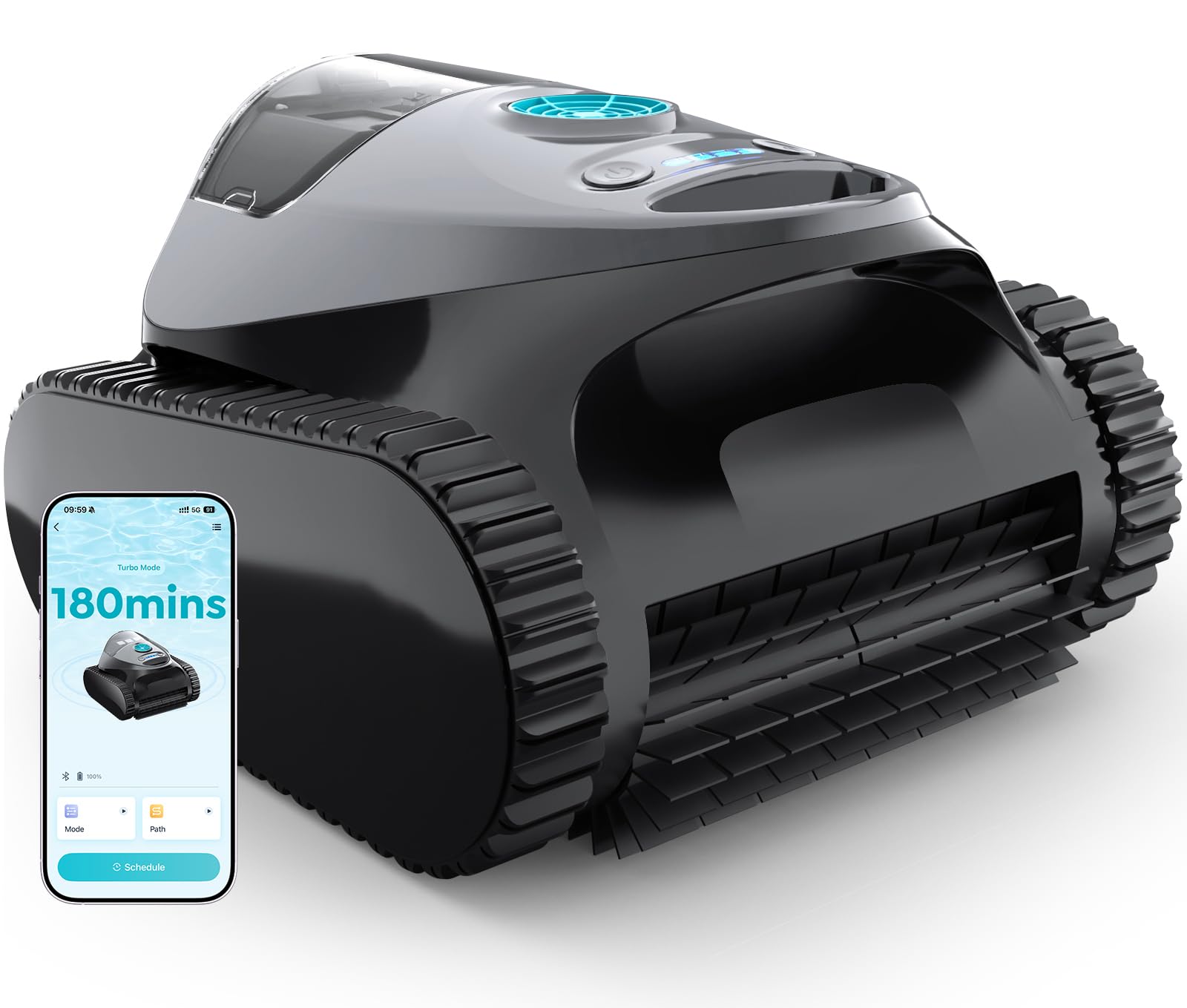
BRINBO C1

BRINBO C1

Tight budgets

Our Score 8.0/10
Check Price

Worth Noting

  • Smallest coverage rating here at 1,615 sq. ft
Battery
96 watt-hours
Runtime
Up to 180 mins in Eco
Coverage
Up to 1,615 sq. ft
Cleaning Modes
7 modes, 7 paths

The C1 is the cheapest cleaner in this guide, and the specification list reads like a much dearer machine: 180 minutes in Eco mode, coverage rated to 1,615 square feet, wall and waterline cleaning, dual filtration, and seven cleaning modes over seven path patterns, all adjustable from the app.

Where it gives ground is size and suction. That 1,615 square feet is the smallest coverage rating here — a third of what the Sora 10 is rated for — and the triple-motor arrangement is described in terms of suction power rather than gallons per hour, so there is no number to set beside the 6,800 GPH of the Beatbots. The 96 watt-hour battery is the smallest in this guide, which is where the 180-minute ceiling comes from. On a modest pool none of that bites; on a large one it will.

The fundamentals are all there: cordless operation, a two-year warranty, wall and waterline modes, and an app that takes firmware updates so routing can improve after you buy. If the budget is the binding constraint and the pool is on the small side, this is the one to start with — otherwise the extra money for the Sora 10 buys real endurance.

Bottom line: We recommend the C1 as the budget entry point: every core feature is present, and its coverage rating suits a modest pool.

How We Tested the Best Robotic Pool Cleaners

We started with every model we could find for sale, then cut the list by pool type, maximum pool length, filtration media, corded versus battery power, and price until seven were left. Each one ran for a full swim season, roughly May through October, on the same two pools: my in-ground pool, which collects a heavy leaf load from a row of trees, and a neighbor's above-ground pool that gets far more sunscreen and sand than debris.

Every cleaner went in on a Sunday morning and ran its complete cycle while we did other things, which is the only honest way to judge whether a robot is actually saving you time. We timed how long it took one person to haul it out, rinse the filter cartridge or bag, and carry it up the deck stairs — weight matters a lot more when the bin is full of water and wet leaves. To check wall climbing, we drew a chalk line along the waterline tile before each run and looked afterward at how much of it had been wiped away and how high the unit actually crested. On battery models we ran each until the motor stopped and logged the real runtime against the claim, then against how long a full clean of our pool takes.

For pickup, we spread the filter contents out on a towel at the end of each run and looked at what was left behind — sand, leaf grit, dog hair, the slick film sunscreen leaves on the shell. At the end of the season we checked brushes for flattened bristles, cables for stiffness, and caddies for wheels that had stopped rolling true after months of chlorine and sun. The robots that scored well are the ones we eventually stopped thinking about.

How to Choose Robotic Pool Cleaners

Match runtime to your pool, not to the brochure

A cleaner rated for 3,200 square feet does not cover 3,200 square feet of walls and waterline in the same session; climbing burns battery faster than cruising the floor, so treat the coverage figure as a floor-cleaning number and leave headroom. Measure your pool's surface area first — length times width for a rectangle, plus the shelf if you have one. If the rating is close to your pool's size, plan on a second cycle after a storm. If it is double, you have room to spare.

Corded units run as long as you like, but they add an outdoor power supply and a cable across the deck, and those power bricks are among the parts that fail first. A cordless machine with a long enough runtime is the more forgiving choice.

What walls and waterline actually mean

A listing that says wall climbing is telling you the unit can travel up the side. Whether it scrubs the tile line laterally, and how shallow it will work, are separate claims with separate numbers. Look for a stated minimum depth — 8 inches on the Sora 70, 12 on most of the cordless models here — if your pool has a sun shelf or a wide top step.

Expect the awkward geometry to be where it struggles. Steps, ladders, and raised main drains catch most robots at some point, and no specification predicts it. Watch the first few cycles and note where the machine lingers, because that is the spot you will still be brushing by hand.

Filtration and the basket you rinse every week

Two numbers describe filtration and both matter. The mesh rating — 180 microns is typical — sets what the basket catches. A second fine layer down to 3 microns is what clears the silt that clouds the water when you brush. Fine layers clog faster, and some are replaceable parts, so check what a season of inserts costs before you commit.

Basket volume runs from 3.6 to 6 liters here, and that difference is how often you haul the unit out mid-clean. Leaf-heavy pools want volume; silty ones want the fine filter.

Weight, retrieval, and who lifts it out

Every cycle ends with a wet machine coming out of the water. The spread here runs from 15.2 to 22.9 pounds dry, and a loaded basket adds to that. If the cleaner lives in a garage beside an in-ground pool, weight is a minor annoyance. If you are lifting it over the rail of an above-ground pool, weight is the deciding specification.

Waterline parking, where the robot climbs to the edge at the end of a run and waits, is worth paying for on a deep pool. It is the difference between a reach and a pole.

What fails, and what the warranty covers

The parts that go are rarely the ones marketing talks about: power supplies, pump motors, and seals do most of the failing. Warranty length across this group runs from two years to three, and longer coverage on a machine that lives in chlorinated water is worth real money.

Check two things before you buy. First, the stated salt tolerance if your pool runs a chlorine generator. Second, whether the maker sells the parts that wear — brushes, filters, treads — because a cleaner you can keep running is cheaper than one you replace.

Frequently Asked Questions

Final Verdict

For most in-ground pools, buy the Beatbot Sora 10. It is the cleaner here that pairs a full-pool runtime with a basket big enough to skip the midweek empty, and it parks where you can reach it without a pole.

Two requirements change the answer. If floating leaves are the constant battle, the Sora 70's surface skimming is the only feature in this group that addresses it, and a three-year warranty softens the premium. If the machine gets lifted over an above-ground rail every week, the Gosvor LiteVac G1 at 15.2 pounds beats everything else on this page.