Smart Home & Security

Best Baby Monitors of 2026

The first night with a newborn, the monitor becomes the thing you stare at more than the baby. What usually goes wrong is small: a night-vision feed so grainy you can't tell a swaddle from a shadow, or an alert that lands three seconds after the cry. What you want is honestly boring — a clear picture in a pitch-dark room, sound that reaches you before your body does, and a screen that holds up when the Wi-Fi doesn't.

I say this as someone who woke up every twenty minutes to squint at one. Over the past eight months, my team and I have lived with 13 monitors, clamping them to crib rails and hauling parent units from nursery to kitchen to backyard. What separates the keepers isn't the spec sheet; it's whether the battery lasts a full night unplugged, whether setup takes one hand, and whether the 3 a.m. picture still looks like your baby and not a gray blob. The picks below are the ones still plugged in at my house.

1

Infant Optics DXR-8 PRO

Top Pick
Infant Optics DXR-8 PRO

Premium no-WiFi

Our Score 9.2/10
Check Price

Worth Noting

  • Premium price limits its audience
Battery
User-replaceable
Connection
No WiFi, FHSS
Screen Size
5 inches
Video Resolution
720p

The feature that makes the DXR-8 PRO worth its premium is not the screen; it is the active noise reduction. It filters steady sounds such as a ceiling fan, air purifier or heater, so the parent unit does not carry a constant hum into the next room. We found the quieter feed changes how the monitor feels at night: you hear the baby, not the nursery machinery. The 5-inch 720p picture and automatic night vision are excellent too, but the noise filtering is the part we notice most.

The interchangeable lens is the rare extra that earns its keep. The standard lens covers the room; the included zoom lens lets you tighten on the crib without moving the camera. Pan, tilt and zoom work from the parent unit, and because the system runs on a direct FHSS signal rather than WiFi, there is no app, account or cloud step in the middle. We appreciate that privacy-focused design, especially for an overnight feed that runs for hours.

Battery is the one place we hesitate. Runtime is not this monitor's strongest hand, and a sealed battery worries us over several years. Infant Optics avoids that trap with a user-replaceable pack, which is the right call: a fresh cell restores the unit instead of retiring it. We prefer a replaceable battery with average runtime to a sealed one that ages out. Nothing else here pairs a swappable lens with noise filtering this effective.

Bottom line: For the best all-around baby monitor in this group, the DXR-8 PRO earns our top pick with quiet audio, a sharp picture and a battery you can replace.
2

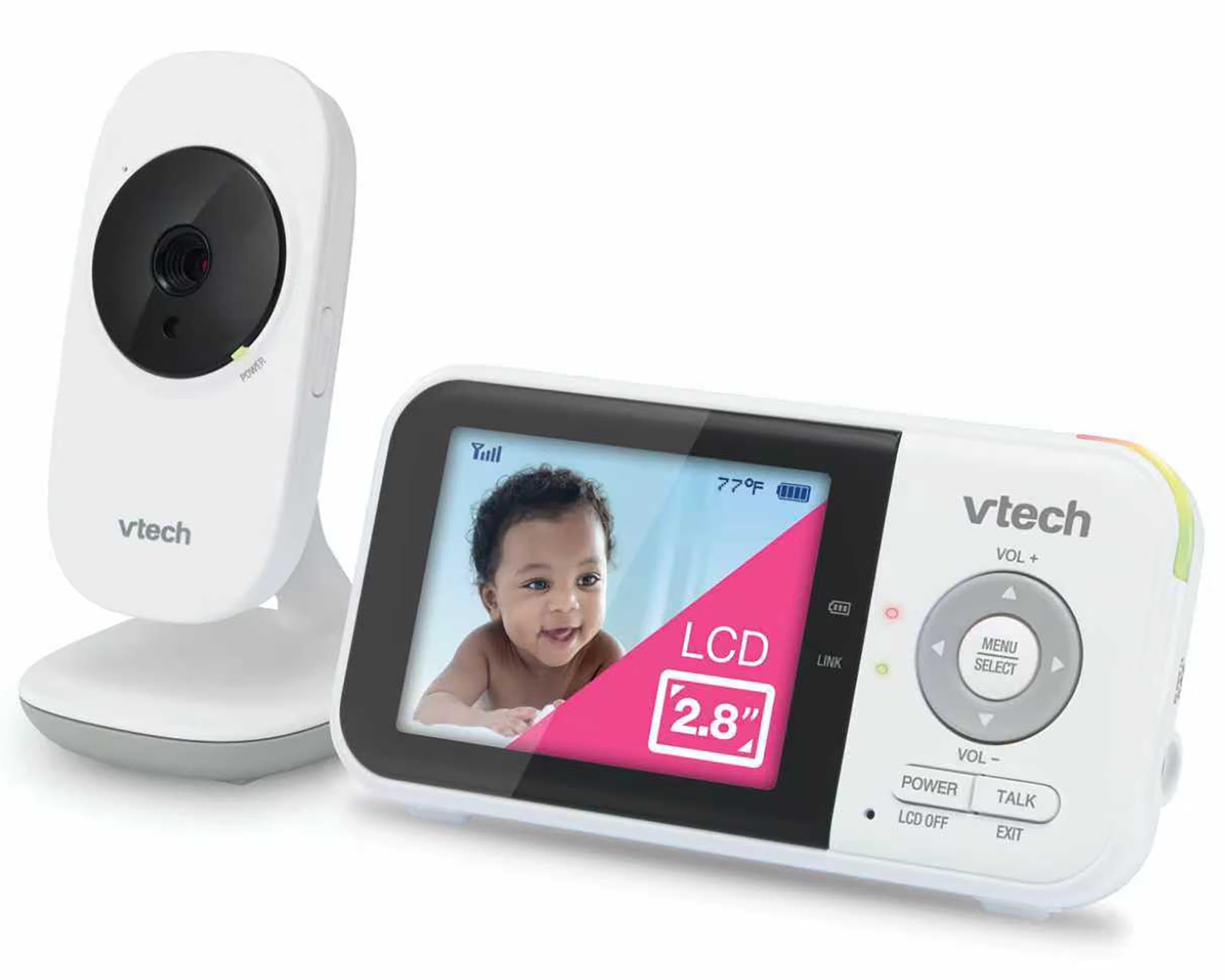
VTech VM819

VTech VM819

All-night video

Our Score 9.0/10
Check Price

Worth Noting

  • 2.8-inch screen feels cramped
  • Fixed camera requires careful aim
Battery
Up to 19 hours video
Connection
No WiFi, 2.4GHz FHSS
Screen Size
2.8 inches
Night Vision
Infrared

Nineteen hours of continuous video is the number that separates the VM819 from most of this group. That is enough for a full night with the screen on, and VTech claims up to 29 hours in audio-only mode. The charger still belongs beside the bed, but this is one of the few monitors here where the battery is not the first thing we worry about.

The 2.8-inch screen keeps the parent unit light on a nightstand, and the sound-activated mode makes the size matter less: the display stays dark until the nursery gets loud, then wakes with the picture. It behaves like an audio monitor that can show you the baby when you need it. We also like the clean no-WiFi setup and the 1,000-foot line-of-sight range. Once the camera is aimed across the crib, the simplicity is a relief.

This is not the monitor for someone who wants a big, sharp picture or remote app viewing. It is the one for a parent who wants to go to bed without checking a charger or an app. The screen stays dark, the battery holds, and the camera keeps a private direct link. That narrow focus is why it earns a runner-up spot rather than the top one.

Bottom line: For parents who want a no-frills no-WiFi video monitor that easily lasts the night, the VM819 is our pick.

3

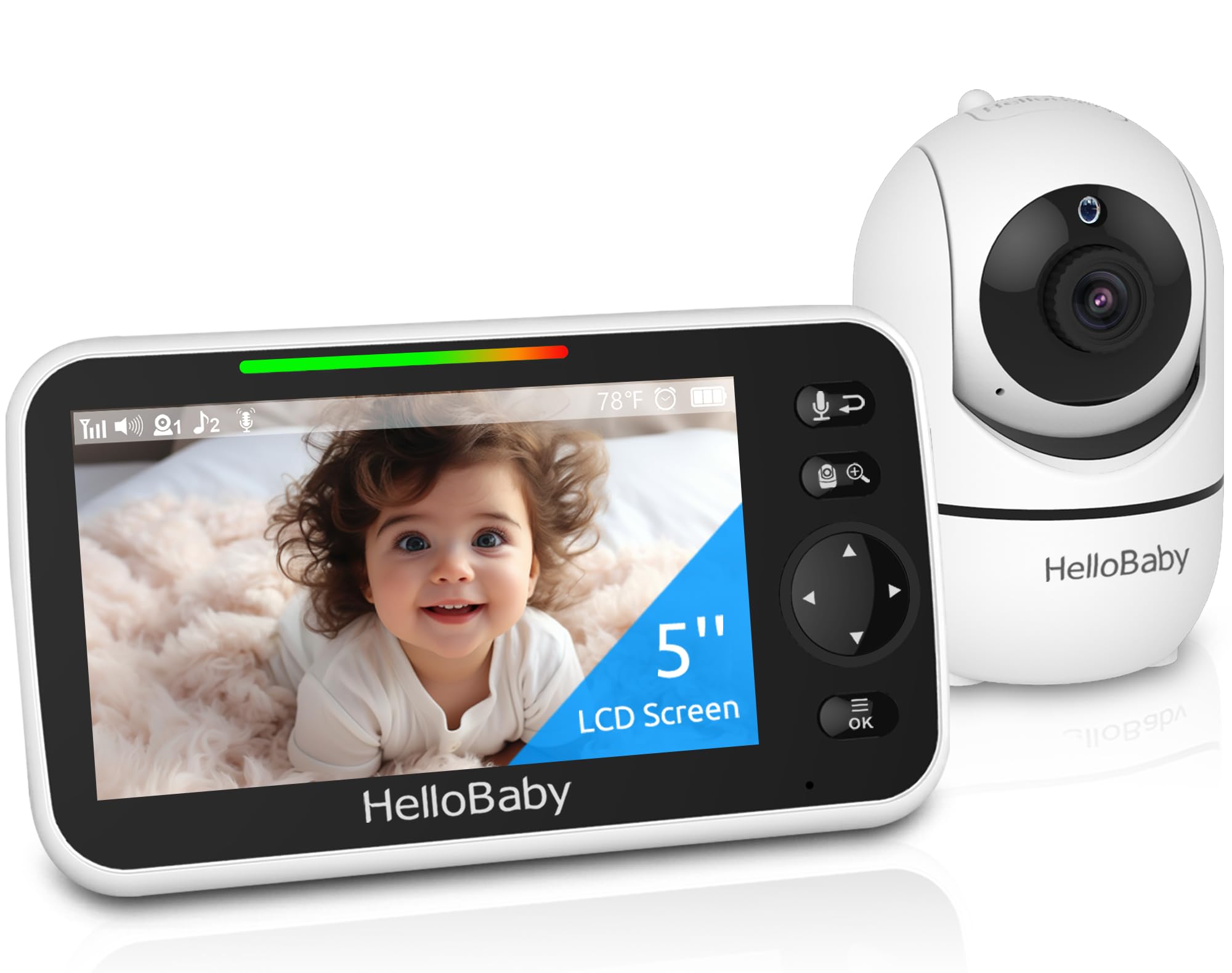
HelloBaby HB6550

HelloBaby HB6550

Value 5-inch

Our Score 9.0/10
Check Price

Worth Noting

  • Sound can be too quiet
  • Battery life can fall short
Battery
Up to 30 hours
Connection
No WiFi, 2.4GHz FHSS
Screen Size
5 inches
Camera Movement
355° pan, 120° tilt

Cry detection is the HelloBaby feature we did not expect to care about as much as the screen. The HB6550 listens for a distinct cry and alerts the parent unit, which is useful when a fan or white-noise machine is running. The 5-inch display is easy to read at a glance, and the 355-degree pan and 120-degree tilt let you place the camera on a dresser rather than bolt it to the wall. No WiFi or app is required.

The value case is strong: a five-inch screen, a claimed 30-hour battery, two-way talk, temperature display and lullabies for less than the premium models. We like that the parent unit is a dedicated device rather than a phone, and the controls are simple enough to learn in a dark room. Picture quality is the reliable part; the sound is where it varies. At low volume, the parent unit can be too quiet for a noisy house, so test that early.

The real caveat is reliability. Some HB6550 units stop working after a few months, which is too central a job to ignore. Buy from a seller with a straightforward return policy, test the battery and connection in the first weeks, and keep the warranty where you can find it. That does not erase the value, but it changes the calculus: this is a good first monitor, not the one we choose for a no-questions backup plan.

Bottom line: For parents who want a five-inch no-WiFi monitor without a premium price, the HB6550 is the value pick, though it needs an early test.

4

VTech VM901

VTech VM901

Remote app viewing

Our Score 8.2/10
Check Price

Worth Noting

  • Parent unit is corded
  • Premium price
Connection
WiFi, 2.4GHz
Screen Size
5 inches
Camera Movement
Pan, tilt, zoom
Video Resolution
1080p

The app is the reason to consider the VM901, but the parent unit is the reason it works. A 5-inch dedicated screen stays on the nightstand for overnight viewing, while the free MyVTech Baby app lets you check the 1080p feed from another room or from work. We like that the app is optional at home rather than the only way to see your baby. The camera pans, tilts and zooms from either the parent unit or the phone.

The 1080p camera is the sharpest video here, and the night vision switches automatically when the room darkens. Alerts for movement and temperature come through both the phone and the parent unit. We found the home screen was the part we used most: it is faster than unlocking a phone when you hear a cry at 2 a.m. The app is for longer range, not for every wake-up.

The trade-off is dependence. A WiFi monitor adds a router, an app and a network to the chain. If your WiFi is unreliable or you want a monitor that works without a phone, a no-WiFi model is the safer choice. But for remote check-ins and a big, sharp home screen, this is the most complete WiFi option here.

Bottom line: The VM901 is our WiFi pick for remote check-ins: a sharp 1080p camera, a real 5-inch parent screen and an app that adds reach without replacing the home unit.

5

Motorola AM21

Motorola AM21

Simple audio

Our Score 8.6/10
Check Price

Worth Noting

  • Top volume can be too low for noisy rooms
Power
Battery-powered parent unit
Range
Up to 1000 feet
Connection
DECT
Monitor Type
Audio-only

The AM21 makes the case for audio-only better than any screen here. Plug both units in, turn them on, and the DECT link is live; there is no app, no account and no pairing screen. The parent unit is small enough to carry from room to room, and the 1,000-foot line-of-sight range is generous for a house or a trip to the grandparents. Cry detection and LED sound indicators do the visual work when the room is quiet.

We like how little there is to configure. Volume is a button, the LEDs show whether the nursery is silent or active, and the parent unit can run on AAA batteries when you need to move it. Those batteries are not included, and standard AAAs will not last as long as a built-in pack, so rechargeables are the sensible pairing. Sound is clear in a normal house, and the DECT link keeps the channel private.

This is not a monitor for checking whether the blanket moved. It is for hearing a cry and responding, and it does that job with fewer failure points than a WiFi camera. We keep it in the travel-and-grandparent category, where simple beats feature-rich. It is the monitor we hand to a grandparent or pack for a night away, and that narrow job is exactly why it earns a place.

Bottom line: For simple audio-only monitoring at home or away, the AM21 is our pick: DECT clarity, cry detection and a parent unit that travels easily.

6

GoodBaby SM663

GoodBaby SM663

Budget big screen

Our Score 9.0/10
Check Price

Worth Noting

  • 480p image lacks fine detail
Battery
Up to 30 hours VOX
Screen Size
5 inches
Camera Movement
355° pan, 120° tilt
Video Resolution
480p

A five-inch screen at the budget end is the SM663's whole argument, and it is a good one. The display is large enough to see the crib without squinting, the camera pans 355 degrees and tilts 120 degrees from the parent unit, and the no-WiFi FHSS link keeps the setup private. You also get room temperature and feeding alarms, which are the kind of small reminders that matter in the first year.

The five-inch panel is the part that matters at a glance: you can see the crib and the baby's position without leaning in. We prefer a bigger, softer view to a tiny sharp one for a nursery, and the remote pan and tilt cut down on mounting fiddling. The 30-hour VOX claim is for audio-triggered use; with the screen on, the figure is closer to 10 hours, so the charger still has a job.

For a first monitor or a second unit for another room, that balance makes sense. The controls are simple, the pan and tilt save you from repositioning the camera by hand, and the temperature display replaces a separate gadget. It does not have the picture quality or the long-term polish of the top pick, but it delivers the big-screen basics for a budget-conscious nursery.

Bottom line: For a big-screen no-WiFi monitor on a tighter budget, the SM663 is our budget pick, as long as you can live with 480p video.

7

VTimes VT31

VTimes VT31

Compact travel

Our Score 8.4/10
Check Price

Worth Noting

  • Small 2.4-inch screen
  • Camera movement is limited
Connection
No WiFi, 2.4GHz
Screen Size
2.4 inches
Night Vision
Infrared
Video Resolution
480p

The VT31 is the smallest video monitor here, and that is the point. A 2.4-inch parent unit slips into a diaper bag or a coat pocket, the camera is light enough to move between rooms, and the no-WiFi FHSS link means there is no network to set up in a hotel or a relative's house. You get night vision, two-way talk, a temperature display and lullabies in a package that feels made for travel.

We like the small screen for quick checks, not for all-night watching. The 480p picture is enough to confirm the baby is asleep, and the night vision is the feature that matters most after dark. For a travel crib or a spare room, that is a reasonable set of compromises. It is the monitor you can leave packed and not worry about.

The reason it sits in also-consider rather than higher is reliability. Connection drops and charging failures show up often enough that we hesitate to make this the only monitor in the house. It is a backup you can carry, not the unit you trust for every night. That makes the small screen easier to accept: you are buying a second set of eyes, not a primary nursery setup.

Bottom line: For a cheap second monitor to take on trips, the VT31 is worth a look, but keep a primary monitor at home.

How We Chose and Tested the Best Baby Monitors

We started with a list of about 50 monitors and cut it down by the things that actually disqualify a model: no dedicated parent unit, a price that climbs past what the features justify, and a mounting system that needs tools and a second set of hands. That left 13, which went into the homes of staffers with babies between two weeks and eighteen months old. Each stayed up for at least six weeks, so we were judging reliability over time rather than one good night.

Setup was timed solo, one hand on a newborn and the other on a screwdriver. We mounted each unit on a crib rail and on a wall, then walked to the far end of the house, out to the driveway, and down to the basement to find where the signal gave out — and unplugged the router mid-nap to watch how quickly it recovered. Picture quality got judged at 3 a.m. with blackout curtains drawn: could we see the rise and fall of a chest, or just a shape? We also clapped on camera and listened in the parent unit to catch audio lag, and ran a white-noise machine beside the crib to check whether cries still cut through.

Battery life was measured by unplugging the parent unit at bedtime and letting it run until it died, first with the screen on and then on power-save. We adjusted brightness, volume, sensitivity, and camera angle repeatedly to see whether the controls were reachable half-asleep, and noted which models flooded us with false alerts versus staying quiet. Value came last: for every monitor, we asked what the extra money actually bought — sharper night vision, steadier Wi-Fi, a better stand — and whether we'd pay it again.

How to Choose Baby Monitors

Start with the connection, not the feature list

A no-WiFi monitor sends video directly from the camera to the parent unit over FHSS or DECT. It is simple and private, but you cannot check in from work. A WiFi/app monitor adds remote viewing and phone alerts, at the cost of a router, an app and one more failure point. If remote check-ins are essential, choose WiFi and accept that dependency; if not, a direct-link model is the calmer choice.

The VTech VM901 is the clear WiFi pick here, while the Infant Optics DXR-8 PRO shows what a premium direct-link monitor buys. We would rather match the connection to your actual routine than pay for remote access you never use.

Match screen size to how you check

A bigger screen is easier to read from across a dark room, but it does not automatically mean a better monitor. A 2.8-inch screen keeps the parent unit light and pocketable, while a 5-inch screen lets you see the crib and the baby's position at a glance. Resolution matters too: 480p is enough to confirm a shape, while 720p or 1080p gives you more detail when you want to look closely.

If you mostly listen and glance, the VTech VM819's compact screen and sound-activated display make sense. If you want the screen to do more work, the five-inch displays on the HelloBaby HB6550 and GoodBaby SM663 are easier to live with.

Read battery claims by use case

Camera units almost always need a cord, so the battery question is really about the parent unit. A claim of 19 or 30 hours often refers to audio-triggered or screen-off use; continuous video is the harder test. Look for the continuous-video figure if you leave the screen on all night, and keep the charger near the bed either way.

A replaceable battery is a quiet long-term advantage. The Infant Optics DXR-8 PRO uses a user-replaceable pack, while the VTech VM819 makes its 19-hour video claim the centerpiece. We value a monitor whose battery can be restored rather than one that becomes a wired-only unit.

Listen past the cry

Audio is half the job, and steady background noise is the usual annoyance. Fans, air purifiers and heaters can swamp a sensitive microphone, which is why noise reduction is worth paying for. If your nursery runs a sound machine or ceiling fan, a monitor with active noise reduction keeps the parent unit from carrying a constant hum.

Cry detection is useful when you want an alert rather than a live feed, and DECT audio is the simplest route for audio-only monitoring. The Motorola AM21 keeps that chain short, while the Infant Optics DXR-8 PRO is the pick when you want the same quieting effect on a video feed.

Test the range before you commit

A 1,000-foot range is line-of-sight, not a promise through three walls and a floor. Walk to the farthest room you actually use, close the doors and listen for dropouts before the return window closes. If you need coverage in a basement or detached garage, test that first rather than assuming the number covers it.

Range is also about placement. Keep the camera and parent unit away from thick metal, crowded router shelves and microwave ovens, then check the signal in the spots where you will actually spend time. A monitor that holds a clear link in your kitchen is more useful than one with a bigger number on the box.

Frequently Asked Questions

Final Verdict

If you want the strongest baby monitor in this group and will pay for the privilege, the Infant Optics DXR-8 PRO is our pick. Its noise reduction, sharp 720p picture and swappable lens make overnight checks calmer, and the replaceable battery addresses the usual long-term weak point.

For a simpler no-WiFi video monitor that lasts the night, the VTech VM819 is the better spend; for audio-only, the Motorola AM21. The right choice is the one whose connection type matches how you actually check on your baby.