Smart Home & Security

Best Motion Sensor Alarms of 2026

A motion sensor alarm has one job: make noise when something moves and stay quiet when nothing does. That sounds simple until a moth sets off the siren at 2 a.m., or a delivery driver is already halfway up your walk before the thing finally chirps. A good one gives you warning early enough to do something about it, and then it shuts up. Over four months, my team and I mounted 16 different alarms on shed doors, driveway gates, garage walls, and one very long apartment hallway to find the ones that strike that balance.

Detection range is the number printed on the box, and I'd treat it loosely — a unit rated for 30 feet often noticed me at 15, depending on the angle. What separates the good ones is adjustability: a sensitivity dial, a swivel mount, a chirp-or-siren switch you can flip without digging out the manual. Placement matters more than anything, and chest height angled across the approach beats pointing it straight down the path every time. Below are the picks that held up for gates, garages, hallways, and one solar option for spots without an outlet.

1

HTZSAFE Driveway Alarm

Top Pick
HTZSAFE Driveway Alarm

Driveways and gates

Our Score 8.8/10
Check Price

Worth Noting

  • Chime notifies rather than deters
  • Sensors need three AA batteries, not included
Expansion
Up to 32 sensors
In The Box
1 Receiver + 4 Sensors
Detection Range
35–50 ft
Transmission Range
1/2 mile

Half a mile of wireless range is the number that separates this kit from everything else on the page, and it changes what a motion alarm can do. The sensors pick up a person or a vehicle from 35 to 50 feet away and send the alert to a plug-in receiver up to 1/2 mile off, so the end of a long drive, a gatepost, or a barn door is within reach of a chime in your kitchen.

Four weather-resistant sensors come in the box, and each one can carry its own tone, so the front gate sounds different from the side yard and you learn which is which in a day. Expansion is real rather than nominal: up to 32 sensors and extra receivers, which means you can start with one entrance and add the rest of the property later without replacing anything.

What puts it at the top is how little attention it asks for. Batteries in, pair, mount, done — and the receiver keeps its pairing when you unplug it and carry it to another room. Of everything here, this is the one we stopped thinking about, which is the highest compliment a gadget on a fence post can earn.

Aiming is where it rewards five minutes of care. PIR sensing reads heat crossing the field, so a sensor pointed through a hedge, at a swaying branch, or across a road that gets traffic will fire at things you don't care about. Mount it waist-high and across the path rather than down it, keep the lens clear, and the nuisance alerts mostly go away.

Bottom line: Our pick if the motion starts outdoors: half a mile of range and four weather-resistant sensors make a long drive, a gate, or a yard genuinely easy to watch.
2

TECKNET Motion Door Chime

TECKNET Motion Door Chime

Entry door alerts

Our Score 9.0/10
Check Price

Worth Noting

  • Shorter detection than the driveway kit
  • Chime only, nothing to scare anyone off
Volume
Up to 110 dB
Detection Range
4–8 m
Sensor Capacity
Up to 20 sensors
Transmission Range
500 ft

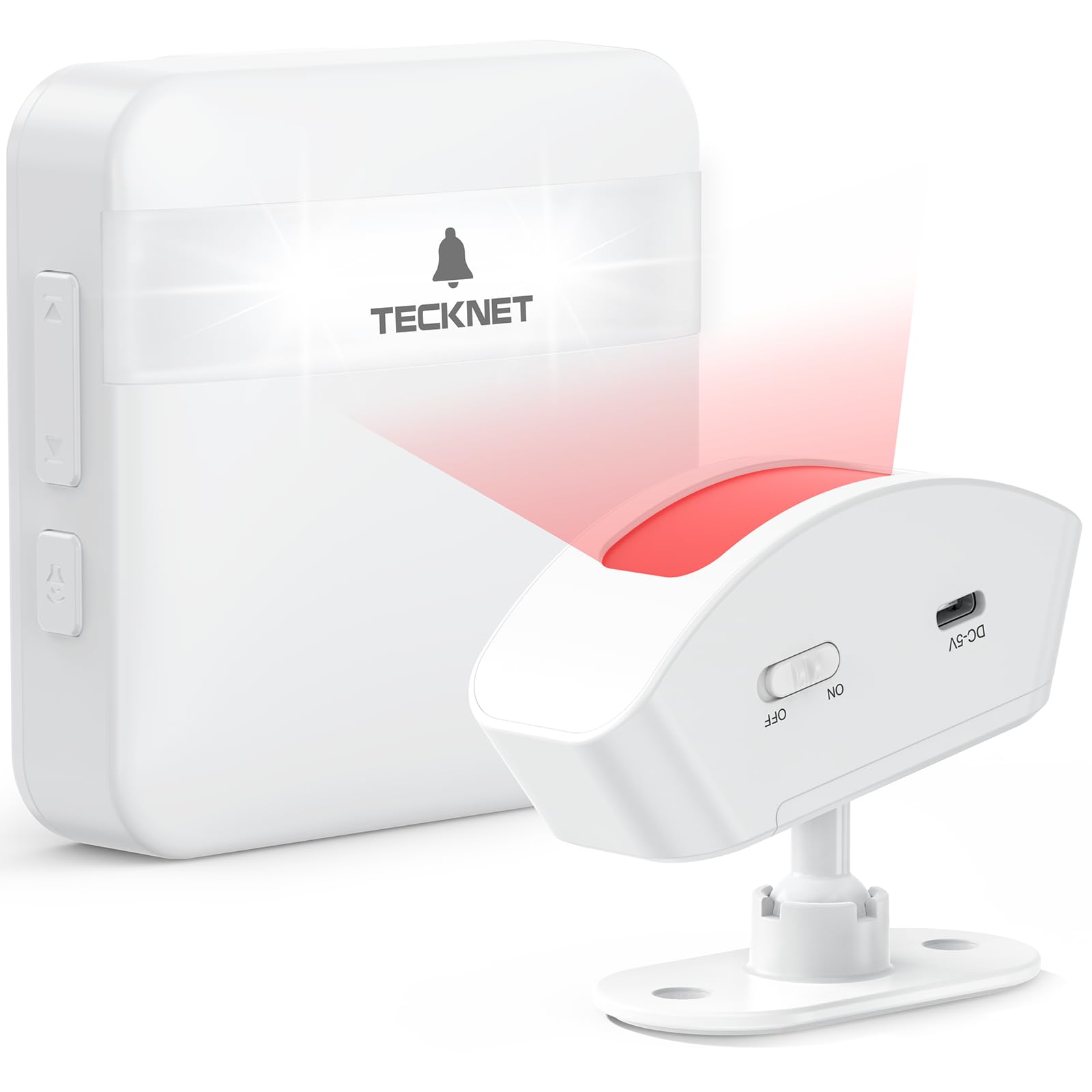
Not every motion alarm needs to protect a perimeter. If the job is knowing that somebody just walked into the shop, the TECKNET chime does it with a small sensor and a receiver you leave in the room where you'll hear it, with 500 ft of signal between the two.

This is our default for a doorway, a counter, or a hallway, and the reason is the control you get over the noise. Thirty-two tones and five volume steps take it from mute to 110 dB, and the flashing LED means a silent setting still catches your eye across a busy room. Pair a sensor per door and you can give each one its own sound rather than remembering which chime means which entrance.

The trade is reach and muscle. The sensor sees 4 to 8 m across 110°, roughly a doorway and the path in front of it, and it is a chime rather than a deterrent — nobody turns around and leaves because of 32 ringtones. For a back door, a reception desk, or a room you want to keep an ear on, that's the whole job done well.

Bottom line: This is the one we send people to when they want to know who just walked in — 500 feet of signal, 32 tones, and a chime that carries.

3

TECKNET 125dB Motion Alarm

TECKNET 125dB Motion Alarm

Garage and shed

Our Score 8.4/10
Check Price

Worth Noting

  • Siren sounds at the sensor, not near you
  • Three AAA batteries are the only power
Power
3 AAA batteries
Remote Range
328 ft
Siren Volume
125 dB
Detection Range
16–26 ft

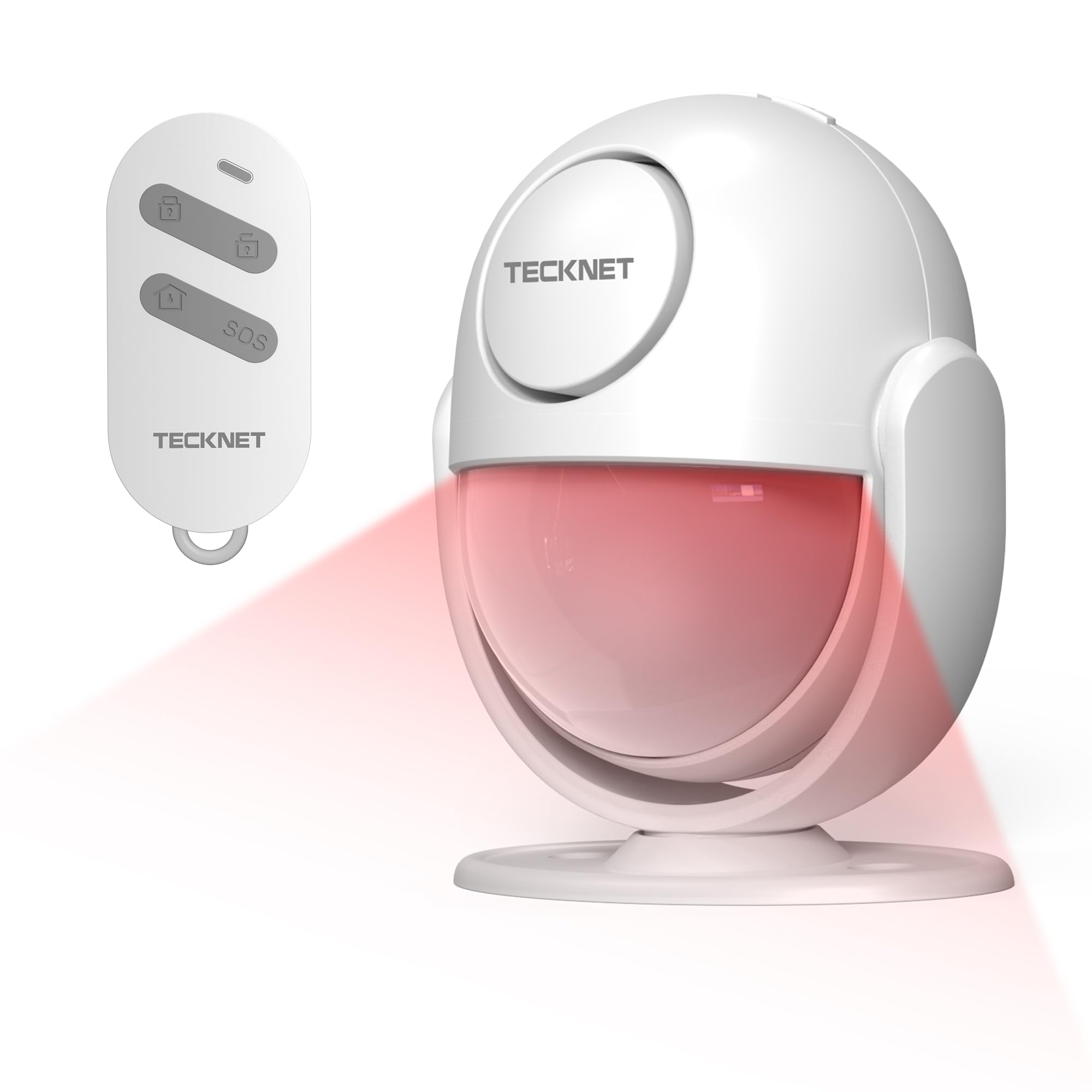
The 125 dB siren is built into the sensor, so it goes off where the motion is rather than where you are. That single fact decides whether this is the right alarm: it is an excellent noisemaker for a garage, a shed, a back stair, or the inside of a van, and a poor way to learn that somebody is in the basement while you're upstairs with the television on.

Around that siren TECKNET has built a genuinely useful little unit. The included remote reaches 328 ft, enough to arm it from the house before you walk out to the car, and there are alarm and chime modes with three volume steps. The head rotates 360°, so you can aim it after the adhesive pad or the screws are already on the wall.

Those volume steps matter more than they look on paper. The lowest setting is a local chirp rather than a siren, which is the mode for a quiet house, while the top one is genuinely painful in a closed room — fine in a shed, less fine in a hallway you cross at midnight.

So the buyer here is specific: someone who wants the noise at the point of entry and a way to switch it on from a distance, not someone who wants a receiver in the kitchen. Compact, battery-only, and easy to move from a door frame to a shelf, it earns its place as the alarm that stays with the thing it's guarding.

Bottom line: We reach for this when the noise should happen at the door itself: a 125 dB siren in a garage, shed, or stairwell, armed from 328 feet away.

4

BESTOONE Motion Sensor Alarm

BESTOONE Motion Sensor Alarm

Multi-room coverage

Our Score 8.6/10
Check Price

Worth Noting

  • Some units quit within weeks of going up
  • Batteries for four sensors not included
Batteries
AAA, not included
In The Box
4 sensors, 2 alarms
Chime Options
38 tones
Transmission Range
300 ft

Two alarms and four PIR sensors arrive in one box, which is a different proposition from the single-sensor kits most people start with. Each detector runs on its own AAA batteries, which aren't included, and talks to either receiver over 300 ft. The receivers carry 38 tones plus a mute mode and an LED indicator.

For a small shop, a flat with several doors, or a house where you want one alarm upstairs and one in the kitchen, this is the most coverage per box in the group. What we appreciate is that the receivers can show which area has activity, so a tone assigned to the back door tells you where to look before you get up.

Where it fits is a building small enough that 300 ft of signal covers all of it, and where several entrances matter more than any single one — a shop floor, a shared hallway, a flat with a front and back door. The ringtones lean toward novelty melodies rather than anything you want to hear forty times a day, which is the sort of thing you notice in week two.

Bottom line: Four sensors and two receivers make this the quickest way to cover a whole small building — good coverage, with durability the thing to watch.

5

Qualirey Solar Motion Alarm 6-Pack

Qualirey Solar Motion Alarm 6-Pack

Fences and orchards

Our Score 8.8/10
Check Price

Worth Noting

  • Sold only as a six-pack
  • Mode switching takes the manual
Pack Size
6 alarms
Siren Volume
129 dB
Weather Rating
IP65
Detection Range
5–8 m

Six solar-powered sirens in one box, for a fence line, an orchard, a chicken coop, or the far end of a field where running power is out of the question. That's the pitch, and it's why these earn a place: nothing else here covers six separate points with no wiring at all.

Each unit detects across 125° at 5 to 8 m and answers with a 129 dB siren and a strobe, in an IP65 housing on a stainless bracket. The four modes are the useful part — around-the-clock flash and siren, flash without the siren, night-only operation, and a timer — so the same hardware can be a quiet marker by day and a loud one after dark.

Charging is the other thing to plan for. The panel handles it in decent light, but a unit parked in deep shade, under a dense hedge or on the north face of a barn, will run down and need moving into the sun. For a fence, a field gate, or a garden you're protecting from deer rather than people, the format makes sense; for one doorway, a single chime is simpler.

Bottom line: Six solar sirens cover a fence line or an orchard in one go, which is why we rate it for land where there's no outlet to plug anything into.

6

COTINSE Motion Sensor Chime

COTINSE Motion Sensor Chime

Doorway chimes

Our Score 8.6/10
Check Price

Worth Noting

  • Receiver can block both sockets on an outlet
  • Pairing tones needs the instructions
Power
2 AAA or USB-C
Volume
0–110 dB
Chime Options
58 melodies
Transmission Range
500 ft

A 15° horizontal detection angle is unusual in a cheap chime, and it's the reason this one is worth a look. The beam is narrow and deliberate rather than a broad fan, so pointed down a hallway or across a doorway it sees the person and not the pet, the radiator, or the curtain moving in the draft.

The rest of the package aims at the same buyer: 58 melodies, five volume levels from silent to 110 dB, 500 ft of signal, and a choice of two AAA batteries or a USB-C port for continuous power. That last option is rare in this group, and it's the difference between a device you leave on a shelf and one you leave plugged in for good.

Two things to know before it goes up. Pairing takes a trip through the instructions, since assigning tones isn't something you'll remember a month later, and the narrow beam cuts both ways — a sensor aimed at a doorway won't notice someone coming around the side of it. Point it at the path people actually use.

For the tell-me-someone-came-in job, this is the chime we point people to. It isn't loud enough to stop anyone, the melody list is longer than it is useful, and none of that matters for a shop door or a hallway. If you want the same idea from a bigger name, the TECKNET costs a little more and detects at a similar distance.

Bottom line: The cheapest chime here that still gets the basics right: 58 tones, USB-C or battery power, and a narrow beam that ignores most of what you don't care about.

7

kbaoele Motion Sensor Siren

kbaoele Motion Sensor Siren

Outdoor deterrence

Our Score 8.4/10
Check Price

Worth Noting

  • Needs an outlet at the mounting point
  • 19 ft detection is the shortest here
Power
AC plug-in
Siren Volume
120 dB
Detection Angle
120°
Detection Range
19 ft

A 120 dB siren with a rotating red strobe, running from a standard AC plug. There's no receiver to site and no batteries to change, which is the whole appeal of the format: you put it where the noise needs to be, and it draws its power from the wall behind it.

The sensor covers 120° out to 19 ft, a wide but shallow field — good across a doorway, a gate, or the side of a shed, and no use at all down a long drive. Mounting is a screw-on base you can lift the unit off, and the manufacturer's own caution is worth following: keep it clear of anywhere leaves fall or traffic passes, because a sensor this ready to fire will report both.

Buy it for deterrence, not for information. When this goes off you hear it outside, and that's the entire message — there's no chime in the kitchen telling you which zone fired, and nothing to check afterwards. For a back alley, a boat shed, or a gate you'd rather nobody walked through, 120 dB and a strobe is serious discouragement. For anything you need to monitor from indoors, pay for a receiver.

Bottom line: A plug-in wall siren for a gate, a boat shed, or a back alley: 120 dB and a strobe, with no batteries to change and no receiver to place.

8

ChunHee Solar Motion Alarm

ChunHee Solar Motion Alarm

Garden and animals

Our Score 8.2/10
Check Price

Worth Noting

  • No sensitivity control; breezes set it off
  • Bark and gunshot sounds come mixed
Siren Volume
129 dB
Weather Rating
IP65
Detection Angle
110°
Detection Range
5–8 m

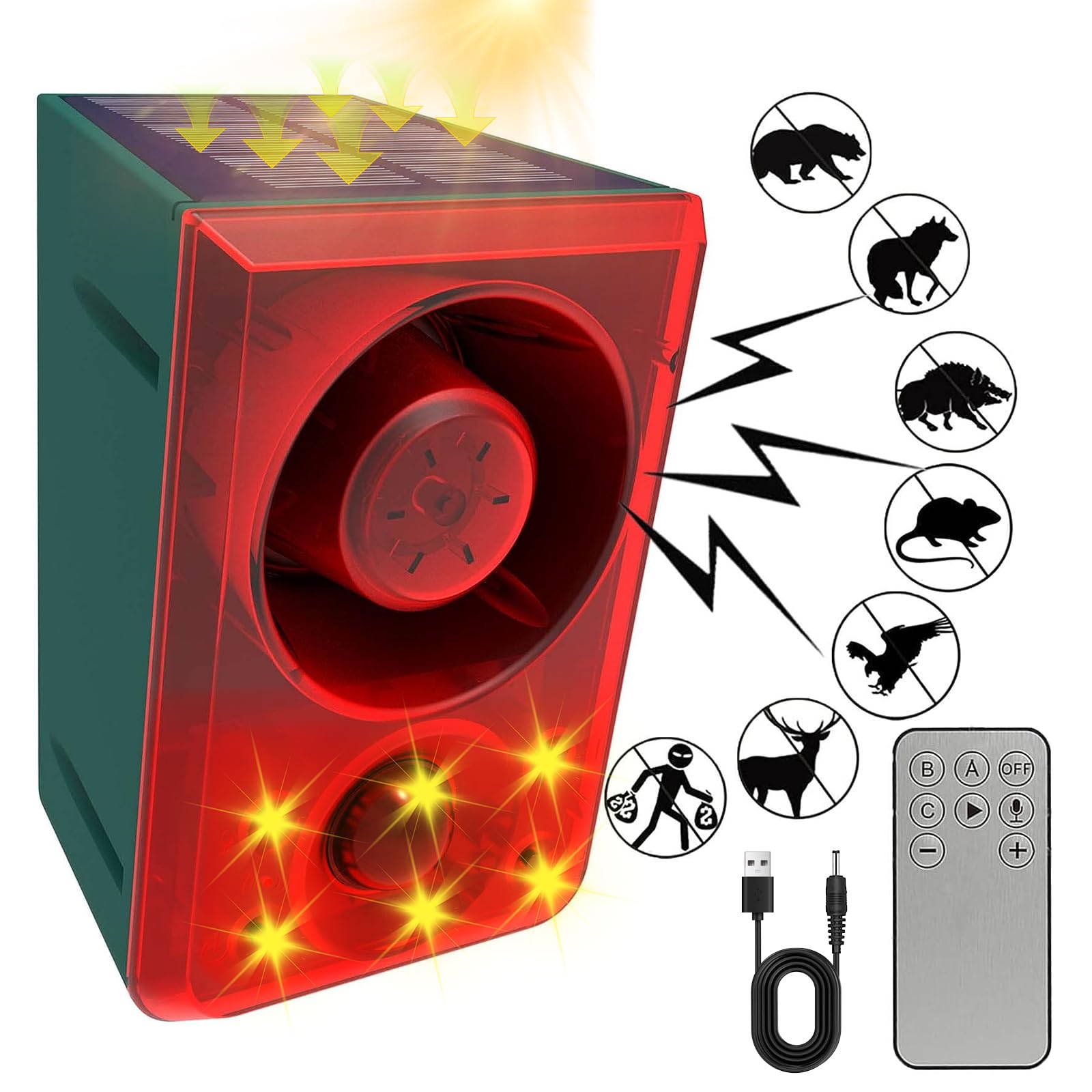
Of all the ways to make a garden unwelcome to animals, a solar box that barks is the one that made us smile, and it does the job. The ChunHee triggers on motion and answers with a 129 dB siren, a strobe, and a sound of your choosing: a dog barking, a gunshot, or a recording of your own voice.

Power is the reason it earns a place on a fence post. The solar panel tops it up, the housing is IP65 with a stainless bracket, and the three modes let you run siren-and-flash around the clock, at night only, or on a timer, so a unit covering a vegetable patch can stay quiet while you're out weeding. A remote comes in the box for switching it on and off.

The catch is control. There's no sensitivity dial, so a breezy night in a leafy corner will set it off, and the sound set can't be separated — the barking comes with gunshots mixed in, which is not what you want with neighbours close by. Treat it as a garden and livestock tool rather than a door alarm and it earns its keep; for the front of the house, buy a chime.

Bottom line: The garden pick: a solar, weatherproof noisemaker that barks, fires a gunshot, or plays your own recording, and asks for no wiring at all.

How We Tested the Motion Sensor Alarms

We started by pulling every motion alarm we could find from major retailers, then narrowed the field by power source, mounting hardware, stated detection range, and whether customer reviews mentioned false triggers or dead batteries. That left 16 units, which we ran for four months across four settings: a backyard shed, a sloped driveway gate, a detached garage, and an interior hallway with a lot of foot traffic.

Each alarm went up at the height its instructions recommended, then again at chest height, so we could see how much mounting angle changed real-world range. We timed setup from opening the box to walking away armed, and we logged every false trigger — one unit wailed at a neighbor's cat eleven times in a single week, while another stayed silent as a person walked straight at it. Loudness got judged the same way you'd judge it at home: standing at the far end of the driveway, and inside with the door shut, listening for both the siren and the low-battery chirp.

Weather and wear got their own pass. Units stayed outside through rain and a cold snap, and afterward we checked seals, battery compartments, and brackets for cracking or rust. Solar models were left in partial shade for a week to see whether they held a charge, since that's where a lot of them end up. We closed by weighing value: what actually came in the box, whether the settings were reachable without a manual, and how many of the advertised functions we used more than once.

How to Choose Motion Sensor Alarms

Separate detection range from transmission range

Every listing quotes a big wireless number and a smaller detection number, and shoppers read the big one as coverage. They aren't the same thing: 500 ft is how far the sensor's signal travels to the receiver, while 4 to 8 m is how far away a person can be and still trip it. A chime with a 500 ft signal still only sees someone at the doorway.

So measure twice. Pace out the gap between where the sensor goes and the room where you'll hear it, then check the detection figure on its own. The driveway kit here is the outlier at 35 to 50 ft; most of the indoor units are doorway-sized.

Decide whether you want a chime or a siren

These devices split into notifiers and deterrents, and the two do different jobs. A chime — 110 dB at the top end here — tells you someone has arrived, and its volume steps and mute setting make it liveable in a shop, an office, or a bedroom. A siren at 125 to 130 dB is meant to make whoever set it off leave.

Buy the noise you want to happen next rather than the loudest number on the page. A siren in a hallway you walk through forty times a day gets switched off within a week, and then it isn't protecting anything.

Match power and weather to where it will live

Pick the mounting spot first, then check what powers it. A battery sensor goes anywhere but needs fresh alkalines; a plug-in receiver needs a socket, which rules out the shelf you had in mind more often than people expect; a solar unit works on a fence line but sulks under a dense hedge.

If the unit lives outside it needs a rating rather than a weatherproof adjective — IP65 is the figure to look for. The corded siren here needs an outlet within reach of the wall you mount it on, which is a real constraint on a gatepost.

Kill false triggers before you drill

Most nuisance alarms come from aiming, not from faulty hardware. PIR sensors respond to heat crossing their field, so a unit pointed down a path sees a person late, while one pointed across it sees them immediately. A sensor facing a hedge, a swaying branch, or a road will also see everything the wind and the traffic do.

Mount at roughly waist or chest height, angle across the approach rather than along it, and keep foliage out of the cone. A narrow detection angle helps more than any setting on the dial.

Buy for the zones you'll want next year

One sensor covers one approach; a receiver that pairs with 20 or 32 of them covers a property. The genuinely useful extra is a distinct tone per sensor, so you learn the gate tone and the back-door tone without looking at anything.

If several people need the warning, or one person needs it in two parts of the house, check how many receivers a kit includes rather than assuming you can add one later. The four-sensor kit here ships with two.

Frequently Asked Questions

Final Verdict

If the motion you care about starts outdoors, buy the HTZSAFE kit. Half a mile of signal and four weather-resistant sensors handle a drive, a gate, or a yard in a way nothing else here can, and it asks for almost nothing once it's up.

Inside a building, spend less. The TECKNET chime tells you when someone comes through a door from 500 feet away, and the TECKNET siren puts 125 dB at the point of entry instead of in your ear. Pick the second only if the noise itself is the point.