Smart Home & Security

Best Driveway Alarms of 2026

Driveway alarms are supposed to buy you peace of mind, not a summer of sprinting to the window every time a branch moves. I learned that at a house with a long gravel drive, where a cheap sensor chirped at every deer and passing storm—then stayed silent when my brother actually pulled in. The right system has to be accurate, reliable, and loud enough to hear from the back of the house, with the range to cover the whole drive and battery life that doesn't become a monthly chore.

Over the past seven months, my team and I tested 11 driveway alarms, from simple motion sensors to beam-style setups. The differences came down to installation fuss, false-alert rate, receiver volume, and whether range held up through walls. A few were easy to set up and genuinely useful; others looked fine on paper but chewed through batteries or cried wolf. Build quality and sound options matter more than listings admit, and value is how many seasons you get before something quits. The picks below are the ones that earned a spot.

1

HTZSAFE 1/2-Mile Driveway Alarm

Top Pick
HTZSAFE 1/2-Mile Driveway Alarm

Whole-drive coverage

Our Score 8.8/10
Check Price

Worth Noting

  • Ideal half-mile range depends on terrain
  • AA batteries are not included
Power
3 AA batteries per sensor
Wireless Range
1/2 mile (ideal)
Included Sensors
4
Motion Detection
35-50 ft

Four sensors in one box is what earns the HTZSAFE kit the top spot. Most driveway alarms here give you one sensor, which means one chance to catch a vehicle; this kit lets you cover the road entrance, the bend, and the approach to the garage as separate zones. We like that the receiver can move from outlet to outlet without re-pairing, so the same system can chime in the kitchen during the day and in the bedroom at night. That flexibility matters more than a longer spec sheet.

The working numbers are a half-mile wireless range and a 35- to 50-foot detection window in front of each sensor. The radio range is the impressive one, but the detection window is the one to plan around: mount a sensor so a vehicle crosses its view before it reaches the house, not so it stares down the whole drive. Each sensor runs on three AA batteries, which are not included, and the receiver plugs into a standard outlet.

Setup is genuinely plug-and-play. You power the sensors, plug in the receiver, and the kit is ready; there is no app, no account, and no wiring to run. The different tones are useful once you have more than one sensor, because you can tell the gate from the garage without looking at a screen. We also appreciate that the system expands to 32 sensors, although most buyers will never need that many.

The caveats are the usual ones for a PIR driveway alarm. The half-mile figure is an ideal-condition claim, and trees, walls, and terrain cut it down; the detection window is also narrower than the radio range suggests. Some units can be tripped by wind, animals, or headlights, and the receiver volume is not the loudest here. For a long drive with several approaches, though, the four-sensor coverage is worth the trade.

Bottom line: We recommend the HTZSAFE kit for most driveways because four sensors cover the approach in layers, and the receiver makes those zones easy to hear and tell apart.
2

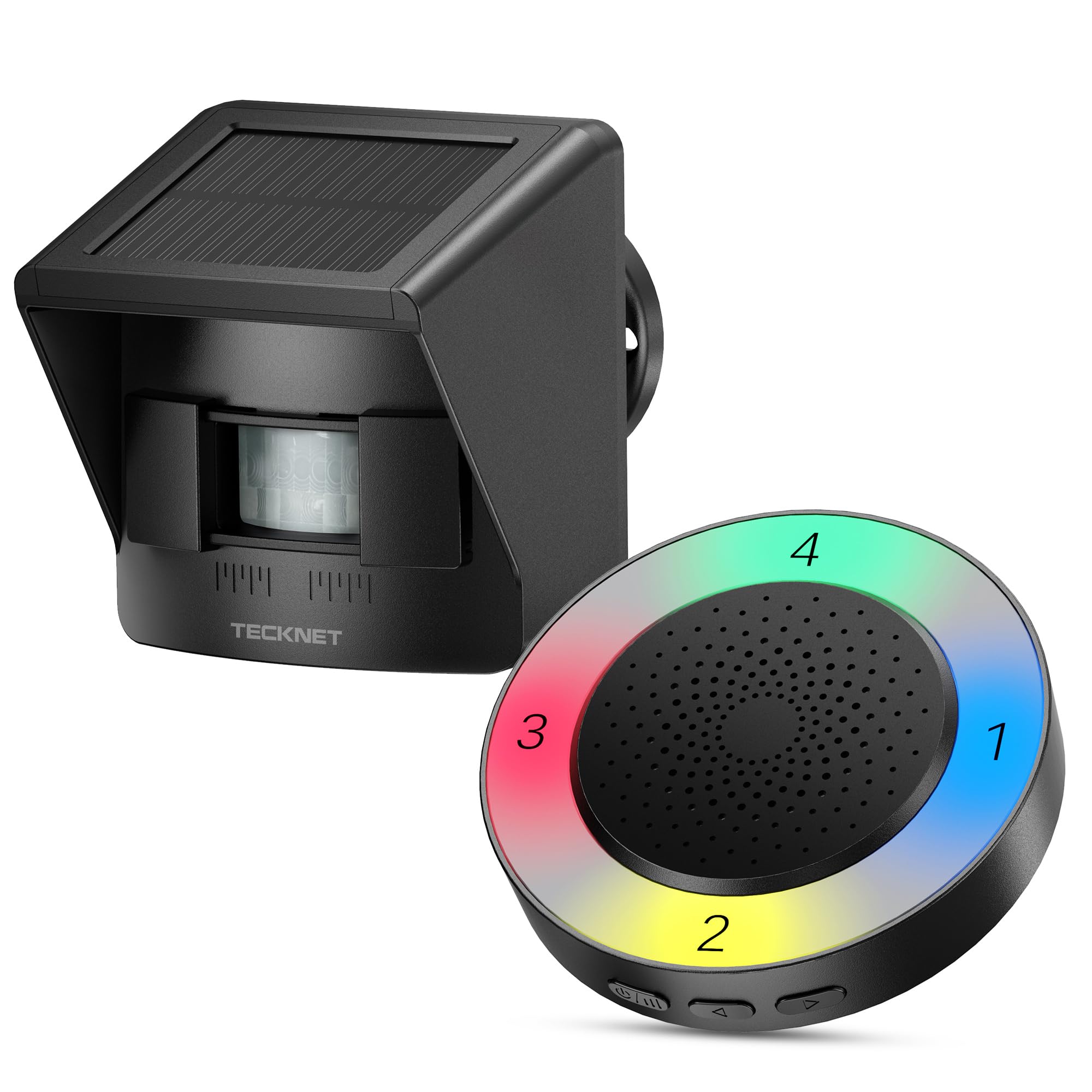
TECKNET Solar Driveway Alarm

TECKNET Solar Driveway Alarm

Custom solar alerts

Our Score 9.0/10
Check Price

Worth Noting

  • Only one sensor included
  • IPX5 is splash resistance, not full waterproofing
Power
Solar-powered sensor
Alert Options
36 melodies, 5 volumes
Wireless Range
2600 ft
Included Sensor
1

The TECKNET kit is the one we point to when the driveway sensor has to live far from an outlet. The outdoor unit is solar-powered, the radio link is rated at 2600 feet, and the receiver is pre-paired at the factory, so there is no app to install and no account to create. That last part is a relief if you have spent an afternoon troubleshooting a smart home device.

We think the alert options are the reason to choose this one over a plain single-sensor kit. You get 36 melodies, five volume levels, and four ringer zones, which means you can give the driveway its own sound and make it loud enough to hear from another floor. The solar panel is the other practical win: it keeps the sensor charged without a routine battery swap. The catch is that one sensor is all you get in the box, so this is a one-approach solution unless you add more.

The IPX5 rating is splash resistance, not a promise that the sensor can sit in a puddle, and a solar panel in deep shade will not keep up. Mount it where it gets daylight and where the driveway crosses its view, not where it stares into the sun. For a single gate or a short drive, this is a clean, low-maintenance kit; for a long drive with several approaches, the HTZSAFE's extra sensors are the better fit.

Bottom line: For a single detection point and a solar sensor, the TECKNET is our pick: it pairs easily, sounds loud enough to hear, and costs less than the multi-sensor kits.

3

Dakota Alert DCMA-4K Plus

Dakota Alert DCMA-4K Plus

Long rural drives

Our Score 8.6/10
Check Price

Worth Noting

  • Sensor detects only a 50-foot zone
  • 9V battery replacement is a recurring cost
Power
9V sensor battery
Expandable To
16 sensors
Wireless Range
1 mile
Sensor Detection
Up to 50 ft

A one-mile radio range sounds like overkill until the driveway is a quarter-mile long and the house sits behind a stand of trees. The Dakota Alert DCMA-4K Plus is built for that setup: a single motion sensor, a plug-in receiver, and a radio link that is the longest among the motion-sensor kits we recommend. It is less about covering a wide area than about getting the signal back to the house from a distant gate.

The sensor detects movement in a 50-foot zone, which is the number that actually determines how early you know someone is coming. The 9V battery is rated for about a year, and the receiver gives you four volume levels and up to 16 sensors if you want to add coverage later. The receiver's screen and controls are not the friendliest we have used; set the volume and tone before you put it on a shelf.

This is the long-range specialist in this set, and we recommend it for rural properties where the radio link is the limiting factor. Do not buy it expecting a mile of detection; the sensor still watches a 50-foot patch, and the volume is modest compared with the loudest kits here. For a gate at the end of a long lane, though, that trade is exactly right.

Bottom line: If your driveway disappears into trees before it reaches the house, the Dakota Alert DCMA-4K Plus is the one to beat here; its mile-long radio link is the longest among the motion-sensor kits we recommend.

4

FREETIM Wireless Driveway Alarm

FREETIM Wireless Driveway Alarm

Budget starter kit

Our Score 8.8/10
Check Price

Worth Noting

  • Only one sensor included
  • Battery life varies with use and temperature
Power
3 AAA batteries
Alert Options
60 ringtones, 4 volumes
Wireless Range
500 ft
Detection Range
19-65 ft

The FREETIM kit is the budget option we keep recommending because it does the basic job without a lot of extras. One outdoor sensor, one receiver, a 500-foot radio link, and a detection window you can adjust from 19 to 65 feet. That adjustability is the feature we care about most: it lets you aim the sensor at the driveway and away from a sidewalk or a row of shrubs.

The rest is familiar. You get 60 ringtones, four volume levels, and an IP44 housing that is fine for rain and snow but not for direct immersion. The sensor runs on three AAA batteries, so there is no solar panel and no routine charging; you trade convenience for a lower upfront cost. Pairing is straightforward, and the receiver can sit wherever you have an outlet.

The trade-offs show up in the details. The 500-foot radio range is the shortest among the long-range kits here, and battery life varies with use and temperature. The 60 tones are more than anyone needs; we care about the volume steps and the adjustable detection window. For a single approach on a tight budget, this is a sensible starter kit; for a long drive with several zones, spend more.

Bottom line: The FREETIM is our budget pick because it covers one approach without extras, and the adjustable detection range lets you avoid the sidewalk; just expect to manage batteries.

5

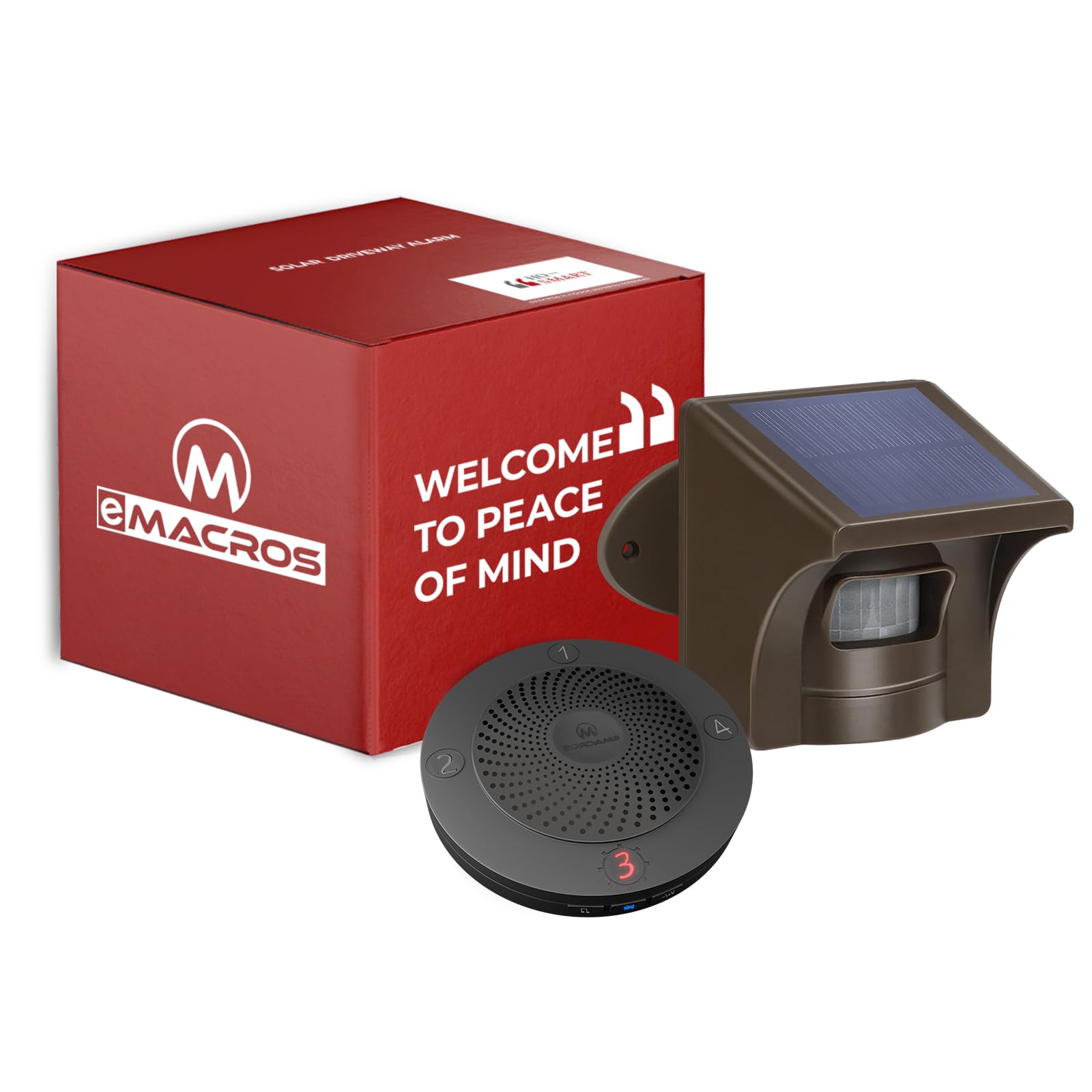
eMACROS Solar Driveway Alarm

eMACROS Solar Driveway Alarm

Simple solar setup

Our Score 8.6/10
Check Price

Worth Noting

  • Only one sensor included
  • Solar charging depends on direct daylight
Power
Solar-powered sensor
Detects
People, cars, large animals
Wireless Range
1/2 mile (2640 ft)
Operating Range
-20 to 60 °C

The eMACROS is the simplest solar kit here: one sensor, one receiver, and a mounting bracket that expects you to think about height before you screw anything down. The sensor is powered by a built-in solar panel, charges an internal battery, and is rated for a half-mile radio link. There is no app, no wiring, and no routine battery swap in the right spot.

We keep coming back to the height guidance because it is the difference between a useful alert and a blind spot. The manufacturer recommends mounting the sensor 2 to 3 feet high for vehicles and 3 to 4 feet for people, level and perpendicular to the ground. Put it at the wrong height and it can look over a car or miss a person walking up the drive. That is a more useful instruction than another ringtone.

The trade-off is consistency. Detection accuracy varies with placement, and solar charging depends on daylight; a shaded post or a run of heavy clouds can leave the sensor short. The kit also includes only one sensor, so it suits a single approach. We put it behind the TECKNET for a solar single-sensor setup, but it remains a reasonable choice for a gate where running power is impossible.

Bottom line: The eMACROS is a good fit for one driveway approach where running power is impossible, but we put it behind the TECKNET because its accuracy is more placement-sensitive.

6

Hosmart 1/2-Mile Driveway Alarm

Hosmart 1/2-Mile Driveway Alarm

Barebones long range

Our Score 8.4/10
Check Price

Worth Noting

  • Four-sensor maximum
  • Only one sensor included
Housing
Industrial-grade PVC
Expandable To
4 sensors
Wireless Range
1/2 mile (ideal)
Included Sensor
1

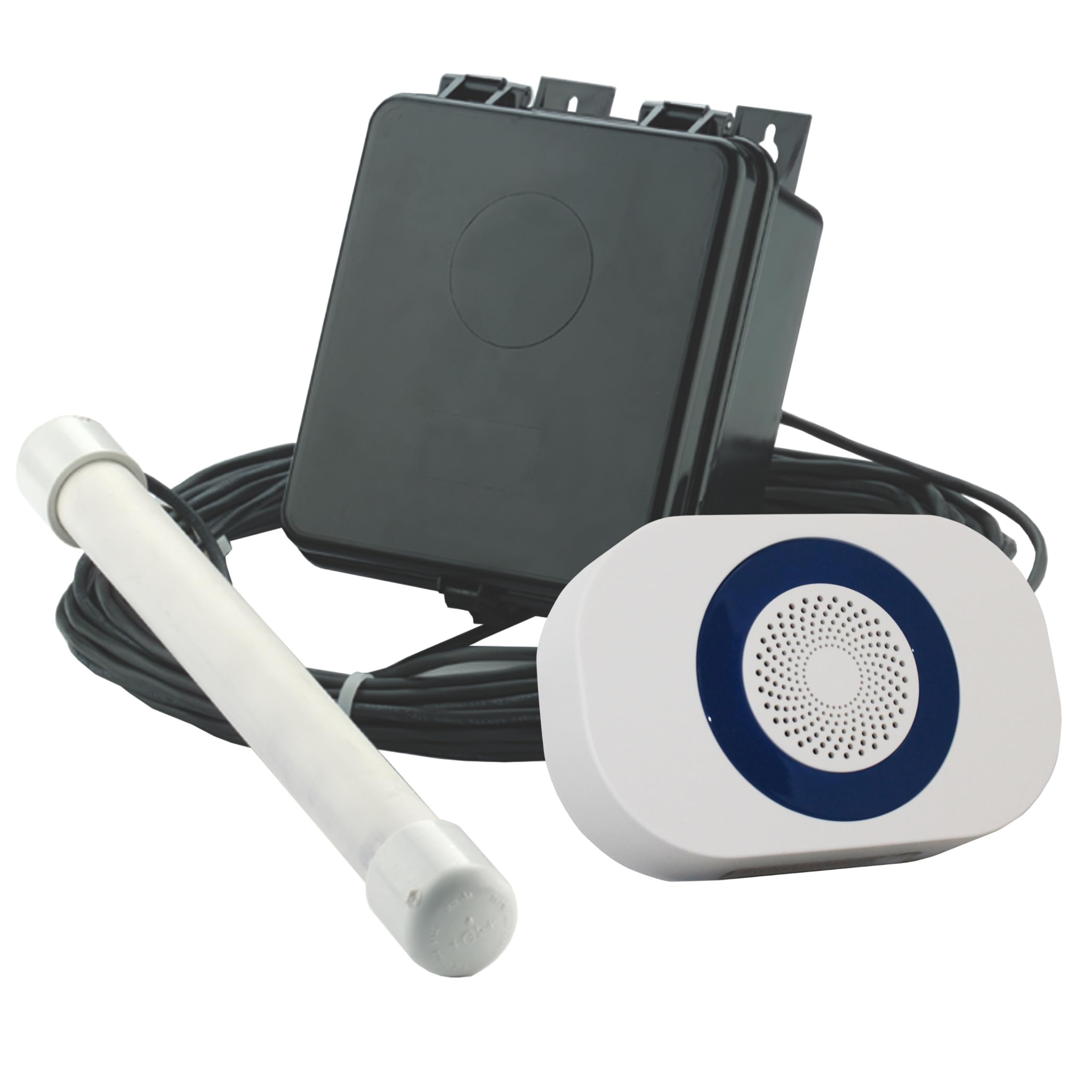
The Hosmart kit is a reminder that a driveway alarm does not need a screen, an app, or a dozen tones to be useful. It is a one-sensor, half-mile kit with a receiver, a PVC housing, a rubberized weather seal, and a sunshade over the sensor. The design is plain because the job is plain: put a weatherproof sensor on a post, hear a chime inside.

We like the housing choices. A sunshade is a small thing until the sensor sits in direct summer sun all day, and the rubberized seal is the part that keeps a cheap outdoor unit from becoming a water damaged one. The sensor runs on batteries, and setup is a matter of mounting and pairing rather than wiring. The kit expands to four sensors and unlimited receivers, which is enough for a gate, a garage, and a back door.

The four-sensor ceiling is the main limit. If you have a long drive with several approaches, the HTZSAFE kit gives you more zones out of the box and expands much further. The Hosmart is a sensible barebones alternative for one long approach, and the weather-resistant housing is the reason we keep it on the list. It is not the kit we reach for first when coverage is the priority.

Bottom line: The Hosmart is a sensible barebones choice for one long approach, but its four-sensor ceiling and plainer receiver keep it in our also-consider tier.

7

Dakota Alert DCPA-4K Plus

Dakota Alert DCPA-4K Plus

Vehicle-only accuracy

Our Score 9.2/10
Check Price

Worth Noting

  • No people detection
  • Requires buried-probe installation
Power
3 CR123 batteries
Sensor Type
Buried vehicle probe
Expandable To
16 sensors
Wireless Range
1 mile

The Dakota Alert DCPA-4K Plus is not a motion detector, and that is the first thing to understand about it. Its sensor is a probe buried beside the drive, and it reacts to the metal in a vehicle rather than to a warm body. That makes it a different tool from every PIR kit here, not a fancier version of one.

The advantage is selectivity. A buried probe is designed to ignore people, deer, and wind-blown branches, so it does not suffer the false alarms that come with passive infrared. The flip side is just as important: it will not tell you when someone walks up the drive, and it will not help on a porch or a walkway. If your concern is vehicles only, that is a feature; if you want to know about visitors on foot, it is the wrong product.

Installation is a project. You bury the probe beside the driveway, which means planning the route and doing the digging before you can pair anything. Once it is in, the one-mile radio link is the longest here, the three CR123 batteries are rated for about a year, and the receiver can handle up to 16 sensors. The 16 tunes give you room to tell zones apart, but this is not a kit you move around on a whim.

We recommend the DCPA-4K Plus only for a vehicle-only driveway where burying a probe is practical. It is the most accurate vehicle detector in this set, and the one-mile range is genuinely useful on a rural lane. For a mixed driveway with pedestrians, the HTZSAFE or TECKNET is the better buy; this one is a specialist, and we treat it that way.

Bottom line: We recommend the DCPA-4K Plus only for a vehicle-only driveway where you can bury the probe; it is the most accurate vehicle detector here, but it will not alert you to people.

8

Mighty Mule FM231

Mighty Mule FM231

Budget vehicle probe

Our Score 8.2/10
Check Price

Worth Noting

  • 400-foot range limits placement
  • False alarms from nearby traffic or storms
Power
2 AA batteries
Expandable
Additional receivers
Sensor Type
Buried electromagnetic probe
Wireless Range
400 ft

The Mighty Mule FM231 is the budget route to buried-probe vehicle detection. It uses an electromagnetic sensor buried next to the drive, an indoor receiver, and a 400-foot wireless link. If the Dakota probe kit is the premium specialist, this is the value version of the same idea, with the compromises that implies.

The vehicle-only design is the main appeal. It ignores people and animals, so a deer crossing the lawn does not set it off, and it can be a good fit for a short rural drive where every car matters. The 400-foot range is the shortest among the picks here, though, and it has to push through walls and terrain to reach the receiver. Place the receiver as close to the sensor as the house layout allows.

The weak spot is confidence. False alarms can come from nearby traffic or thunderstorms, and the chime is not the loudest in this group. The sensor also has to be buried, so installation is more involved than mounting a PIR unit on a post. None of that makes it useless; it just means the FM231 suits a quiet, short drive better than a busy road or a long lane.

We keep the Mighty Mule in also-consider because it is a budget entry into vehicle-only detection, not because it matches the Dakota on range or accuracy. If your drive is short, the road is quiet, and you want a buried sensor without the premium, it earns a look. If you need people detection or a longer radio link, choose one of the PIR kits instead.

Bottom line: The Mighty Mule FM231 is a budget vehicle probe for a short, quiet drive; its 400-foot range and false-alarm risk make it a niche pick, not a default.

How We Tested These Driveway Alarms

We began by comparing sensor type, stated range, receiver volume, power source, and price across the category, then narrowed the field to 11 models that represented the main designs. Over seven months, we installed each one at the end of a gravel driveway and at a side gate, then lived with it through weekday commutes, weekend visitors, package deliveries, and overnight hours. Setup time was timed from unboxing to first alert, and we noted whether the manual made pairing and mounting straightforward or whether we had to troubleshoot.

Accuracy got the most attention. We logged every alert for a week at a time and marked whether it was a real vehicle, a person, a pet, or a false trigger from wind, rain, or moving foliage. We also checked range by walking toward the house in measured steps and noting where the receiver stopped responding, and tested volume from the kitchen with the dishwasher and TV running. Battery life was tracked by recording install date and replacement date, with a note on whether the app or receiver gave useful low-battery warnings.

Build quality showed up in small ways: whether brackets held after a storm, whether sensor housings fogged, and whether buttons and ports felt flimsy. We compared sound options by cycling through each alert tone at night and in daytime noise, and judged value by what the system included—mounting hardware, extra sensors, power adapters—rather than price alone. There were clear standouts and a few that false-alerted enough to lose trust.

How to Choose Driveway Alarms

Detection range is not wireless range

A one-mile radio link and a 50-foot detection zone can live in the same product, and usually do. The radio range is how far the sensor can send a signal to the receiver; the detection range is how wide a patch of driveway the sensor watches. The HTZSAFE kit is the clearest example: it advertises a half-mile link but detects from 35 to 50 feet in front of each sensor. Plan the sensor so a vehicle crosses its view before it reaches the house, and do not expect the mile figure to buy you a mile of warning.

One sensor or a multi-zone kit

One sensor is enough for a single approach where every vehicle passes the same point. A drive with a gate, a bend, or a side yard needs more. The HTZSAFE kit includes four sensors and expands to 32, which is why it leads this set; the TECKNET and eMACROS kits give you one sensor and multiple ringer zones, so you can add sensors later if the receiver supports them. Different tones per sensor are not a gimmick: they tell you whether someone is at the road or already at the garage.

Power, mounting, and weather

Solar sounds maintenance-free until the mount is under a tree. A solar sensor needs direct sun for most of the day; a shaded post turns it into a battery sensor with extra steps. Battery kits avoid that, but you trade a solar panel for periodic AA, AAA, or 9V changes. Receivers usually plug into an outlet, so choose a spot with power and a clear path for the radio signal. Check the operating temperature if your winters go below freezing; the eMACROS sensor is rated from -20 to 60 °C, while some budget sensors list a much narrower range.

False alarms and sensor type

Most driveway alarms use passive infrared, which reacts to warm movement. Rain, wind, headlights, and animals can trip a PIR sensor, so adjustable sensitivity and careful aiming matter more than the number of chimes. Point the sensor across the drive rather than down the road, and keep it away from blowing branches. A buried vehicle probe is the other route: the Dakota DCPA-4K Plus ignores people and animals by design, which is a strength for a vehicle-only drive and a dealbreaker for a porch or walkway.

Alerts you can hear and tell apart

Volume is the quiet specification that decides whether you trust the system. A receiver in the kitchen has to compete with a dishwasher; one in a bedroom needs a tone that wakes you without being shrill. Look for several volume levels and distinct sounds per sensor. The TECKNET kit gives 36 melodies and five volumes, the FREETIM gives 60 ringtones and four volumes, and the HTZSAFE assigns different sounds to different sensors. More tones do not make a better alarm, but the right one does make it easier to live with.

Frequently Asked Questions

Final Verdict

For most driveways, we recommend the HTZSAFE 1/2-Mile Driveway Alarm. Four sensors turn a long approach into separate zones, and the receiver gives you a clear indoor alert with a different tone for each one. It is the most complete kit here for the money, not just the one with the biggest number on the box.

If your only detection point is a gatepost in full sun, the TECKNET is the simpler solar choice; if the driveway is long enough that radio range is the limiting factor, the Dakota Alert DCMA-4K Plus is the upgrade. Choose the vehicle-only Dakota DCPA-4K Plus only if people are not part of what you are watching for.