Office Electronics

Best Financial Calculator of 2026

A financial calculator is a small machine for turning a messy loan or investment into a number you can defend. That sounds simple until you are midway through an amortization schedule, the keystrokes stop registering, and you start wondering whether the answer on screen is the calculator’s fault or yours. I have used these tools for coursework, client prep, and my own mortgage math, and the difference between a good one and a frustrating one rarely shows up in the spec sheet. What matters is whether it keeps up with your fingers, gives the same answer twice, and still feels solid after a semester in a backpack.

Over the past four months, my team and I worked through 12 financial calculators, running the same mortgage, NPV, bond-yield, and break-even problems on each before passing them around for quick calculations during meetings and late-night study sessions. The keepers were the ones that made financial functions feel obvious, handled everyday arithmetic and statistics without complaint, and felt worth the money for how often you would actually reach for them. A few had impressive menus but fussy keys, and those did not last long on my desk; the picks below are the ones that earned a permanent spot in a bag or desk drawer.

1

BA II Plus

Top Pick
BA II Plus

Finance exams

Our Score 9.2/10
Check Price

Worth Noting

  • Keys can need a firm, deliberate press
Dimensions
6.48 x 2.98 x 0.72 in
Exam Approvals
CFA and FRM
Cash-flow Analysis
Uneven cash flows
Financial Functions
TVM, NPV/IRR, amortization

The BA II Plus is the calculator we reach for when the job is a finance course or a professional exam. Its biggest advantage is not a single button but the combination: named CFA and FRM exam approvals, time-value-of-money and amortization keys, and NPV/IRR analysis for uneven cash flows. That mix covers the calculations that send most people shopping for a financial calculator in the first place.

The layout rewards a little practice. Once you learn the TVM order, a mortgage payment or annuity takes a short sequence instead of a formula, and the cash-flow worksheet keeps a string of uneven amounts in one place. We also appreciate the statistics and regression functions, though they are extra rather than the reason to buy this one. For a student moving between corporate finance and accounting, that breadth is useful without turning the keypad into a mystery.

The compact body disappears into a bag. At 3.68 ounces and 6.48 inches long, it leaves room for a notebook and still sits comfortably on a crowded exam desk. The battery is included, so there is no extra purchase before the first class, and the size is the quiet advantage: it takes up less space than a paperback.

Bottom line: For finance students and exam candidates, the BA II Plus is the safest default: named CFA and FRM approvals, full TVM and cash-flow tools, and a compact body.
2

HP 12C

HP 12C

RPN workflows

Our Score 9.4/10
Check Price

Worth Noting

  • RPN learning curve for algebraic users
Included
Case, cloth, batteries
Entry System
RPN, programmable keys
Cash-flow Capacity
20 cash flows
Financial Functions
120+ functions

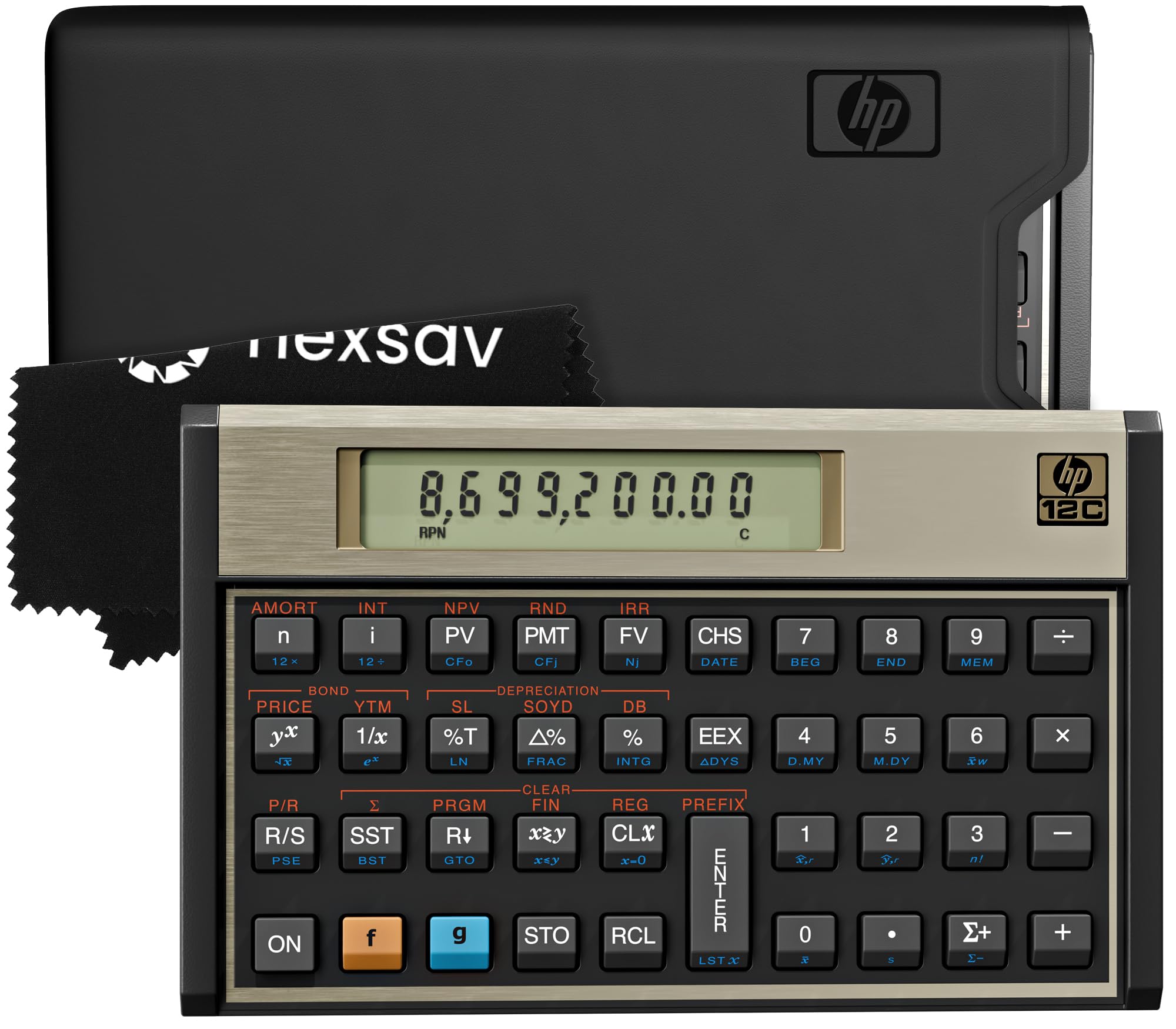
The HP 12C opens with its defining choice: reverse Polish notation. You enter the numbers first and the operation second, so a chain of calculations needs fewer parentheses and fewer taps. The 120-plus functions cover loans, bonds, depreciation, NPV, and IRR, and the programmable keys store a keystroke sequence for work you repeat.

We recommend it for the professional who already works in RPN and wants those repeat calculations ready to run. The 20-cash-flow capacity is enough for many investment and real-estate analyses, though sprawling models still belong in a spreadsheet. The 6-by-3-inch body sits easily on a desk, and the programmable keys are the feature we expect experienced users to value most. For a mortgage desk or a real-estate office, that repeatable sequence is the practical draw.

A case, cleaning cloth, and batteries come in the box, which is useful if the calculator lives in a briefcase rather than on a desk. The cleaning cloth is a small point, but it keeps the display readable without a hunt for a tissue.

Bottom line: Choose the HP 12C if you already work in RPN and want programmable, repeatable financial calculations in a classic desk-friendly body.

3

HP 10bII+

HP 10bII+

Standardized tests

Our Score 9.4/10
Check Price

Worth Noting

Weight
3.04 oz
Display
Adjustable contrast, labels
Test Approvals
SAT, PSAT/NMSQT, AP
Financial Functions
100+ built-in functions

The HP 10bII+ is the straightforward choice for a student who wants an algebraic calculator and has an SAT, PSAT/NMSQT, or AP test in view. The stated approvals cover those exams, and the keyboard is laid out to keep common functions close to the surface. Over 100 built-in functions include probability distributions, so it has room beyond the basic finance keys. That makes it a calmer first calculator than a model with more layered menus.

We recommend it when you want to enter expressions in the order you read them and do not need the BA II Plus's named CFA and FRM approvals. For finance coursework, it handles the usual time-value and statistical work; for a professional exam, check the approved-model list first, because the listed approvals are for SAT, PSAT/NMSQT, and AP. The adjustable-contrast display and on-screen labels help in a lecture hall or at a desk, and the 3.04-ounce body is light enough to carry every day. The value case is simple: you get the core finance and statistics set without paying for professional-exam approvals you may not need.

Bottom line: The HP 10bII+ suits students who want algebraic entry, a clear labeled display, and stated SAT, PSAT, and AP approvals.

4

CATIGA CF-300

CATIGA CF-300

Case protection

Our Score 9.0/10
Check Price

Worth Noting

Case
Flip-open hard case
Display
2-inch LCD
Warranty
2-year manufacturer
Financial Functions
TVM, IRR, NPV

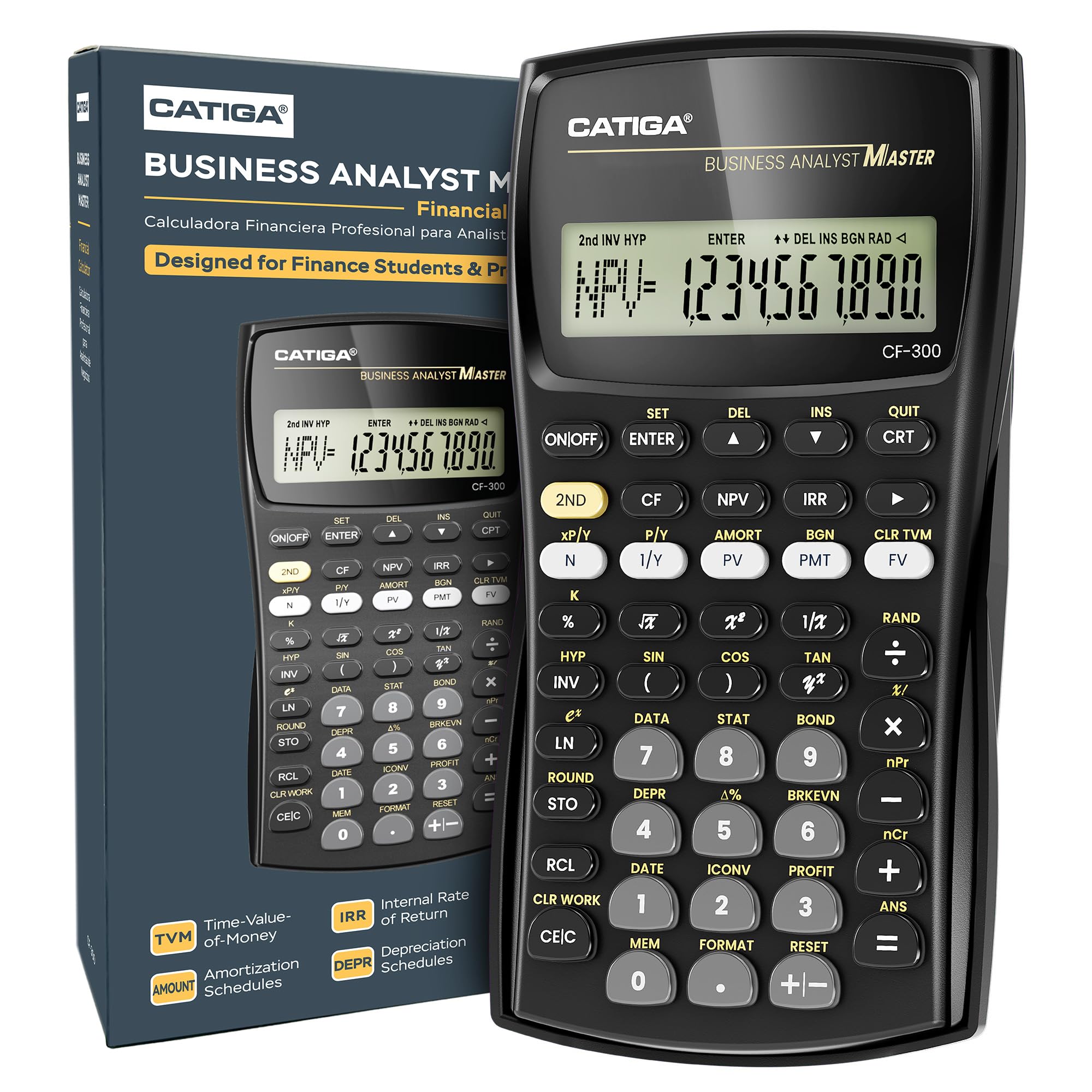
The CATIGA CF-300 makes its case with the thing you see first: a flip-open hard case that snaps shut. We like that for a calculator that rides in a backpack or briefcase, because the keypad and screen get a shell instead of a soft sleeve. Underneath, it lists TVM, IRR, NPV, amortization, bond pricing, depreciation, and break-even analysis.

The rest of the package is sensible: a 2-inch LCD, a compact 6.46-by-3.15-inch body, and a two-year manufacturer warranty. We see it as a budget-minded option for a student or occasional user who wants the core finance functions and a protected keypad. The listing does not name a specific professional exam approval, so check your exam's approved list before you rely on it. If the calculator lives on a desk, the case is less important; if it lives in a bag, it changes the ownership experience.

The hard case is the detail we keep coming back to. A calculator without one needs a pouch or a dedicated pocket, and the CF-300 removes that small piece of planning from the morning routine. The two-year warranty also gives a first-time buyer more time to find out whether the keypad and display suit them.

Bottom line: The CATIGA CF-300 is the budget-minded pick for core finance functions and a hard case, provided you confirm your exam accepts it.

How We Chose and Tested the Best Financial Calculators

We started by pulling together the calculators that finance students, instructors, and working analysts mention most often, then narrowed the list by available functions, display readability, battery type, and whether the manual was actually usable. We also filtered out models that were too limited for time-value-of-money work or so overloaded with menus that basic arithmetic became a chore. That left 12 calculators, which we used for four months.

Each calculator went through the same problem set: a 30-year mortgage amortization, NPV and IRR for a small project, bond yield, and a break-even calculation, plus ordinary arithmetic and a few statistics problems. I checked every result against a spreadsheet and ran the calculations twice, sometimes days apart, to see whether a missed keystroke or a low battery could throw off the answer. We noted how much pressure each key needed, whether fast entry produced double entries or dropped digits, and how easy it was to correct a mistake mid-problem.

The calculators lived where they would in real life: one in my bag for a week at a time, others on a desk during class prep notes, client meeting rehearsals, and a messy tax-season stretch. We dropped each from desk height onto a wood floor, tossed it into a bag with keys and a water bottle, and kept using it afterward to see whether the case loosened or keys stuck. Value came down to how many of those tasks a model handled without a manual and whether the build felt solid enough to justify carrying it every day.

How to Choose the Right Financial Calculator

Start With the Approved-Model List

Exam approval is a gate, not a tiebreaker. Before comparing cash-flow capacity or keypad feel, check the official list for your exam and the year you are sitting it. The BA II Plus names CFA and FRM approvals; the HP 10bII+ lists SAT, PSAT/NMSQT, and AP. Those are different audiences, and a model approved for one test may not appear on another list. If you are buying for professional work rather than an exam, approval matters less, but portability and entry logic matter more.

Match the Functions to the Work

TVM and amortization cover loans, mortgages, leases, and savings. NPV and IRR matter when you evaluate uneven cash flows, and bond pricing or depreciation matter in specialized roles. The BA II Plus and CATIGA CF-300 list the core finance set; the HP 12C adds programmable sequences and 20 cash flows for IRR/NPV. Write down the three calculations you do most often, then buy for those.

Choose Algebraic or RPN Entry

Most financial calculators use algebraic entry: you key the expression roughly as you read it. The HP 12C uses RPN, where you enter numbers first and operators second; experienced users need fewer keystrokes, while newcomers have to unlearn old habits. If you have never used RPN, an algebraic model is the lower-risk choice for a timed exam. If you already work in RPN, the HP 12C's programmable keys are a genuine workflow advantage.

Treat the Keypad and Display as Core Hardware

A financial calculator is a data-entry tool, so a key that needs repeated presses or a display with weak segments turns a simple problem into a recheck. Test the keypad and screen as soon as the calculator arrives, and buy from a seller with an easy return path. We also look for a case if the calculator travels: the CATIGA CF-300's hard case and the HP 12C's included case address different kinds of bag life.

Frequently Asked Questions

Final Verdict

The BA II Plus is the financial calculator we recommend first. It is the only pick here with named CFA and FRM exam approvals, and its TVM, NPV/IRR, amortization, and uneven cash-flow tools cover the work finance students and professionals do most. If you already work in RPN and want programmable repeat calculations, the HP 12C is the better fit. If your test is SAT, PSAT, or AP and you want straightforward algebraic entry, choose the HP 10bII+.