Car & GPS

Best Golf GPS Watches of 2026

A rangefinder gives you the number to the flag with real precision, if you can hold it steady and find the pin while the group behind you waits. A golf GPS watch gives up a little of that precision for something you'll use more often: front, middle, and back, glanceable in the two seconds before you pull a club. What separates a good one from an annoying one isn't the spec sheet — it's whether the satellite locks before you reach your ball, whether the yardage holds as you walk, and whether the battery survives the back nine.

I've played the same tree-lined muni for years, so a watch that's guessing stands out fast. Over six months our team wore nine of them through weekend rounds, league nights, and a couple of soggy twilight nines, checking every number against a rangefinder. The keepers have a few things in common: you can read them in flat glare, they hold a charge for two full rounds, the band doesn't rub after 18 holes, and they don't make you pay for features nobody uses. What's below is what survived.

1

Garmin Approach S12

Top Pick
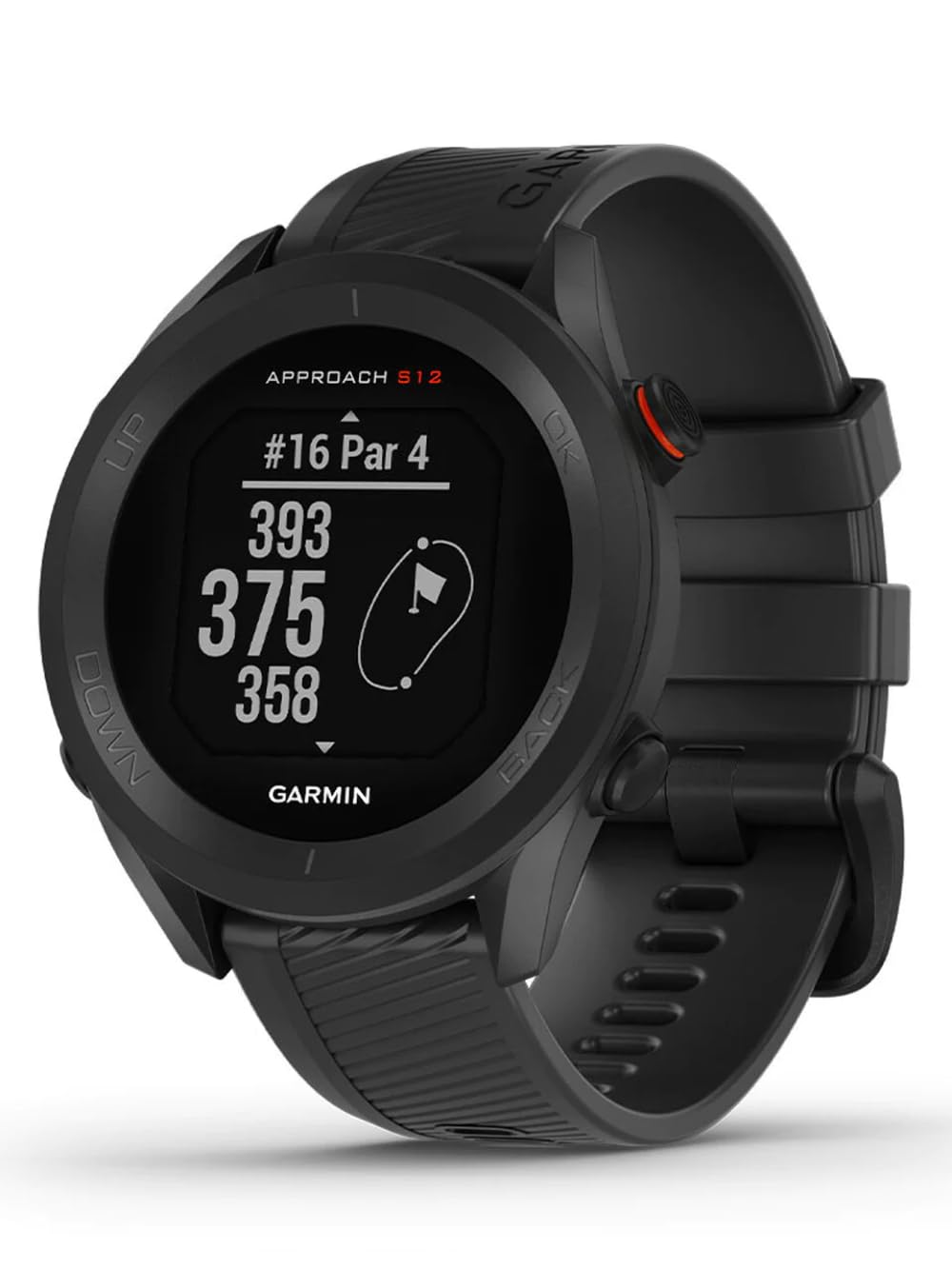
Garmin Approach S12

All-round golf

Our Score 9.0/10
Check Price

Worth Noting

  • Monochrome screen, no color hole maps
Weight
1.2 oz
Display
Sunlight-readable MIP
GPS Battery
Up to 30 hours
Preloaded Courses
42,000+

The Approach S12 has no touchscreen, no color maps and no virtual caddie, and after a few rounds we stopped wishing for any of them. Press one button, pick the course you're standing on, and it gives you front, middle and back along with carries over the bunkers and water in front of you. The display is the part that surprised us: it's a monochrome transflective screen, so it looks flat and gray indoors and gets sharper and easier to read the brighter the sun gets. On a bright tee box it was the clearest thing anyone in the group was holding.

At 34 grams it disappears on the wrist, and the buttons work through a glove without you looking down — we got through a full nine before anyone mentioned the watch, which is the highest praise a golf gadget gets. Garmin lists 30 hours in GPS mode, so it's several rounds between charges, and with 42,000-plus courses preloaded there's nothing to download before you tee off. Score entry takes a couple of presses at the green, and the round uploads to the Garmin Golf app from the parking lot afterwards.

What you give up is everything beyond the yardage. There's no shot tracking unless you add Garmin's CT10 sensors, sold separately, and no notifications, heart rate or color overhead view of the hole. If you want one watch that doubles as a smartwatch, this isn't it — the S44 is. What we keep noticing is how little there is to notice: no menu tree to learn, no battery percentage to check, no fiddling on the first tee.

Bottom line: For most golfers we recommend the Approach S12: accurate front, middle and back yardages, a full weekend of battery, and nothing to learn before the first tee.

2

Garmin Approach S44

Garmin Approach S44

Bright screen

Our Score 8.6/10
Check Price

Worth Noting

  • Can freeze mid-round and need a restart
  • Enhanced maps need a paid Garmin membership
Weight
1.5 oz
Display
1.2-inch AMOLED
GPS Battery
Up to 15 hours
Preloaded Courses
43,000+

The S44 is the pick if the screen matters to you, and on a bright day it will. Its 1.2-inch AMOLED is the sharpest display of the three here, with full-color hole maps and hazard views you can read at arm's length, and it holds contrast when the sun is straight overhead. We liked it most for the hazard screen: scrolling through the bunkers and water on a hole you've never played is quicker than squinting at a card in the cart.

Underneath the glass it's a proper smartwatch — phone notifications, steps and workouts, and a look that passes at dinner, with an aluminum bezel that shrugs off bag chatter. The touchscreen is genuinely useful for scrolling a hole map or dropping a pin, but we played most of our rounds on the buttons; a swipe doesn't work through a glove and a press does. You can ignore the touch layer for 18 holes and never feel like you're missing anything.

The trade-off is battery. Garmin rates it at 15 hours in GPS mode, roughly half what the S12 gives you, which makes it a charge-every-few-rounds watch rather than one that lives in the bag all month. For a golfer who wants one watch for the week that's a fair swap rather than a splurge — the extra money goes on the screen, the maps and the smartwatch side.

Bottom line: Choose the Approach S44 if you want one watch for golf and the rest of your week; the AMOLED screen, color maps and notifications justify the premium.

3

TecTecTec ULT-G

TecTecTec ULT-G

Tight budgets

Our Score 8.6/10
Check Price

Worth Noting

  • About two rounds between charges
Weight
1.94 oz
GPS Battery
Up to 10 hours
Subscription
None required
Preloaded Courses
38,000+

The ULT-G is the cheapest watch here and the only one that isn't a Garmin, and its case is simple: 38,000 preloaded courses, front-middle-back yardages, hazard distances and no subscription, for noticeably less than the S12. It also stands entirely on its own during a round. There's no app to open and nothing to pair — press the satellite button, it finds the course you're standing on, and you're reading a number before your playing partner has a laser out of the bag.

Five buttons run everything, and within a hole we were moving between screens without looking. The 1.09-inch LCD isn't a pretty screen, but the numerals are big enough to read at a glance, and hazard distances sit on the same screen as the green instead of behind a menu. At 55 g it's the heaviest of the three, though still light enough that we stopped noticing it by the turn.

Charging is where the savings show up. The cable ends in a clip that has to land on two pins, and seating it takes a deliberate press and a small wiggle — we got into the habit of checking for the charging icon before walking away. Do that and it's a non-issue, and the rest of the watch asks nothing of you. What we didn't expect to use is shot distance: it tells you how far the drive actually went, which settles a lot of friendly arguments.

Bottom line: If the budget decides, the ULT-G still gives accurate yardages, 38,000 preloaded courses and no subscription — for a once-a-week golfer, that is enough watch.

How We Tested Golf GPS Watches

We started with every golf GPS watch we could find that had a real course library, a display you could read outdoors, and a price that made sense for what it offered, then cut anything that hid basic yardages behind a subscription. That left nine watches, worn for six months from early spring into fall. They went to the range, to league night at a nine-hole muni, into a Saturday scramble, on a twilight nine after work, and around a full 18 in a steady drizzle. Most were worn walking, since a watch that's uncomfortable by the fourth mile doesn't get worn twice.

Accuracy got checked the boring way: at the 100, 150, and 200 markers we wrote down the watch's number beside a rangefinder's, and at each green we stood on the same sprinkler head and compared front, middle, and back. We timed satellite lock from power-on to first yardage, and again on a course the watch hadn't seen before. Ease of use meant glove on, club in the other hand — how many taps to reach a hazard carry, whether the buttons worked with a thumb, whether the screen held up in flat midday sun and behind polarized lenses.

Battery got recorded at the first tee and again in the parking lot, on hot afternoons and cool mornings alike, because a watch that dies at the 15th is one you stop trusting. We timed full charges and tried a top-up from a portable battery during a 20-minute drive between nines. Then we watched for failures: a dropped GPS fix on the back nine, a frozen screen, a scorecard that took three tries to sync. Value came down to whether the extra money bought a better screen and more courses, or just a subscription and a fancier strap.

How to Choose Golf GPS Watches

Battery life: start with the round, not the spec sheet

Every rating here is for GPS mode, which is the only number that matters, because a round runs four to five hours with the satellite radio on the whole time. Ten hours, the ULT-G's figure, is about two rounds. Fifteen hours on the S44 covers a weekend. Thirty hours on the S12 gets you through a golf trip if you forget the cable.

If you play 36 in a day, or the watch lives in your bag between rounds, buy the bigger number. If you plug your phone in every night anyway, 15 hours is plenty and you should spend the difference on the screen instead.

The screen: transflective or AMOLED

Two technologies doing different jobs. A transflective memory-in-pixel display like the S12's uses reflected sunlight, so it sharpens as the day gets brighter and barely touches the battery. An AMOLED panel like the S44's is richer, shows full-color hole maps, and costs you the runtime above.

The trap is judging either one indoors. The transflective screen looks flat and gray in a pro shop and looks excellent on the first tee. Decide where you'll actually read it, outside with sunglasses on, and buy for that.

Buttons, touch, and playing with a glove on

A touchscreen is lovely until your hands are damp or gloved. Every watch here can be run on physical buttons, and that's the mode we use on the course, since a press works through a glove and doesn't ask you to look down mid-backswing.

Touch earns its keep for scrolling a color hole map or setting a pin position. If all you want is front, middle and back, buttons alone are enough and usually cheaper.

Courses, memberships, and what you keep paying

All three come with tens of thousands of courses preloaded, and none charges a subscription to show you a yardage. Money creeps back in only as an option: on the S44, Garmin's membership adds enhanced CourseView maps, green contours and PlaysLike distance.

Before you buy, confirm your home course is mapped and current. A layout that has been re-routed can still display the old routing, and that's the one situation where a trustworthy number will steer you wrong.

Weight, size, and the one-watch question

The S12 weighs 34 grams, the ULT-G 55, and the S44 1.5 ounces — a difference you notice on the first hole and forget by the fourteenth. The more useful question is whether you'll wear it away from golf. The S44 is the only one of the three that passes as an ordinary smartwatch; the other two are golf instruments that happen to tell time.

If you want one device for the whole week, pay for the S44. If the watch lives in your golf bag, lighter and simpler wins.

Frequently Asked Questions

Final Verdict

The Approach S12 is the watch we recommend to most golfers, and the reason is unglamorous: 42,000-plus courses, front-middle-back yardages, and 30 hours of GPS battery in a 34-gram case that never asked us to think about it.

Spend more when you have a reason. The S44 buys a bright AMOLED screen, color hole maps and smartwatch features for the golfer who wants one watch for the week; the ULT-G is the budget answer for a player who wants a trustworthy number and can live with a charger that needs a second try.