Car & GPS

Best Running Watches of 2026

The morning my phone died at mile 11 of a half marathon, I ran the last two miles on feel and crossed the line with a finish time I still don't entirely believe. That's the hole a running watch fills: pace, distance, heart rate, and splits on your wrist without a phone bouncing around in your pocket. It also handles the quieter stuff — the 5 a.m. run where you don't want to carry anything at all, the tempo session where you need to hit an exact number, the Sunday long run where stopping to check a screen defeats the whole point.

The catch is that the figure printed on the box is rarely the figure you get. Battery estimates assume GPS-only, the screen dimmed, and no music playing, and GPS traces can shave corners on tree-lined streets. We've spent six months wearing 10 watches through training blocks and races, and the ones worth buying were the ones that held up when conditions weren't ideal — and that you didn't mind looking at on a rest day. The picks below are sorted by what each one is genuinely good at.

1

Garmin Forerunner 165

Top Pick
Garmin Forerunner 165

Everyday running

Our Score 9.4/10
Check Price

Worth Noting

  • GPS battery is the shortest here
  • Phone pairing can take a few attempts
Weight
1.38 oz
Display
1.2-inch AMOLED
Battery, GPS Mode
Up to 19 hours
Battery, Smartwatch Mode
Up to 11 days

The 1.2-inch AMOLED display is the first thing that makes the Forerunner 165 feel more expensive than its place in this group. It's bright enough to read at a glance in direct sun, and Garmin keeps physical buttons around the touchscreen, which matters when your fingers are wet or you're mid-interval. That combination is why this is the watch we recommend first to runners who want one device for daily miles, a race block and sleep tracking.

The numbers we cared about most are the ones that affect a training week: up to 11 days in smartwatch mode and up to 19 hours in GPS mode. The 19-hour figure is the honest measure for long runs, and it covers marathon training for most people. We also used the daily suggested workouts, which adjust with performance and recovery, and the 25-plus activity profiles make it easy to log cycling, strength or pool sessions without reaching for a second device. At 1.38 ounces, it stayed comfortable enough to wear overnight.

The 265S is the step up if you want recovery scores and multiband GPS; for everyone else, the 165's simpler approach is the point. Neither gap changes the recommendation for a first serious running watch: the core experience is simple, the screen is excellent, and the battery lasts through a normal training week. We kept coming back to it because it does the obvious things without making us think about the watch.

Bottom line: The Forerunner 165 is the all-round running watch we point most people toward: bright screen, usable buttons and enough GPS battery for a marathon block.

2

Garmin Forerunner 265S

Garmin Forerunner 265S

Smaller wrists

Our Score 9.4/10
Check Price

Worth Noting

  • Premium price for a running watch
Display
1.1-inch AMOLED
Case Size
42 mm
Battery, GPS Mode
Up to 24 hours
Battery, Smartwatch Mode
Up to 15 days

A running watch can have every metric and still lose if it sits wrong on the wrist. The 265S answers that with a 42 mm case and a 39 g weight that disappear under a jacket cuff, while the 1.1-inch AMOLED screen stays bright and legible. On a narrow wrist, it was the one that needed the least fiddling with the strap to stay put, and that mattered more than the smaller display.

The training side is where the 265S earns its keep. It has up to 15 days in smartwatch mode and up to 24 hours in GPS mode, plus multiband GPS, training readiness, HRV status and a morning report that puts recovery and the day's workout in one place. We found the readiness score most useful on heavy weeks, when it gave us a reason to take an easy day instead of stacking another hard session. The menus are dense, though; the first few days felt like learning a new phone rather than putting on a watch.

The 265S is the more advanced choice in this group, and the smaller screen means you see less at a glance than on the 165. That trade is worth it if wrist fit and recovery guidance are the priority. We kept it on for overnight wear because the lighter case made that easy, and the morning report was the first thing we checked before deciding how hard to run.

Bottom line: Our pick for smaller wrists is the Forerunner 265S, with a 42 mm case, recovery scores and multiband GPS in a light build.

3

COROS PACE 4

COROS PACE 4

Long-distance training

Our Score 9.6/10
Check Price

Worth Noting

  • Water-resistance listing is modest for pool laps
Display
1.2-inch AMOLED
Case Thickness
11.8 mm
Battery, GPS Mode
41 hours
Battery, Daily Use
Up to 19 days

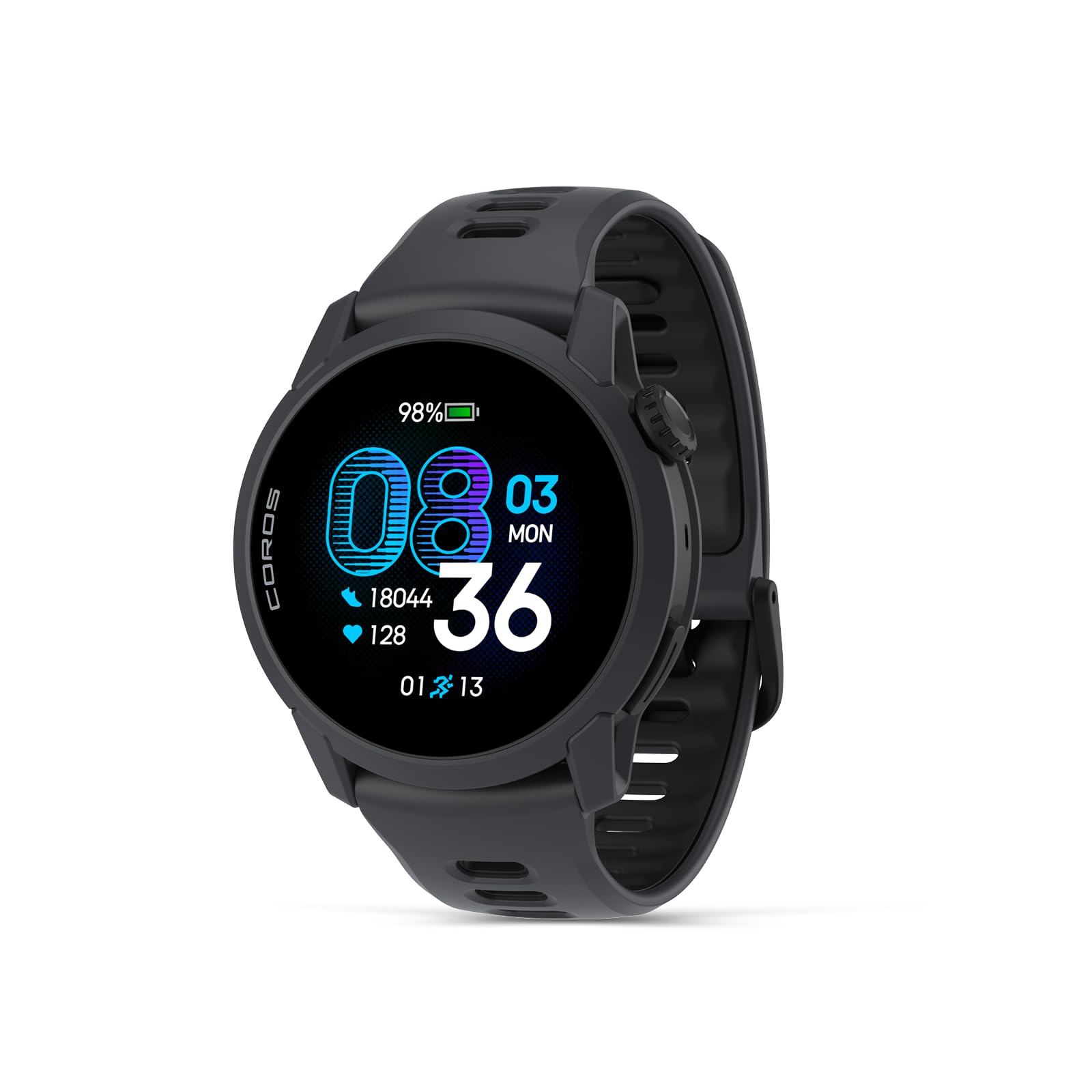
The PACE 4's 41-hour GPS rating is the number that changes the shape of a training week. It's more than double what the Forerunner 165 offers in GPS mode, and it means a long race or a full day in the hills doesn't have to end with a charger hunt. With up to 19 days in daily use, this is a watch you can leave off the charging cable for days at a time.

COROS also made the PACE 4 easy to live with between runs. The 11.8 mm case is slim, the 1.2-inch AMOLED screen stays readable, and the combination of a digital crown, two buttons and a touchscreen gives you a physical way to start and stop without stabbing at glass. We liked the voice-note tool more than expected: after a session, you can record how you felt and what you saw without typing a thing into your phone. The two-year warranty is also a longer commitment than the one-year cover on the Garmins.

The PACE 4 is the pick when the run is the main event and you don't want to think about charging. We reach for it on the longest days because the battery headroom is the difference between a watch that records the whole effort and one that quits near the end. It isn't the most feature-dense watch in this group, but it's the one that makes a long day feel uncomplicated.

Bottom line: For long days that outlast the Garmin pair, we take the COROS PACE 4 and its 41-hour GPS battery.

How We Tested 10 Running Watches Over Six Months

We built the shortlist by pulling every current model from the major endurance-sport brands and filtering on what actually decides whether a watch stays on your wrist: GPS chipset, rated battery life in the modes people really use, whether it handles music and payments on its own, and price against what you get. That cut a long list down to 10 watches, which we wore for six months.

Each one went through the same six months of training — Tuesday tempo runs on the same 5-mile loop, Sunday long runs on mixed road and gravel, a track session, a treadmill run, and at least one race. We wore them overnight, in the rain, and through the rest of the day with jeans and a work shirt to see how they looked away from running, and we kept an eye on scuffs and screen scratches as the weeks added up.

On the run, we checked each watch's distance and pace against a measured loop, then overlaid the GPS traces afterward to see which ones cut corners or wandered under tree cover. Battery got its own test: we drained each watch flat, charged it full, and counted days of real use with GPS, music, and an always-on display rather than trusting the rated hours. We tapped through every menu one-handed with sweaty fingers to judge the interface, and paired each watch to a phone, headphones, and a chest strap to see how often the connection dropped. Features only counted if we reached for them twice — a recovery score you ignore is worth less than a lap button you can find without looking.

How to Choose Running Watches

Start with GPS-mode battery

Smartwatch-mode battery ratings are the ones manufacturers put in big type, but GPS mode is what a run consumes. A watch rated for two weeks between charges can still run out during a long race, so compare the GPS figure first and leave a margin for cold weather and satellite hunting. The Forerunner 165's 19 hours cover marathon training for most runners; the PACE 4's 41 hours are for days when the run itself is the whole outing. If you charge weekly and rarely run longer than a few hours, 19 hours is plenty.

Fit the case and controls to your run

A running watch that slides or catches on a sleeve will make every mile feel longer. Case size and weight matter more than screen size for comfort, especially overnight. The Forerunner 265S is the smaller-wrist option here at 42 mm and 39 g, while the 165 is 43 mm and 1.38 ounces. Controls matter too: touchscreens are fine for scrolling, but you want physical buttons for start, stop and lap when your fingers are wet or cold. Start with the smallest case that shows the fields you need, then practice the button sequence.

Check GPS accuracy, not just GPS

Every watch here has built-in GPS, so the useful difference is how it handles difficult sky. Multiband GPS is the feature to look for if you run among tall buildings, dense trees or steep valleys; it uses more satellite signals to reduce drift. The Forerunner 265S includes multiband support, which is the better choice for city races and wooded trails. If your routes are open and familiar, standard GPS is usually enough. Pay for the better satellite handling only if your regular runs give GPS a hard time.

Pay for training guidance you'll follow

Daily suggested workouts are the useful baseline: they give structure without a coach and adapt as your training changes. Recovery scores, HRV status and race-day readiness are worth the upgrade only if you'll act on them. The 265S is the deeper training tool in this group, while the 165 covers the basics well. Be honest about your habits; a watch full of metrics you ignore is just a more expensive timer. Start with guided workouts, then upgrade when you find yourself wanting more recovery context.

Check the app, warranty and water rating

The watch is only half of the ownership experience. Plan for the phone app you'll use for setup and run review, and check the warranty before you commit: Garmin lists one year on both models here, while COROS lists two years on the PACE 4. Water resistance matters if you swim or run in heavy rain; the Garmins list 50 meters, while the PACE 4 listing shows IP68 and a 5-meter depth rating. Rinse any watch with fresh water after chlorine or salt.

Frequently Asked Questions

Final Verdict

For the runner who wants one watch for daily miles and a race block, the Forerunner 165 is the best balance here: a bright screen, usable buttons, daily suggested workouts and enough GPS battery for a marathon block. It keeps the essentials simple and wears light enough to forget.

If you have a smaller wrist or want recovery scores and multiband GPS, the Forerunner 265S is the upgrade. If your long runs stretch past a day, the COROS PACE 4's 41-hour GPS battery is the reason to choose it instead.