Office Electronics

Best Heavy Duty Paper Shredders of 2026

A heavy-duty shredder is supposed to make a mess of paperwork disappear, not make your afternoon disappear with it. The promise is simple: feed it old bank statements, junk mail, and anything with your name on it, and it keeps going. The reality is that some machines bog down after ten minutes, heat up, and force you to wait while the motor cools. The right one clears a whole file box without drama, sits quietly enough that you forget it's there, and doesn't take over the room.

I've shredded my share of tax-season leftovers, and my team has spent the past eight months running nine heavy-duty models through real paperwork piles. The differences show up fast: machines that sound calm at first but rattle under a stapled envelope, cutters that promise security but leave long strips, and footprints that look modest online until the box lands in your hallway. A shredder is one of those purchases where a little extra capacity and a quieter motor tend to be worth it—up to a point. The picks below are the ones that earned their floor space.

1

Aurora AU1210MA

Top Pick
Aurora AU1210MA

Home office default

Our Score 9.4/10
Check Price

Worth Noting

  • 5-gallon bin is the smallest in this group
  • Lowest sheet count here at 12 per pass
Bin Capacity
5 gallons
Security Level
P-4 micro cut
Sheets Per Pass
12 sheets
Continuous Run Time
60 minutes

An hour of continuous shredding is the figure that earns this one its place. Most machines here need a cooldown after ten or twenty minutes, which leaves you standing over a pile of statements waiting for a motor to cool; the Aurora keeps cutting, and it takes 12 sheets a pass while it does it. The particles come out at 5/32 by 15/32 inch, P-4, the level we look for in anything holding account numbers, and a row of lights tells you when the bin is full, the motor is hot or the door isn't shut.

Nothing else here is as easy to have in the room. The sound is a low grind rather than the whine we expected from this much motor, and we ran it at the edge of a working desk without anyone reaching for headphones. It sits near the top of this group on quiet running, which matters more than the spec panel suggests once the machine lives where you work.

Ownership stays simple: the bin slides out on its own drawer, the lights do the diagnosing, and there's no programming to learn. Micro-cut cutters want occasional oil to keep cutting cleanly rather than mashing paper into the teeth. At 22.4 pounds the machine stays where you put it, so give it a permanent spot instead of a cupboard shelf.

Bottom line: We recommend the Aurora to most buyers: an hour of nonstop shredding, P-4 micro-cut particles and quiet running, for the least money in this group.

2

BONSEN S3104

BONSEN S3104

Big manual loads

Our Score 9.4/10
Check Price

Worth Noting

  • One-year warranty
Bin Capacity
6.6 gallons
Security Level
P-4 cross cut
Sheets Per Pass
20 sheets
Continuous Run Time
60 minutes

Twenty sheets in a single pass is more than any other manual-feed machine here will take, and it changes the shape of a session: a filing drawer that would be an afternoon on a 12-sheet machine is an hour's work instead. The 60-minute runtime means you keep going without stopping to let the motor cool, and at 20 sheets a pass that hour covers a lot of paper.

The weight is the part we came to appreciate. At 26.6 pounds it's a substantial machine, and the thick enclosure and nitrided steel cutters give it a solidity the lighter picks here don't have; this one feels built rather than assembled. Casters on the base mean you can still push it out of the way, and 60 dB is quiet enough to hold a conversation over.

Cross-cut is the compromise. The particles are 5 by 25 mm, still P-4 but with less margin than the 4 by 12 mm micro-cut machines, and fluffier in the bin, so 6.6 gallons doesn't stretch as far as the number suggests. The Bonsaii C149-C takes 18 sheets for less money; the BONSEN answers with the heavier build and the two extra sheets.

Bottom line: We reach for this one when the shredding comes in thick stacks: 20 sheets a pass and an hour of runtime make short work of a filing drawer.

3

Bonsaii C283-A

Bonsaii C283-A

Hands-free batch work

Our Score 9.2/10
Check Price

Worth Noting

  • Auto-feed tray takes flat letter paper only
  • Large footprint and heavy at 33.9 pounds
Manual Feed
12 sheets
Bin Capacity
8.1 gallons
Auto-feed Capacity
200 sheets
Continuous Run Time
60 minutes

Drop a stack of letter paper into the tray, press the button, walk away. That's the whole pitch, and it's a better one than it sounds: 200 sheets feed themselves while you get on with something else, and the 60-minute runtime means the machine is still working when you come back.

The 8.1-gallon bin is rated for roughly 700 sheets of shreds, so a long session ends with one trip to empty it rather than five. A separate manual slot takes cards and staples, up to 12 sheets, even while the tray is running. At 58 dB it's among the quietest machines here, we took a call in the same room while it worked, and the casters mean it rolls rather than gets carried.

Where it earns the money is bulk: a small office clearing a filing cabinet, or a home office that lets paperwork accumulate until the box is full. Set against the kitnery, it gives up half the tray and half the bin in exchange for a footprint you can tuck against a wall, and a one-year warranty that is standard at this end of the group.

Bottom line: We keep this one for the cabinet-clearing job: load 200 sheets, walk away, and come back to a bin that's still not full.

4

Fellowes 79Ci

Fellowes 79Ci

Shared busy office

Our Score 9.2/10
Check Price

Worth Noting

  • 20 minutes of runtime before a cooldown
  • Highest stated noise here at 64 dB
Bin Capacity
6 gallons
Security Level
P-4 cross cut
Sheets Per Pass
16 sheets
Continuous Run Time
20 minutes

Jams are what actually end these machines in practice: half-shredded sheets wrapped around the cutters, a reverse button that doesn't help, and a screwdriver. The 79Ci is built around never getting there. It powers through overloads, backs itself out, and the maker claims jam-proof outright, which in a shared office where people feed whatever is in their hand, staples and folded envelopes included, is worth more than a bigger sheet count.

SafeSense is the feature we rate highest. A sensor around the feed opening stops the cutters when a hand comes close, which matters in a room with children or visitors and then quietly stops mattering. Sixteen sheets a pass, 397 P-4 particles per sheet and a 6-gallon bin are all sensible for a shared desk, and the build is heavy in the right way.

At 28.2 pounds it's a two-handed move when you reposition it, and the cross-cut particles are coarser than what the micro-cut machines produce. The two-year warranty is the longest in this group, though, and for an office that treats a shredder as equipment rather than a gadget, that cover is the argument.

Bottom line: We point shared offices here: 16 sheets, feeding that shrugs off staples, and a safety sensor that stops the cutters when a hand comes close.

5

Bonsaii C149-C

Bonsaii C149-C

Mid-price long runs

Our Score 9.0/10
Check Price

Worth Noting

  • One-year warranty
  • Coarser cross-cut particles than the micro-cut machines
Bin Capacity
6 gallons
Security Level
P-4 cross cut
Sheets Per Pass
18 sheets
Continuous Run Time
60 minutes

Eighteen sheets a pass, a full hour of runtime and a 6-gallon bin rated for about 400 sheets: that's most of what the premium machines offer at a mid-range price, and it's why this is our value pick. The 18-sheet figure sits close enough to the BONSEN's 20 that you won't notice in practice, and the runtime is identical.

It's also easier to live with than the size suggests. Four casters mean it rolls out of the way, 62 dB keeps it tolerable two rooms over, and auto start/stop means you feed paper and nothing else. There's a pullout wastebasket with a window, so you can see how full it is without lifting the head.

What tempers the recommendation is the motor. Machines that stop powering on are the failure to watch for here, so buy it somewhere with an easy return and keep the receipt. Treat the 18-sheet rating as a ceiling rather than a target, feed it 15 and let it breathe, and you're getting most of the BONSEN's capability for noticeably less money.

Bottom line: We think this is the best value in the group: 18 sheets, an hour of runtime and a 6-gallon bin for less than the premium machines.

6

kitnery 400-Sheet

kitnery 400-Sheet

High-security bulk

Our Score 9.2/10
Check Price

Worth Noting

  • Manual slot takes only 8 sheets
  • Largest and heaviest machine here
Manual Feed
8 sheets
Bin Capacity
13.2 gallons
Security Level
P-5 micro cut
Auto-feed Capacity
400 sheets

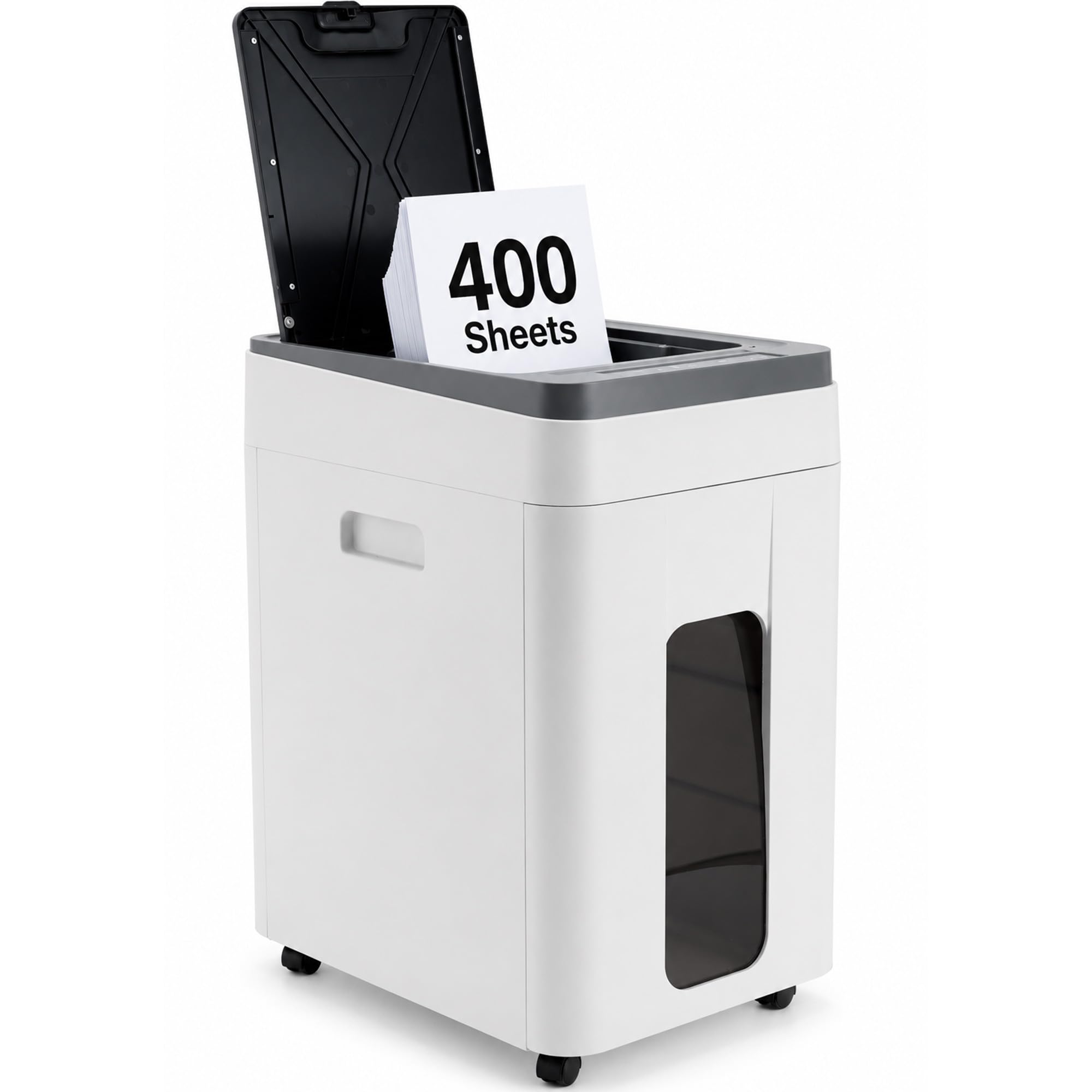
P-5 is the reason to look here. Particles come out at 2 by 12 mm, smaller than anything else in this group, and if you're shredding documents where a breach would be someone else's problem as well as yours, that's the level to buy. The 400-sheet auto-feed tray and 13.2-gallon bin are the largest here by a wide margin, and the 56 dB figure is the lowest stated noise in the set.

The manual slot handles credit cards and stapled sheets while the tray is running, and the jam-resistant feed pairs with overload and overheat alerts rather than a plain reverse button. Casters, a pullout bin with a window, and a machine that's built to sit in one place and be fed complete the picture, and we appreciated the window more than the spec suggests while the tray was mid-cycle.

For a small business clearing boxes of archived files, that combination is hard to beat, and it's the one we reach for when the job is an archive rather than a week of mail. The runtime claim is open-ended rather than a stated number of minutes, so pace a long session the way you would on any of these machines: in batches, with a pause between.

Bottom line: We choose this one for archives and client files: P-5 particles, a 400-sheet tray and the biggest bin here, if you have the floor space.

How We Tested Heavy-Duty Shredders

We started by pulling together the heavy-duty models sold at major retailers and office suppliers, then narrowed the list by cut type, sheet capacity, duty cycle, bin size, and the dimensions each manufacturer listed. We ended up with nine machines and ran them for eight months in a home office, a small business back office, and a converted garage where paperwork tends to pile up. Each one handled the same mix: bank statements, junk mail, envelopes with windows, occasional staples and paper clips, and the cardboard sleeves that come with online orders.

On the first pass, we fed each shredder a stack of ten pages at a time and listened for strain. We timed how long it ran before the motor needed a cool-down, then repeated the cycle after lunch to see whether it recovered or slowed down. We measured noise with a decibel meter from three feet away and noted whether the sound was a low hum or a high whine that carried through a closed door. We also checked the output by hand: whether the pieces were uniform confetti, long curls, or a mix that could be pieced back together.

Size got its own reality check. We measured each footprint, rolled or lifted the machine into place, and lived with it for a week before deciding whether it belonged under a desk, beside a filing cabinet, or in its own corner. Jams were cleared the way you would at home—by reversing, pulling, and sometimes swearing—and we noted how easy the cutter access was. Over the eight months, we kept track of any machine that needed repeated cool-downs, started rattling, or lost its edge on staples; at the end, we checked the build quality for wobbly wheels, loose bins, and cracked plastic. Value came down to what each one could handle without babysitting: a quiet, reliable shredder that ran all afternoon was worth more than a cheaper one that quit after twenty minutes.

How to Choose Heavy Duty Paper Shredders

Sheets per pass and minutes of runtime

Sheet ratings are ceilings taken with 20 lb letter paper, and feeding a machine at its maximum on every pass is the fastest way to cook a motor. What actually shapes your day is the duty cycle: how long it runs before a cooldown. The Fellowes 79Ci takes 16 sheets but stops after 20 minutes. The Aurora takes 12 and runs a full hour. If you shred a month of mail in one sitting, runtime wins every time; if you feed a few sheets through the day, pass capacity matters more than you'd guess.

Warranty cover is a useful tell about what the maker expects: a year on most of these, two years on the Fellowes. We put runtime ahead of sheet count for anyone clearing a backlog.

Cut type and security level

Everything here is P-4 or better, but the particles vary: 5 by 25 mm on the cross-cut machines, 4 by 12 mm on the micro-cut ones, and 2 by 12 mm on the kitnery, which is P-5. Smaller particles are harder to reconstruct and pack more densely, so the same bin holds more sheets before it fills. The cost is speed and price, because micro-cut makes more cuts per sheet.

For statements, invoices and tax paperwork, P-4 at 4 by 12 mm is plenty. Reach for P-5 only if a breach would be someone else's problem as well as yours.

Manual feed or auto feed

An auto-feed tray is a real luxury: load 200 to 400 sheets and walk away. It is also specific. Trays take flat, staple-free letter paper, so envelopes, folded mail, receipts and card stock go through the manual slot, and a crumpled stack jams the feed. Auto-feed machines are also the biggest and heaviest in this group, 34 pounds and up.

Buy one if you regularly face 50-page batches. If your shredding is a handful of envelopes a day, a manual machine with a long runtime gets you there for less.

Bin size, noise and where it lives

Bin capacity is really a question of how often you want to stop: 5 gallons holds roughly 300 sheets of shreds, 8 gallons closer to 700. Pullout bins beat lifting a head off a basket, and casters matter more as the machine gets heavier. Noise runs from 56 to 64 dB across this group, which is the difference between shutting a door and not bothering.

Measure the spot before you order. The biggest machine here wants about 19 by 14 inches of floor, and a socket within reach of the cord.

Frequently Asked Questions

Final Verdict

The Aurora AU1210MA is the machine we point most people to. An hour of continuous running clears a backlog in one sitting, the P-4 micro-cut particles are small enough for anything you'd worry about, and it costs less than everything else here. If your shredding arrives in twenty-sheet stacks, the BONSEN S3104 is the upgrade worth paying for; if you're clearing boxes rather than drawers, the Bonsaii C283-A's 200-sheet tray is the feature that changes the job.