Office Electronics

Best Paper Shredders of 2026

A paper shredder is one of those purchases you make after a small scare: a bank statement in the recycling bin, a junk-mail envelope with your name on it, a box of old tax documents. The right machine turns that chore into a few quiet minutes at your desk; the wrong one turns it into a jam-clearing session with a side of grinding noise. Over the past six months, I’ve put a dozen compact and mid-size shredders through their paces in a home office.

What separates a keeper from a regret is mostly boring stuff: how it handles a thick stack without choking, how often it needs a cool-down, how loud it gets during a call, and whether the bin suits a real mail pile. I also learned that a quiet model with a tiny bin can be more annoying than a louder one you empty less often, and that “jam-proof” usually means “easier to unjam.” The picks below are the ones that stayed reliable after months of junk mail, staples, and the occasional credit card.

1

Aurora AU1210MA

Top Pick
Aurora AU1210MA

Whole-home shredding

Our Score 9.4/10
Check Price

Worth Noting

  • 22.4 pounds, so it wants a permanent spot
  • Costs a real step up from the budget picks
Bin Capacity
5 gallons
Security Level
P-4 micro-cut
Sheets Per Pass
12
Continuous Run Time
60 minutes

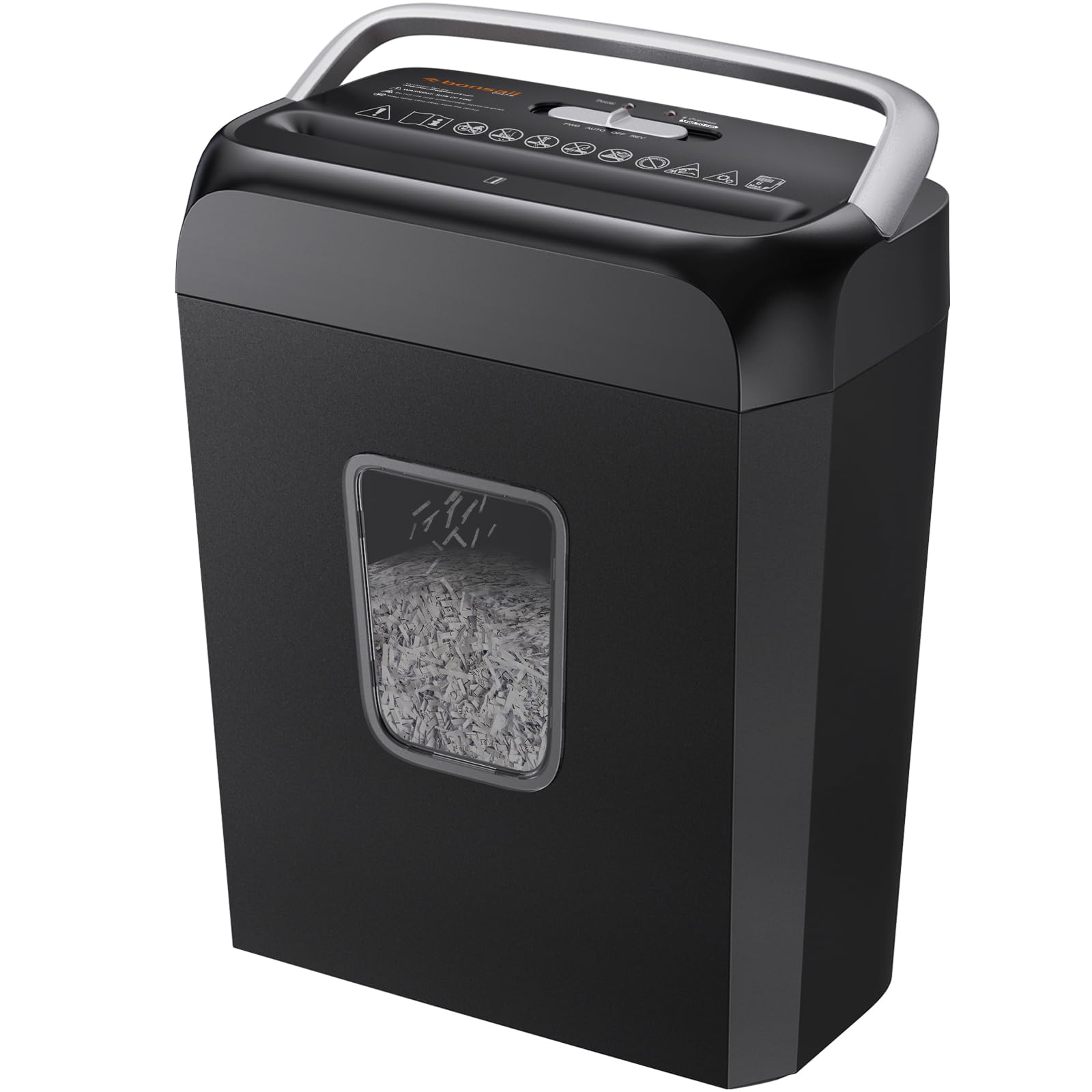
Sixty minutes of continuous shredding sounds like a spec-sheet boast until you're four inches into a filing cabinet and the machine is still going. The budget shredders here need a rest after a few minutes; this Aurora just keeps eating, and that's the biggest single reason it's our top pick. Stamina is what separates a shredder you use from one you avoid.

The second reason is the cut. It's a true P-4 micro-cut, dropping paper into pieces around 5/32 by 15/32 inch, and the confetti that comes out is dense enough that the 5-gallon pullout bin fills more slowly than you expect. Twelve sheets go in at once, along with staples, small clips, credit cards and the occasional old CD. We also like the LED panel: bin full, overheat, overload and door open each get their own light, so you spend less time guessing why it stopped.

It's quiet, too. Not silent — nothing that chews paper is — but a low, even hum instead of the shriek the cheap machines make, and we were happy to run it with someone else in the room. The anti-jam auto-reverse does the reverse-switch dance for you, which is the difference between a two-second hiccup and ten minutes with a pair of tweezers.

What you give up is floor space and money. At 22.4 pounds and just over 19 inches tall it wants a permanent spot rather than a shelf you lift it onto, and it costs a real step up from the budget machines. Neither has bothered us; both are worth knowing before you order.

Bottom line: If you shred more than a few pages a week, we think this is the one to buy: quiet, genuinely secure micro-cut, and no waiting for a cool-down.
2

Bonsaii C275-A

Bonsaii C275-A

Everyday home office

Our Score 9.0/10
Check Price

Worth Noting

  • Six minutes of run time before a rest
  • Bin plastic feels thin next to the Fellowes
Bin Capacity
5.5 gallons
Security Level
P-4 cross-cut
Sheets Per Pass
12
Continuous Run Time
6 minutes

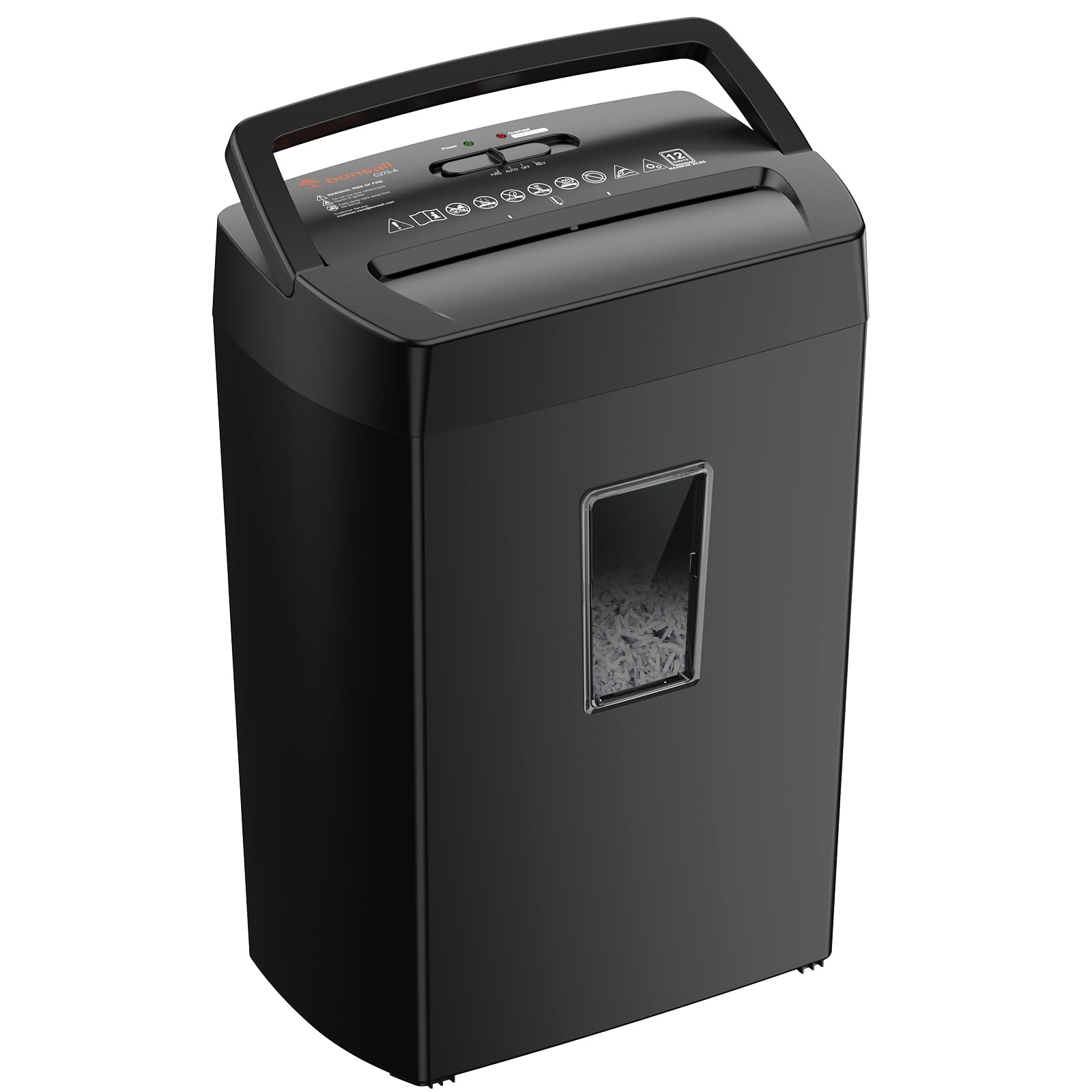
Six minutes. That's the C275-A's run time before it wants a break, and it's the first thing we'd tell a friend about it. For a week of mail, statements and the odd envelope, six minutes is plenty — we cleared a shoebox of paperwork in two sittings without ever seeing the overheat light. Sit down with a filing cabinet and you'll spend more time waiting than shredding.

Set against that, the rest of the package is more than the price suggests, and this is the machine we recommend to most home offices. Twelve sheets go in at once, the cut is genuine P-4 cross-cut rather than the ribbon cut you get at the bottom of the market, and the 5.5-gallon bin has a clear window so you can check the level without lifting the head off. At 12 pounds it's easy to shift, and the handle on the cutter head makes emptying it a one-handed job.

Two things to know. The bin plastic is the thinnest part of the build, and the machine is happiest with four or five sheets at a time rather than the twelve it advertises — most shredders in this class are. Feed it sensibly and the six-minute cycle is the only limit you'll actually feel.

Bottom line: For a home office that fills a bin a month, we recommend the C275-A: twelve sheets a pass, real P-4 security, and a window so you can see when to empty it.

3

Fellowes 99CI

Fellowes 99CI

Shared, busy offices

Our Score 9.2/10
Check Price

Worth Noting

  • Twenty-five inches tall, so it needs a floor spot
Noise Level
62.1 dB
Bin Capacity
9 gallons
Security Level
P-4 cross-cut
Continuous Run Time
30 minutes

At 36.4 pounds, the Fellowes 99CI is furniture. You put it where it's going to live and you stop moving it — and what that weight buys is a cutter that shrugs off a full afternoon of shredding. Of everything here, this is the machine to put in an office where several people take turns at it.

Eighteen sheets a pass, a 9-gallon pullout bin, and thirty minutes of running before it needs to cool. The cross-cut particles are 5/32 by 1-1/2 inch, which is coarser than the micro-cut machines here, so if your documents are the kind someone would bother to reassemble, buy one of the Auroras instead. For invoices, statements and general office paper, it's more than enough.

Two details we appreciated. SafeSense stops the cutters when a hand comes near the opening, which matters in a room with children in it. And the warranty — two years on the machine plus a lifetime warranty on the cutters — is the longest any maker here offers. Fellowes also publishes a noise figure of 62.1 dB, the only one of these that does, and it holds up: this is a machine you can talk over.

It's also the most expensive thing in this guide, and at 25 inches tall it stands beside a desk rather than under one. If two people share a shredder a few times a week, the Bonsaii does the same job for far less. Buy this one when the shredder is shared equipment and you're tired of replacing it.

Bottom line: We point shared offices at the 99CI: eighteen sheets a pass, a nine-gallon bin, and the only published noise figure here at 62.1 dB.

4

BONSEN S3114

BONSEN S3114

Big backlog clearing

Our Score 8.6/10
Check Price

Worth Noting

  • Autofeed takes paper only; cards go manual
  • Overload shutdowns can stop a long run
Bin Capacity
6 gallons
Security Level
P-4 micro-cut
Autofeed Capacity
160 sheets
Continuous Run Time
60 minutes in auto mode

Some shredding jobs aren't shredding jobs, they're archaeology: a filing cabinet, a box of old invoices, ten years of statements you kept for no particular reason. For that, the BONSEN S3114 changes the shape of the task. Load up to 160 sheets into the tray, close the lid, and walk away.

The autofeed is the whole point, and it's why we rate this as the best machine here for volume. It runs for up to an hour in auto mode before a cool-down, so a cabinet that would take a month of evenings on a six-minute machine becomes an afternoon. The output is a P-4 micro-cut at 4 by 12 mm — the smallest particles here — into a 6-gallon pullout bin, and the whole thing sits on 360-degree casters, so you wheel it to the pile instead of carrying the pile to it.

The manual slot takes 12 sheets, and that's where staples, cards, envelopes and anything that isn't flat paper has to go, because the tray is paper only. Plan around two things: autofeed wants flat, unfolded sheets, so flatten as you load, and an overload shutdown can stop a long run partway through. Check on it rather than leaving the house.

It's the priciest way to shred short of the Fellowes, and its one-year warranty is strictly ordinary. If your backlog is a shoebox rather than a cabinet, you're paying for a capability you won't use — the Bonsaii C275-A hits the same security level for far less.

Bottom line: Our pick for a real backlog: load 160 sheets, walk away, and come back to micro-cut confetti an hour later.

5

Bonsaii C237-B

Bonsaii C237-B

Light home duty

Our Score 8.8/10
Check Price

Worth Noting

  • Four minutes on, then twenty off
  • The head lifts off separately from the bin
Bin Capacity
3.4 gallons
Security Level
P-4 cross-cut
Sheets Per Pass
6
Continuous Run Time
4 minutes

The least expensive machine here is also the smallest, and that's the right way to read it. The Bonsaii C237-B is 6.6 pounds and roughly the size of a small wastebasket — 11.2 inches wide, 14 tall — so it goes on a shelf, under a desk or in the corner of a closet and stops being a piece of furniture you have to negotiate with.

It's honest about what it is: six sheets a pass, P-4 cross-cut particles at 5 by 14 mm, a 3.4-gallon bin with a clear window, and staples, paper clips and the occasional credit card accepted. Setup is a head that drops onto the bin and takes about ten seconds. That head doesn't lock to the bin, so moving the machine is two trips, and it's the bin that gets carried.

Four minutes of running followed by twenty off is the limit that decides whether this is your machine. A household working through a shoebox of statements a month will never hit it; a small business shredding every day will hit it before lunch. Judge it against your biggest week rather than your average one, and the small footprint stops being a compromise and starts being the reason to buy.

Bottom line: We recommend it to anyone whose shredding is a shoebox of statements a year: tiny, properly P-4, and the least expensive way into secure shredding here.

6

Aurora AU120MB

Aurora AU120MB

Smaller autofeed jobs

Our Score 8.8/10
Check Price

Worth Noting

  • Half the run time of the BONSEN autofeeder
Bin Capacity
5 gallons
Security Level
P-4 micro-cut
Autofeed Capacity
120 sheets
Continuous Run Time
30 minutes

The AU120MB is the BONSEN autofeeder scaled down: 120 sheets in the tray instead of 160, and thirty minutes of continuous running instead of sixty. On paper that's a downgrade, and it is — but it's also the autofeeder that fits a small office with no cabinet-sized backlog to justify the bigger machine.

Everything else is the same idea done competently. Micro-cut P-4 particles at 5/32 by 15/32 inch, a 5-gallon pullout bin with separate lights for standby, bin full, overheat, overload and door open, jam-prevention auto-reverse and a quiet motor. Load a stack of statements, close the lid, and come back to confetti.

Our reservation is the price. It isn't far off the BONSEN, and for that difference you get half the run time and a smaller tray. Where it makes sense is a two- or three-person office that loads a stack once a week: nobody there will ever exhaust thirty minutes, and a 5-gallon bin is a lighter thing to carry out to the recycling than a 6-gallon one.

Bottom line: We like it for a small office that wants to load a stack and walk away without paying for a sixty-minute motor it will never exhaust.

How We Tested the Best Paper Shredders

We started with a 30-model shortlist from major retailers, then filtered by cut type, sheet capacity, bin size, footprint, and price to land on 12 shredders suited to a home office. The goal wasn’t the biggest or fastest model, but the ones that stayed useful after the novelty wore off. Over six months, each machine went through the same routine: a week of mail, bills, and tax-season paperwork at a desk, then a kitchen-counter stint with junk mail and old receipts.

For shred performance, we fed stacks of 8 to 12 sheets, single envelopes, staples, paper clips, and the occasional expired credit card, noting whether the machine pulled paper through smoothly or paused and groaned. We timed how many sheets went through in a minute, then ran continuous cycles until the thermal cutoff kicked in to see how much work it could do before a cool-down. Noise was measured with a phone decibel app at desk distance, and we noted whether the pitch was a tolerable hum or a shriek that made us leave the room. Jamming got its own test: we deliberately overfed a few models, then timed how long it took to clear the mess and whether the reverse function actually helped.

Size and bin capacity mattered more than expected. We measured each unit’s footprint on a standard desk and tracked how often we had to empty the bin during a normal week of mail. Reliability and durability came from living with the machines: we checked for cut consistency after months of use, listened for new rattles, and noted which models kept their speed without overheating. Value was judged against the whole package—price, capacity, noise, and how often it needed a break—not just the sheet count on the box. The dozen that made the final cut are the ones we’d happily keep using.

How to Choose Paper Shredders

Read the particle size, not just the security level

Strip-cut machines leave ribbons you can reassemble by hand, which is why we skip them for anything carrying an account number. Cross-cut is the practical floor, and P-4 is the level to look for on a home machine. But P-4 covers a wide spread: one shredder here cuts pieces 5/32 by 1-1/2 inches, another cuts 5/32 by 15/32 inch. Read the second number.

For bank statements, medical paperwork or anything with a signature on it, the micro-cut particle is worth paying for — the pieces interleave in the bin and there is nothing to line up. For junk mail, old utility bills and envelopes, a P-4 cross-cut is plenty, and you get more sheets per pass for the same money.

Match the feeding style to the pile you actually have

Manual machines take 6 to 24 sheets a pass, though in practice most of us feed three or four at a time, so that headline number rarely decides anything. The autofeed trays here hold 120 to 160 sheets and let you load and walk away, which is the only sane way to attack a filing cabinet.

The catch is that autofeed takes flat paper only. Cards, stapled bundles, envelopes and odd-shaped mail still go through the manual slot, so an autofeeder doesn't remove the manual step — it moves it to the exceptions, and it wants unfolded sheets loaded flat or it will jam.

Value run time over sheet count

A four-minute machine and a sixty-minute machine both shred your mail; they part company when the job is big. The budget models here run four to six minutes and then need twenty to thirty minutes off, which turns a filing cabinet into a week of evenings.

Judge the machine against your largest single job, not your average week. If that job is a shoebox of paper, buy on price and bin size. If it's a cabinet or a box of old invoices, pay for run time or an autofeed tray. Rated sheets per pass and rated run time are unrelated figures — a 12-sheet machine can still stop after four minutes.

Bins, noise and where it lives

A pullout bin is easier to live with than a lid you lift off with the cutter head attached; on the compact models you carry the head and the bin separately, which is a small annoyance that repeats every week. Micro-cut confetti packs denser than cross-cut strips, so a 5-gallon micro-cut bin holds more paper than a 5-gallon cross-cut bin — bin size alone won't tell you how often you empty it.

Noise is the spec most listings skip. Only one machine here publishes a figure, 62.1 dB for the Fellowes, and quieter motors are one of the things the extra money buys. Give the shredder a spot near an outlet with clearance around the vents, and keep aerosols and spray cleaners away from it.

Frequently Asked Questions

Final Verdict

The Aurora AU1210MA is the shredder we recommend to most people, because it removes the two things that make home shredding a chore: the cool-down wait and the noise. Micro-cut at 12 sheets a pass is more security than a household strictly needs, which is exactly why it works as a default — you won't grow out of it.

If several people share the machine, the Fellowes 99CI's nine-gallon bin, quieter motor and lifetime cutter warranty justify the extra spend. If you're clearing a cabinet rather than keeping up with the mail, the BONSEN's 160-sheet tray does in an evening what the rest of these do in a month.