Office Electronics

Best Laminators of 2026

A laminator has one job, and it either does it or it eats what you fed it — a curled sheet with a milky haze across the middle, or a pouch welded around the rollers. I've hovered over enough school-project laminations to know the difference between a machine that seals clean on the first pass and one that needs a second run and still looks cloudy. What you're paying for is hot, even rollers and a footprint small enough to disappear into a closet between uses.

My team and I spent six months with 12 laminators, running flash cards, bookmarks, and full-page certificates through each one. Heat-up ranged from about 30 seconds to over four minutes, and the fastest machines weren't the cleanest sealers. Nobody tells first-time buyers that pouch thickness matters more than the speed setting, or that a jam-release lever is worth more than an extra feed tray — and what's in the box often decides whether a cheap machine is a real bargain. The picks below earned their counter space.

1

Crenova A4 Laminator

Top Pick
Crenova A4 Laminator

Everyday home use

Our Score 9.2/10
Check Price

Worth Noting

  • Heat settings are hot and cold only, with no mil setting
  • Feed slot stops at 9-inch pouches
Modes
Hot and cold
Warm-up
1-2 min
Footprint
13.78"L x 4.13"W x 3.15"H
Feed Width
9 in

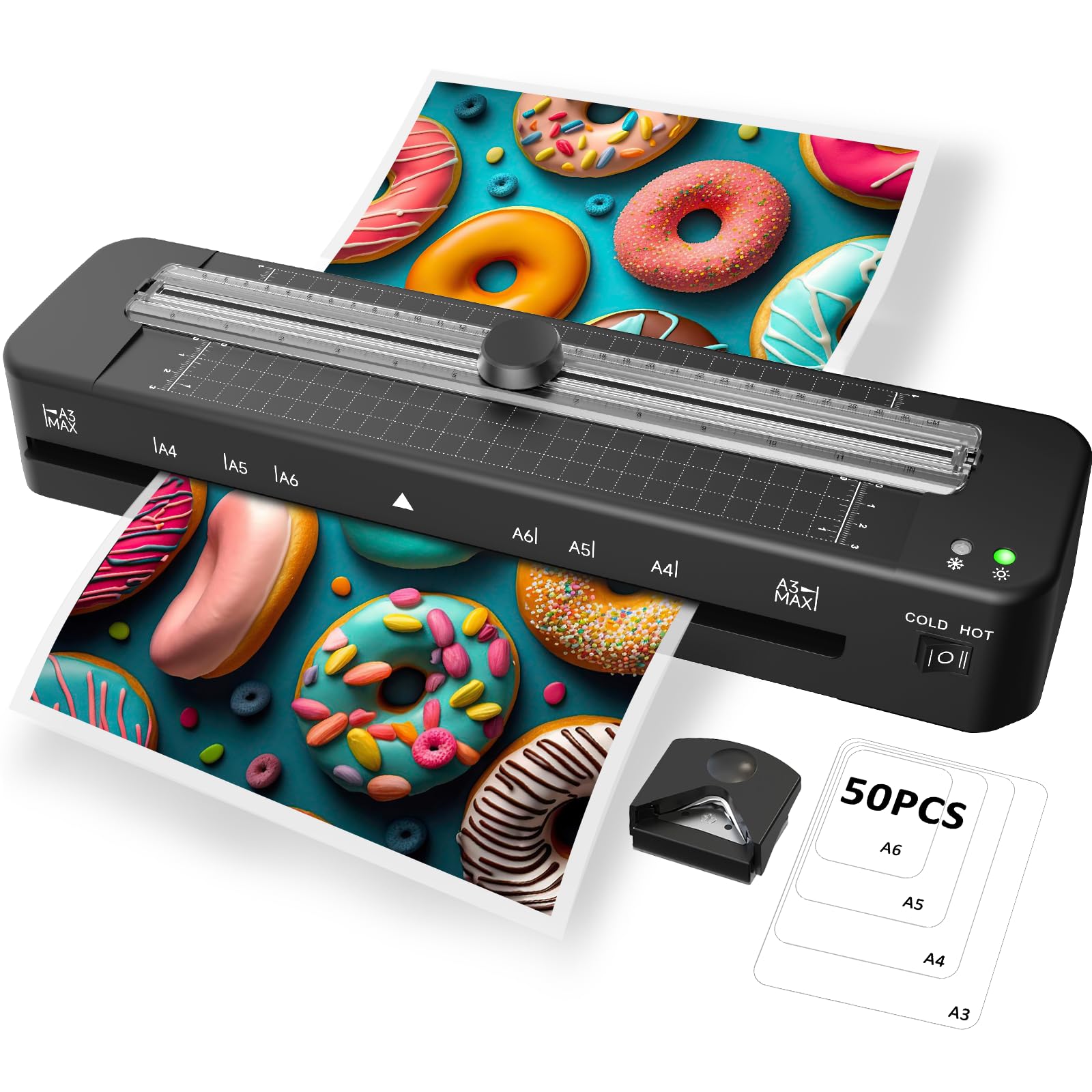
The box does a lot of the selling: a laminator, ten pouches, a paper trimmer and a corner rounder, for less than any other machine on this page asks for the machine alone. We set it up for a batch of flash cards and had the first sheet through before the second cup of coffee went cold. For a household that laminates a few times a month, that combination of nothing else to buy, nothing to assemble and a slot that takes a full letter sheet is the easiest recommendation in this roundup.

The 9-inch inlet swallows A4 and letter pouches with room on each side, and one switch does the rest: HOT or COLD. We did find that small cutouts fed loose can catch at the mouth of the slot, so give anything smaller than a business card a pouch with a clear border around it and the feed straightens out. For documents and worksheets, that is the only technique you need.

Where it feels its price is the long haul. The body is light plastic, the feed is single-speed, and a whole afternoon of classroom prep is more than it was built for. That is not the job most people have. It goes back in a drawer when you are done, which is more than the wide machines can say, and it is ready again a minute after you plug it back in.

Bottom line: We think it is the best first laminator you can buy here: hot and cold modes, a cutter, a corner rounder and ten pouches for less than any other machine on the page.

2

Bonsaii 9-Inch Laminator

Bonsaii 9-Inch Laminator

Jam-prone projects

Our Score 9.2/10
Check Price

Worth Noting

  • Three-minute warm-up before the first sheet
  • Feed speed near the slow end of this group
Warm-up
1-3 minutes
Feed Width
9 in
Included Sheets
50
Pouch Thickness
3-5 mil

Bonsaii's answer to the thing everyone worries about is a feed engineered not to jam, and the company puts two years of service behind the machine. Fifty 3-mil pouches come in the box as well, which means you can find out whether you are actually a laminating household without buying film first.

After a stack of worksheets and a run of laminated labels, we think the anti-jam design earns its billing: the feed takes a trimmed pouch straight and square, and we never had to hold the exit steady to keep a sheet from curling. It is not quick, though. At 0.98 feet per minute it sits near the slow end of this group, so a letter sheet spends close to a minute inside the rollers. Twenty sheets is a coffee break rather than a five-minute job.

Sealing is the part that needs a little care. Thin margins are where a pouch comes out cloudy along one edge, and a second pass through the machine clears it, so leave a quarter inch of film all round anything you plan to keep. It stores on a cabinet shelf without complaint, which matters more than it sounds in a house where the ironing board already has a spot.

Bottom line: This is our pick for anyone who has lost a sheet to a jam: the anti-jam feed is the whole point, and the two-year service and fifty starter pouches make it a low-risk first buy.

3

Scotch PRO TL906

Scotch PRO TL906

Heavy weekly use

Our Score 9.2/10
Check Price

Worth Noting

  • Five-minute warm-up, the longest of the nine-inch machines here
Warm-up
5 minutes
Feed Speed
1.25 feet per minute
Feed Width
9 in
Pouch Thickness
3-5 mil

Five minutes is the honest warm-up figure for the TL906, and it tells you what kind of machine this is: not something you grab for a single sheet, but a small appliance that sits on the desk and runs all afternoon. What you get in exchange is two heated rollers and two temperature settings rather than one heat, which is what lets 3-mil and 5-mil film each get the pressure it needs.

We ran name tags and a batch of photo pages back to back, and the difference showed at the edges. The 5-mil pouches came out flat and clear, with no bubbles creeping along the seal. The 1.25 feet per minute feed is brisk for a 9-inch unit, a letter sheet is in and out in well under a minute, and it is quiet enough to run while somebody is on the phone in the same room.

It is a 3.2-pound machine that stays where you put it, and the 3M limited warranty is the sort of thing you only test when something goes wrong. The cost is patience at the start: if you laminate once a month, five minutes of waiting is a genuine tax, and the Crenova is ready in a fraction of that.

Bottom line: If you laminate most weeks and want even pressure on thicker film, this is the 9-inch machine we reach for; just switch it on before you start sorting sheets.

4

Scotch 13-Inch Laminator

Scotch 13-Inch Laminator

Wide documents

Our Score 8.8/10
Check Price

Worth Noting

  • Takes 13-inch sheets, not 11x17
Weight
4.2 lb
Warm-up
1 minute
Feed Speed
11.8 in per minute
Feed Width
13 in

Thirteen inches of feed slot changes what you can laminate: letter and legal pouches with room to spare, landscape handouts, menu covers, small posters. Nothing in the group reaches temperature faster, at one minute, and 11.8 inches per minute through the rollers is quick enough that a set of handouts does not turn into an afternoon.

The rest of the numbers are just as plain. Two heated rollers do the pressing, and the 4.2-pound body is heavy enough to sit still while you feed it one-handed. That last point sounds trivial until you have chased a lighter machine across a desk mid-pouch.

Width is the entire argument, and it is a narrow one. If your documents are letter or legal size, the nine-inch machines here do the same job with less desk under them, and the Crenova throws in a cutter as well. If your sheets are genuinely wider, this is one of three machines in this group that takes them, and it is the fastest of the three.

Bottom line: Buy it when the sheet is wider than letter size and you want a name behind the rollers; for A4 and letter work the nine-inch machines here are the smarter spend.

5

Fellowes Saturn 125

Fellowes Saturn 125

Busy school offices

Our Score 9.0/10
Check Price

Worth Noting

  • Five pounds and a 20.9-inch-long body
Warm-up
1 minute
Warranty
2 year
Feed Width
12.5 in
Thickness Settings
3, 4 and 5 mil

The Saturn is the only machine here that behaves like office equipment rather than a kitchen gadget. It is the biggest and the priciest of the group, it weighs five pounds, and it wants nearly 21 inches of desk. None of that makes sense in a kitchen drawer; all of it makes sense in a school office that runs a few hundred sheets a term.

The features that justify it are the ones you stop noticing once they work. Jam detection catches a mis-feed before it wraps around the rollers, and the manual release lever unlatches them so a pouch pulls back out instead of the machine being taken apart to get it. CleanAlert nags you to run a cleaning sheet, and the unit shuts itself off when it has been idle.

Three thickness settings, 3, 4 and 5 mil, plus a 12.5-inch entry make it the most flexible machine here, and the 60-second warm-up means the flexibility does not cost you a wait. We moved between 3-mil cards and 5-mil tags with one button press, and the temperature held between the changes.

Our hesitation is about the long game rather than this week. Machines in shared rooms get used hard, and dirty rollers are the usual reason a laminator starts leaving marks, which is exactly why the cleaning reminder is there. Buy it for a school, a print room or a church office where the counter runs daily. At home it is capacity you will never touch.

Bottom line: For a school office or a copy room that runs daily, this is the machine we point to; a household laminating a few sheets a month should keep the desk space and the money.

6

SINOPUREN 9-Inch Laminator

SINOPUREN 9-Inch Laminator

Binder-ready projects

Our Score 9.0/10
Check Price

Worth Noting

  • Three-minute warm-up
  • Widest 9-inch body here at 5.5 inches
Warm-up
3 minutes
Feed Width
9 in
Built-in Tools
Paper trimmer and 2-hole punch
Included Pouches
10 A4 3 mil

A trimmer bolted to the top of a laminator sounds like a gimmick until you have trimmed a hundred flashcards at a kitchen table. SINOPUREN fits a paper trimmer and a two-hole punch to the machine, adds a separate corner rounder and ten A4 3-mil pouches, so the whole job of laminating, trimming, punching and filing happens in one place with one power cord.

We used it for binder-ready reference sheets: laminate, trim to size on the built-in cutter, punch two holes, straight into the folder. It runs a single roller where most machines here use a pair, which is the more basic feed design in this group, and it held its line on everything we sent through.

It earns its place where finishing is the bottleneck, meaning the trimming and punching rather than the laminating itself. If your projects are photographs or big posters, the tools are dead weight and a wider machine serves you better. For classroom prep and office binders, nothing else here keeps the cutter and the punch attached to the machine.

Bottom line: It is the one here that saves a step you would otherwise do by hand, so we recommend it for classroom prep and office binders rather than photo projects.

7

Raycial 13-Inch Laminator

Raycial 13-Inch Laminator

A3 and posters

Our Score 8.6/10
Check Price

Worth Noting

  • Included sheets are mostly A5 and A6
  • 16.9-inch body needs a wide shelf
Modes
Hot and cold
Warm-up
95 seconds
Feed Width
13 in
Included Sheets
50, four sizes

The Raycial is one of three machines here that take a 13-inch sheet, and it is the one that goes after 11x17 and A3 by name. That is a different job from laminating letters: anchor charts, posters, menus, anything a teacher wants on the wall and reusable next term.

Our judgement after a run of A4 and a couple of A3 sheets is that the format is the reason to buy and the heat is the reason to be careful. Rushed, it can leave a pouch sealed at the edge and cloudy in the middle. Give it the full 95 seconds, run one test sheet in each pouch size, and the rest of the stack behaves.

The package is generous: fifty sheets across four sizes, a paper cutter, a corner rounder, an ABS release button for the jam that eventually comes, and a two-year warranty. The sheets skew small, most of them A5 and A6, so plan on buying A3 film separately if big formats are the whole point.

Bottom line: If your projects are bigger than letter size, this is the machine that gets you to A3 without stretching to the Fellowes, provided you test the heat before committing a stack.

8

Elysine 13-Inch Laminator

Elysine 13-Inch Laminator

Classroom kits

Our Score 9.2/10
Check Price

Worth Noting

Modes
Hot and cold
Warm-up
60 seconds
Feed Width
13 in
Accessory Storage
Built-in compartment

The Elysine's trick is a compartment built into the body that swallows its own accessories, so the trimmer, the corner rounder and spare pouches travel as one lump and nothing goes missing between September and June. In a classroom that is worth more than any single line on the spec sheet.

It warms in about a minute and feeds at 450 mm/min, which puts it among the quicker 13-inch machines here. We ran a mixed pile of A3 charts and small labels without a jam, and the wide sheet came out flat from edge to edge.

Hot and cold modes cover the usual ground, and the 13-inch entry takes A3 and 11x17 alongside letters, the same format range as the Raycial from a kit that is easier to keep together. The dual-roller feed and the temperature control are the parts doing the work.

Long-term wear is the open question on this one, so check the first finished sheet a day later. A pouch that lifts at the edge within 24 hours is telling you about the heat, not the film. Buy it for the format range and the storage, and keep the carton until a couple of dozen sheets have come out clean.

Bottom line: We recommend it where the kit has to survive a school year intact: the storage compartment, 13-inch range and one-minute warm-up make it the tidiest classroom machine here.

How We Tested These Laminators

We started by pulling every laminator in stock that was sized for a home office or small classroom — no roll-fed commercial units — then filtered by throat width, whether the machine handled 5-mil pouches as well as standard 3-mil, and what came in the box. Reviews did a lot of the cutting: anything that popped up repeatedly in complaints about jams, uneven heat, or a motor dying within months was out before we spent a dollar. That left 12 machines.

Each one lived on a kitchen counter or a spare desk for six months and got used the way people actually use a laminator: flash cards, bookmarks, a book report, wet-erase classroom signs, price tags for a craft seller. We timed heat-up from cold with a stopwatch, counting only when the machine was genuinely ready rather than just lit up. Every unit sealed a printed page in 3-mil and cardstock in 5-mil; we held each sheet to a window to check for cloudiness, ran a thumb along the edge to see if it lifted, and noted whether it came out flat or curled.

Jams got their own test: we fed a pouch in crooked on purpose, then cleared it and noted whether the release lever saved the sheet and how long the rescue took. We felt the housing after 20 straight sheets, listened to the rollers at desk distance, and measured each footprint with the tray folded, since most of these end up in a closet. Last, we ran a fresh pouch after all that use to see whether the seals were still clean.

How to Choose Laminators

Start with the widest sheet you laminate

The number in the product name is the feed width, and it is a hard ceiling. Nine inches covers A4 and letter pouches with room to spare. Thirteen inches covers legal, landscape handouts, menus and small posters. What thirteen inches does not cover is 11x17, because that sheet is 17 inches wide and needs a machine whose listing names A3 or 11x17.

We would rather see you buy for your widest realistic project than for the average one. If that widest project is a letter worksheet, a 9-inch machine does everything a 13-inch one does with less desk underneath it.

Warm-up and feed speed decide how a batch feels

A one-minute warm-up and a five-minute one are the difference between laminating a permission slip now and deciding to do it tomorrow. Feed speed matters just as much once you are going: at 11.8 inches per minute a letter sheet spends about a minute inside the rollers, so a class set of thirty is a half-hour job before trimming.

If you laminate in batches, buy for speed and accept a slower start. If you laminate a sheet at a time, buy for warm-up and ignore the throughput figure entirely.

Buy a release lever, then feed small pieces properly

Every machine here can jam; the question is what happens next. A release lever or an ABS button unlatches the rollers so a pouch pulls back out instead of the machine coming apart. That is worth more than a marketing claim about never jamming, because the pouch that jams is usually the one you cannot reprint.

The other half is technique. Leave a clear border of film around anything small, and feed narrow strips inside a pouch rather than loose, since a loose strip is exactly what catches at the mouth of the slot.

Match pouch thickness to how the sheet gets handled

3 mil is the everyday film: flexible, fine for worksheets, flashcards and signs that go on a wall. 5 mil is stiffer and survives handling, which is why it belongs on bookmarks, luggage tags and anything a child will bend. Most machines here take both.

Not all of them switch heat to suit, though. The Scotch PRO and the Fellowes have dedicated thickness settings; the Crenova gives you hot and cold and nothing in between. A 5-mil pouch run on thin-film heat is where cloudy corners and peeling edges come from.

Cold mode is for photographs, not just thick film

Cold laminating uses a pressure-sensitive pouch instead of heat. It is the setting for inkjet prints, thermal receipts and anything that would darken or cockle at laminating temperature, and it is the one feature we would not compromise on if photos are the main job.

Check the listing rather than assuming. Several machines here offer hot and cold; a hot-only machine will cockle an inkjet print, and that is not a fault you can fix afterwards.

Frequently Asked Questions

Final Verdict

The Crenova is the machine we recommend to most people. It is the least expensive here and still arrives with pouches, a cutter and a corner rounder, it is ready in a minute or two, and it handles the letters, worksheets and photos that make up almost all home laminating.

Two requirements move the answer. If you laminate most weeks and want even pressure on 5-mil film, the Scotch PRO's paired heated rollers justify the slower start. If your sheets run wider than letter, the Raycial or the Scotch 13-inch takes sizes the nine-inch machines physically cannot.