Smart Home & Security

Best Outdoor Smart Plugs of 2026

The fantasy is a patio strung with lights, a fountain murmuring in the corner, an inflatable snowman glowing on the lawn. The reality is you crouched behind a shrub at eleven at night, yanking a plug out of a wet extension cord. An outdoor smart plug moves all of that onto your phone — schedules, sunset triggers, one tap from the kitchen — so you're not wading through wet grass to cut the power, and not lying awake wondering whether the lights have been burning since noon.

I've had one die mid-December with an entire light display running, so I care less about clever features than whether a plug keeps its schedule when the Wi-Fi hiccups. We've spent four months with 14 of them, and the pattern held: the ones that last are the ones you can set up in five minutes and still switch by hand when the app won't load. Most run only on 2.4GHz, and the far corner of the yard is exactly where that band struggles. The plugs that handled it without complaint are the ones below.

1

Tapo P400M

Top Pick
Tapo P400M

Most yards

Our Score 9.0/10
Check Price

Worth Noting

  • Some units stop powering on within a year
Outlets
2, independent
Works With
Matter; Alexa, Google Home
Load Rating
15 A / 1800 W
Weather Rating
IP65

Most outdoor plugs tie you to one app and one assistant, and changing your mind later means starting over. The Tapo P400M sidesteps that with Matter: it pairs once and then turns up in Apple Home, Alexa, Google Home or SmartThings, whichever you already run. Two outlets sit at the end of a six-inch cable, each with its own switch and its own schedule.

The part we appreciate most is that the flexibility does not cost you hardware. The housing is IP65, the best rating on any dual-outlet plug in this group, with covers that stay attached and a clamp and screw in the box for wall mounting. Two independent 15-amp sockets at that level of sealing is exactly the combination a patio wants: string lights on one, a fountain or a bug zapper on the other, both off by eleven whether or not anyone remembers.

Setup runs through the Tapo app's guided routine and needs 2.4GHz Wi-Fi, with no hub and no subscription. TP-Link quotes 300 feet of range in open field, which in a garden means line of sight through maybe one wall, so an outlet at the back of a lot behind a brick garage will want a mesh node closer to it. The six-inch cable is long enough to reach past a cover and short enough not to dangle.

Mounting is straightforward: a clamp and screw are in the box, the cable clears most covers, and the body can hang from a post or sit flat against a wall. Site it where you can reach it without a ladder, because the two-year warranty is the backstop and swapping a plug is easier when it is not behind a mature shrub.

Bottom line: Matter support, IP65 sealing and two separately switched outlets make this the plug we point most people to, especially anyone who might change phone platforms in the next few years.

2

Kasa EP40

Kasa EP40

Two-device setups

Our Score 9.2/10
Check Price

Worth Noting

  • Pairs poorly at the edge of Wi-Fi coverage
Outlets
2, independent
Cord Length
6 in
Load Rating
15 A / 1875 W per outlet
Weather Rating
IP64

Two outlets that switch independently is the whole reason the Kasa EP40 stays on our patio: lights on one, the bug zapper on the other, each with its own schedule. What seals it is the capacity: 15 amps and 1875 watts at each socket rather than shared between them, which is more headroom than most dual-outlet plugs here give you.

The rest is the Kasa app, the same one the brand's indoor plugs and bulbs use, so an outdoor plug can be grouped with the lamp in the hallway and switched with a single tap. Schedules and a countdown timer do the daily work, the sunset and sunrise offset shifts them through the year without anyone touching it, and the attached covers keep the sockets out of the dirt when nothing is plugged in. A clamp and screw come in the box for mounting it to a post.

Where it lands in the group is the value question. Two independently switched sockets, a two-year warranty and mounting hardware in the box is a lot of plug for the money, and the only thing it really asks in return is a decent 2.4GHz signal at the outlet. If your yard is a Wi-Fi dead zone, fix that first; if it is not, this is the straightforward buy.

Bottom line: For two devices on two schedules, the EP40 gives you more usable socket capacity than anything else here at the price, plus the Kasa app to run it.

3

Kasa KP401

Kasa KP401

Single fixtures

Our Score 9.0/10
Check Price

Worth Noting

  • 90-degree body fights recessed in-use covers
Outlets
1
Load Rating
15 A / 1875 W
Wi-Fi Range
Up to 300 ft
Weather Rating
IP64

One fixture, one plug. The KP401 is what we reach for when a single thing needs a schedule, whether that is a fountain pump, a run of path lights or the tree in December, and it is the least expensive route into the Kasa app here. It is also rated for 300 feet of Wi-Fi range, which matters when the outlet is on a garage wall at the back of the lot.

The 90-degree body is the detail to check before ordering. It keeps a cord flat against the wall and out of the mower's path, and it can be genuinely stubborn going into a recessed in-use cover where a straight plug slides in. Measure the depth of your box, or plan on a short outdoor-rated extension cord. Otherwise this is a plain, sealed 15-amp single socket with a two-year warranty, and for one device it is all the plug most people need.

Bottom line: A single sealed socket with long Wi-Fi reach and a two-year warranty, and the least expensive way to put one outdoor fixture on a schedule.

4

Lutron Caseta Outdoor Plug

Lutron Caseta Outdoor Plug

Caseta households

Our Score 9.4/10
Check Price

Worth Noting

  • No dimming: on/off switching only
Hub
Caseta Smart Hub required
Outlets
1
Load Rating
15 A or 1/2 hp
Weather Rating
IP65

Lutron builds the Caseta outdoor plug like an outdoor fixture rather than an accessory: a polycarbonate body, fully protected internal electronics, an IP65 rating, and a fit and finish that makes the cheaper plugs feel like what they are. It is the piece of hardware in this group we would happily leave on a wall for a decade.

It connects through Lutron's own radio rather than Wi-Fi, so it needs a Caseta Smart Hub in the house, and that is the requirement that decides whether it belongs to you. In exchange it will switch 15 amps or a half-horsepower motor, enough for a fountain pump or a vent fan that would give a cheaper relay trouble, and the system keeps its own clock, holding schedules through daylight saving changes and power cuts without a trip outside.

For a HomeKit household already on Caseta, none of the arithmetic is difficult: the plug lands in the same app and the same scenes as the switches on the wall, and it joins a system that does not ask for much attention. Everyone else should look hard at the Tapo, where the same two-outlet job needs no bridge and no second hub on the shelf.

Bottom line: Buy it when a Caseta hub already runs your lights: the housing, the half-horsepower rating and the schedule that survives outages are the best of any single-outlet plug here.

5

DEWENWILS Smart Yard Stake

DEWENWILS Smart Yard Stake

Multi-device yards

Our Score 8.6/10
Check Price

Worth Noting

  • All six sockets share one schedule
Outlets
6, one schedule
Mounting
Yard stake
Cord Length
6 ft
Load Rating
15 A / 1875 W

Six outlets on a stake answers a very specific mess: the tangle of adapters and single plugs that builds up wherever path lights, a fountain and the holiday decorations all want power. DEWENWILS puts six grounded sockets on a six-foot cord with a stake to push into a bed, rated for 15 amps and 1875 watts across the lot of them.

All six switch together, and that is the design rather than a shortcoming, because a lighting run should come on as one at dusk and one schedule is easier to live with than six. What we like about the stake format is the height: it lifts the connections out of wet grass and standing water, which is exactly where an extension cord on the ground goes wrong. An overload switch on the body is a small thing that matters when everything is plugged in at once.

Two boundaries worth naming. There is no IP number on the listing, only a waterproof cover over the sockets, so treat it as sheltered rather than sealed and site it under an eave or behind a shrub. And the sockets are one circuit: if the fountain should stop at nine while the lights run to midnight, this is not the plug, because the Tapo and the EP40 handle that split.

Bottom line: Six sockets, one schedule and a stake that keeps the connections off the ground: the tidy answer for a yard with more devices than outlets.

6

Amazon Basics Outdoor Plug

Amazon Basics Outdoor Plug

Alexa households

Our Score 9.0/10
Check Price

Worth Noting

  • No IP rating; weather-resistant housing only
Outlets
2, independent
Works With
Alexa only
Load Rating
15 A

Amazon Basics sells a two-outlet outdoor plug that does most of what the Kasa EP40 does inside the Alexa app. Two independently switched sockets, 15 amps, UL listed, and setup that happens the moment it has power, with no second account and no second app to keep updated.

In an Alexa-only home that is a real convenience. The plug turns up in the app on its own, routines you already have can pick it up, and sunrise and sunset scheduling means the porch lights handle themselves through the year. Anyone who has spent twenty minutes fighting a manufacturer app will notice how little there is to fight here.

The Alexa lock-in is the real cost. No Google, no HomeKit, no Matter: change assistants, move ecosystems or pass the Echo on, and this becomes a well-made dumb plug. Routines are only as portable as the platform holding them, and that is worth thinking about before it is wired to the porch.

Where it earns its spot is the combination: two independent outlets and the least fiddly setup of anything here, for a household that is never leaving Alexa. Two sockets, two schedules, one app you already open every day. That is a tidy bit of kit, and the limitation only bites if your smart home changes.

Bottom line: The easiest outdoor plug to add to an Alexa household, with two independent outlets and nothing new to install, as long as Alexa is where you are staying.

7

Minoston MP22M

Minoston MP22M

One-device jobs

Our Score 8.6/10
Check Price

Worth Noting

  • iOS app is the weak point
Outlets
1
Works With
Matter; Alexa, Google Home
Load Rating
15 A
Weather Rating
IP65

Matter on a single-socket plug near the bottom of the price range is the Minoston MP22M's whole pitch. It pairs over 2.4GHz Wi-Fi into Smart Life or Minoston's own app with no hub, and from there Matter carries it into Alexa, Google Home, SmartThings or Apple Home.

Physically it is compact, about three inches tall and a shade over two wide, with an IP65 housing and a 15-amp rating, so a bug zapper, a fountain pump or one run of lights sits well within it. One socket is the point: this is a plug for the one thing that needs a schedule, not for a lighting run. A two-year warranty covers it.

What keeps it behind the Tapo and the Kasa plugs is partly the app and partly the seal. Where rain drives in sideways the cover is the weak point, so it wants an eave or a post with something over it. Do that, and it is a sound single-device plug for someone who wants Matter without paying for a second socket they have no use for.

Bottom line: The least expensive route to a Matter-ready outdoor socket for one device, provided it lives somewhere with a roof over it.

8

BN-LINK Outdoor Smart Plug

BN-LINK Outdoor Smart Plug

Sheltered displays

Our Score 8.6/10
Check Price

Worth Noting

  • Sockets cannot be switched separately
Outlets
3, one schedule
Cord Length
6.8 in
Load Rating
15 A / 1875 W
Weather Rating
IP44

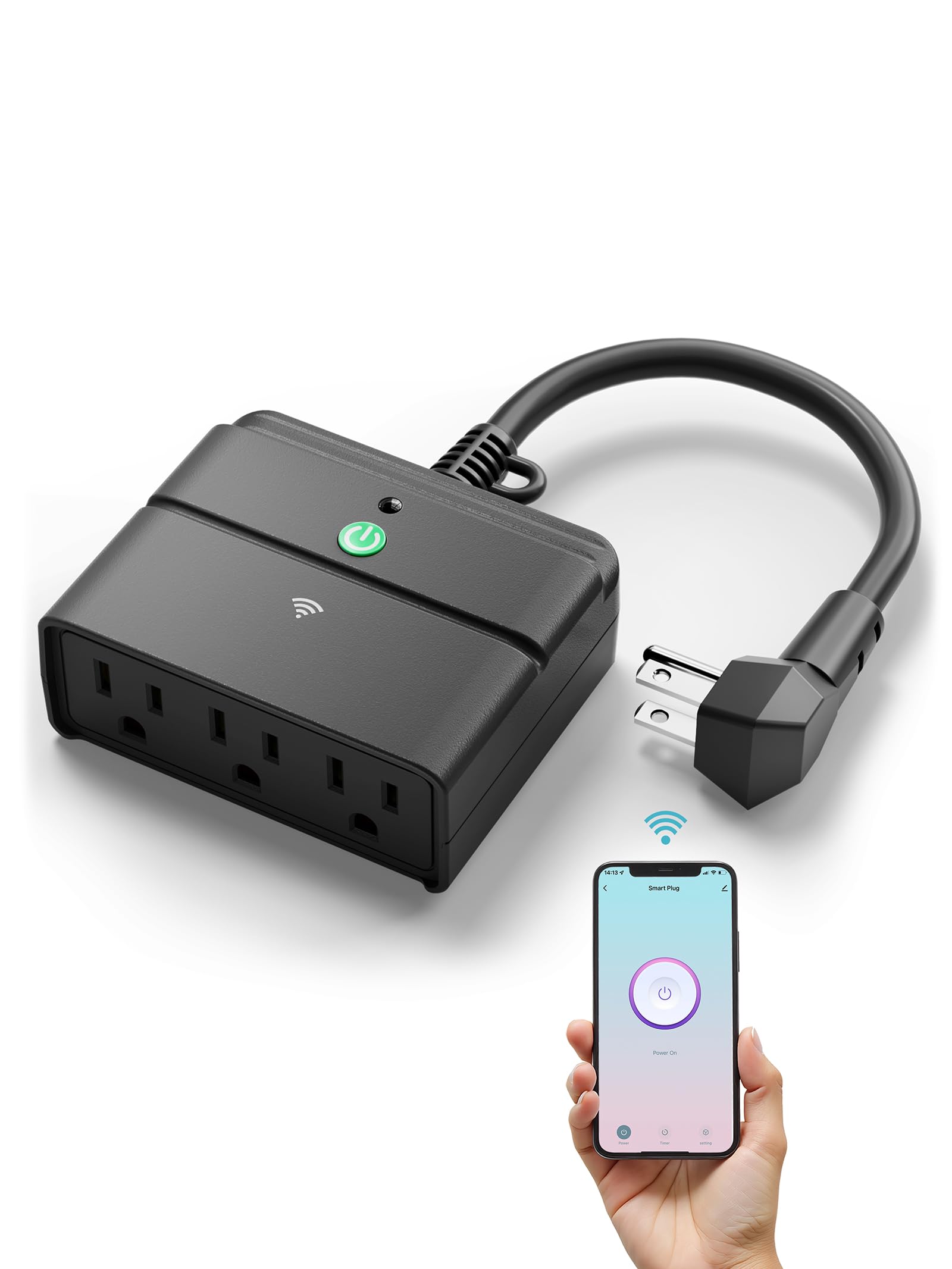
Three grounded outlets on one plug is what the BN-LINK offers, and it suits a job the dual-outlet designs do not: a whole holiday display, or a set of beds that should all come on together at dusk. The cord is short at 6.8 inches, so the body sits close to the wall box rather than draping across a wall.

With 15 amps and 1875 watts there is plenty in hand for lights and a small pump, and behind it sits the Smart Life app, the same one a lot of budget smart gear uses, so schedules, countdowns and Alexa or Google voice control all behave the way you expect them to. The countdown timer is the feature we used most, since it turns a set of lights off without anyone remembering to.

Weather is where to be careful. IP44 is splash protection, enough for rain falling on a covered porch but not the IP65 seal the better plugs here carry, and an exposed post in the middle of a lawn is the wrong home for it. Under an eave or inside a covered outlet box it is a different story entirely.

So: three devices, one schedule, light weather protection, and a price below every other multi-outlet plug on this page. For a sheltered outlet running one display, that is a sensible buy. For anything that has to sit out in the open through a winter, the extra sealing on the better plugs is worth the difference.

Bottom line: Three sockets sharing one schedule, at the lowest price of the multi-outlet plugs here, and a sound value pick for one display on a sheltered outlet.

How We Tested the Best Outdoor Smart Plugs

We started with a shortlist of about 50 models and narrowed it by what actually decides whether an outdoor plug is worth owning: a real weather rating, a cover that closes over a cord, single versus dual outlets, and whether it needs a hub or a subscription to do anything useful. Price per outlet settled the close calls. That left 14 plugs, which we ran for four months.

Setup was timed with a stopwatch, from slicing the box open to the first schedule actually firing, and each plug was paired on both an iPhone and an Android phone. We counted failed pairing attempts, noted how many taps it took to build a schedule, and checked whether the physical on/off button was reachable with work gloves on. Each one was also added to Alexa and Google Home to see whether it appeared on the first try and whether voice commands survived a routine rename.

The plugs lived on a patio outlet under an eave, on a post at the back fence, and at the front porch, running string lights, a fountain pump, a holiday inflatable, a soaker hose, and for one cold stretch, an ice-melt cable. Testing ran from late summer through the holidays, so they saw driving rain, sprinkler overspray, a week well below freezing, and plenty of dust.

We kept notes on what happened: whether a schedule still fired after the router was rebooted, whether the plug reconnected on its own or had to be unplugged and re-added, whether the cover stayed shut in wind, and whether the housing yellowed or the hinge stiffened by month three. We also checked fit, because a plug that blocks the second outlet or won't close over a thick cord is a problem no app can fix.

How to Choose Outdoor Smart Plugs

Independent outlets or one shared switch

Count what you want to control, then ask whether those things need different schedules. A dual-outlet plug such as the Kasa EP40 or the Tapo P400M switches each socket separately, which is what you want when the path lights run to midnight and the fountain should stop at nine. A stake or bar that switches everything together, like the DEWENWILS or the BN-LINK, is cheaper and simpler, and it is the right call for one holiday display. Paying for per-outlet control you will never use just adds taps to the app.

What the IP number actually promises

The two digits do different jobs: the first is dust, the second is water. IP44 handles splashes from any direction. IP64 and IP65 are dust-tight, with IP65 adding protection against low-pressure jets, which is the rating the better dual-outlet plugs here carry; IP66 takes stronger jets. That matters because weatherproof and waterproof are not regulated words, and a plug with no IP number is telling you something.

Even a sealed plug is happier under an eave than in a puddle, and a recessed cover that will not close over the plug undoes the rating entirely.

2.4GHz, hubs and platform lock-in

Nearly every plug here is 2.4GHz only, so confirm your network still broadcasts that band before deciding a plug is broken. The bigger question is what holds it. Kasa and Tapo want their own app; the Amazon Basics plug lives inside the Alexa app; a Matter plug such as the Tapo P400M or the Minoston turns up in whichever ecosystem you already use, which is worth a small premium if you might move between Apple, Google and Amazon. Lutron goes the other way and needs its own hub, which is sensible only when that hub is already running your lights.

Will the body fit your outlet box

The plug is always bulkier than the socket, and outdoor outlets are usually recessed behind an in-use cover. A straight-bodied plug pushes the cord out and can hold the lid open; a 90-degree body like the Kasa KP401's lies flatter but sometimes fouls the hinge or the rim. Measure the depth of the box and the clearance under the lid before ordering, because a cover that will not shut leaves the connection as exposed as no cover at all. A short outdoor-rated extension cord solves most of these problems.

What you can plug into one

Fifteen amps and 1875 watts is the usual ceiling, and it covers everything downstream: the extension cord, the splitter, every light on the run. Add the load up rather than assuming each socket gets the full figure. Motors are the line item to read for, since the Lutron plug is rated to a half-horsepower motor and pumps and fans pull a hard surge at startup. Anything you want to dim needs a dimmer plug, not one of these.

Frequently Asked Questions

Final Verdict

The Tapo P400M is the plug we recommend to most people: two sockets that switch separately, the best weather sealing in the dual-outlet group, and Matter support so the choice survives your next phone. If a Caseta hub already runs your house, the Lutron is the better-built plug and an easy decision. If one schedule across six devices is the job, the DEWENWILS stake handles it with no per-outlet fiddling at all.