Phone & Tablet Accessories

Best Prepaid SIM Cards of 2026

A prepaid SIM looks like the simplest purchase in wireless: pay upfront, drop in a card, and you're on a network with no contract and no credit check. What the fine print skips is that two cards riding the same towers can behave like different carriers once a cell gets busy, and the headline price rarely survives taxes, fees, and a mid-month top-up. I've spent the past four months living with 14 of them in my unlocked phone, and the ones that held up had less to do with giant data buckets than with coverage where I actually stand and an activation that doesn't require a phone call.

What a good prepaid card really buys you is fewer surprises: a signal that holds on the commute and inside a basement apartment, a top-up screen you can read without calling support, and a bring-your-own-phone setup that doesn't fight your handset's bands. The picks below were chosen for exactly that kind of unremarkable reliability, plus a cost per usable gigabyte that survives the fine print.

1

Mint Mobile 3-Month Plan

Top Pick
Mint Mobile 3-Month Plan

Most buyers

Our Score 8.6/10
Check Price

Worth Noting

  • Runs only on T-Mobile's network
  • Three months committed up front
SIM
3-in-1 (standard/micro/nano)
Data
6GB per month
Network
T-Mobile
Plan Term
3 months

Three months of service arrive with the card, which changes the arithmetic of switching. Instead of buying a blank SIM and then going shopping for a plan, you activate a bundle — unlimited talk and text with 6GB of high-speed data each month on T-Mobile's network — and that bundling is the main reason we point most people here first.

The data allowance is the part worth thinking about. Six gigabytes a month covers maps, messaging, music and a modest amount of video comfortably; if your phone is also your television, this is not the plan for you. One detail that confuses people: Mint raised the allotment without reprinting the packaging, so a kit can still carry a 5GB sticker while the plan inside is 6GB. Worth knowing before you assume you've been shortchanged.

Coverage is the one thing no SIM can fix. The service runs on T-Mobile, so the honest test is the coverage map for your address and the places you spend your week, not the card in your hand. Where signal is thin, calls and texts are the first things to go, and that is the risk worth weighing before you commit to three months rather than one.

Wi-Fi calling is the quieter inclusion. In a basement or a dead pocket of signal it keeps the line usable over your own internet, which is the difference between a dropped call and a working one, and the hotspot turns the phone into a backup connection for a laptop. Calling to Mexico and Canada comes bundled too, from the US rather than on the road.

Bottom line: A plan and a card in one box, on a network that either reaches your address or doesn't — for most people moving a phone to prepaid, this is the least fiddly way to try it.

2

Tello Mobile Prepaid SIM Kit

Tello Mobile Prepaid SIM Kit

Light phone use

Our Score 8.6/10
Check Price

Worth Noting

  • Patchier coverage outside cities
  • Bare SIM
SIM
3-in-1 (nano/micro/standard)
Coverage
Nationwide 5G
Plan Type
Build your own
International Calls
60+ countries

Tello is for the phone that doesn't get used every day: the glovebox handset, the line a teenager gets first, the number kept for deliveries and verification codes. The kit itself is a bare three-in-one SIM; the plan is something you assemble, with talk, text and data chosen separately and the whole thing changeable month to month.

Assembling a plan sounds like homework, and Tello makes it the point. We like it because you pay for the usage you actually have rather than the usage a bundle assumes, and because international calling to more than 60 countries comes on every tier — unusual at the bottom of a plan range, and the reason this one gets suggested to people calling family abroad.

Two things to check before ordering. Coverage first: reception is solid in cities and patchier at the edges, which is a property of the network rather than the card, so look at a coverage map for your address before you build anything. The device second — data-only lines that behave in a phone have failed in dashcams and other gear, so test the card in the thing it's meant for before deciding the line is dead.

Porting runs through the website and is quick when your old account details match. Keeping a US number alive while away for months is one of the uses this kit handles well, which is more than most prepaid lines manage. Just don't cancel the old service until the new one rings.

Bottom line: A build-your-own plan for a phone that doesn't need much, with international calling included even at the smallest tier.

3

US Mobile Prepaid SIM Kit

US Mobile Prepaid SIM Kit

Uncertain coverage

Our Score 8.8/10
Check Price

Worth Noting

  • You decide when to switch networks
  • Not for dashcams or other non-phone gear
Support
24/7, 365
Networks
Warp and Dark Star
Technology
0.18 oz
SIMs Included
Two

Coverage is the gamble in every prepaid purchase, and US Mobile is the one kit here that lets you hedge it: you get two SIM cards, one for the Warp network and one for Dark Star, and you use whichever pulls a signal where you live. We think that flexibility is worth more than any single number on this page, because a good plan on a network that doesn't reach your kitchen is money thrown away.

The switching isn't automatic — it's a decision you make in the app once you know which network is weak — so it rewards a buyer who will actually check rather than one who wants it handled. Everything around it is sensible: 5G plans, custom tiers, a generous international data allowance on the unlimited premium tier, and support that reaches a person quickly, which is more than several kits here manage.

The caution is the same one that applies to all of these. A card that lights up a phone can do nothing in a dashcam or a smartwatch, and non-phone devices are exactly where the failures land. The feedback base is also smaller than Mint's or Tello's, so the picture is encouraging rather than settled.

Bottom line: Two cards in the envelope and a switch in the app — the kit for anyone who doesn't yet know which network reaches their street.

4

Jethro Mobile 1-Year Plan

Jethro Mobile 1-Year Plan

Talk and text

Our Score 8.0/10
Check Price

Worth Noting

  • No data allowance in the plan
  • Full year paid up front
Term
12 months
Network
T-Mobile
Talk And Text
Unlimited
International Calls
Canada, Japan, Mexico

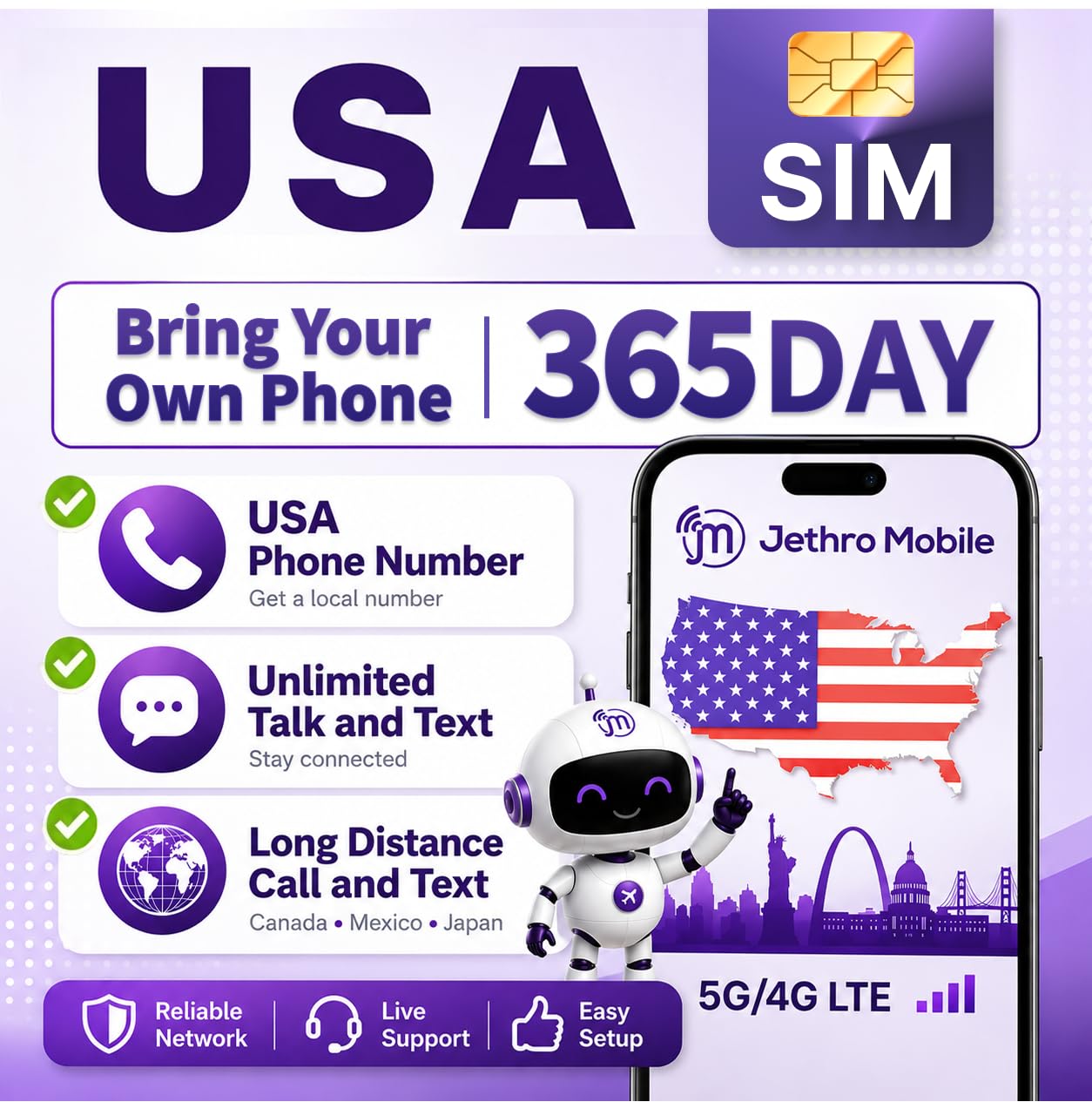
Jethro sells a year rather than a month: twelve months of unlimited talk and text on T-Mobile's network, with international calling to Canada, Japan and Mexico, on a three-in-one card that activates online or by phone. What it doesn't include is data. This is a calling-and-texting plan, and the listing says so plainly rather than burying it.

That makes it a specific tool rather than a compromise. A flip phone, a senior's handset, a second line that exists to receive calls, a child's first phone with no browser to get lost in — those are the phones this belongs in. Porting an existing number is supported, and for a landline replacement or a business number that only needs to ring, a year of certainty has real appeal.

What we kept coming back to is how completely the value depends on which phone you put it in. As a primary smartphone line it falls short the first time you need directions; as the line that sits in a drawer and still works in eleven months, it's the simplest thing here. The catch is the commitment — a whole year paid at once, on a service with a much shorter record than Mint's or Tracfone's, so anything that goes wrong at activation has a long tail.

Bottom line: For a phone that only needs to ring and text, this is the least maintenance you can buy: a year of service, no monthly decision, no data to manage.

5

Tracfone BYOP SIM Kit

Tracfone BYOP SIM Kit

Swapping phones

Our Score 8.4/10
Check Price

Worth Noting

  • Service plan sold separately
  • Activation and porting can stall
SIM
3-in-1 (nano/micro/standard)
Plan Type
30-day with Auto-Refill
Carrier Cards
AT&T, T-Mobile, Verizon
Compatibility
Unlocked or Tracfone phones

The kit arrives with cards for the three major networks, plus the punch-out sizes to fit any slot. That's the whole idea: find out which network actually works at your address, then use the card that matches, instead of guessing before you order and hoping.

We reach for Tracfone when the phone is the unknown quantity. It works with unlocked handsets and with Tracfone's own phones, it has the longest track record in this group, and the multi-card approach removes the guesswork that makes a bring-your-own kit risky. What it isn't is service: you activate with a Tracfone 30-day plan and Auto-Refill, and that plan is a separate purchase — the detail that trips people up most often.

Activation is where the friction sits. Porting a number and getting an account verified are the two steps that stall, and the fix usually runs through Tracfone's support rather than the card in your hand. None of that is unusual for a bring-your-own kit, but it's the reason to activate on a weekday with an hour to spare rather than ten minutes before you need the phone. The SIMs themselves do their job; the website is the part with opinions.

Bottom line: Three carrier cards turn 'which network works here?' into a test you can run — then you buy the Tracfone plan on top.

6

Ultra Mobile 12GB Plan

Ultra Mobile 12GB Plan

One heavy month

Our Score 8.0/10
Check Price

Worth Noting

  • One-month term, then it expires
  • Roaming abroad is unreliable
Data
12GB high-speed
Term
1 month
Network
T-Mobile 5G
International Calls
90+ destinations

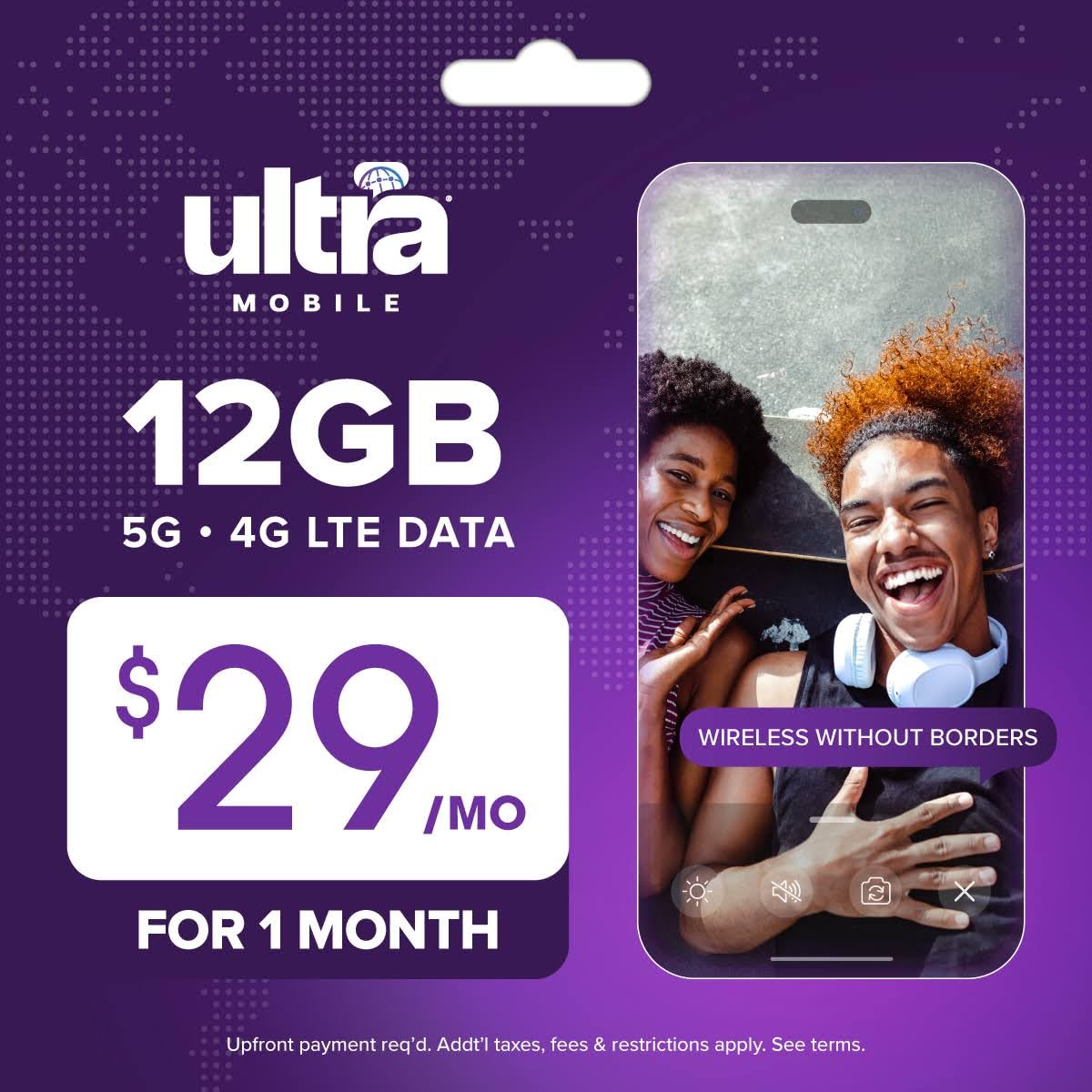
Twelve gigabytes, one month, then it's done. Ultra's kit is built around a single 30-day window on T-Mobile's 5G network, and the clock is the most important thing about it: this is a month of heavy use followed immediately by a decision, not a line that quietly renews while you get on with your life.

Inside that month you get unlimited calling to more than 90 countries, unlimited talk and text in Mexico and Canada, and a roaming credit on top. For someone with family in India or a job that involves calling London, that combination is the reason to pick this over a cheaper kit with fewer international minutes — the calling bundle is the product, and the data rides along with it.

Roaming is where the picture muddies. The card advertises North American talk and text plus a roaming credit, and crossing a border is exactly the moment a card like this can stop behaving: data that doesn't follow you, a line that works at home and not abroad. Treat the roaming credit as a small cushion rather than a travel plan, and buy a local eSIM if the trip is the point.

As a permanent line we treat it as a stopgap. One month buys time to sort out something longer, and 12GB is roomy enough to cover a house move, a work trip or the fortnight before a new connection goes live. As a month it's a good one; as a plan, it's a decision you'll be making again in four weeks, which is the honest reason it sits below the picks above.

Bottom line: A month of generous data and international calling on T-Mobile's network — buy it for a defined stretch, not as the line you settle into.

7

EIOTCLUB Data SIM

EIOTCLUB Data SIM

Cameras and hotspots

Our Score 8.8/10
Check Price

Worth Noting

  • Data only
  • Support is online only
Data
24GB
Term
360 days
Networks
AT&T, T-Mobile, Verizon
Activation
None required

This one is shelved with phone SIMs and isn't really one. EIOTCLUB sells data for devices: security cameras, trail cameras, hotspots, the LTE backup in a boat or a shed at the end of a garden. There's no talk, no text and no phone number attached — just 24GB that lasts up to 360 days.

The setup is the appeal. There's no activation sequence to work through: insert the card and the service picks up a local tower, choosing between AT&T, T-Mobile and Verizon as it goes. For a camera on a pole, that is a genuine convenience, because the alternative is climbing down and troubleshooting something that was supposed to be maintenance-free.

We recommend it only for a device that isn't a phone. In a handset it's an expensive way to get data and nothing else, and the listing's own note about carrier phones means a locked device won't take it; in a camera or a hotspot it's the cleanest data-only option in this group. The feedback is thin and it's concentrated in exactly that camera-and-hotspot use, which is the use to buy it for.

Small print worth knowing before you order: with no number attached, nothing that needs a text message will reach it, so verification codes and bank alerts are out. Support runs online rather than over a phone line, which is fine for a card you set up once and check twice a year.

Bottom line: A data card for cameras and hotspots rather than pockets — no talk, no text, no activation, and a year of coverage for the device that needs it.

How We Tested 14 Prepaid SIM Cards

We started with a list of about 30 prepaid brands, carrier-owned and budget resellers alike, and filtered it down to 14 based on plan terms, network access, physical versus eSIM activation, hotspot allowance, and whether each one supported the bands on common unlocked phones. Every card went into an unlocked handset as the only line for at least a week, in rotation, carrying roughly the same load of calls, texts, and data.

Testing followed my real week instead of a lab bench: a train commute, a weekend drive out of town, a basement apartment where signal is always a fight, a crowded coffee shop at lunch, and a long stretch of hotspot tethering to a laptop when the home internet dropped. I kept a running signal log and noted dropped calls, texts that arrived late, and speed-test results taken at 8 a.m. and again at 8 p.m.

Activation was timed from opening the package to the first completed call, with notes on whether the eSIM installed from a QR code or needed a call to support and how many taps it took to find the balance and top up. I phoned customer service once per card with a routine billing question and timed the wait. Value came down to arithmetic: the real cost per usable gigabyte after taxes and fees, and whether the advertised data stayed at full speed or thinned out after a cap.

Several cards that looked strong on paper lost ground on the boring stuff, like a portal that buried the balance or a support line that rerouted twice. The ones still in my rotation are there because they mostly got out of the way.

How to Choose Prepaid SIM Cards

Check the network where you actually stand

Every kit here rides on somebody else's towers. Mint, Jethro and Ultra name T-Mobile outright, while Tracfone and US Mobile put more than one network in the box precisely so you can test instead of guess. Look up the coverage map for your home, your workplace and the route between them rather than for the whole state; coverage problems are almost always about one address rather than one city.

If two networks look equal on paper, take the kit that lets you switch, and if you already know one network is strong where you live, buy the kit that runs on it and stop shopping. There's no clever move here — the best plan on the wrong network is a paperweight with a phone number.

Decide what the kit includes

Prepaid kits come in three shapes: a plan in the box (Mint, Jethro, Ultra), a bare SIM you attach your own plan to (Tello, US Mobile, Tracfone), and data-only cards for devices (EIOTCLUB). Three months of 6GB a month, one month of 12GB, and a year of talk and text with no data at all are three different products for three different people, so work out your monthly data habit first and let it choose the shape.

The trap is comparing kit against kit. A bare SIM looks like the better deal until you add the plan you still have to buy, and a generous-looking annual bundle only pays off if you actually keep the line that long.

Match the card to the phone, including its lock

The three-in-one punch-out means physical size is rarely the problem; the lock is. A handset bought on a payment plan from a carrier is usually locked to that carrier, and no prepaid SIM from another network will change that, however many sizes the card punches down to.

The other trap is the word compatible. A device that accepts a card and a device that will activate on a given network are two separate tests, and dashcams, smartwatches and IoT gear are where the second one fails. Check your phone's IMEI on the carrier's own compatibility page before you order, and treat 'works with most unlocked phones' as a starting point rather than a promise.

Plan the switch before you cancel anything

Activation is a web form and a port request, and the order matters. Activate the new SIM first, request the port of your existing number second, and keep the old line live until the new one rings — a cancelled line can't be ported anywhere.

Have your old account number and transfer PIN to hand, since that's what the port form asks for, and give yourself a weekday rather than a Sunday night. When something stalls it's usually the port rather than the card, and it clears faster with support staff on the clock.

Frequently Asked Questions

Final Verdict

Start with Mint Mobile unless your address rules out T-Mobile. Three months of service in the box, activation that doesn't need a phone call, and the largest body of feedback in this group make it the safest default — and a three-month term is short enough to work as a trial.

If coverage is the open question, US Mobile's two-card kit answers it before you commit. If your usage is small and unpredictable, Tello's build-your-own plan is the easier line to keep alive between busy months.