Phone & Tablet Accessories

Best Solar Power Banks of 2026

Every solar power bank makes the same promise: free electricity forever, as long as the sun cooperates. The reality is quieter. The panel on even a good one is a trickle, not a tap — it's there to top the battery off over a long weekend, not to rescue a dead phone in an hour. What separates a keeper from a drawer-dweller is everything around that panel: how much it actually holds, how fast it refills a phone from the wall, whether it survives a drop onto rock, and whether it's light enough that you'll actually clip it to a pack instead of leaving it in the car.

I've cycled through a dozen of these on camping trips, in gloveboxes, and through one memorably long blackout weekend, and my team has spent the past eight months putting 14 of them through the same routine. A couple of things surprised me. Wireless charging on a rugged brick is far more useful than it sounds, and the heaviest models were rarely the ones that held up best. The picks below are the ones that earned their space in the bag.

1

BLAVOR PN-W12-Pro

Top Pick
BLAVOR PN-W12-Pro

Off-grid charging

Our Score 9.0/10
Check Price

Worth Noting

  • Heavier and pricier than compact packs
Capacity
20,000 mAh
USB-C Output
18W PD
Solar Charging
4 panels, 1.2A max
Water Resistance
IPX5

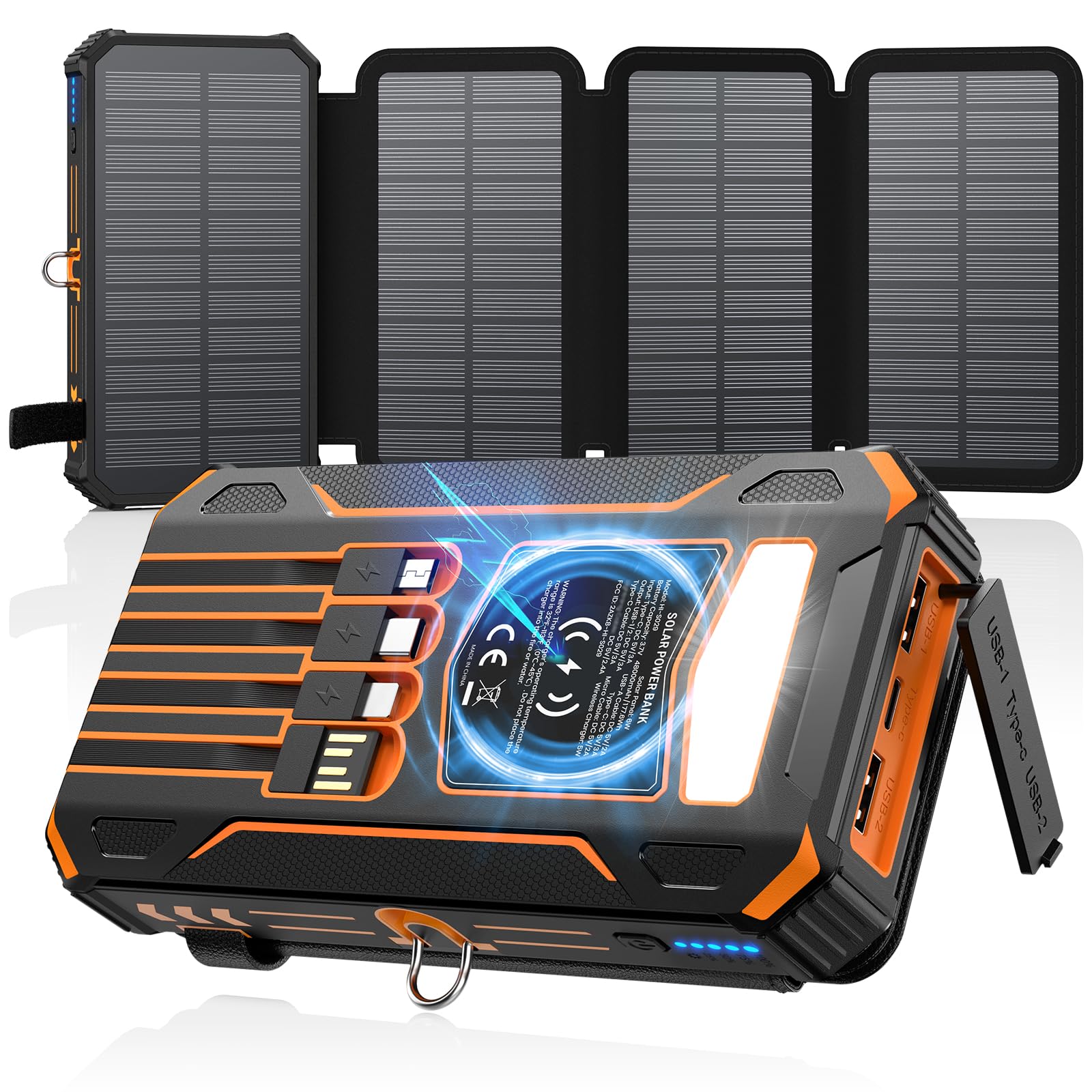
The first thing we do with a solar power bank is look at the panel, not the battery number. The BLAVOR PN-W12-Pro is the pack that makes the solar side feel engineered rather than decorative: four foldable panels are rated to deliver up to 1.2A in strong sun, which is a meaningful trickle compared with the tiny strip on most packs. That is why it is our top pick for off-grid charging. We also like that the 20,000mAh battery is paired with 18W USB-C PD, so you can fast-charge a phone from the wall before you leave and top up from the sun when you are out.

The rest of the package is built for camp. The three-level camp light is bright enough to light a tent, and the IPX5 shell and rubber bumpers make it feel like a tool rather than a fragile accessory. We appreciate the three outputs and the three-year warranty, too; the latter is longer than most here. The trade-off is weight and price: this is a pack you toss in a car or a basecamp bag, not one you forget in a jacket pocket. If you want the smallest possible pack, the BLAVOR PN-W05 is the better fit; if you want maximum capacity per dollar, the BLASOUL is the one to compare.

What sold us is the balance. A 20,000mAh pack is enough for a weekend of phone and headlamp charging, and the four-panel array means a sunny afternoon can add real charge instead of just slowing the drain. We still charge it by cable before a trip; solar is a backup, not a plan. But when the trip runs long, this is the one we reach for.

Bottom line: We recommend the BLAVOR PN-W12-Pro for anyone who needs a solar power bank that can actually contribute on a long trip, thanks to its four-panel array and 18W USB-C output.
2

BLAVOR PN-W05

BLAVOR PN-W05

Pocket carry

Our Score 8.4/10
Check Price

Worth Noting

  • 10,000mAh is a one-day capacity
  • Wireless charging is slower than USB-C
Weight
9.3 oz
Capacity
10,000 mAh
USB-C Output
20W
Wireless Charging
Qi

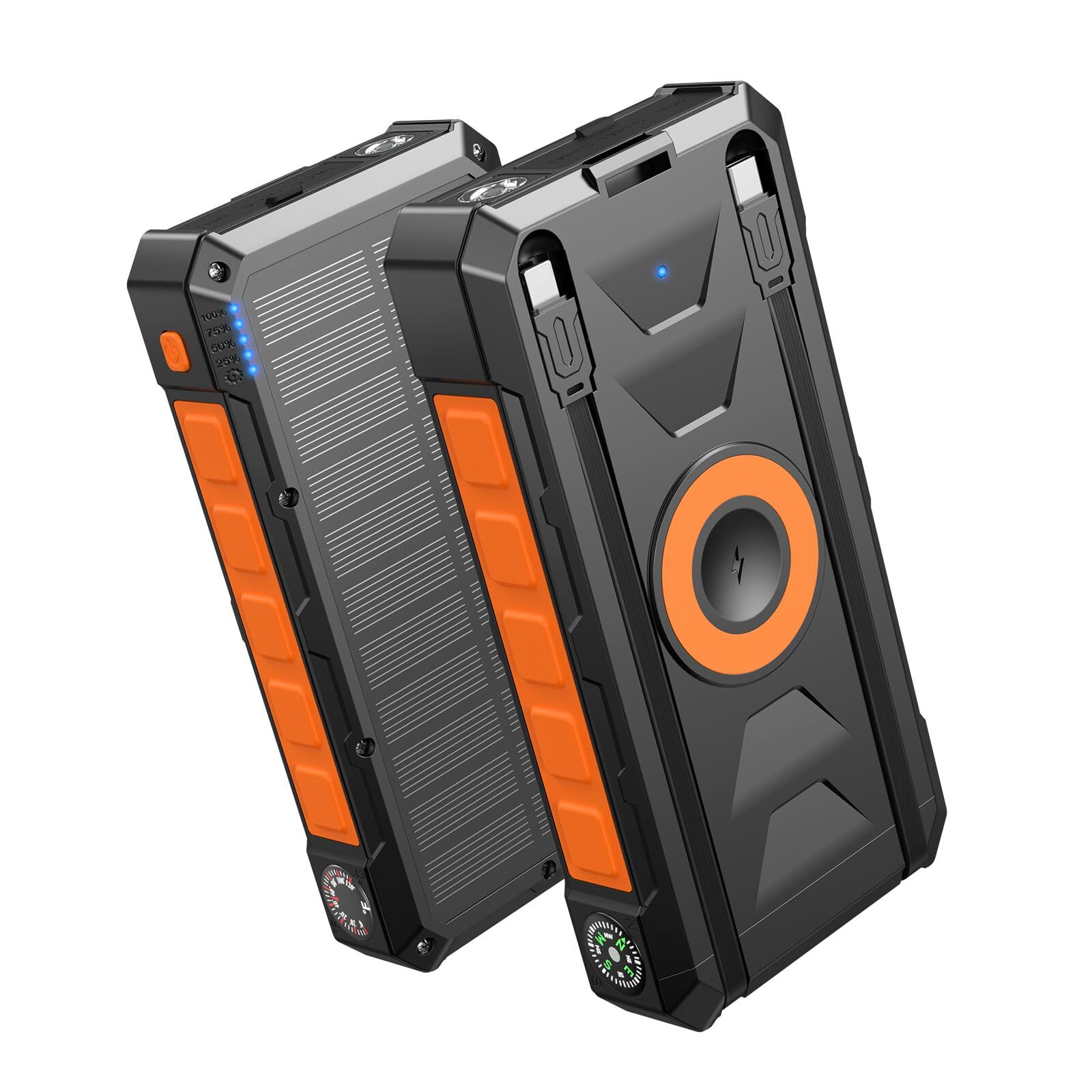
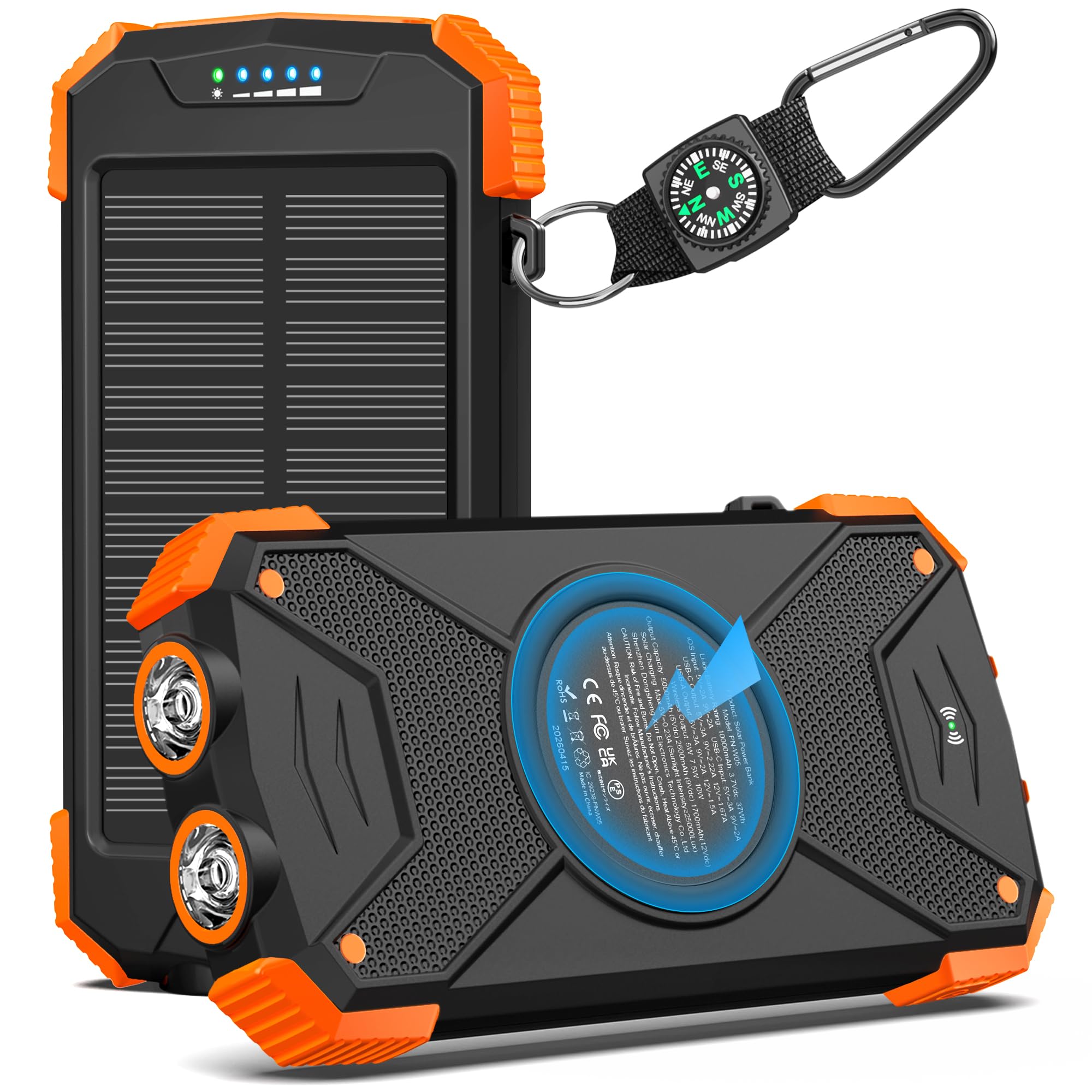
At 9.3 ounces, the BLAVOR PN-W05 is the one we can forget in a daypack until we need it. That is the whole pitch: a 10,000mAh battery, 20W USB-C, Qi wireless charging, and an IPX5 shell in a package that is closer to a thick phone than a brick.

The 20W USB-C output is the feature we use most; it gives a phone a useful top-up in the time it takes to eat lunch. The wireless pad is convenient for a phone, though it is slower and fussy about cases. The 10,000mAh capacity is the real limit: it is a one-day pack, not a weekend pack. For a long trip, the 20,000mAh top pick or the high-capacity BLASOUL is the better call.

We also appreciate the three-year warranty and the IPX5 rating, which are reassuring for something that lives in a bag. The solar panel is still a trickle charger; we treat it as a way to slow the drain on a sunny lunch stop, not as a way to refill the pack. If you want a solar power bank that disappears into your carry, this is the one.

Bottom line: We keep the BLAVOR PN-W05 for days when pocket space matters more than capacity: it is the lightest way here to carry 10,000mAh, 20W USB-C, and wireless charging.

3

BLASOUL PD-W49

BLASOUL PD-W49

Family outages

Our Score 8.4/10
Check Price

Worth Noting

  • Heavy and bulky for travel
Capacity
49,800 mAh
USB-C Output
22.5W
Built-in Cables
4
Water Resistance
IP65

Six devices at once is the number BLASOUL puts on the box, and for a family outage or a car full of phones, that is the useful part. The PD-W49 pairs a 49,800mAh battery with four built-in cables—three output leads for iOS, USB-C, and micro-USB, plus a USB-A input lead—so you can hand it around without hunting for a cable.

We like the 22.5W USB-C PD output and the 15W wireless pad, which cover a phone quickly and let a second phone charge without a lead. The IP65 rating is the other practical detail: this is a pack that can sit on a picnic table or in a tent vestibule without much worry. The built-in cables are a convenience, not a replacement for a longer cable if you want to use the phone while it charges, but they are the reason this one is easy to share.

The cost is weight. At 7 x 3.66 x 1.28 inches, it is a brick, and the 49,800mAh number is the kind of claim we take as a sign of intended capacity rather than a promise of six full phone charges. We still recommend it for car camping and household outages, where it can live in a bag and charge several devices overnight. For a hike, the 20,000mAh top pick is the more sensible carry.

Bottom line: For a family outage or a car full of devices, we choose the BLASOUL PD-W49 for its four built-in cables, 22.5W USB-C output, and 49,800mAh battery.

4

Uukto PN-M5W

Uukto PN-M5W

Campsite light

Our Score 8.8/10
Check Price

Worth Noting

  • Heavy for a 20,000mAh pack
Capacity
20,000 mAh
Lighting
Camp light + 2 flashlights
Warranty
2 years
Built-in Cables
3

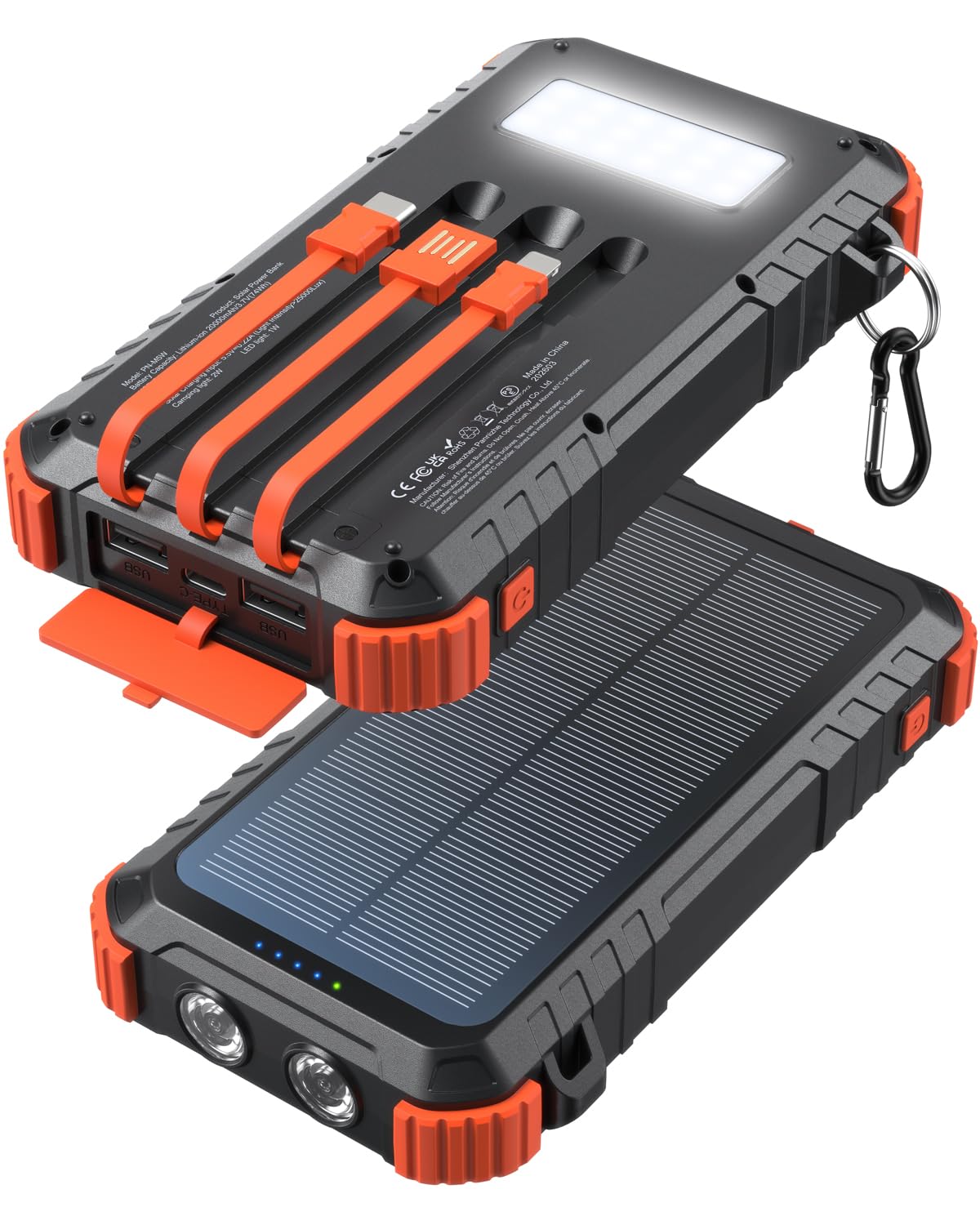
The Uukto PN-M5W is the one we reach for when the tent needs light more than the phone needs a charge. Its large camping light and two multi-mode flashlights turn it into a lantern as well as a 20,000mAh power bank, and the three built-in cables mean you can leave the charging pouch at home.

We like the two-year warranty and the USB-C input/output, which make it easy to live with. The light is the standout: it has a wide, bright panel for a tent and a separate flashlight for walking to the washroom. The 20,000mAh capacity is enough for a weekend of phone top-ups, and the built-in cables cover iPhone, USB-C, and micro-USB. The pack is heavy for its capacity, though; at just over a pound, it is a basecamp item rather than a pocket carry.

If you already carry a headlamp, the light is less of a draw, and the top pick is a better solar performer. But for a family campout or an emergency kit where a lantern is genuinely useful, the Uukto earns its place. We also appreciate the two-year warranty, which is longer than the budget packs offer.

Bottom line: We like the Uukto PN-M5W for campers who want a lantern and a charger in one pack; its three cables and two-year warranty make it a practical basecamp hub.

5

SOARAISE SPB2601

SOARAISE SPB2601

Survival kit

Our Score 8.8/10
Check Price

Worth Noting

  • Compass and thermometer are basic extras
  • Heavy at 16 ounces
Tools
Flashlight, compass, thermometer
Capacity
50,000 mAh
USB-C Output
22.5W
Wireless Charging
15W

A 50,000mAh battery, a compass, and a thermometer: the SOARAISE SPB2601 is pitched as a survival kit, and the capacity is the part that matters. It has a 22.5W USB-C PD output, 15W wireless charging, and enough ports and cables to charge six devices at once, which makes it a reasonable hub for a car camp or a long outage.

We like the built-in USB-C and Lightning cables and the three-mode flashlight, and the 12-month warranty is standard for the category. The compass and thermometer are the kind of extras that are fun to have but not a reason to choose the pack; a separate compass is more reliable, and the thermometer is not a cooking tool. The 16-ounce weight is the real trade-off: it is light enough for a car kit, not for a long hike.

We treat the 50,000mAh label as a capacity target rather than a guarantee of six full charges, and we test it with your own devices before relying on it for a long outage. If you want a high-capacity pack with a few survival extras and a lower price than the top pick, it is worth a look. If you need the stronger solar array, the BLAVOR PN-W12-Pro is the safer buy.

Bottom line: The SOARAISE SPB2601 is the high-capacity pick we suggest when you want 22.5W charging, wireless top-ups, and a few survival extras in one heavy pack.

6

Luvknit PS38K

Luvknit PS38K

Budget backup

Our Score 8.2/10
Check Price

Worth Noting

  • Heavy enough to notice in a bag
  • Small solar panel is a trickle charger
Capacity
20,000 mAh
Warranty
Lifetime
USB-C Output
22.5W PD
Built-in Cables
3

The warranty is the first thing that stands out on the Luvknit PS38K: lifetime replacement or refund for non-human damage, with no return required. That is a stronger promise than most packs here, and it makes a budget 20,000mAh pack easier to take a chance on.

The hardware is competitive for the money. You get 22.5W PD charging, three built-in cables for USB-C, Lightning, and micro-USB, and a pair of LED lights. We like the built-in cables for a glovebox or a daypack because they remove one thing to forget. The pack has a heavy, dense feel that you notice in a purse, though, and the capacity is best for a day or two rather than a week.

It is not the one we choose over the top pick for solar performance; the panel is a backup feature, not a fast refill. But if you want a low-cost backup with cables attached and a generous warranty, it is a sensible second pack. Keep the first few charges on a hard surface and watch for heat.

Bottom line: Our budget pick is the Luvknit PS38K: 22.5W charging, three built-in cables, and a lifetime replacement promise make it an easy second pack to keep charged.

7

SOARAISE 48000mAh

SOARAISE 48000mAh

Car emergency

Our Score 8.4/10
Check Price

Worth Noting

  • Bulky and heavy
  • USB-C output tops out at 3A
Capacity
48,000 mAh
Solar Panels
4
USB-C Output
5V/3A
Built-in Cables
4

If the top pick's price is too much, the SOARAISE 48000mAh is the obvious alternative to look at. It gives you four solar panels and four built-in cables for less money, plus wireless charging and a 3A USB-C port.

We like the cable set most: four built-in cables are attached, covering the common phone connectors, so you can charge almost anything without a pouch. The four-panel array is also more serious than the single strip on budget packs, though the pack is bulky enough that we treat it as a car or basecamp item. The 48,000mAh capacity is in the same class as the high-capacity picks, and the 3A USB-C output is enough for a phone, not a laptop.

Durability is the caveat. The pack has a heavy-duty look, but the shell and port covers are the parts we watch, and the finish is not as reassuring as the top pick's rubber bumpers. We still see it as a strong value for an emergency kit or a family car, where it can sit in the trunk and charge several devices.

The calculation is simple: if you want the most solar panel and cable coverage for the money, this is the one. If you want the most confidence in the build, pay for the BLAVOR. For a pack you carry every day, the smaller BLAVOR PN-W05 is the better fit.

Bottom line: We point value shoppers to the SOARAISE 48000mAh for its four solar panels, four built-in cables, and wireless charging, as long as they accept the bulk.

How We Tested Solar Power Banks

We started by gathering every solar power bank with a real customer base and a plausible spec sheet, then filtered by claimed capacity, panel wattage, port selection, whether it had a wireless pad, and price. That left 14 models. We bought all of them at retail so no one could send us a hand-tuned unit.

Each one lived with us for eight months — in a daypack on weekend hikes, on a dashboard during a long drive, on a patio table through several afternoons of direct sun, and through one four-day blackout. We weighed all 14 on a kitchen scale and compared them against a full water bottle, since "portable" means nothing without a reference. We timed how long each took to bring a dead phone to 50 percent, then drained each bank into a phone on repeat to see how much of its labeled capacity actually came out the other end. On the wireless models we tested with and without a case on, and noted whether the phone drifted off the coil mid-charge.

Durability got its own pass: a waist-high drop onto concrete, a week riding in a bag alongside keys and a carabiner, then an inspection of every port cover and hinge afterward. We logged real solar gain too, measuring the percentage of battery added per hour of unobstructed midday sun, which is where the marketing claims and our numbers parted ways most often. We also parked each bank in a drawer for a month to see whether it held its charge, and closed by comparing cost per usable watt-hour rather than sticker price.

How to Choose Solar Power Banks

Match capacity to the trip, not the biggest number

A 10,000mAh pack is the daypack size: enough for a phone top-up or two, and light enough to forget. The BLAVOR PN-W05 is the clearest example here at 9.3 ounces. Step up to 20,000mAh for a weekend of phone, headlamp, and earbud charging; the top pick is that size. The 49,800mAh and 50,000mAh packs are for car camping, family outages, or a group, and they carry like it—the BLASOUL PD-W49 is a 7-inch brick.

Treat a huge capacity number as a target, not a promise. Usable energy is lower than the cell rating, and a pack that claims 50,000mAh still has to fit in your bag. Pick the smallest capacity that covers your longest usual trip, then add a small backup if you need more.

The solar panel is a trickle charger

An integrated panel is a backup, not a wall charger. Panel area and stated solar current tell you more than a marketing claim: the BLAVOR PN-W12-Pro's four panels are rated at 1.2A max in strong sun, which can add a useful top-up over an afternoon. A single small strip will barely move the gauge.

Charge by USB-C before you leave, and use the panel to slow the drain while you are out. If you need a full recharge from the sun, plan for a long day with the panel angled at direct light, not a quick stop in the shade.

Output and cables decide how useful it is

Look for USB-C PD output of 18W or more for a phone; the BLASOUL PD-W49 and Luvknit PS38K both list 22.5W, while the top pick lists 18W. A high-capacity pack with a slow output is a brick that takes all afternoon to fill a phone.

Built-in cables are a real convenience for family use—four on the BLASOUL, three on the Uukto—but they are short and limit you to the attached connectors. Wireless charging is handy for a phone, though it is slower than USB-C and can be fussy about cases. We prioritize a fast USB-C port first, then cables, then wireless.

Ruggedness, light, and warranty are the camping extras

For hiking, weight and weather resistance matter more than capacity. IPX5 or IP65 covers rain and splashes, not submersion, and a carabiner helps you clip the pack to a backpack. A built-in camp light is genuinely useful in a tent; the Uukto PN-M5W is the clearest example, with a large panel and two flashlights.

Check the warranty and the battery safety basics. A 2- or 3-year warranty is a better signal than a vague lifetime promise, though the Luvknit's lifetime replacement is unusually generous. Do not leave any power bank in a hot car or direct sun for days, and stop using it if the case swells or gets unusually hot.

Frequently Asked Questions

Final Verdict

The BLAVOR PN-W12-Pro is the solar power bank we recommend first because its four-panel array and 18W USB-C output make it a real off-grid tool, not just a battery with a solar sticker. It is heavier and pricier than the compact packs, so choose the BLAVOR PN-W05 if pocketability matters more, or the BLASOUL PD-W49 if you need to keep several devices charged during a family outage.

For most weekend trips, the PN-W12-Pro is the one we pack.