Phone & Tablet Accessories

Best Smartphone Gimbals of 2026

A gimbal is three small motors working against your own hands — one for each axis of wobble — so the phone stays level while you walk, turn, and inevitably trip over a curb. The idea is simple; the execution isn't. Some units balance in seconds and hold a lock on a moving subject, while others fight you, drift mid-shot, or go flat before your second location. What you're buying is the difference between footage you'll post and footage you'll delete.

Over the past six months, my team and I have handed 12 gimbals to people who'd never used one, filmed with them on hikes and in crowded markets, and carried them loose in backpacks. What separated them had less to do with spec sheets than with friction: the ones we kept reaching for folded down small, balanced in under a minute, and held up when the companion app was doing the heavy lifting. The hardware is rarely the weak link — the app is. The picks below are sorted by how you plan to shoot.

1

DJI Osmo Mobile 7P + Mic Mini TX

Top Pick
DJI Osmo Mobile 7P + Mic Mini TX

Vlogging all-rounder

Our Score 9.2/10
Check Price

Worth Noting

  • Heavier than the base Osmo Mobile 7
  • App-dependent tracking and advanced modes
Audio
Mic Mini TX included
Weight
13 oz
Built-in
Extension rod and tripod
Stabilization
3-axis gimbal stabilization

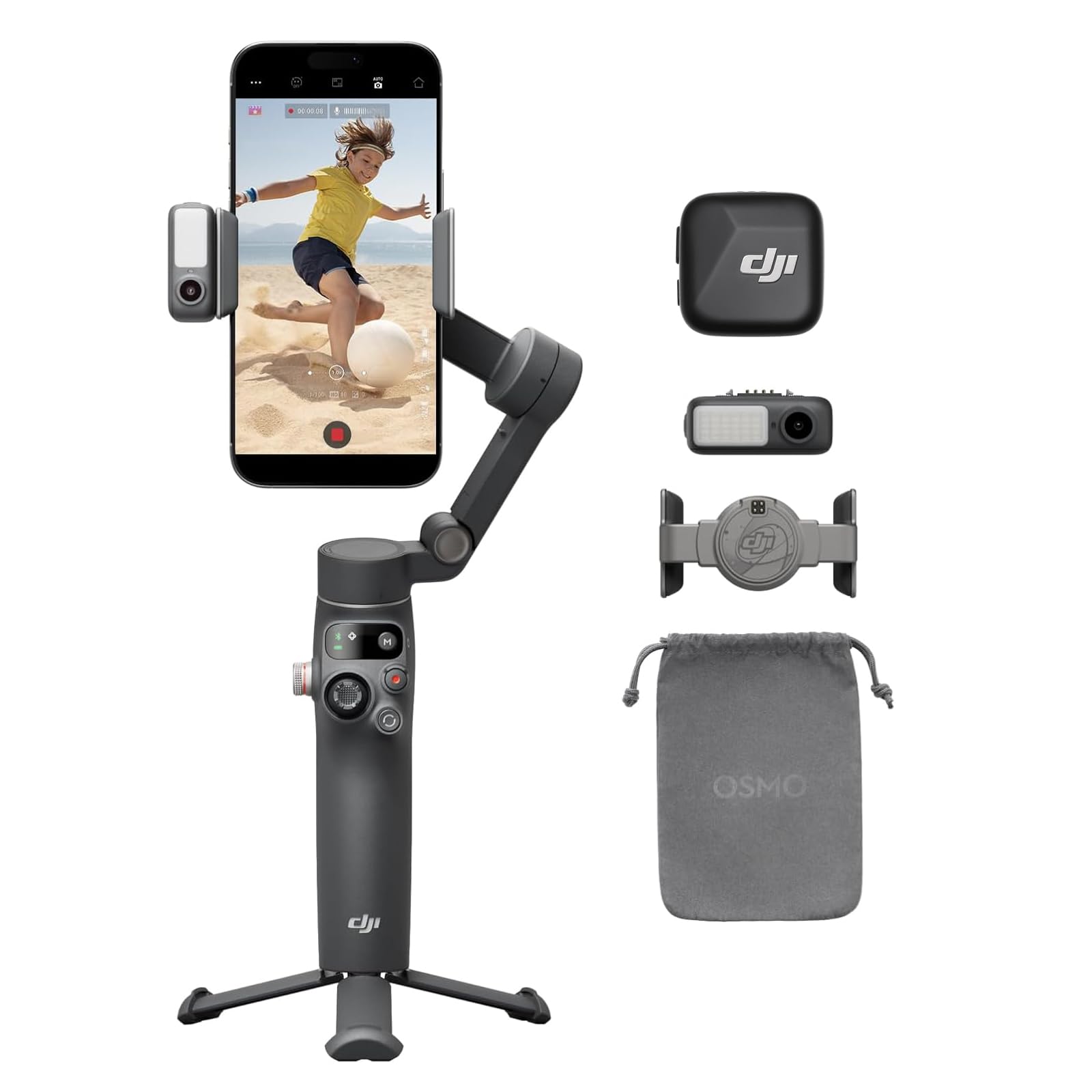
The Mic Mini transmitter in the box is the detail that changes the Osmo Mobile 7P from a stabilizer into a small vlogging kit: clip it on, set the gimbal on its built-in tripod, and step back without adding a separate receiver to your phone. The built-in extension rod does the same for framing, giving you a group selfie or an overhead angle without a second monopod.

That combination is why this is our top pick. You get 3-axis stabilization, a 368 g body, a folding design, and the multifunctional module that handles tracking, mic reception, and lighting. We found the module earns its space because it removes two accessories from the bag. The 7P has the extra hardware, and the body still folds into a 190mm x 95mm x 46mm package.

The stabilization itself is the familiar DJI smoothness, and the magnetic clamp makes phone changes quick. The 368 g body is balanced enough for handheld work, and the folded shape still fits a small case. What we appreciate most is that the rod and tripod are built in rather than screwed on, so a solo shot takes seconds to set up. For a two-person interview, the extra reach also means you can frame both faces without handing the phone to someone else.

Bottom line: We recommend the 7P first for solo vloggers who want stabilization, a built-in rod, and a bundled mic in one kit.

2

DJI Osmo Mobile 7

DJI Osmo Mobile 7

Light everyday setups

Our Score 8.8/10
Check Price

Worth Noting

  • 300 g payload is tight for large phones
Weight
10.6 oz
Payload
10.6 oz
Built-in
Tripod
Battery Life
10 hrs

The 300-gram Osmo Mobile 7 is the one we reach for when the shoot is a walk, a market, or a day out rather than a planned production. It folds into a small package, and the built-in tripod means you can set it down without hunting for a separate base. That combination makes it our lightweight pick.

The 3-axis stabilization and ActiveTrack 7.0 do the core job, and the magnetic clamp is quick to seat a phone. The 10-hour battery is enough for a day of short clips, and the anti-slip handle is comfortable for a long handheld take. The built-in tripod opens into a stable base for a tabletop demo or a solo stand-up, which is more useful than it sounds until you leave the extra mount at home.

For travel, the folded 179x95x39mm body is the reason it stays in the bag, and the 300 g weight is easy to hold for a long walk. We also like that the clamp is magnetic, so moving from a horizontal clip to a vertical one is quick. The Osmo Mobile 7 is the simple, light option in this group, and it does not pretend to be a full production rig.

Bottom line: The Osmo Mobile 7 is the lightweight pick for phone-only shooters who want a built-in tripod and simple stabilization without the 7P's extra kit.

3

Hohem iSteady M7

Hohem iSteady M7

Large phones

Our Score 8.8/10
Check Price

Worth Noting

  • 629 g body is heavy for long handheld shoots
  • Tracking can lose a subject in busy scenes
Remote
1.4" touchscreen
Weight
1.39 lb
Payload
1.1 lb
Extension
193 mm

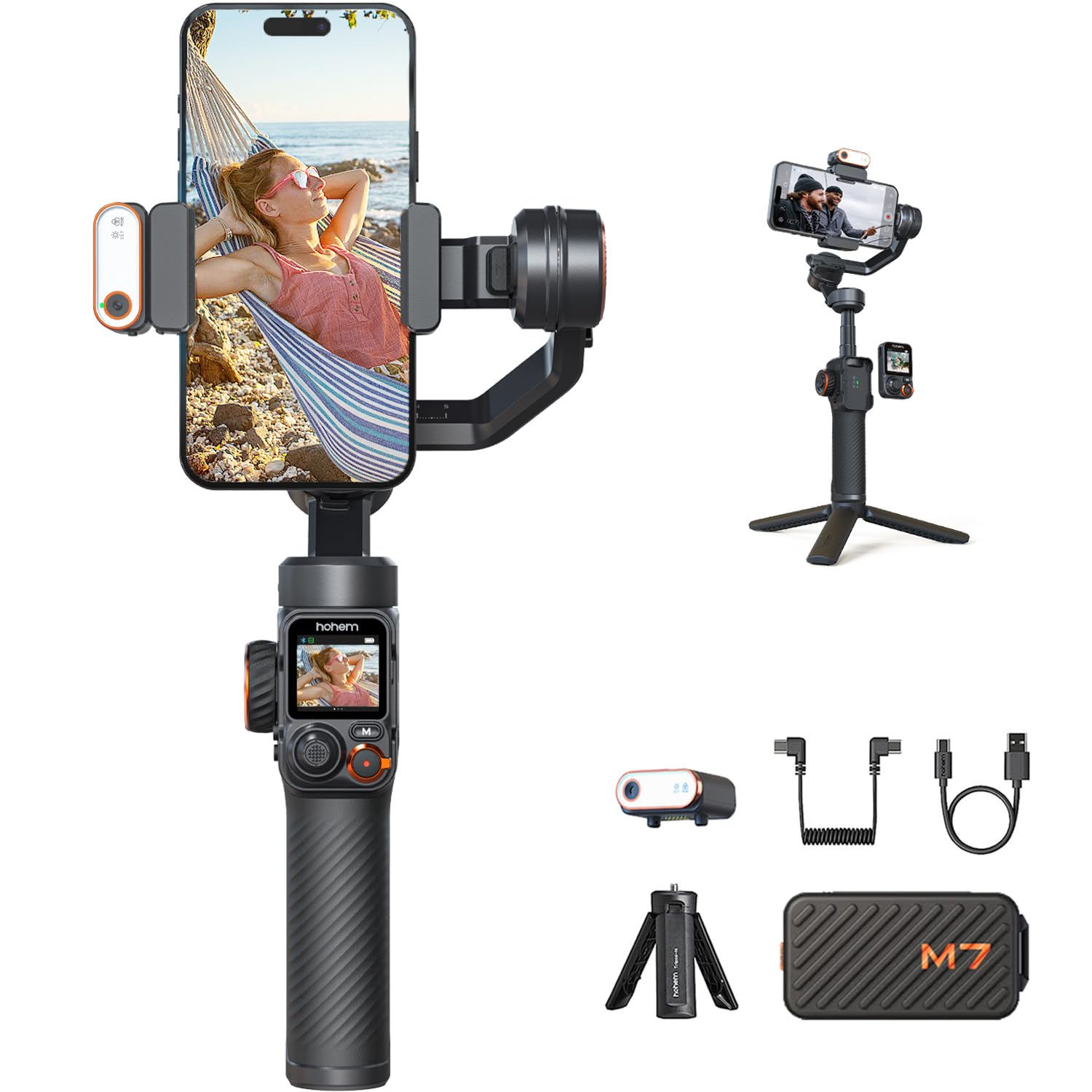
The 500-gram payload is the headline on the iSteady M7. It leaves room for a large phone plus a clip-on lens or a small light, which is more than the 300-gram class can manage. That extra capacity is not just a number for the spec sheet; it changes which phone you can bring and how much accessory weight you can add.

The detachable 1.4-inch touchscreen remote is genuinely useful, not a spec-sheet extra. We set the gimbal on its tripod, walked back, and adjusted framing and tracking from the remote. The built-in 193 mm extension rod and the AI tracker with fill light add reach and light, and the three quarter-inch accessory ports give you places to mount extras. That makes the M7 our pick for large phones and solo shooters who need controls away from the handle.

For a one-phone interview, you can leave the phone on the tripod and make small framing changes without walking back to the handle. The M7 is more gimbal than most casual shooters need, but when the phone is heavy, the extra capacity is the difference between a stable shot and a motor that complains. The fill light also helps in a dim room without a separate lamp.

Bottom line: The iSteady M7 is the one for a large phone or accessory-heavy setup, with a 500 g payload and a touchscreen remote that pays off in solo shoots.

4

Hohem iSteady M6

Hohem iSteady M6

Long shoot days

Our Score 9.0/10
Check Price

Worth Noting

  • Heavy at 551 g for handheld use
Weight
1.21 lb
Display
0.91" OLED
Payload
14.1 oz
Battery Life
18 hours

The iSteady M6's 18-hour battery rating is the sort of number that changes how you pack: you can leave the charger at home for a day of interviews, b-roll, and travel shots. The gimbal also reverse-charges a phone through its power-out port, which is a small feature until your phone is the thing running low.

The 400 g payload is the other practical bit. It gives a large phone more margin than the 300 g class, and the 0.91-inch OLED shows battery and Bluetooth status without opening the app. The controls include a wheel for roll, focus, and light adjustment, and the carrying case lets the M6 stay adjusted between stops.

We like it for long shoot days and for anyone who wants to top up a phone from the gimbal. The battery and payload are the two specs that matter when the day runs long, and the OLED display makes the settings easier to trust at a glance. The reverse-charge port is the detail we did not expect to use as often as we did.

Bottom line: The iSteady M6 is the long-day pick, pairing an 18-hour battery and 400 g payload with a display that keeps settings visible.

5

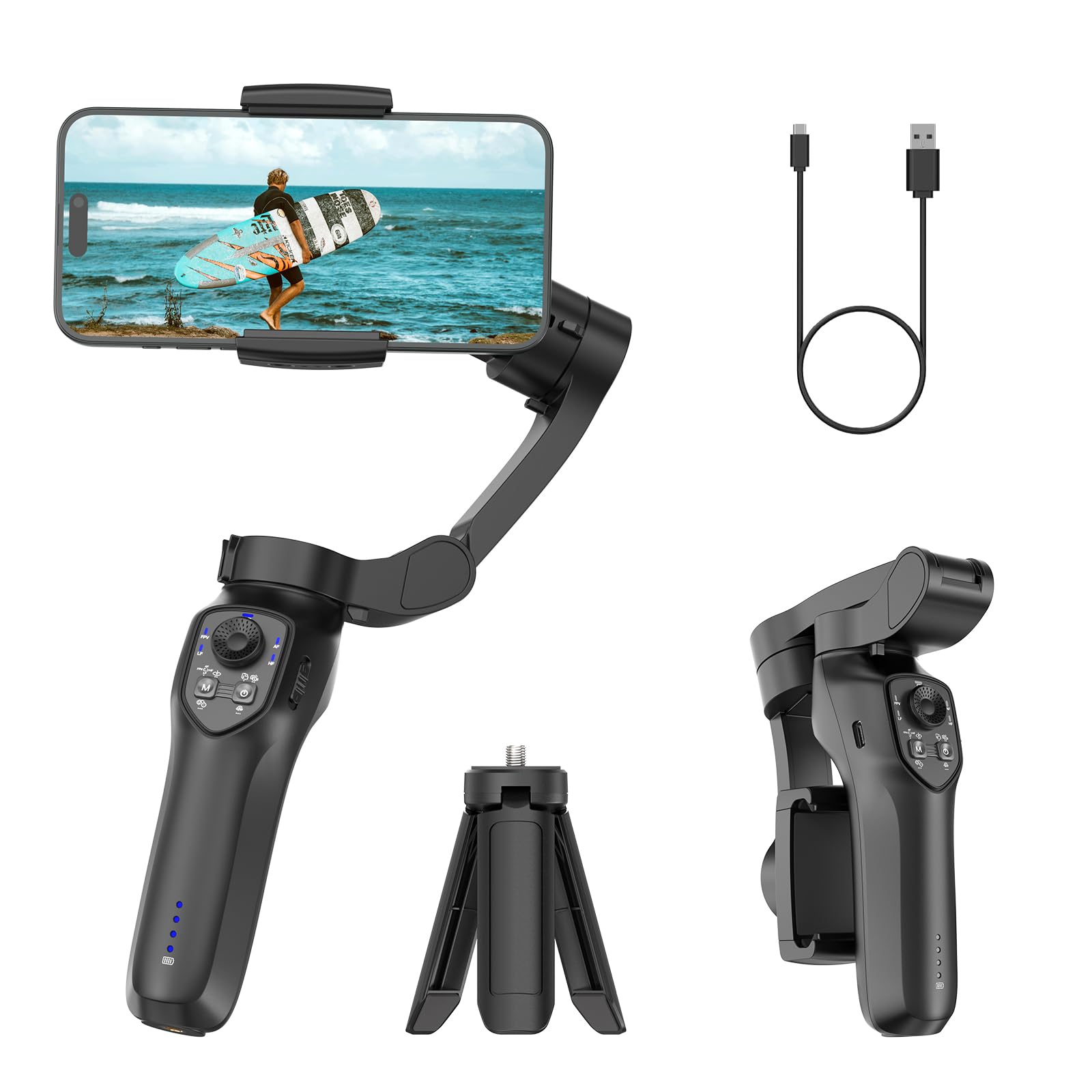
COMITOK L7C Pro

COMITOK L7C Pro

First gimbal

Our Score 8.4/10
Check Price

Worth Noting

  • App connection and face tracking can be inconsistent
  • Landscape mode can flip the phone unexpectedly
Weight
12.8 oz
Battery
2600 mAh
Payload
9.92 oz
Folded Size
6*4.3*1.8 inches

The L7C Pro's appeal is simple: it is the least expensive way here to get a 3-axis gimbal with face and object tracking, and it does not require leveling before you shoot. That no-leveling mount is the time-saver: you clamp the phone and go, rather than sliding the arm until it balances.

For casual clips, that is enough. The 9.92-ounce payload covers a normal phone, and the 2600mAh battery is generous for the size. The folded 6*4.3*1.8-inch body is small enough to live in a bag, and the grip tripod gives you a stand for simple two-shots. The app is where the tracking and shooting modes live, and the phone clamp is the part that decides whether the setup feels secure.

We see it as a first gimbal for short social clips, not as the one you trust for a paid shoot. The stabilization is fine for walking at a normal pace, and the no-leveling mount saves the fiddly step that trips up a first-time gimbal user. The 2600mAh battery also means you are not babysitting a charger during a short outing.

Bottom line: The L7C Pro is the budget pick for casual clips, with a no-leveling mount and 3-axis stabilization at the lowest cost here.

6

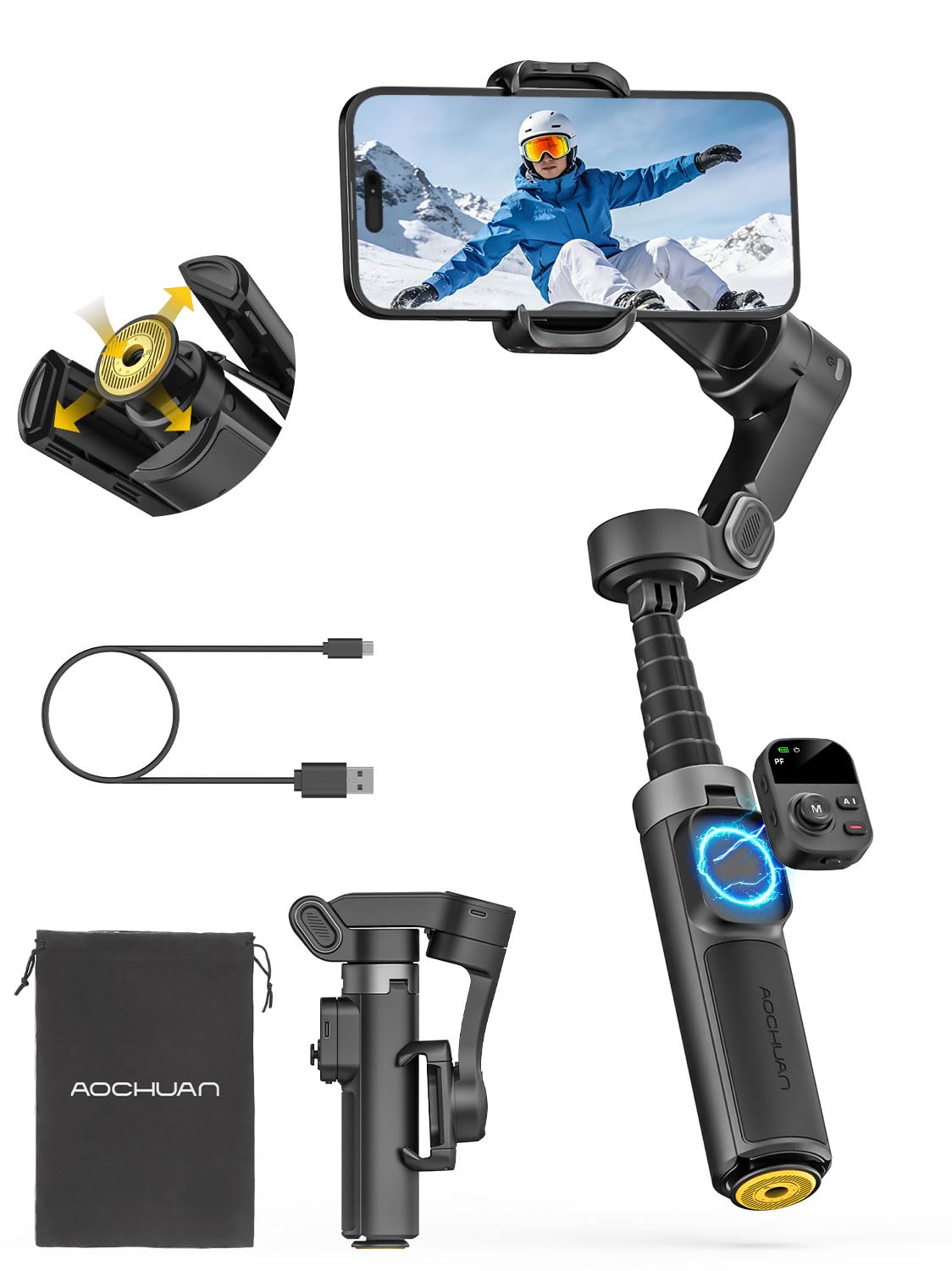
AOCHUAN Smart X3

AOCHUAN Smart X3

360° solo shots

Our Score 8.2/10
Check Price

Worth Noting

  • Handle is small for larger hands
  • Tracking requires the AOCHUAN app
Weight
14.4 oz
Pan Range
360°
Remote Range
33.8 ft
Extension Rod
20 inches

The Smart X3's 360° infinite pan is the feature that separates it from the other budget-adjacent gimbals here: it can keep rotating with a subject instead of stopping at the end of a turn. The magnetic remote has a 33.8-ft range, and the hidden 20-inch rod gives you a selfie stick when you need one.

The one-touch tripod is another practical touch; we popped it open on a table and had a stable base without screwing on a separate plate. The 14.4-ounce body folds to 4.4*1.73*6.89 inches, and the remote attaches magnetically, so you can pull it off the handle and frame yourself from across a room.

We see it as a niche pick for solo shooters who want remote control and a long extension rod without moving up to the premium Hohem. The 360° pan is the reason to pick it over the cheaper L7C Pro if you film moving subjects, and the remote range is enough for a one-person product demo. The feature mix is unusual at this end of the set.

Bottom line: The Smart X3 is a niche pick for solo shooters who want 360° pan, a magnetic remote, and a long extension rod in one package.

How We Tested Smartphone Gimbals

We built the shortlist on paper first: only gimbals rated to hold a phone in a case (some balk at an add-on lens clip), only models whose companion app had been updated in the past year, and only units at meaningfully different price points rather than five versions of the same thing. That left 12, from fold-flat pocket models to larger ones with built-in tripods and grips. Testing ran for six months.

Every gimbal got the same first test: clamp on the same phone, balance it cold out of the box, and time it. Then we handed it to someone who'd never touched one and watched whether they could get it level without coaching. On a gravel trail, up and down a set of stairs, and behind a dog that refused to hold still, we looked for frame drift, checked whether the subject stayed locked after a bump, and noted how quickly each unit recovered. Back at a laptop, we scrubbed the clips for the micro-jitter that ruins an otherwise good shot.

We paired each gimbal with both an iPhone and an Android phone, installed whatever firmware it demanded, and shot a full session through the companion app — noting crashes, controls buried three menus deep, and whether footage actually landed in the camera roll. Battery life was measured by filming until each one died; two didn't survive a full afternoon out. Durability came from folding and unfolding each unit dozens of times and hauling them loose in backpacks, watching for joints that developed play. We also logged what came in the box — case, mini tripod, strap — since a cheaper gimbal that needs accessories bought separately usually isn't the bargain it looks like.

How to Choose Smartphone Gimbals

Match the payload to your phone, case, and add-ons

A gimbal's payload rating is not the same as its own weight. The Osmo Mobile 7 is rated to 300 g, the Hohem M6 to 400 g, and the M7 to 500 g; a large phone in a thick case, plus a clip-on lens or light, can eat that margin. Weigh your phone with the case you plan to use, then leave room for accessories. If you are near the limit, the motors have less headroom for fast moves, and the gimbal can feel like it is fighting the phone.

Decide how much app you want in the shot

Tracking, gesture control, and many creative modes live in each maker's app, and app behavior varies by phone. The DJI Mimo app is central to the Osmo Mobile 7P's tracking and shot guides; the Hohem M7 can track through the phone's native camera with its AI tracker, which is a different workflow. If you mostly want smooth handheld footage, basic stabilization works without much app work. If you rely on active tracking, test it on your own phone before a shoot and learn the mode you will actually use.

Choose the support you need for solo shooting

Built-in tripods, extension rods, and remotes are not luxury extras if you film alone. A tripod lets you set the phone down for a two-shot or a product demo; an extension rod adds reach for group selfies and overhead angles. The Osmo Mobile 7P bundles both, while the Hohem M7 adds a detachable touchscreen remote, and the AOCHUAN Smart X3 has a 20-inch rod and 360° pan. Pick the support that matches the shot you repeat most, not the longest list.

Weigh battery life against the weight you carry

Battery ratings are measured under specific conditions, so treat 10 or 18 hours as a guide rather than a promise. A long rating is useful for interviews and travel days; a lighter body is useful on a long walk. The Hohem M6's 18-hour rating and reverse charging suit a full day away from an outlet, while the Osmo Mobile 7's 300 g body is easier to hold for short clips. If you shoot in cold weather or rely on active tracking, carry a power bank and keep the gimbal within its payload.

Check the parts that decide reliability

The motor, the phone clamp, and the charging port are the parts that decide how long a gimbal stays useful. A removable clamp and a standard tripod thread make replacement easier; a built-in battery does not. Look for a clear warranty and a support path, and test the full range of motion in the first week. If the gimbal drifts, shuts down, or refuses to hold a normal phone load, return it rather than working around a failing motor.

Frequently Asked Questions

Final Verdict

The DJI Osmo Mobile 7P + Mic Mini TX is the gimbal we recommend first. Its bundled mic and built-in extension rod turn a phone into a solo vlogging kit, and the 3-axis stabilization is the foundation. If you mainly shoot short clips on the move, the lighter Osmo Mobile 7 makes more sense.

For a large phone with accessories, the Hohem iSteady M7's 500 g payload and touchscreen remote are worth the extra bulk; the Hohem M6 is the better match for long days.