Wearables & Health

Best Smartwatch for Android of 2026

Android phones come from a dozen manufacturers, and not every smartwatch is polite about it — some of the best-looking models quietly lock their best features to one brand of phone, leaving everyone else with an expensive notification screen. A good Android watch should pair in a couple of minutes, count your steps without inflating them, get you through a long weekend on a charge, and let you answer a call from your wrist without sounding like you're shouting from a storm drain. That's the gap these watches are meant to close.

Over the past six months my team and I wore 12 smartwatches — on morning runs, at desks, and in the car — pairing each with a different Android phone to catch the compatibility gaps. The biggest thing I learned: battery estimates are written with the always-on display off, so knock about a third off any claim you read. Ease of use and looks mattered as much as the spec sheet, and value rarely tracked price. The picks below are grouped by what they genuinely do well.

1

Samsung Galaxy Watch 7

Top Pick
Samsung Galaxy Watch 7

Galaxy phone owners

Our Score 9.2/10
Check Price

Worth Noting

  • Galaxy AI extras need a Samsung phone
Battery
Up to 22 hours
Display
480 x 480 OLED
Storage
32 GB
Case Size
40 mm

The reason to pay for the Galaxy Watch 7 isn't the screen, although the 480 x 480 OLED at 2,000 nits is the brightest and sharpest display here. It's the health layer on top of it: an Energy Score each morning, Wellness Tips built from your own readings, and sleep tracking that can flag signs of moderate to severe sleep apnea. That last feature is the one we keep coming back to, because it turns a watch into a prompt to get something checked — not a diagnosis, but a nudge most people never get.

For anyone carrying a Samsung phone, this is the best Android smartwatch in this set, and the hardware is why. There's 32GB of storage against the 128MB to 256MB the budget watches list, GPS built in, 50 meters of water resistance, and a 40mm case that slides under a shirt cuff. What separates it from the cheaper picks is what it does with that hardware: the readings feed a daily readiness number and a sleep screening prompt rather than sitting in an app as a graph you scroll past.

Then there's the 22-hour battery rating, which is less a number than a habit: the watch comes off and goes on the charger every night. That sits awkwardly with the sleep tracking that makes the health features worth having. A short top-up while you shower keeps the overnight wear going without an evening scramble, and it's the routine that makes the whole package work.

Bottom line: We recommend it to anyone carrying a Galaxy phone who wants the deepest health features and the best display in this group.

2

Garmin Forerunner 165

Garmin Forerunner 165

Running and training

Our Score 9.2/10
Check Price

Worth Noting

  • Watch-to-phone syncing can stall
GPS
Built-in
Battery
Up to 11 days
Display
1.2-inch AMOLED
Case Size
43 mm

Where the Galaxy Watch tries to be a phone on your wrist, the Forerunner 165 is a coach on it, and that's exactly why it earns a place here. Daily suggested workouts adapt to how hard you've been training and how well you've recovered, Garmin Coach and race adaptive plans build the weeks around a goal, and the morning report hands you sleep, recovery, HRV status and the training outlook before you've had coffee. If you're training for something, that's worth more than another grid of apps.

The hardware holds up its end: a 1.2-inch AMOLED that stays readable in direct sun, 11 days in smartwatch mode, 19 hours with GPS running, and a 1.38 oz case you forget about overnight. We were also glad Garmin kept its five-button layout alongside the touchscreen, because scrolling a menu with wet hands is exactly where touchscreens fall apart. Twenty-five activity profiles cover the gym as well as the road, and the phone app pulls the whole training history together in one place.

Bottom line: If your training matters more than your notifications, this is the watch we point you to: built-in GPS, 11 days of battery and coaching that adjusts daily.

3

aeac IDW28

aeac IDW28

Everyday value

Our Score 8.6/10
Check Price

Worth Noting

  • No built-in GPS
Battery
Up to 7 days
Display
1.85-inch AMOLED
In The Box
Second band included
Water Resistance
IP68

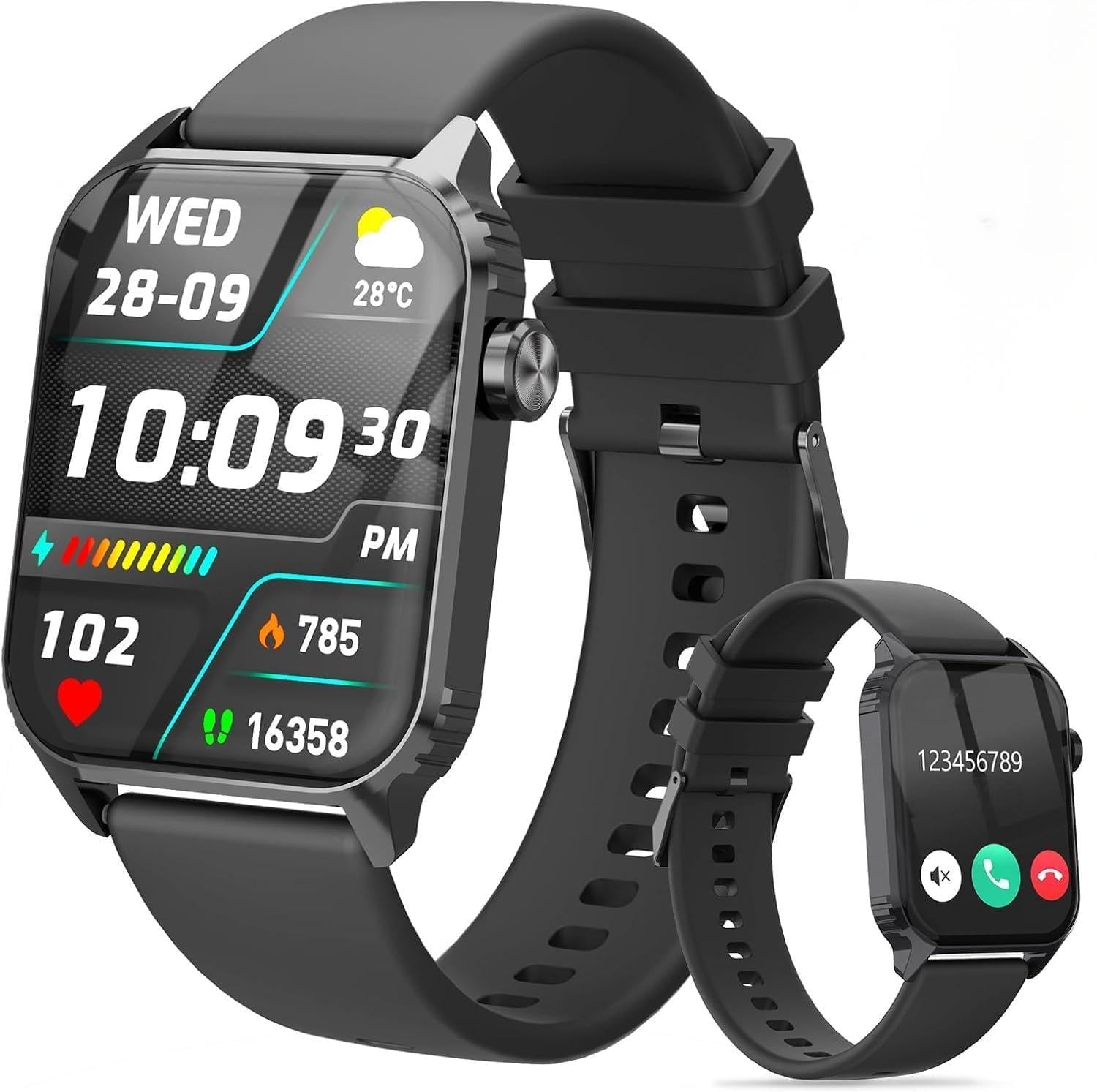
At 1.85 inches, the IDW28 has the largest display in this group, and it's AMOLED where most watches at this price settle for LCD. The 60Hz refresh rate is the detail that caught us out — notifications scroll smoothly instead of stepping — and the aluminum case plus the second band in the box make it look and feel like a watch that costs more than it does.

Calls run over Bluetooth 5.3 with a dedicated audio chip, which is enough for a quick check-in and not how you want to take a long call. Messages are where the ceiling shows: you can read a notification and dismiss it, but replying means reaching for your phone. That's the standard budget-watch compromise, and it's the thing that sends people back to their handsets.

Seven days of battery, IP68 and more than 100 sport modes round out a package with no obvious hole in it — and at this price, nothing else here puts a screen this good on your wrist. Just treat the wrist as a notification screen rather than a messaging device, and it delivers far more than its place in the market suggests.

Bottom line: This is the value pick of the group: a 1.85-inch AMOLED, two straps and Bluetooth calls for midrange money.

4

Gydom IDW19

Gydom IDW19

Hands-free Alexa

Our Score 8.4/10
Check Price

Worth Noting

  • Pairing and app sync can drop
Battery
Up to 7 days
Display
1.8-inch touchscreen
Voice Assistant
Alexa built-in
Water Resistance
IP68

The IDW19 is built for someone who wants Alexa on the wrist without paying flagship money, and it delivers on a 1.8-inch screen with more than 100 sport modes, IP68 and a 300mAh battery rated for seven days. At 40g it's a full-size watch rather than a featherweight band, which matters if your wrists are small — the case and the 22mm strap take up real estate.

The Alexa integration is what we appreciate most, because it's genuinely hands-free: timers, weather and quick questions while your hands are full, where the other budget watches make you touch a screen. The small conveniences land too — sedentary reminders, a find-my-phone tile, and a two-hour charge that fits inside a lunch break. It's a lot of watch for the money, and the screen size is the reason to choose it over the cheaper TRAUSI.

Bottom line: We point Alexa-seekers here: a 1.8-inch screen, hands-free voice control and a week of battery.

5

aeac AR-01

aeac AR-01

Dressy everyday wear

Our Score 8.8/10
Check Price

Worth Noting

  • Small screen makes long messages fiddly
Case
43 mm round
Battery
Up to 10 days
Display
1.32-inch AMOLED
Water Resistance
3 ATM

Round cases are rarer than they should be at this price, and the AR-01 makes the most of it: a rose-gold case, a metal band, and a 1.32-inch AMOLED at 466 x 466 that hides its pixels completely. It's the only watch here that reads as a watch rather than fitness gear, and that's the reason it made this list.

The rest of the package holds up: up to 10 days per charge, the longest of the midrange picks, 3ATM water resistance, and heart rate, blood oxygen, stress and sleep tracking alongside 110-plus sport modes and Alexa built in. The 43mm case takes a standard 20mm band, so the metal bracelet can come off for silicone on training days. It's the one-watch answer for someone moving between an office and a weekend.

Bottom line: This is the pick for anyone who wants a watch that looks like a watch — round AMOLED, metal band and 10 days between charges.

6

TRAUSI TG08

TRAUSI TG08

Tight budgets

Our Score 8.6/10
Check Price

Worth Noting

  • IP67: sweat and rain, not swimming
Battery
5 to 7 days
Display
1.83-inch LCD
Voice Assistant
Alexa built-in
Water Resistance
IP67

The TG08 is the cheapest watch here we can recommend without an asterisk, and it gets there by being plain about what it is: a 1.83-inch screen, 120 workout modes, Bluetooth calling, Alexa, and a 350mAh battery rated at five to seven days. Nothing on that list is exciting. All of it is useful.

You do give things up. The panel is LCD instead of AMOLED, so it's dimmer in sunlight than the aeac pair, and the GPS is borrowed from your phone, which means a run with the handset left at home won't map a route. The 22mm band is standard, so a cheap silicone strap can change the look whenever the stock one stops suiting you.

What surprised us at this price is how complete the everyday basics feel: notifications arrive, calls connect, Alexa answers, and the screen is big enough to read a message at a glance without squinting. For a first smartwatch, a second watch for the gym bag, or a gift where you're not sure the recipient will take to wearing one, it's the low-risk buy — and the money you keep is real, not a rounding error.

Bottom line: We hand this to anyone buying a first smartwatch on a tight budget: calls, Alexa and a big screen, with nothing essential missing.

How We Chose and Tested 12 Android Smartwatches

We started with roughly 40 watches sold as Android-compatible, then cut anything that hid core features behind one manufacturer's phone, anything that couldn't take a call or send a reply on a plain Android device, and near-duplicates that only differed by case size. That left 12 watches across a wide price range, which we wore for six months.

Pairing came first: we set each watch up from the box with a different Android phone, timing how long it took to get from opening the companion app to seeing a step count, then checked how fast notifications arrived after the phone had been out of range and back. To judge step tracking, we walked a measured 1,000-step route indoors and outdoors and compared each watch's count against a hand tally. Battery life was measured with the always-on display enabled and a tracked workout each day, and we logged how long a full charge took.

For calls, we dialed from a quiet office, a busy sidewalk, and a parked car with the engine running, then asked the person on the other end to rate how we sounded — several watches were fine indoors and rough outdoors. Ease of use went to whoever on the team had never touched that model: we watched them set a timer, dismiss a notification, and swap a band without instructions. Appearance was a slower judgment; we wore each watch with a sweatshirt and with a jacket, asked coworkers whether it read bulky or dressy, and noted scuffed cases and stretched bands by month six. Value we settled at the end, weighing what each watch did against what the models above and below it in price offered.

How to Choose the Right Smartwatch for Android

How deeply it plugs into your phone

Every watch here supports Android, and that line tells you almost nothing on its own. What matters is what survives pairing. The Galaxy Watch 7 puts its best features — Energy Score, Wellness Tips, sleep apnea detection — under the Galaxy AI umbrella and is specified for Samsung Galaxy phones, while the cheaper models run through a companion app that mirrors notifications and stores your workouts.

Before you buy, write down the three things you actually need: calls on the wrist, replies to messages, alerts from one particular app. Then check those three on the specific model, not the compatibility badge.

Set your charging rhythm before you fall for a display

Displays are the biggest battery decision you'll make. The AMOLED panels here — on the Galaxy Watch 7, the Garmin and both aeac models — are brighter outdoors and easier to read at a glance than the LCDs, though they reward dark watch faces. Even so, the spread is wide: roughly a day on the Galaxy Watch 7's 22-hour rating, about a week on the midrange models, and 11 days on the Forerunner 165.

If you'll wear it overnight for sleep data, a nightly top-up is a routine you have to build into your day. If you won't, a week of battery is the calmer choice.

Calls and messages come in tiers

Bluetooth calling means the watch borrows your phone's connection: a speaker and microphone let you answer with the phone in another room, and nothing works once you're out of range. Messaging splits further. On the budget watches you can read a notification and dismiss it, but replying means picking up the phone — the single most common frustration at that end of the market.

If replying from the wrist matters to you, confirm it on the exact model rather than assuming a higher price buys it.

Read the GPS line carefully

Built-in GPS means the watch tracks a route on its own, which is what the Forerunner 165 and the Galaxy Watch 7 offer. GPS via smartphone — the wording on several picks here — means the watch borrows your phone's location. That's fine for a walk with the phone in a pocket and useless for a run where you leave it at home.

Fit, water and the second year

Cases run from 40mm on the Galaxy Watch 7 to 43mm on the Garmin and the aeac AR-01, with 20mm or 22mm bands, so most standard straps will fit one of them. Read water ratings literally: IP67 handles sweat and rain, IP68 survives a dunking, and 3ATM or 50 meters is the level to look for if you swim.

Nothing in this group comes with a guarantee of a trouble-free second year, so buy where returns are easy, register the watch when it arrives, and keep the box for the first month.

Frequently Asked Questions

Final Verdict

The Galaxy Watch 7 is the Android smartwatch we recommend, with one condition: it belongs on a Samsung owner's wrist, where the Galaxy AI health layer, the 2,000-nit display and the 32GB of storage all pull in the same direction. Pair it with another brand and you're paying for extras you may not get.

If your phone isn't a Galaxy, buy the aeac IDW28 instead — the biggest screen in this group, two straps and calls, for far less. And if training is the point rather than notifications, the Forerunner 165 is the one to wear.