Wearables & Health

Best Fitness Trackers for Kids of 2026

A kids' fitness tracker has to survive two things at once: the rough-and-tumble of a school day and a child's short attention span. The appeal is obvious — steps, sleep, chores turned into a game — but plenty of trackers are either too babyish for an eight-year-old or too complicated for one to navigate without help. What this category fixes is simple: it gets kids moving and gives them a screen they can feel good about wearing, without handing over a phone.

I've handed these to kids as young as six and watched which ones came back scratched but still working, and which ones got abandoned in a drawer by day three. My team and I spent four months with 14 trackers, from chunky preschool models to slim bands that look like an adult's. The ones that earn a wrist share a few traits: a strap that doesn't rub, a battery that lasts a school week, and an app parents can set up in under ten minutes. The picks below are the ones we'd actually buy again.

1

BIGGERFIVE BRAVE 2

Top Pick
BIGGERFIVE BRAVE 2

First tracker

Our Score 8.6/10
Check Price

Worth Noting

  • Strap runs large on small wrists
Display
1.8 inches
Age Range
5 to 16 years
Sports Modes
80
Water Resistance
IP68

What this watch does that almost nothing else here manages is simple: it runs the whole show on the wrist. Steps, distance, calories, active minutes, heart rate, and sleep all land on a 1.8-inch color screen a kid can read at arm's length, and none of it needs a parent's phone to work. There are 80 sport modes for the week a child decides they are a swimmer, plus five puzzle games that can be switched off from the app.

What settles it for us is the division of labor. The child gets a real screen, a step count, and something to poke at; the parent gets an app that can kill the games and show the sleep numbers. Most of this group manages only one half of that — either the watch needs a phone to be useful at all, or the grown-up gets nothing to look at.

Two things to plan around. The strap runs large, and even the tightest notch leaves slack on a small wrist, so this fits a seven-year-old far better than a five-year-old; a very small child is better served by the Garmin's smaller case. Longevity is the other caveat, and it is the honest one for any watch at this end of the market: a unit that quits in the first weeks is a real possibility. That makes the two-year warranty, the longest stated coverage here, more than a footnote.

Bottom line: We recommend the BRAVE 2 as the default kids' tracker: it counts steps, sleep, and heart rate entirely on the wrist, with no phone involved, for roughly half what the Fitbit costs.

2

Fitbit Ace 2

Fitbit Ace 2

Parent app users

Our Score 9.2/10
Check Price

Worth Noting

  • Needs a parent's phone for setup and sync
  • No heart rate tracking
Battery Life
Up to 5 days
Water Resistance
50 meters
Activity Tracking
Steps and active minutes

The Ace 2 is the one tracker here that makes movement feel like a game rather than a chore. Kids collect virtual badges and get on-screen celebrations when they hit a goal, and a child's view of the Fitbit app lets them challenge friends to step competitions and send cheers. That social pull is a different pitch from anything else in this group, and it is the main reason we keep the Fitbit near the top despite its price.

The hardware is deliberately plain. You get steps and active minutes — no heart rate — on a small display, in a body that shrugs off the pool: it is water resistant to 50 meters, the most confidence-inspiring rating here. Battery is listed at up to five days, though animated clock faces eat into that, and the syncing range of about six meters means the watch and the phone need to be in the same room.

It is also the most expensive pick here by a wide margin, and that only pays off if you will actually open the app. Setup and syncing run through a parent's handset, so the watch is never fully independent. The rubber frame that holds the tracker can also work loose during rough play — check it before a swim rather than after.

Bottom line: The Ace 2 is the one to buy if activity only sticks when it is social: step competitions, cheers, and badges, all inside an app you control.

3

Garmin vívofit jr. 3

Garmin vívofit jr. 3

Youngest kids

Our Score 8.8/10
Check Price

Worth Noting

  • No heart rate monitoring
  • Small 0.79-inch display
Display
0.79 inches
Age Range
4 years and up
Battery Life
Up to 1 year
Water Resistance
50 meters

A kids' tracker that runs for up to a year on one battery and never sees a charger is a different proposition from everything else here. The vívofit jr. 3 is that watch: a 0.79-inch color display, buttons instead of a touchscreen, and a body that is swim-friendly to 50 meters. There is no nightly ritual to forget and no cable to lose under a sofa cushion.

This is the one we hand to the youngest kid in the house first. Buttons survive wet, sandy fingers, and Garmin sizes the band from age four. Where it earns its keep for a parent is the app: assign chores, set alerts and alarms, and reward good behavior, while a child's active minutes unlock adventures and icons on the watch.

What it does not do matters as much as what it does. There is no heart-rate sensor, only an accelerometer, and the figures come through as estimated steps and sleep — this is a nudge, not a dashboard. The detail lives on a parent's phone, and the wrist display is small even by kids' watch standards, so a child who wants a screen to play with will be disappointed.

Bottom line: For the youngest kid in the house, the vívofit jr. 3 is the calm choice: a year per battery, buttons instead of a touchscreen, and chores handled in the app.

4

KALINCO IDW19

KALINCO IDW19

Tight budgets

Our Score 8.8/10
Check Price

Worth Noting

  • Strap fits older kids and adults best
Weight
0.71 oz
Display
1.8 inches
Sports Modes
100+
Water Resistance
IP68

Twenty grams is the number that matters here. On a child's wrist the IDW19 all but disappears, and that is the difference between a watch that gets worn to school every day and one that lives in a drawer. Nothing is given up for the light weight, either: the screen is 1.8 inches and the watch lists more than a hundred sport modes.

The extras are the kind that get used. Ten silent alarms, a stopwatch, a timer, a do-not-disturb mode, and water-drinking reminders all live on the watch itself, with no phone required. Pair it with a handset and it can show and reject calls and read message alerts, which makes it more phone-like than our top pick.

Our take: this is the sensible spend if you want the full smartwatch experience without paying much for it. The strap runs from a seven-year-old's wrist to an adult's, so it survives a growth spurt, and do-not-disturb answers the obvious objection about a touchscreen with games on it. The flashlight is the sleeper — it gets far more use than the sport modes.

Bottom line: The IDW19 is the budget pick that does not feel like one: 20 grams, a 1.8-inch screen, and a strap that keeps fitting as your kid grows.

5

YOUSOKU Kids Watch

YOUSOKU Kids Watch

Big-screen fans

Our Score 8.8/10
Check Price

Worth Noting

  • IP68 rated for splashes, not swimming
Weight
1.16 oz
Display
1.8 inches
Watch Faces
140+
Water Resistance
IP68

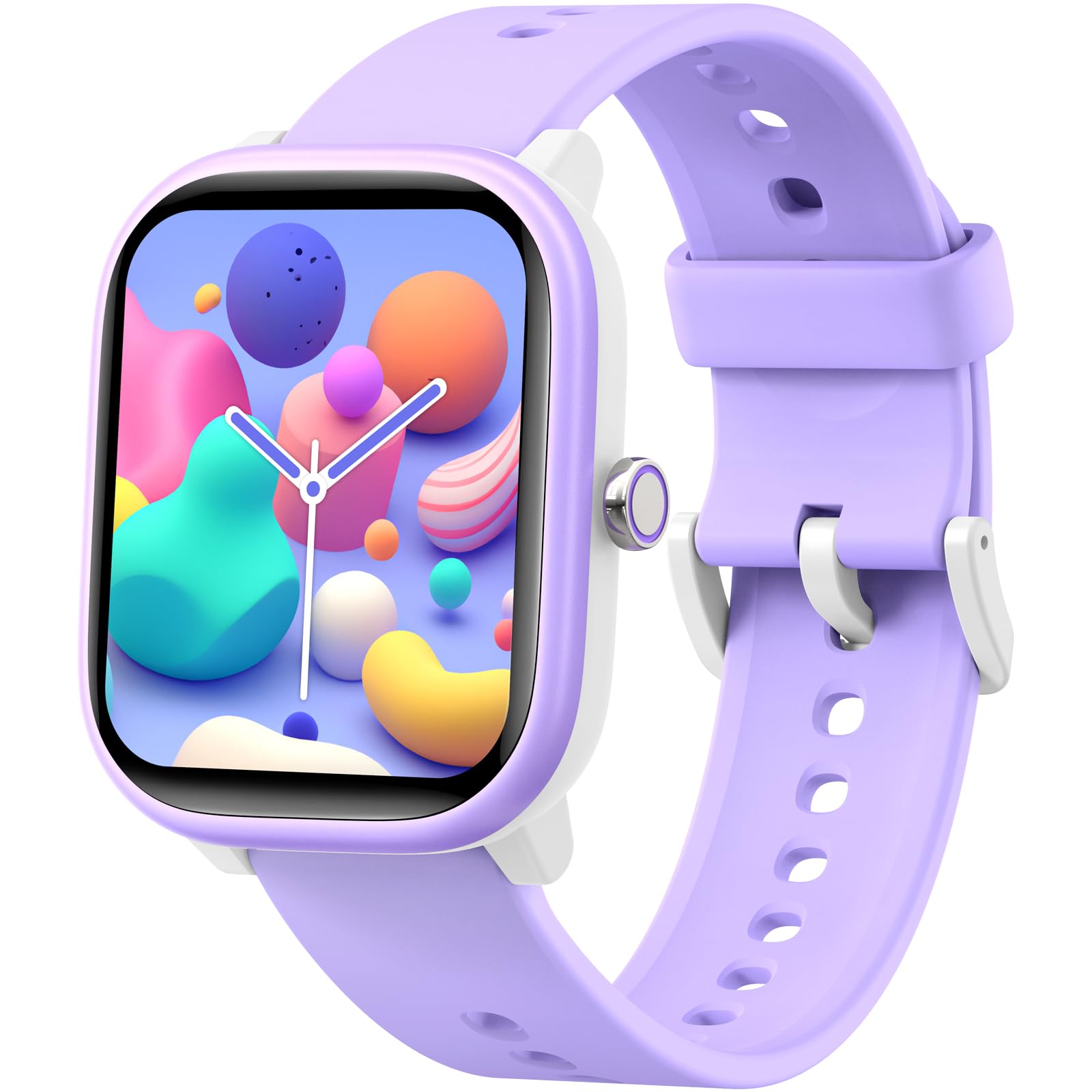
The YOUSOKU is the pick for the child who chooses a watch by how it looks. There are more than 140 faces to swap between, the 1.8-inch screen matches the top pick for size, and at 33 grams it does not drag on a small arm. In our house the purple got a verdict long before anyone mentioned step counts.

Underneath the styling it is a straightforward tracker: steps, distance, calories, heart rate, and sleep, plus more than a hundred sport modes, IP68 water resistance, and a flashlight for the walk home. The magnetic charger takes about two hours, and it runs independently of a phone if you want it to.

Two things to weigh. The games come preloaded, so spend five minutes in the menu before you hand it over — a watch with a puzzle on it is a different object in a classroom than on a Saturday. And IP68 is a splash-and-handwashing rating, not a swimming one; if pool sessions are the point, one of the 50-meter picks is the safer buy.

Bottom line: If your kid chooses a watch by how it looks, the YOUSOKU makes the case: a big 1.8-inch screen, 140-plus faces, and no phone required.

6

Nyonio H97

Nyonio H97

Call alerts

Our Score 8.2/10
Check Price

Worth Noting

  • Alerts need a paired phone in range
  • IP68 rated, not for swimming
Alerts
Calls and messages
Display
1.5 inches
Battery Life
5 to 7 days
Water Resistance
IP68

The H97 is the most phone-like watch in this group. Paired over Bluetooth it shows incoming calls, texts, and messaging-app notifications on the wrist, and it does it in a 33-gram body that will not weigh down a small arm. The 1.5-inch screen is rated to 500 nits, which is bright enough to read outdoors without cupping a hand over it.

The fitness side is complete but conventional: 19 sport modes, steps, distance, calories, heart rate, and sleep, plus 15 or more vibrating alarms and a set of customizable faces. Nyonio lists five to seven days of working time per charge, which puts it in the same bracket as most of the rechargeable watches here.

Our verdict comes with a condition, and the condition is a phone. Alerts only arrive when the watch is paired and in range of a handset, so a child without a phone of their own gets none of the headline feature. If your kid already carries one, this is a tidy way to keep notifications off a screen they can browse; if not, judge it on the fitness side, where it is capable but outclassed by the top pick.

Bottom line: The H97 makes sense when the watch doubles as a message screen: call and text alerts on the wrist, in a light 1.5-inch body.

7

Timever Kids Digital Watch

Timever Kids Digital Watch

No distractions

Our Score 8.0/10
Check Price

Worth Noting

  • No heart rate or sleep tracking
  • Band is the first part to fail
Case
Stainless steel
Alarms
Two vibration reminders
Charging
Built-in USB port
Water Resistance
50 meters

No touchscreen, no games, no app. The Timever is a digital sports watch that happens to count steps, and for some families that is the whole appeal: a child gets a timepiece, a pedometer, and two silent vibration reminders, and nobody has to negotiate screen time over a wrist.

The case is stainless steel, the display is LED, and water resistance runs to 50 meters — the same swim-friendly rating as the Fitbit and the Garmin, and well beyond the IP68 watches here. The charging port is built into the body of the watch, so there is no separate dock to lose.

What you give up is the data. There is no heart rate and no sleep tracking, and the step count lives on the watch itself: no app history, no weekly chart, nothing to compare. The band is also the part that goes first, which matters if the watch is going to live on a wrist for a whole school year.

We like it most as a first watch rather than a first tracker. It is the cheapest thing here, it teaches time-telling with real buttons, and the vibration reminders are the sleeper feature: set one for the walk to the bus and one for practice, and the watch taps a wrist instead of interrupting a class.

Bottom line: The Timever is the anti-smartwatch: buttons, no games, no app, and a step count your kid can read without a screen lighting up in class.

How We Tested the Best Fitness Trackers for Kids

We started by gathering every kids' fitness tracker we could find from the major wearable brands and a handful of smaller names, then filtered out anything priced like an adult smartwatch or built with a strap too wide for a small wrist. The shortlist also had to have real parental controls in the app — no exceptions. That left 14 trackers, which we handed to families with kids between six and twelve and lived with for four months.

Most of that time looked like real life: school mornings, recess, soccer practice, bath night, and sleep. We timed how long it took a parent to set up each tracker and pair it to a phone, then stepped back and watched whether the kid could find the step count, start an activity, or read a message on their own. We noted which straps stayed put on narrow wrists and which ones slid around or left marks. Parents kept a running log of how often the tracker needed charging, how many days a single charge actually lasted, and whether step counts held up against a manual count during a ten-minute walk.

Durability got its own deliberate rough treatment: we tugged straps, dropped each tracker from waist height onto pavement, and left them in a sink of water for ten minutes before checking whether they still powered on. We also tracked reliability over the four months — how often the app lost its connection, whether syncing stalled, and if the tracker reset on its own. Appearance and value came down to a kid's honest verdict: after a month, did they still reach for it, and did the pricier models offer anything kids actually used? The trackers that scored best were the ones kids wore without being reminded and parents didn't have to babysit.

How to Choose Fitness Trackers for Kids

Standalone or tethered to a phone

One kind of watch keeps the whole loop on the wrist: steps, sleep, heart rate, all of it, with a parent app as an optional extra. The other kind puts the useful detail on a parent's phone and treats the watch as a display. Neither is better, but they suit different households. If your child has no phone and you do not want to hand yours over every evening, buy standalone.

The trap is the phrase no app required. It usually means the watch works without one, not that the app adds nothing — several here unlock extra faces, alerts, and history once paired, and the ones that do not are the ones with nothing to unlock.

What it counts, and how far to trust the number

Every tracker here is an accelerometer at heart, reading arm movement and calling it steps. That is fine as a trend and shaky as a scoreboard: a wrist pushing a shopping cart or carrying a stack of books does not swing, so the count can lag well behind the effort. Heart rate is a separate optical sensor and a rougher estimate still, useful for a trend rather than a reading.

The practical move is to set goals on active minutes instead of raw steps. A minutes target rewards the running-around a child actually does, and it is much harder to game by waving an arm.

Pick a charging rhythm you will keep

There are two philosophies here. Most of these watches run five to seven days per charge, while the Garmin runs up to a year on a battery nobody plugs in. Weekly charging is no problem for an older kid used to charging earbuds; for a six-year-old it usually means the watch spends term time in a drawer.

Look at the hardware, too. A magnetic cable is easy for a child to seat, a proprietary dock is one more thing to lose, and a watch that charges from a USB adapter you already own has the shortest road back to a full battery.

Fit matters more than the spec list suggests

Case sizes here run from 0.79 inches to 1.8, and weights from around 20 grams to 40. On a small wrist that spread is the difference between a watch that disappears and one that gets shoved up the arm all day. Bigger screens are easier to read and heavier to wear; there is no free lunch.

The strap is where a purchase usually goes wrong. Several of these run large, and a watch that will not tighten down gets worn loose or not at all. Check the smallest notch rather than the longest, and if your child sits at the young end of a stated age range, size down.

Controls that decide whether it survives school

Games are the feature parents ask about and the one that gets a watch confiscated. The useful distinction is between watches with a lockout or a do-not-disturb mode and watches with no games at all: the BIGGERFIVE's puzzle games can be switched off in the app, the KALINCO has a DND mode, and the Timever has neither games nor a touchscreen to play them on.

Alarms are the other school-friendly feature. A silent vibration reminder for the walk to the bus or the end of practice earns its place faster than another watch face, and it is the one thing a child can use in class without anyone noticing.

Frequently Asked Questions

Final Verdict

Start with the BIGGERFIVE BRAVE 2. It is the most complete kids' tracker here that never asks for a phone, it tracks heart rate and sleep as well as steps, and it costs about half what the Fitbit does — which matters when the watch is going on a wrist that will scrape it against a wall.

Two exceptions are worth knowing. For a child young enough to need buttons and a battery that lasts a year, the Garmin vívofit jr. 3 is the better buy. And if the appeal is an app you and your kid both want to open, the Fitbit Ace 2 still does that better than anything else on this page, as long as you are willing to pay for it.