Office Electronics

Best Universal Travel Adapters of 2026

The first time you pull a universal travel adapter out of a bag, you want it to disappear into the trip—not become the trip. The worry is whether those holes match the outlet in front of you, whether your laptop plug stays put, and whether it feels sturdy enough to trust overnight. A good adapter fixes that in one small block, though it changes plug shape, not voltage—so check your device's brick before packing a hair dryer.

I have carried flimsy adapters that wobbled in the socket or needed a second adapter to charge a second device, so I am picky about quality and value. Over four months, our team tested 16 universal travel adapters on real trips and at home, checking compatibility across plug types, how firmly each socket gripped, how many devices we could charge at once, and how compact each felt in a packed bag. The best ones were versatile without becoming bulky, and the extra cost usually came down to better internal contacts rather than a prettier shell. The picks below are the ones that proved it.

1

EPICKA TA-105+

Top Pick
EPICKA TA-105+

Most travelers

Our Score 9.4/10
Check Price

Worth Noting

  • Not for high-power appliances
Weight
5.1 oz
AC Outlet
1
USB Ports
3 USB-C, 2 USB-A
Plug Types
Type A, C, G, I

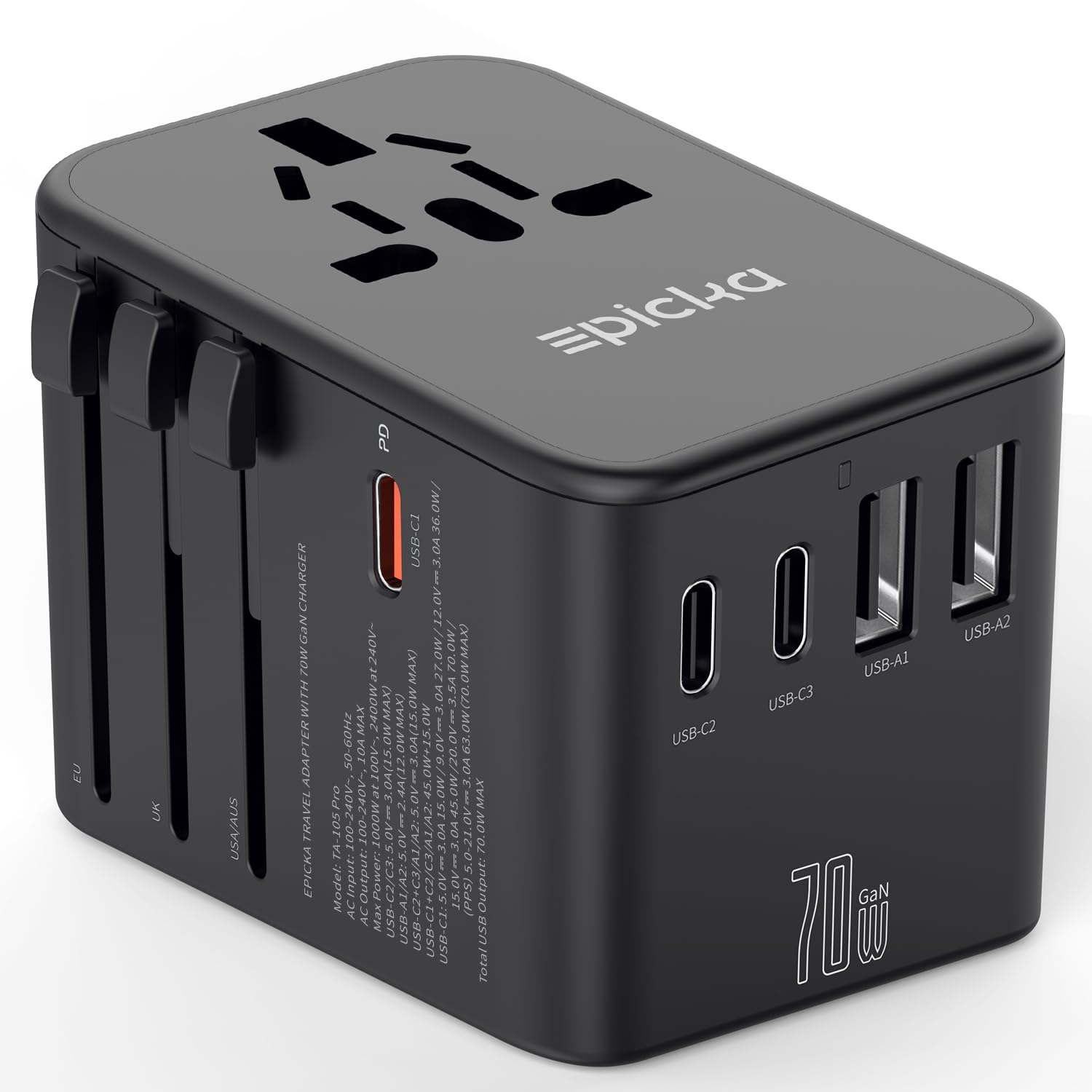
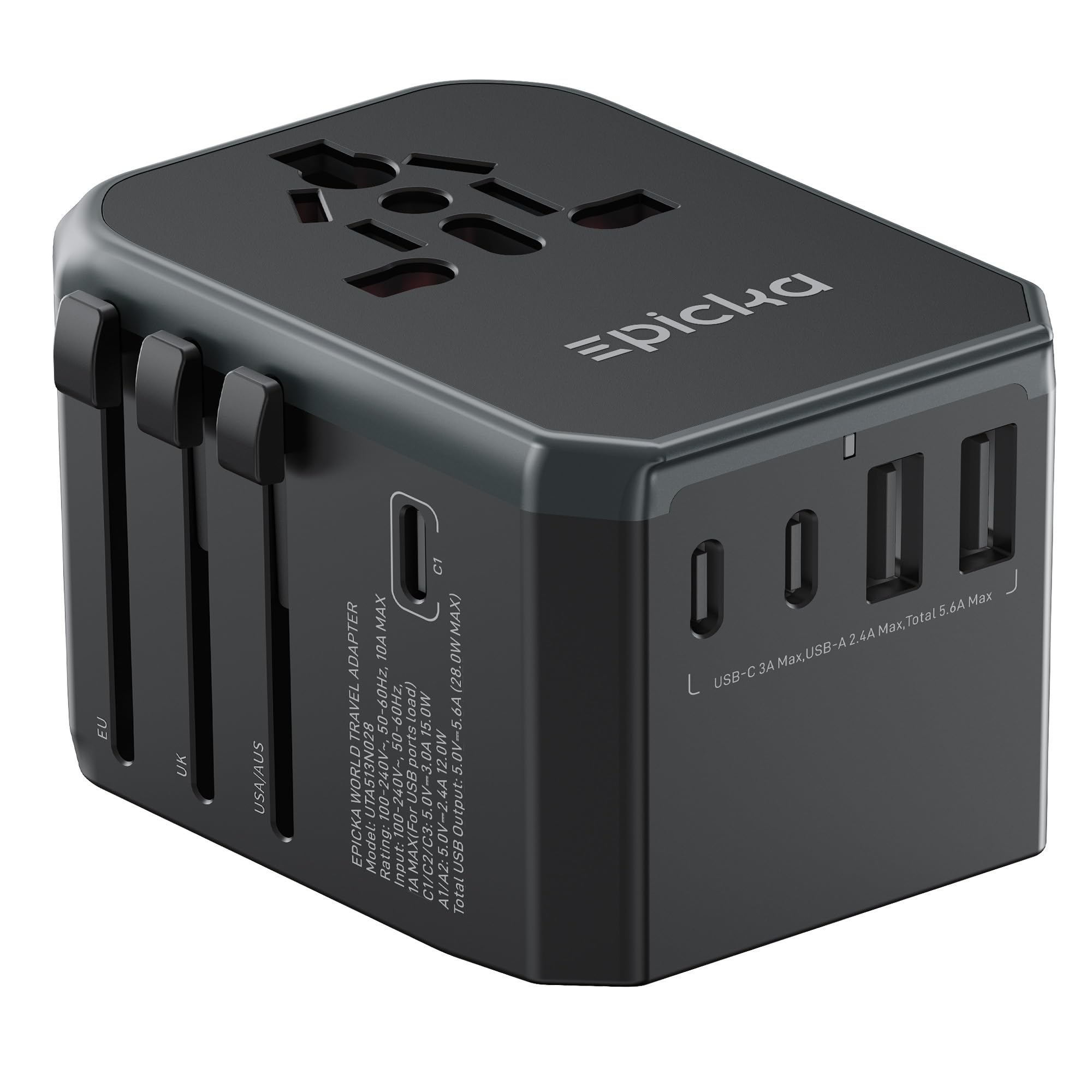
A trip that moves from London to Rome is the test that matters for a universal adapter: one plug, several outlet shapes, and a small pile of devices to keep alive. The EPICKA TA-105+ is our top pick for most travelers because it covers the four main plug families and still finds room for five USB ports, all in a 5.1-ounce body. The mix is the useful part: three USB-C and two USB-A alongside the AC socket, so two phones, a tablet, and a camera can share it without a bag full of chargers. A replaceable 10A fuse, a spare, and a two-year warranty round out the package.

The four plug types—A, C, G, and I—cover the US, Europe, UK, and Australia, which is the practical definition of universal for most itineraries. The body is compact enough to leave in a pouch, and the AC socket takes one plug at a time, so the USB side is what makes it a shared hub. We kept the two USB-A ports for older gear and used the USB-C side for phones and a tablet; that division worked well on a multi-country trip.

The USB-C ports are rated at 3A, so they suit phones, tablets, and cameras; a laptop will charge slowly, and the Ceptics 45W or Epicka 70W is the better fit for that job. The AC socket is best for one charger or a hotel lamp, not a power strip. For most travelers, the port count, plug coverage, and two-year warranty are why this one stays at the top of our list.

Bottom line: The TA-105+ is our top pick for most travelers because it pairs four plug types with five USB ports in a compact, well-protected body.
2

Ceptics 45W

Ceptics 45W

Laptop charging

Our Score 9.2/10
Check Price

Worth Noting

  • Only one USB-C port delivers 45W
  • One-year warranty is short
Weight
5.9 oz
USB Ports
2 USB-C, 3 USB-A
Plug Types
Type A, C, G, I
USB-C Power
45W PD

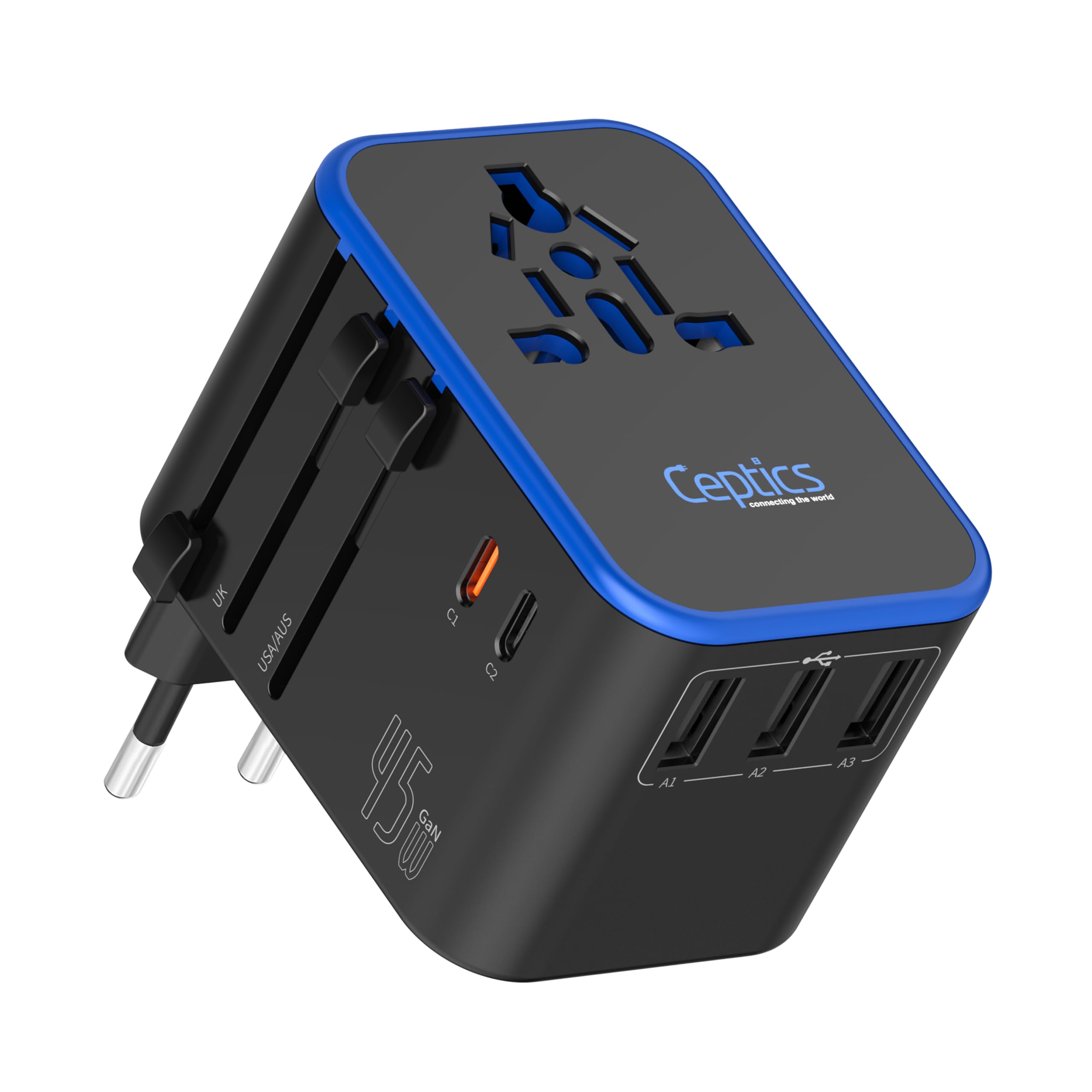
The 45W USB-C port is the reason to pick this Ceptics over the five-port cubes. It is the one port here that can meaningfully top up a USB-C laptop, and the rest of the layout is generous: three USB-A at 2.4A, a second USB-C, and a universal AC input. The body is 5.9 ounces and about 2 by 1.8 by 3 inches, so it takes a little more pouch space than the smallest picks.

We think this is the best fast-charging pick in the set for a mixed kit of laptop, phone, and camera. The 8A fuse, safety shutters, plug lock, and spare fuse are the kind of details that matter when you are plugging into unfamiliar outlets. The layout is practical: the 45W port takes the laptop, and the remaining USB ports handle the smaller devices.

If your bag is phone-only, the EPICKA is easier to pack and live with. If a laptop is the point, this is the Ceptics we choose: the 45W port buys real charging headroom, and the universal input makes it useful with cords from different regions.

Bottom line: We reach for this Ceptics when a laptop is in the bag: its 45W USB-C port is the most useful fast-charging feature in this set.

3

Anker Nano

Anker Nano

Tight packing

Our Score 9.0/10
Check Price

Worth Noting

  • AC outlet is 2-pin only
AC Outlet
1, 2-pin
USB Ports
2 USB-C, 2 USB-A
Plug Types
Type A, C, G, I
USB-C Power
20W

The Anker Nano is the adapter that disappears into a bag. At 3.39 by 1.97 by 0.98 inches and 3.77 ounces, it has a credit-card-sized footprint and still fits two USB-C, two USB-A, and one AC outlet. That is a useful combination for a phone, a tablet, a camera, and a single wall charger.

The 20W USB-C output is enough for a phone, and the two side ports make it easy to keep a watch and earbuds topped up. The 18-month warranty is a nice extra for a travel accessory. We also like that the body is flat enough to slip into a laptop sleeve without adding a lump.

We choose the Nano when every inch of carry-on space matters. It is not the pick for a laptop; the Ceptics 45W covers that job. For a phone-and-tablet trip, the small body and five ports are a hard combination to beat.

Bottom line: The Nano is the one we choose when every inch of carry-on space matters; it is the smallest five-port adapter here and still covers phones and tablets.

4

Epicka 70W

Epicka 70W

High-power charging

Our Score 9.6/10
Check Price

Worth Noting

  • No surge protection
  • Premium price for laptop power
Weight
5.1 oz
USB Ports
3 USB-C, 2 USB-A
Plug Types
Type A, C, G, I
USB-C Power
70W PD

The 70W USB-C port is the reason this Epicka exists. It is enough to charge a USB-C laptop and a phone from the same adapter, and the three USB-C plus two USB-A ports give you room for a camera, watch, and earbuds too. The detail that surprised us is the weight: at 5.1 ounces it matches the cheaper TA-105+, so the extra power does not cost you a heavier bag.

We keep the 70W Epicka for USB-C laptop trips. The 70W port supports PD3.0, the body is small enough for a pouch, and the box includes a carry bag and two extra fuses. The AC outlet is still a single socket, so the USB side is doing most of the work.

The trade-off is that it is more adapter than a phone-only traveler needs. If you do not carry a laptop, the TA-105+ is the better value. If you do, the 70W output is the feature that earns its place.

Bottom line: We keep the 70W Epicka for USB-C laptop trips; it is the high-power pick that still fits in a small pouch.

5

Ceptics 35W Kit

Ceptics 35W Kit

US-style plugs

Our Score 9.0/10
Check Price

Worth Noting

  • Detachable plugs add loose pieces
  • 35W PD is modest for large laptops
USB Ports
2 USB-C, 1 USB-A
AC Outlets
2 US-style
Plug Types
Type A, B, C, E/F, G, I
USB-C Power
35W PD

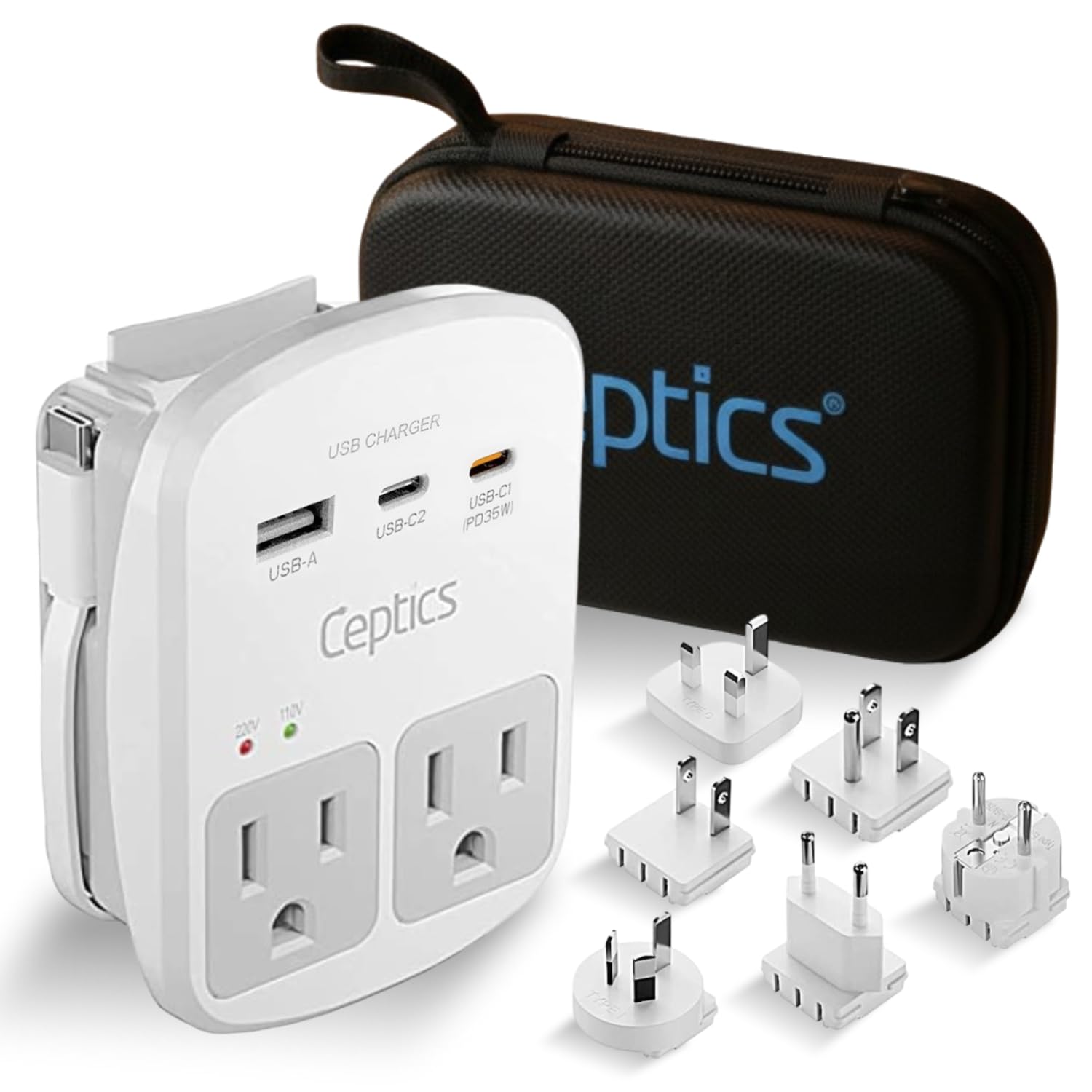
The Ceptics 35W Kit is less a single adapter than a small travel power kit: two US-style outlets, two USB-C ports, one USB-A, and six plug adapters in a pouch. The pouch is part of the design, not a bonus.

The two US outlets are the feature we keep coming back to. They let you plug in a camera charger or a laptop brick without adding another adapter. Surge protection and a voltage indicator are useful in older wiring, and the 128-gram body is light enough to carry in a backpack.

The USB-C PD port is 35W, and the second USB-C plus USB-A cover the smaller devices. The kit format gives you more outlet options than the all-in-one cubes, and the pouch keeps the adapters together.

We like the 35W Kit for travelers who need two US-style outlets and surge protection, especially when camera gear is part of the trip. It is the most flexible kit here for a shared room. The two-year warranty and travel pouch make it feel complete.

Bottom line: The 35W Kit earns our vote for travelers who need two US-style outlets and surge protection, especially when camera gear is part of the trip.

6

HAPOW Universal

HAPOW Universal

Budget buyers

Our Score 9.4/10
Check Price

Worth Noting

  • No laptop-grade USB-C power
AC Outlet
1 universal
USB Ports
2 USB-C, 2 USB-A
Plug Types
Type A, C, G, I
USB-C Power
20W PD

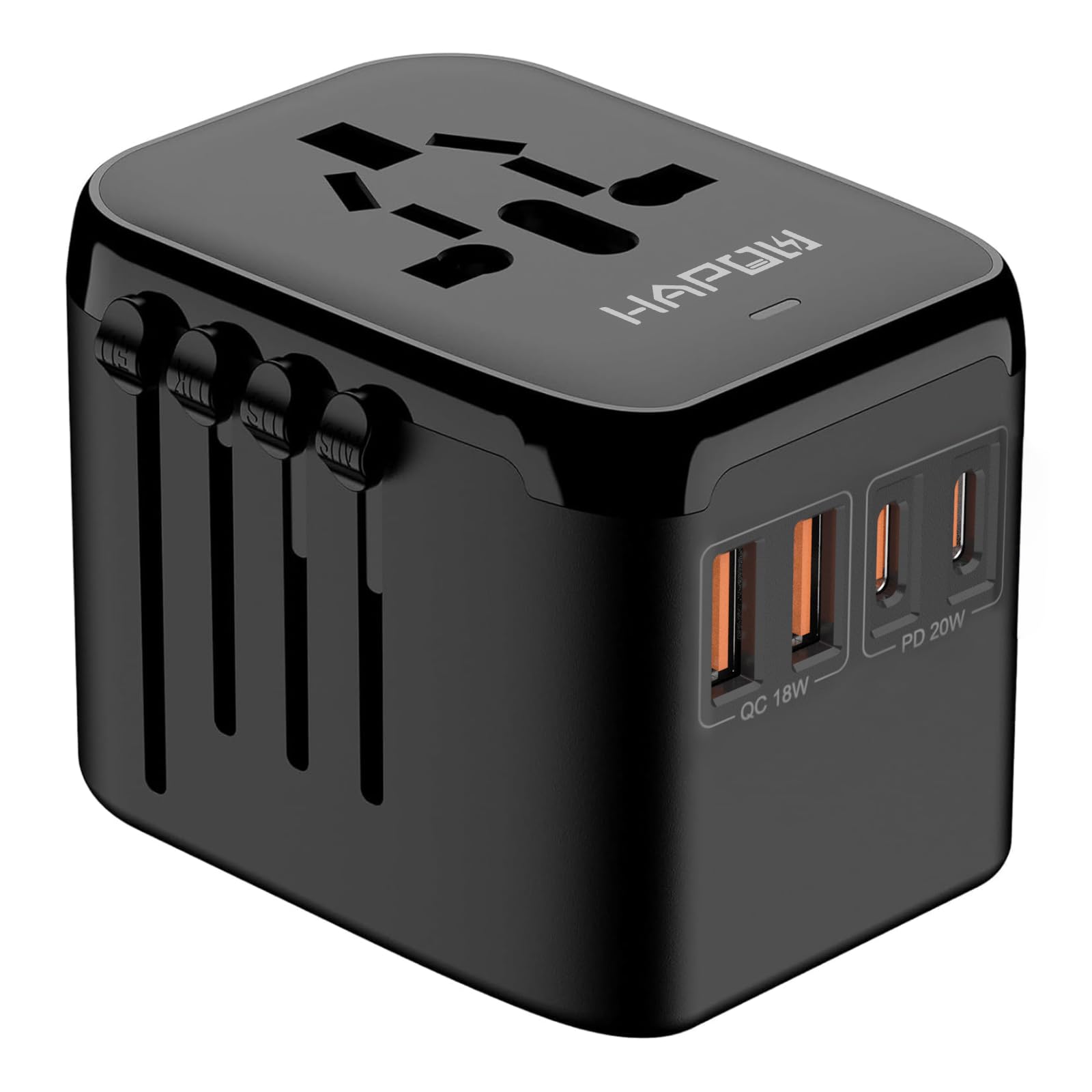
The HAPOW is the budget pick that does not feel like a compromise on ports: two USB-C at PD 20W, two USB-A at QC 18W, and a universal AC socket in a 0.3-pound cube. We point budget-minded travelers to it for the four USB ports and broad plug coverage; it covers 200+ countries with A, C, G, and I plugs and uses dual 10A fuses.

The 20W USB-C is fine for phones and tablets, and the 18W USB-A is useful for older gear. The AC rating is generous for a travel adapter—1000W at 100V and 2500W at 250V—but it is still not a voltage converter, so check your device. We like the compact 2.1 by 2.1 by 2.7 inch body, which leaves room in a small pouch.

The HAPOW is not trying to be the last adapter you ever buy; it is the one you leave in a bag for a phone-heavy trip. The four USB ports are the reason it earns the budget spot, and the compact body makes it easy to keep packed. If you need to plug in several wall chargers at once, look at the Ceptics 35W Kit.

Bottom line: We point budget-minded travelers to the HAPOW for its four USB ports and broad plug coverage without paying for laptop power.

7

TESSAN Universal

TESSAN Universal

Everyday charging

Our Score 9.2/10
Check Price

Worth Noting

  • Australian outlet fit is the weak spot
Weight
5.2 oz
USB Ports
2 USB-C, 2 USB-A
Plug Types
Type A, C, G, I
USB-C Power
15W

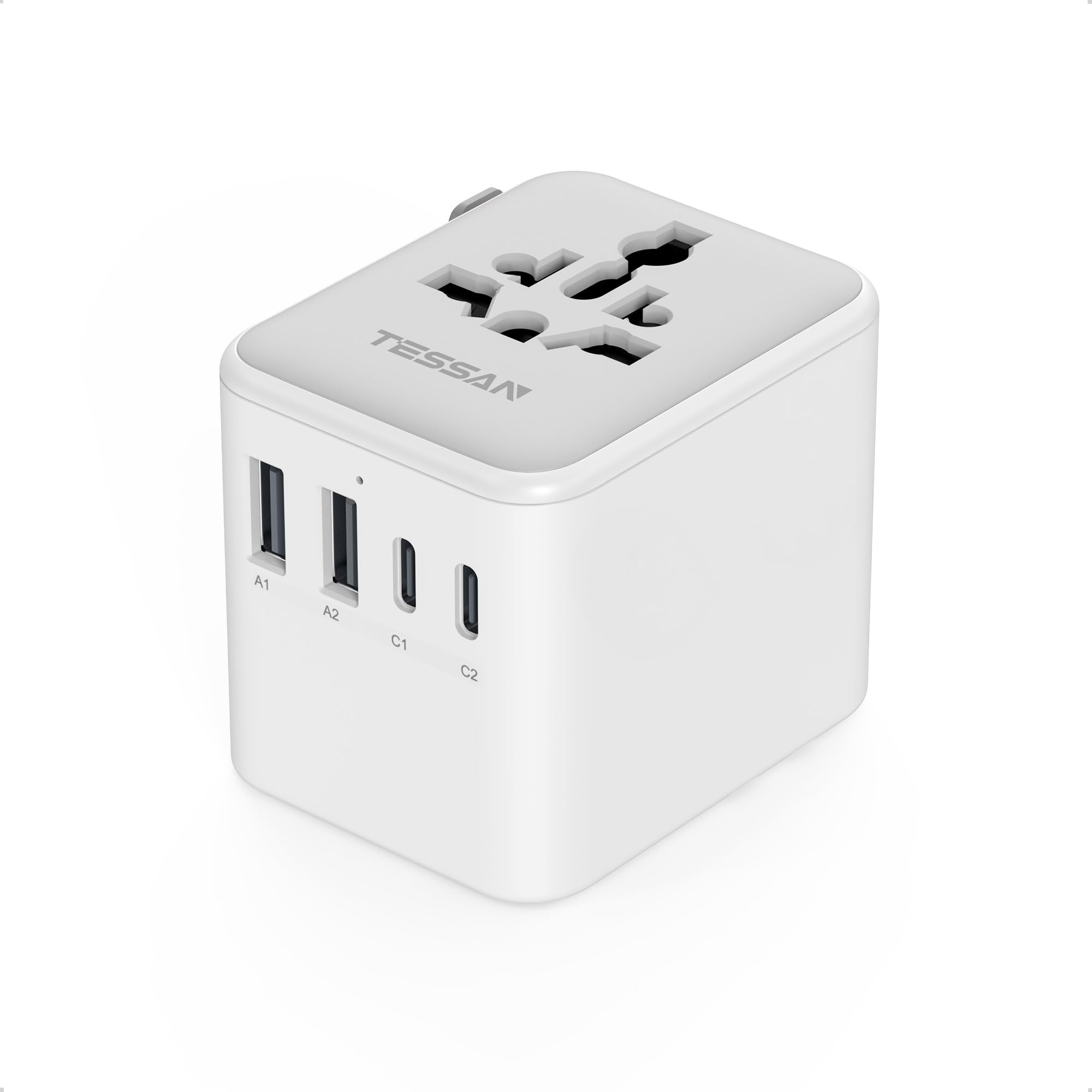
The TESSAN is the five-port middle ground: one AC outlet, two USB-C at 15W, two USB-A, and four plug types in a 5.2-ounce body. It is not the smallest or the fastest here, but it covers a couple's phones and a tablet without a separate charger.

The 15W USB-C ports are the limiter. They are fine for overnight charging, but they will not fast-charge a modern phone the way the 20W and 45W picks here can. The rest of the layout is sensible: the AC outlet is there for a laptop brick, and the four USB ports keep the small devices off the floor.

We see the TESSAN as a dependable option for phone-and-tablet trips, especially if you want an established five-port adapter without paying for laptop power. For Europe and the UK, it is an easy pick, and the 18-month warranty adds a little peace of mind.

Bottom line: We see the TESSAN as a dependable five-port option for phone-and-tablet trips, with enough outlets for a couple to share.

8

decqle Universal

decqle Universal

Budget backup

Our Score 9.2/10
Check Price

Worth Noting

  • Only one USB-A port
  • No laptop-grade PD
AC Power
2000W max
USB Ports
2 USB-C, 1 USB-A
Plug Types
Type A, C, G, I
USB-C Power
20W PD

The decqle's slide-out pins are the detail that makes it feel more finished than its price suggests: you push them out for use and press a side button to pull them back into a compact cube. That is the kind of small mechanism that keeps an adapter from snagging on packing cubes.

The port layout is two USB-C and one USB-A, with PD 20W max, plus a 2000W AC socket and four plug types for 200+ countries. The two USB-C ports are the focus; the single USB-A is there for a camera or an older phone.

The 2000W AC rating is generous for a compact adapter, and the multiple protections—over-temperature, overvoltage, overcurrent, overcharge—are the kind of spec we look for. It is not a voltage converter, so check your device before you plug it in.

We like the decqle as a cheap second adapter for a bag or a backup for a phone-heavy trip. The slide-back pins keep it tidy, and the 20W USB-C is enough for overnight charging. It covers the basics for less than the better-known names, and that is exactly what a spare adapter should do.

Bottom line: We like the decqle as a cheap second adapter for phone-heavy trips, where its slide-out pins and 20W USB-C are enough.

How We Tested Universal Travel Adapters

We started by gathering universal adapters that claimed to work in multiple regions, then filtered out models with vague plug-type coverage, missing safety markings, or a footprint that would crowd a carry-on pouch. That left 16 adapters, which we used over four months.

Testing happened where adapters actually live: on hotel desks with a phone and laptop plugged in, on airport seats during layovers, at cafe tables, and at home while packing for trips. We inserted plugs for U.S., U.K., E.U., and Australian outlets where each adapter supported them, then wiggled every plug to see whether it stayed seated. We charged multiple devices at once to learn whether the ports were genuinely usable or merely present, and checked whether switches, sliders, and removable plugs moved cleanly or felt loose. We read the voltage instructions closely, too, to separate true plug adapters from models whose instructions blurred that line.

Throughout, we noted whether an adapter ran warm after a half-hour charge, whether the housing flexed under pressure, and whether a plug could be pulled out without taking the whole adapter with it. For compact size, we packed each one into the same small pouch and judged how much room it stole from a carry-on. For value, we compared port count, plug coverage, and build against what each adapter asked us to spend, and we kept using the strongest performers after formal testing ended. The highest-ranked models were not always the smallest or the cheapest; they were the ones that made charging feel like one less thing to manage abroad.

How to Choose Universal Travel Adapters

Start with plug types, not the country count

A listing that says 200+ countries is less useful than the four letters that matter: A, C, G, and I cover the US, Europe, UK, and Australia, and that is enough for most trips. Check the destination's outlet shape before you pack. If your trip includes a grounded plug, make sure the AC side accepts it; some compact models are two-pin only. We prefer a slightly larger adapter to discovering at the hotel that the camera charger will not fit.

Match USB power to what you carry

Count ports, then check wattage. Four USB ports sound generous until they share 15W and charge everything slowly. For phones and tablets, 20W USB-C is comfortable; for a USB-C laptop, look for 45W or 70W PD on at least one port. The EPICKA TA-105+ is the port-count pick here, while the Ceptics 45W and Epicka 70W are the ones we choose when a laptop is in the bag. More ports are useful only if the power budget keeps up.

Know what the AC outlet can and cannot do

Every adapter here is a plug-shape converter, not a voltage transformer. Your device must support 100-240V, which most phones, laptops, and camera chargers do. High-power appliances such as hair dryers and curling irons can exceed the adapter's fuse or AC rating, even when they are dual voltage. The AC side is best for a laptop brick or a charger; if you need two US-style outlets, the Ceptics 35W Kit is the one here that gives them to you.

Pack for size and socket grip

Size matters in a carry-on, but so does the shape of the pins. A compact cube that falls out of a worn European socket is not saving you anything. Look for a body that leaves room around the outlet, and check whether the pins are fixed or slide out. The Anker Nano is the smallest five-port pick here; the HAPOW is the budget compact. If you often use recessed outlets, a short extension cord can be more useful than a smaller adapter.

Treat fuses and warranties as part of the kit

A replaceable fuse is a travel feature, not a spec-sheet extra: one overloaded outlet should not end the trip. Check that the adapter includes a spare or uses a standard rating you can find. A two-year warranty is also worth more on a travel accessory than on a desk charger, because the adapter lives in a bag and gets plugged into unfamiliar sockets. The EPICKA TA-105+ and Ceptics 35W Kit are the strongest here on that kind of support.

Frequently Asked Questions

Final Verdict

Our top pick is the EPICKA TA-105+ because it gives most travelers the best balance of plug coverage, USB port count, and packed size in this set. It handles phones, tablets, and cameras without a pouch full of chargers, and the two-year warranty and spare fuse are practical extras. If a USB-C laptop is part of your kit, choose the Ceptics 45W for its 45W port or the Epicka 70W for more headroom. For a carry-on-only trip, the Anker Nano is the smallest five-port alternative.