Phone & Tablet Accessories

Best USB-C Car Chargers of 2026

A dead phone in the car has a way of turning a normal drive into a small crisis — no directions, no music, no way to tell someone you're running late. I've had a bargain-bin charger quit on a highway shoulder, and I've had one get so hot I unplugged it at a red light. The difference between a charger that works and one that just lights up is usually invisible until you need it.

Over the past four months, I've run 16 USB-C car chargers through daily commutes, a long weekend road trip, and stop-and-go errands where everyone wants a port at once. We timed how quickly each one revived a dead phone, checked whether the ports shared power honestly, and noted heat, fit, and whether the charger still held a cable snugly after months of use. The wattage on the package is a promise, not a measurement — and the picks below are the ones that delivered.

1

Anker 167.5W 3-Port

Top Pick
Anker 167.5W 3-Port

Laptop and phone

Our Score 9.6/10
Check Price

Worth Noting

  • Premium price for the extra power
  • Can run warm under sustained 100W load
Ports
2 USB-C + 1 USB-A
Weight
2.79 oz
Max Output
167.5W
USB-C1 Output
100W

The 100W USB-C port is what separates the Anker 167.5W from the rest of this group. It is the one we reach for when a laptop has to come along, because the same plug can also top up a phone and a tablet without making you choose between them. The second USB-C port delivers up to 45W, which is quick enough for most phones and tablets, and the USB-A slot keeps an older cable in the mix.

We think that flexibility justifies its place at the top if your car is a mobile office or a road-trip hub. The 167.5W total is shared, so a laptop on the 100W port is the main event and the other ports slow down when everything is plugged in. That is normal for a car charger, and it is still the most capable setup in this set for mixed devices. If you usually carry one phone, the smaller Anker 40W is easier to justify; the 167.5W earns its keep when a laptop or tablet joins the trip.

The body is compact for the power, and the included 3.3-foot USB-C cable saves a search through the console. We noted that the plug sits securely without crowding the socket, so it is easy to leave in place. The three-port layout also means a passenger can charge while the driver's phone stays on navigation. It is a serious charger, not a tiny emergency top-up.

Bottom line: We recommend the Anker 167.5W for road trips and mixed devices: its 100W USB-C port runs a laptop while two other ports handle phones and tablets.

2

Anker 40W 2-Port

Anker 40W 2-Port

Everyday phone charging

Our Score 9.4/10
Check Price

Worth Noting

  • 40W is shared across both ports
  • No laptop-grade output
Cable
Not included
Ports
2 USB-C
Weight
1.12 oz
Max Output
40W

A 40W charger sounds modest next to the 90W and 167.5W models here, but the Anker 40W is the one we kept coming back to for simple phone duty. Its two USB-C ports are enough for a driver and passenger, and the tiny body sits close to the socket instead of crowding the console.

What we liked most is the lack of fuss: no built-in cable to tangle, no app, no extra bulk. You bring your own USB-C cable, so pair it with one rated for your phone's fast-charge standard. Both ports are USB-C, which means a newer Android phone and an iPhone 15 or later can share the charger without an adapter.

If you want one charger to leave in the car and forget about, this is the easiest of the group to justify. It does not have the headroom of the Anker 167.5W, but most commuters never need it. We liked that it stays out of the way in a center console, which matters more day to day than a wattage number.

Bottom line: We recommend the Anker 40W for phone-only commuters who want two USB-C ports and a tiny footprint without paying for laptop-grade power.

3

LISEN 84W Retractable

LISEN 84W Retractable

Tidy cable setup

Our Score 9.0/10
Check Price

Worth Noting

  • No wired CarPlay or data transfer
Ports
4 total
USB-C PD
45W
Max Output
84W
Retractable Cables
2, 31.5 in

The retractable cables are the whole reason to consider the LISEN 84W. Pull one out to 31.5 inches and the console stays clear of the usual tangle; let it go and the cable disappears back into the body. With two built-in cables and two extra USB ports, it can keep a family's devices going without a drawer full of loose cords.

The USB-C cable delivers up to 45W, which is quick for a phone and enough for many tablets, and the four-port layout means you are not constantly swapping plugs. We liked not hunting for a cable at a red light, and the built-in cords make this the easiest charger here to live with on a daily basis.

The catch is that the cables are fixed and thin, so they are the wear point; if one fails, the charger loses a port. The body is also bulkier than a bare plug because it has to hold the spools, so check clearance if your outlet sits under a lid. We think it is still a strong choice for people who value a tidy car, as long as you treat the cords gently.

Bottom line: We recommend the LISEN 84W for anyone tired of loose cables: its retractable cords keep the console tidy, and 45W USB-C is quick enough for most phones.

4

LISEN 69W 2-Pack

LISEN 69W 2-Pack

Two-car budget

Our Score 9.2/10
Check Price

Worth Noting

  • 36W USB-C won't power a laptop
  • Can be hard to pull from tight sockets
Body
Aluminum
Pack
2 chargers
USB-A Output
18W
USB-C Output
36W

Two chargers in one pack is the practical pitch, and the LISEN 2-pack is the budget pick we recommend for a two-car household. Each unit has a 36W USB-C port and an 18W USB-A port, so a modern phone gets a fast top-up while an older cable or passenger device uses the A port.

The aluminum body feels sturdier than the price suggests, and the flush shape keeps the socket area clear. We liked that the pair lets you leave one in each vehicle instead of moving the charger and cable between cars. The USB-A port is best for slower accessories, while the USB-C side handles the phone you actually care about.

For the money, it is the easiest way to cover two cars without buying two separate chargers. The aluminum body and flush fit make both units feel more considered than a basic plastic plug, and the pair is small enough to leave in place.

Bottom line: We recommend the LISEN 2-pack for two-car households that need fast phone charging in both vehicles without buying two separate chargers.

5

JUNVANG 90W 4-Port

JUNVANG 90W 4-Port

Family road trips

Our Score 9.2/10
Check Price

Worth Noting

  • All four ports split the 90W, so charging slows
Cable
3 ft, 240W
Ports
4 total
USB-C PD
45W
Max Output
90W

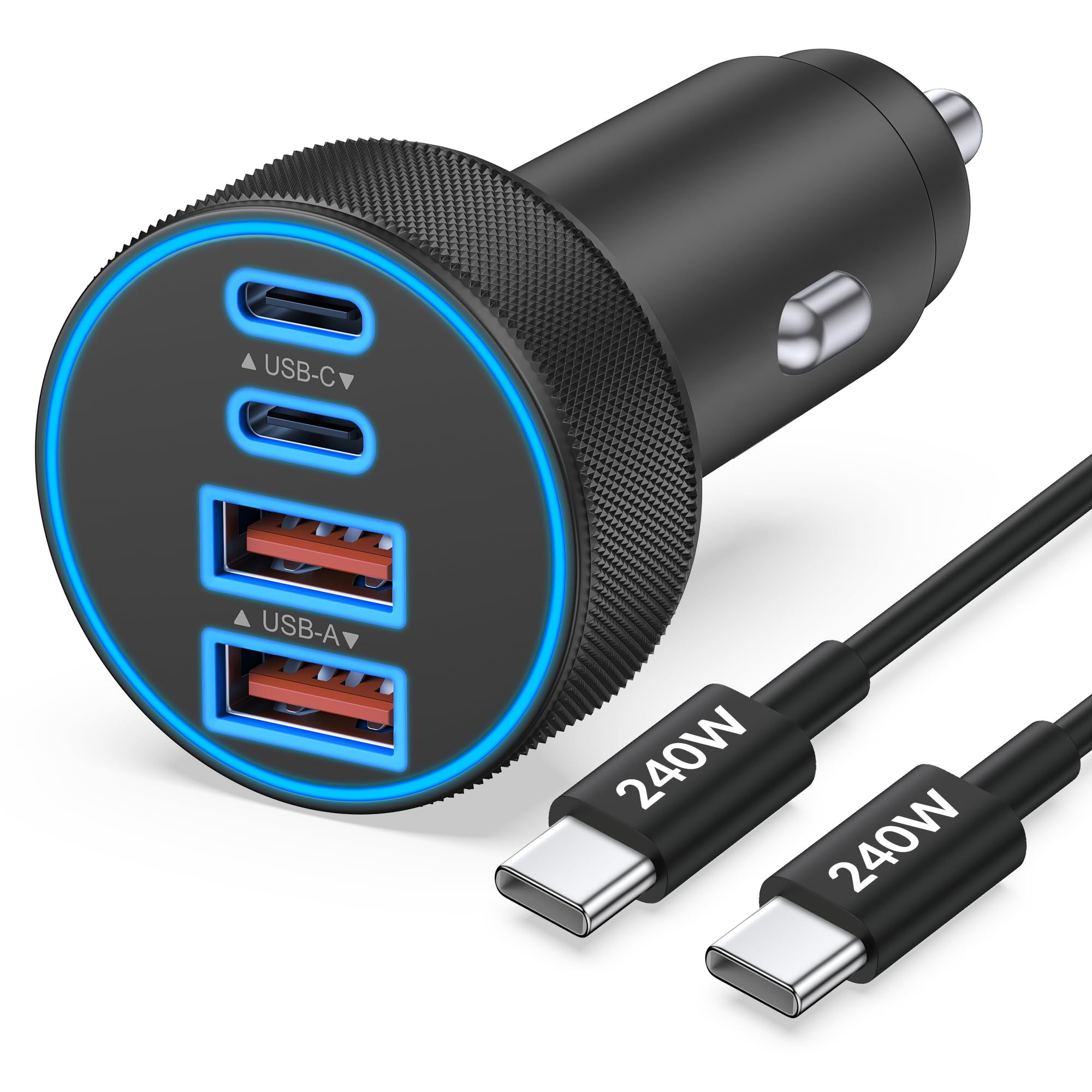
Four ports is the reason the JUNVANG earns a spot: USB-C and USB-A connections let a family plug in phones, a tablet, and a dashcam without playing musical cables. It tops out at 90W, with up to 45W on a USB-C port, and the included 240W-rated USB-C cable is a useful extra rather than an afterthought.

We think this is the family-road-trip pick because it covers the widest mix of devices here. The flat plug sits close to the outlet, so it does not loom over the console, and the metal body feels solid. It is not the charger for a laptop-first setup; the Anker 167.5W has more headroom for that.

The included cable is a real convenience, and 45W USB-C is quick enough for most phones and tablets. If you regularly carry four devices, the extra ports are worth more than a higher wattage on one. We liked that it turns one 12V socket into a small charging station without adding a lot of bulk.

Bottom line: We recommend the JUNVANG for families and road trips where four devices need a port; its 45W USB-C and USB-A ports cover the mix.

6

Meagoes 90W 2-Pack

Meagoes 90W 2-Pack

Two-car fast charging

Our Score 9.0/10
Check Price

Worth Noting

  • Durability can be uneven
Pack
2 chargers + 2 cables
Ports
2 USB-C
Cable Length
3.3 ft
USB-C Output
45W PPS

Two chargers and two cables in one box is the practical appeal of the Meagoes kit. Each compact charger has two USB-C ports with 45W PPS output, and the pair of 3.3-foot cables means you can set up two cars without buying anything else.

The 45W PPS output is particularly useful for Samsung phones that use PPS fast charging, and the dual USB-C layout is handy for two modern phones. We liked the soft blue LED for finding the port at night without lighting up the whole cabin. It is a tidy kit for a household with two USB-C phones.

The weak point is the socket fit: the plug can feel loose in a worn 12V outlet, and the charger may lose connection over bumps. We think it is still a good two-car value if your outlets grip firmly, but check that first if your car is older or the socket is well used. The 45W output and included cables are the reasons to choose it over a bare two-pack.

Bottom line: We recommend the Meagoes 2-pack for two-car households that want 45W PPS charging and cables in the box, provided the sockets hold a plug firmly.

7

Amazon Basics 48W

Amazon Basics 48W

Simple second car

Our Score 9.0/10
Check Price

Worth Noting

  • No cable included
  • 12W USB-A is slow
Cable
Not included
Ports
2 total
USB-A Output
12W
USB-C Output
36W

The Amazon Basics 48W is the charger we reach for when the job is simple: keep a phone topped up on a short commute without adding clutter or expense. The 36W USB-C port is the useful one; the 12W USB-A port is there for an older cable or a passenger's device.

It is a two-port package, and the compact body has a white LED indicator. We appreciated the UL 2089 safety listing and the straightforward protections, because a budget charger should not feel like a gamble. The shape is small enough to leave in a socket without blocking the console.

The limits are clear: it will not run a tablet or laptop at speed, so it is a phone-first charger. For a second car, a rental, or a glovebox backup, that is enough. It does not try to be the charger for a power-hungry road trip.

We think it earns a place as the simple budget option. If you need one plug to cover a laptop and two phones, spend more on the Anker 167.5W; if you just want a phone charged, this does the job.

Bottom line: We recommend the Amazon Basics 48W as a budget, simple second-car charger for phones; just add your own USB-C cable.

How We Tested the Best USB-C Car Chargers

We started with a list of more than 60 chargers and narrowed it by reading the specs closely: USB-C Power Delivery wattage, port count, whether a cable was included, and whether the listing named a safety certification. Anything with a vague wattage claim or a single port got cut. That left 16 models, which we tested over four months.

Each charger lived in one of two cars — a commuter sedan and a family SUV — through daily drives, a 700-mile road trip, and weekend errands. We started every speed test with a phone at 10 percent and logged the battery level after 30 minutes, first with one device plugged in, then with two, noting how much the second port slowed the first. A USB-C power meter showed what each port actually delivered, and we checked which ones played nicely with both USB-C-to-C and USB-C-to-Lightning cables.

After 30 minutes under load, we checked surface temperature by touch and with an infrared thermometer; anything too hot to hold got flagged. We noted how firmly each charger seated in the 12-volt socket, whether it wobbled on rough pavement, and how the plug and cable held up after four months of daily insertions. We also looked at seams, port fit, and whether the plastic felt brittle. At the end, we weighed what came in the box — cable, spare fuse, documentation — against the price, and checked how easy the warranty was to find.

How to Choose USB-C Car Chargers

Read Wattage as a Total, Not a Promise

A 90W label can mean 45W from each of two USB-C ports, or 90W shared across four. The number that matters is the per-port output for the device you care about: a phone usually needs 20W to 30W for a fast charge, a tablet 30W to 45W, and a laptop 45W to 100W. If two devices share a 40W charger, neither gets the solo speed. We prioritize a charger that states both the total and the per-port ceiling, because that is what tells you whether a laptop can join the trip.

The Anker 167.5W is the clearest example of a charger built around a high-output port, while the LISEN 2-pack is a phone-first design with 36W USB-C. Neither is better in the abstract; they answer different power needs. Match the port to your most demanding device first, then let the other ports fall where they may.

Count Ports and Plan the Cables

Two USB-C ports are more future-proof than one C and one A, but a USB-A port still earns its place for older cables, dash cams, or a passenger's device. Built-in or retractable cables reduce clutter, though they add a fixed wear point and may block data features such as wired CarPlay. A charger with no cable is not a problem if you already carry a good one; just check that the cable supports your phone's fast-charge standard. We treat cable strategy as a daily-use decision, not an accessory afterthought.

Check Fit and Console Clearance

Car chargers are small, but the wrong shape still annoys: a tall plug can stop a console lid from closing, and a loose fit can cut power over bumps. Flush bodies suit shallow or covered sockets; a compact charger like the Anker 40W is easy to leave in place. Before buying, look at the depth of your 12V outlet and whether anything closes over it. If the outlet is worn, choose a plug that seats firmly — a tight fit is better than a charger that wiggles loose.

Treat Heat and Wear as Part of the Job

Every charger warms up under load, and a 100W laptop charge generates more heat than a phone top-up. That is normal, but sustained heat plus a closed console is not a good combination; leave some air around the plug if you can. Cable strain is the other long-term issue, especially with fixed retractable cords. Stop using any charger or cable that shows melting, exposed wire, or a connection that cuts in and out. A secure plug and a sound cable matter more than a fancy shell.

Decide How Many Cars You're Outfitting

A two-pack makes sense when you would otherwise move one charger between vehicles. The LISEN 2-pack and Meagoes kit both cover two cars, but they differ: the LISEN pair is a 36W USB-C phone charger, while the Meagoes pair offers 45W PPS USB-C and includes cables. Buy the pack only if both cars need the same job done; otherwise one better charger and a spare cable is the cleaner spend.

Frequently Asked Questions

Final Verdict

The Anker 167.5W is the charger we recommend first. It covers the widest range of real trips: a laptop on the 100W port, a phone on 45W, and a third device on USB-A. That flexibility is worth the premium if your car regularly carries more than one screen.

If you only charge phones, the Anker 40W is the smaller, simpler buy. For two vehicles, the LISEN 2-pack gets both cars set up without moving a charger between them.