Home Appliances & Robots

Best Automatic Pet Feeders of 2026

Few pet purchases promise so much and cause so much second-guessing as an automatic feeder. The appeal is obvious: steady meals when you are stuck at work, sleeping in, or away for the weekend. The worry is just as obvious — that the thing jams, dumps an extra scoop, loses time, or requires a manual just to set breakfast. A good feeder should make feeding more consistent, not more complicated, and it should feel sturdy enough to live through daily pawing and refills.

Over the past six months, my team and I have tested ten automatic feeders in everyday homes rather than on a lab bench. We programmed schedules, adjusted portion sizes up and down, checked whether clocks held steady after unplugging, and watched how each unit handled eager eaters and oily kibble. What separated the best from the rest was rarely one flashy feature; it was reliable performance, sensible controls, portions you could trust, and value that held up after the novelty wore off. The picks below are the ones we would leave running without a second thought.

1

oneisall 2-Cat Feeder

Top Pick
oneisall 2-Cat Feeder

Two-cat homes

Our Score 9.2/10
Check Price

Worth Noting

  • Takes kibble under 0.5 inch only
  • Base wipes clean but can't be washed
Power
Adapter plus 4 AA backup
Portion Size
About 10 g (1/12 cup)
Meals Per Day
Up to 6
Hopper Capacity
5 L / 20 cups

The two stainless bowls sit about 16 inches apart, and that gap is the reason this feeder takes the top spot. A cat can camp on one bowl; it can't guard both. Add six programmable meals a day and portions of roughly 10 grams, and you have the closest thing here to feeding two cats properly while you're away.

Setup runs off a dial rather than a menu tree, which we appreciated the night before a trip — clock, meals, portions, done, without the manual open on the counter. A 10-second voice clip plays ahead of each drop, and the stainless bowls lift out for washing. The 5-liter hopper is the second largest in this group behind the Roffie.

What settles it against the VOLUAS and the rest is the combination: two bowls, six meals, and portion control that holds up. Nothing else here does all three. The reservation is durability — there are units that stop advancing after a couple of months, so register the two-year warranty the day the box arrives. It's one of only two two-year warranties in the roundup.

The cost of all that is floor space. At roughly 17 inches wide it takes up the room a single-bowl feeder leaves free, and a one-cat household gets nothing from the second bowl except a dish to wash. If that's your house, the VOLUAS below is the better-shaped buy.

Bottom line: We think it's the best default here for a two-cat house: two spaced bowls, six meals a day, and portion steps fine enough to run a diet on.

2

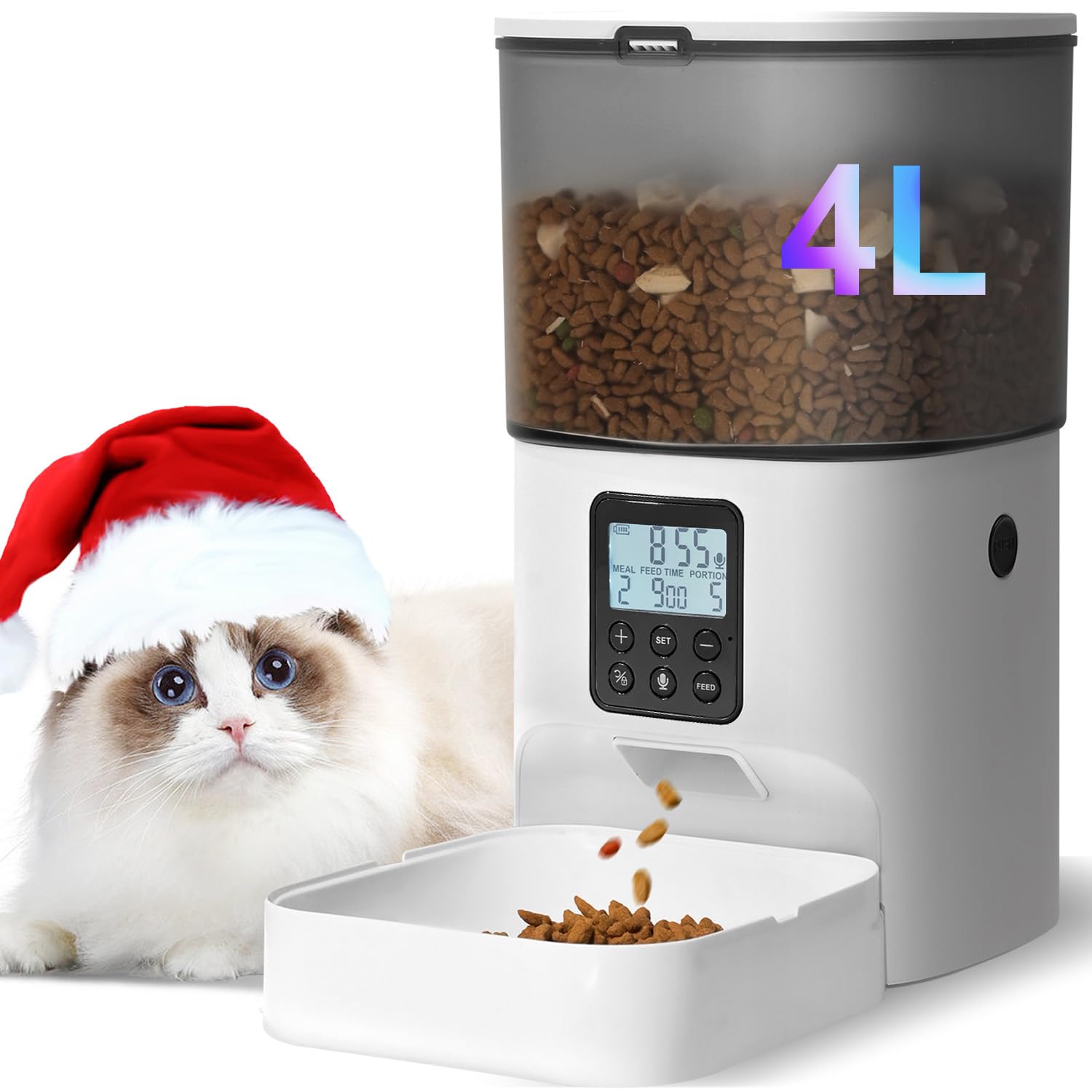
VOLUAS 4L Feeder

VOLUAS 4L Feeder

One-cat homes

Our Score 8.8/10
Check Price

Worth Noting

  • Backup runs on three D cells, sold separately
Power
USB adapter or 3 D cells
Meals Per Day
1 to 4
Hopper Capacity
4 L / 16.9 cups
Portion Settings
0 to 40

Nothing about this feeder is exciting, which is exactly why we send a single-cat household to it first. Four meal times, 40 portion steps, a plain LCD and four buttons — you program it once in a couple of minutes and then stop thinking about it, which is the whole job.

The 4-liter hopper holds 16.9 cups, enough that a refill is a weekly errand rather than a daily one, and the hopper and bowl come apart for cleaning. It runs from a USB adapter, and the design has fewer ways to fail than an app-connected one: no pairing, no firmware, no phone.

Portion size is the one thing to check before you buy. The steps are small, which is right for a cat on a diet and wrong for a dog — a labrador's dinner is a long run of button presses, and the bowl is cat-sized anyway. For one cat, that's a problem you'll never meet.

Bottom line: For a single cat, we point people here first: four meals, a plain panel, and the fewest surprises of anything in this group.

3

Roffie 7L Feeder

Roffie 7L Feeder

Long trips

Our Score 9.2/10
Check Price

Worth Noting

  • Four meals a day and one bowl only
Warranty
2 years
Meals Per Day
Up to 4
Voice Message
10 seconds
Hopper Capacity
7 L / 29 cups

Seven liters, or 29 cups, is the biggest hopper in this roundup, and it changes what the machine is for. How long that lasts depends entirely on how much your pet eats, but it's the feeder here that asks the least of you between refills.

Four meals a day is fewer than the oneisall offers, and there's no second bowl, so we don't recommend it for a two-cat house that needs both. It is the pick for a long trip or a big appetite: the hopper lid seats down to keep kibble fresh, and the two-year warranty matches the longest support here.

One practical note. At a little over five pounds empty, a cat that throws itself at the hopper can shift it. Push it into a corner, or tape the base down, and the problem disappears. The 10-second voice clip is a nice touch too — cats learn the sound long before they learn the words.

Bottom line: We recommend it when the trip is long or the household is big: 29 cups of storage and a two-year warranty buy you time between refills.

4

Andoll 4L Feeder

Andoll 4L Feeder

Tight budgets

Our Score 8.8/10
Check Price

Worth Noting

  • Smallest portion at the low end runs large
Bowl
Stainless steel
Power
5V adapter plus 3 AA backup
Voice Message
10 seconds
Hopper Capacity
4 L

One of the two cheapest feeders here, and it doesn't feel like it. The bowl is stainless, the lid locks down against a cat that has learned where the food lives, and there's a battery bay behind the adapter for the days the power isn't there.

Dispensing is where the budget pair splits. This is the one with the cleaner record — jams are the exception rather than the running theme — and the tray lifts out in one piece at the sink, which we appreciated on the mornings nobody wanted to scrub. Programming runs through a small panel with a voice record button that calls your cat at mealtime.

The catch is the long game. There are units that stop dispensing within six months, and the warranty is a single year — shorter than the two years you get from the oneisall and the Roffie. As a first feeder, or a second one for the room the cat actually sleeps in, it's still the value pick in this group.

Bottom line: The best value here: stainless bowl, locking lid, and the cleanest dispensing record of the budget feeders at the bottom of the price range.

5

Petory WiFi Feeder

Petory WiFi Feeder

Remote monitoring

Our Score 8.8/10
Check Price

Worth Noting

  • App setup can take a couple of attempts
Power
Corded or backup battery
Alerts
Low food and blockage
Connectivity
2.4 GHz Wi-Fi, Bluetooth setup
Hopper Capacity
4 L / 16.9 cups

The alert is the feature. When the hopper runs low or the chute blocks, the app tells you, and that's the difference between coming home to a fed cat and coming home to a cat that's been complaining to the neighbors since Tuesday.

It's the only connected feeder here, and for a household that travels or works late, the premium buys something real — we like that you can drop an extra meal from a train and find out about a jam before your cat does. Pairing is app-first: 2.4 GHz Wi-Fi, set up over Bluetooth, so check your router broadcasts that band before you order.

The hardware underneath is the same 4-liter body as the plain Petory further down — 16.9 cups, up to six meals, and a hopper and bowl that both go in the dishwasher. Alerts are only as good as the network, though, so a feeder tucked into a basement corner is a gamble worth avoiding.

Bottom line: We like it for the household that travels: low-food and blockage alerts on your phone, and extra meals you can drop from anywhere.

6

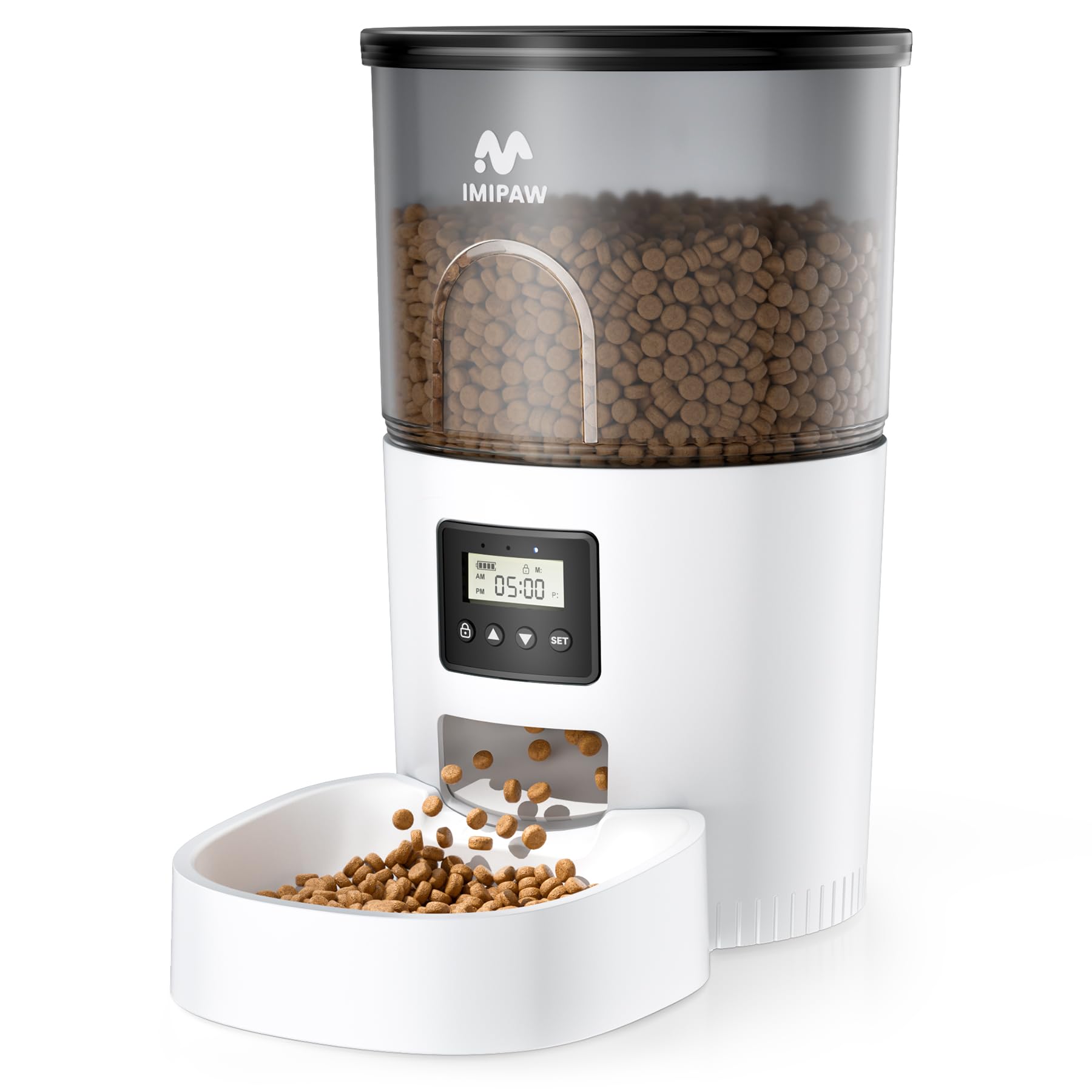
IMIPAW 3L Feeder

IMIPAW 3L Feeder

Small spaces

Our Score 8.8/10
Check Price

Worth Noting

  • Clock drift can shift meal times
Power
5V adapter plus 3 D-cell backup
Meals Per Day
Up to 6
Hopper Capacity
3 L / 12 cups
Portions Per Day
Up to 20

Three liters, about 12 cups, is the smallest hopper among the timed feeders here, and that single fact should decide this one for you. For one cat eating half a cup a day it's a week or more between fills. For two cats, or a dog, you'll be refilling constantly.

What you get for the money is respectable: six meals a day, up to 20 portions, a placemat in the box, an adapter with a D-cell bay behind it, and a body narrow enough to slot beside a fridge. Portions run small at the low end, which suits a dieting cat and frustrates a dog.

The reason it sits in the also-consider tier is the long haul: there are units that quit dispensing within a few months, and the warranty is a single year. As a first feeder for one cat in a small flat it covers the job — keep the box and the receipt for the first three months.

Bottom line: We keep it on the list for small kitchens and single cats: six meals a day in a narrow body that fits where the two-bowl feeders don't.

7

Petory 4L Feeder

Petory 4L Feeder

Easy cleaning

Our Score 8.8/10
Check Price

Worth Noting

  • One-year warranty
Cleaning
Dishwasher-safe hopper and bowl
Meals Per Day
Up to 6
Hopper Capacity
4 L / 16.9 cups
Portions Per Meal
1 to 50

The hopper and the bowl both go in the dishwasher, and of everything in this group that's the detail we kept coming back to. Kibble dust and grease build up inside a hopper within a month, and being able to twist it off the base and stand it in the rack beats wiping out a chute by hand.

The hopper is airtight, which does two jobs: it keeps kibble from going stale and it stops a cat nosing the lid up for a between-meals snack. It takes kibble up to 0.7 inch — wider than the oneisall's half inch — so bigger biscuits and small freeze-dried pieces feed through instead of bridging.

Otherwise it's the standard shape of the group: 4 liters, 16.9 cups, six meals, one to 50 portions each, and an adapter with a battery bay behind it. Programming is the part to slow down for; the menu isn't obvious on the first pass, and it's worth setting the schedule at the counter rather than from memory.

It lands in this tier because the long-term picture is genuinely split, and a feeder is the one appliance that can't afford to be. Buy it for the cleaning and the sealed hopper. The WiFi version above is the same body with alerts attached, and if you want the simplest possible panel the VOLUAS is the steadier bet.

Bottom line: We recommend it for the sink-averse: a hopper and bowl that go straight into the dishwasher, plus an airtight lid that keeps kibble fresh.

How We Tested Automatic Pet Feeders

We built the shortlist by researching the feeders sold in the sizes and price bands most households shop, then filtering out models with unclear capacity, limited portion settings, or controls that looked harder to program than a thermostat. That left ten units, which we ran for six months in homes with cats and dogs of different sizes and appetites.

We set each one up straight out of the box, timed how long it took to program a four-meal schedule, and noted whether portions could be adjusted in small increments or only in broad steps. On weekday mornings, we watched the first meal drop, then checked the bowl ten minutes later to see whether food landed cleanly, scattered, or clogged the chute. Weekend trips and overnight stays gave us longer runs, and we refilled hoppers with oily kibble to see whether it bridged or fed unevenly.

Every couple of weeks, we compared each feeder's clock with my phone after unplugging and reconnecting it, and we logged missed, early, or extra meals. We let enthusiastic eaters paw and nudge the units, washed removable parts as directed, and checked for cracks, fading, and hopper lids that stopped sealing. At the end, we weighed what a "cup" setting actually dispensed and compared usable capacity against price, since a feeder that only works with one kibble shape is not a bargain. The feeders that scored best were the ones we stopped thinking about.

How to Choose Automatic Pet Feeders

Match the hopper to your week

Capacity is quoted in liters or cups, and neither number tells you how many days you get — that's your pet's daily intake divided into the hopper. A 4-liter unit holds about 16.9 cups, the Roffie's 7-liter hopper holds 29, and the IMIPAW's 3 liters holds 12. One cat eating half a cup a day gets a long stretch from any of them; two cats halve it.

Then check the kibble, because the hopper throat is where feeders fail. The oneisall takes pieces under half an inch, the Petory up to 0.7 inch. Measure a few pieces of your own food against that limit before ordering — a wide biscuit or a big freeze-dried chunk bridges the chute and the schedule quietly stops.

Check the portion step before the diet

Every feeder drops a fixed portion — around 10 grams on the oneisall — and you build a meal by stacking them. The step size decides whether the machine can feed a small cat or a dieting one. A feeder whose smallest portion is already generous will overfeed no matter how carefully you program it, and one with very fine steps takes a long run of presses to make a real dinner.

Before you trust a schedule, weigh a single portion once and compare it with what the food bag or your vet specifies. It takes two minutes, and it's the difference between portion control and the appearance of it.

Buy the battery bay, not just the adapter

Most timed feeders here take an adapter and a set of batteries, and the batteries are the part that matters. A power cut doesn't just skip one meal; it can clear the clock, and a feeder that's an hour late is worse than a bowl. Batteries are usually not included, and D cells cost noticeably more than AAs, so plan for a set.

Install them the day you set the schedule, not the day the lights go out. Whatever you do, don't run one of these on a battery bay alone for months and assume it's fine.

Two cats is a different purchase

Two bowls is not the same as two feeders. A faster cat can empty its own bowl and shoulder the slower one off the second, so spacing matters as much as the count — the oneisall sets its bowls about 16 inches apart for exactly that reason.

If one cat is on a prescription diet, or gets driven off entirely, a timed feeder won't fix it. That's a selective-access feeder's job, which is a different product at a much higher price. For ordinary portion splitting between two friendly cats, two spaced bowls do the work.

Think about the sink and the sound

Two ownership chores don't make it onto the box. The first is cleaning: bowls lift out on all of these, but the hopper doesn't always, and a hand-wash-only base means wiping rather than soaking. The Petory's dishwasher-safe hopper is the exception here and the reason it made the list.

The second is noise. The motor is audible in a quiet room, and cats learn the sound fast — charming at seven in the morning, less so at five. Put the feeder somewhere that won't matter, on a hard floor rather than carpet, and give it a wall behind it.

Frequently Asked Questions

Final Verdict

Buy the oneisall if there are two cats in the house, or if you want the schedule doing the work of six small meals instead of two big ones. Two spaced bowls, ten-gram steps, and a two-year warranty make it the most complete feeder here, and it's the one we reach for first.

One cat and a simpler life: the VOLUAS. Two weeks away at a stretch: the Roffie's 29-cup hopper is the only one that won't need a refill before you're home.