Power & Charging

Best Battery Chargers for Rechargeable Batteries of 2026

Rechargeable batteries are supposed to save you money, but the charger decides whether that actually happens. A bargain unit that pushes a fixed current into four slots can cook a set of AA cells within a year, and one that only charges in pairs leaves you waiting on the weakest battery in the row. I've ruined more NiMH cells than I'd like to admit that way. A good charger reads each slot on its own, eases off when a cell is full, and tells you something useful while it's working — that's the difference between a drawer of batteries you trust and one you raid for the TV remote every third week.

Mine live in a kitchen drawer and on a garage shelf, where they get dropped, unplugged mid-cycle, and asked to top up half-drained cells five minutes before a toy needs them. Over four months, my team and I ran 14 chargers through that same routine, timing full charges, checking how warm the cells got, and re-measuring capacity after repeat cycles. Here's which ones earn their outlet space.

1

EBL C9042W Charger

Top Pick
EBL C9042W Charger

Everyday household charging

Our Score 9.0/10
Check Price

Worth Noting

  • Some units stop charging within months
  • A full tray of eight is slow
Bays
8
Power
Corded AC
Charge Time
4 hours
Battery Sizes
AA, AAA

Eight bays that each charge on their own is the reason this EBL is our top pick. Drop in a single cell from a remote, three AAAs from a flashlight and four AAs from a controller, and no slot waits for a partner before it starts. For a household that never quite knows how many dead batteries it has, that flexibility is worth more than anything printed on the box.

The plug sits on a cord rather than being molded into the body, which sounds minor until you're reaching a power strip behind a desk. Each bay carries its own light: red while charging, green when the charger decides the cell is done, and a flashing red for a battery it has given up on. We ended up using that last signal as a filter — a drawer of old AA cells sorted itself into keepers and rubbish the first time it went through.

One quirk to know before you buy. With a single cell in a bay, the light can sit green from the moment the contacts close, so there's no way to tell a charging cell from a finished one. Charge singles in pairs, or check the battery in a device afterwards. It's a small annoyance, but it's the sort of thing that reads as a fault the first time you meet it.

The return window is 30 days, which is short for something that doesn't always survive its first year, so keep the receipt. We still hand this to most homes — the bay count and the independent slots do the real work — but buy it as an excellent charger at a low price rather than as a lifetime purchase.

Bottom line: We recommend this to most households: eight slots that each charge on their own, a cord that reaches the strip, and one of the lowest prices in this group.

2

Rayovac 8-Bay USB Charger

Rayovac 8-Bay USB Charger

Desk and travel

Our Score 9.2/10
Check Price

Worth Noting

  • No USB power adapter included
  • Charges can finish short of full
Bays
8
Power
USB
Charge Time
7 hours
Battery Sizes
AA, AAA

The Rayovac takes its power from a USB port instead of the wall, and that single decision explains almost everything else about it. Feed it from a laptop, a power bank or the adapter you already use for your phone, and the charger itself stays small — a five-ounce box that will sit on a desk without claiming a socket.

There's no screen and no countdown. A bay's light goes green when the charger judges the cell done, and automatic shut-off ends the current there. Eight bays take a full drawer of AA and AAA cells in one sitting, and the listed charge time is about seven hours for a full tray — the slowest of the chargers here that state a time. That's an overnight habit, not a same-evening top-up.

Where it earns its place is capacity without a power brick: this is the eight-bay charger we pack for a trip or keep on a desk where the outlets are already spoken for. The thing to watch is where a charge ends. Cells can come off short of full, so run the first few batches in a device you know well and see how long they last — if they fade early, the charger is the first suspect, not the battery.

No adapter comes in the box, which is the detail that catches people out: it arrives ready to work but with nothing to plug into unless you own a spare USB wall charger. If you do, it's the tidiest eight-bay option here, and the one least likely to be unplugged by someone who needs the outlet.

Bottom line: For a desk or a travel bag where sockets are scarce, this is the eight-bay charger we pack: USB power, automatic shut-off, and a body small enough to leave out.

3

Energizer Recharge Pro

Energizer Recharge Pro

First rechargeable kit

Our Score 9.2/10
Check Price

Worth Noting

  • Charges in pairs, never a single cell
Bays
4
In The Box
4 NiMH AA cells
Indicators
Red, yellow, green lights
Battery Sizes
AA, AAA

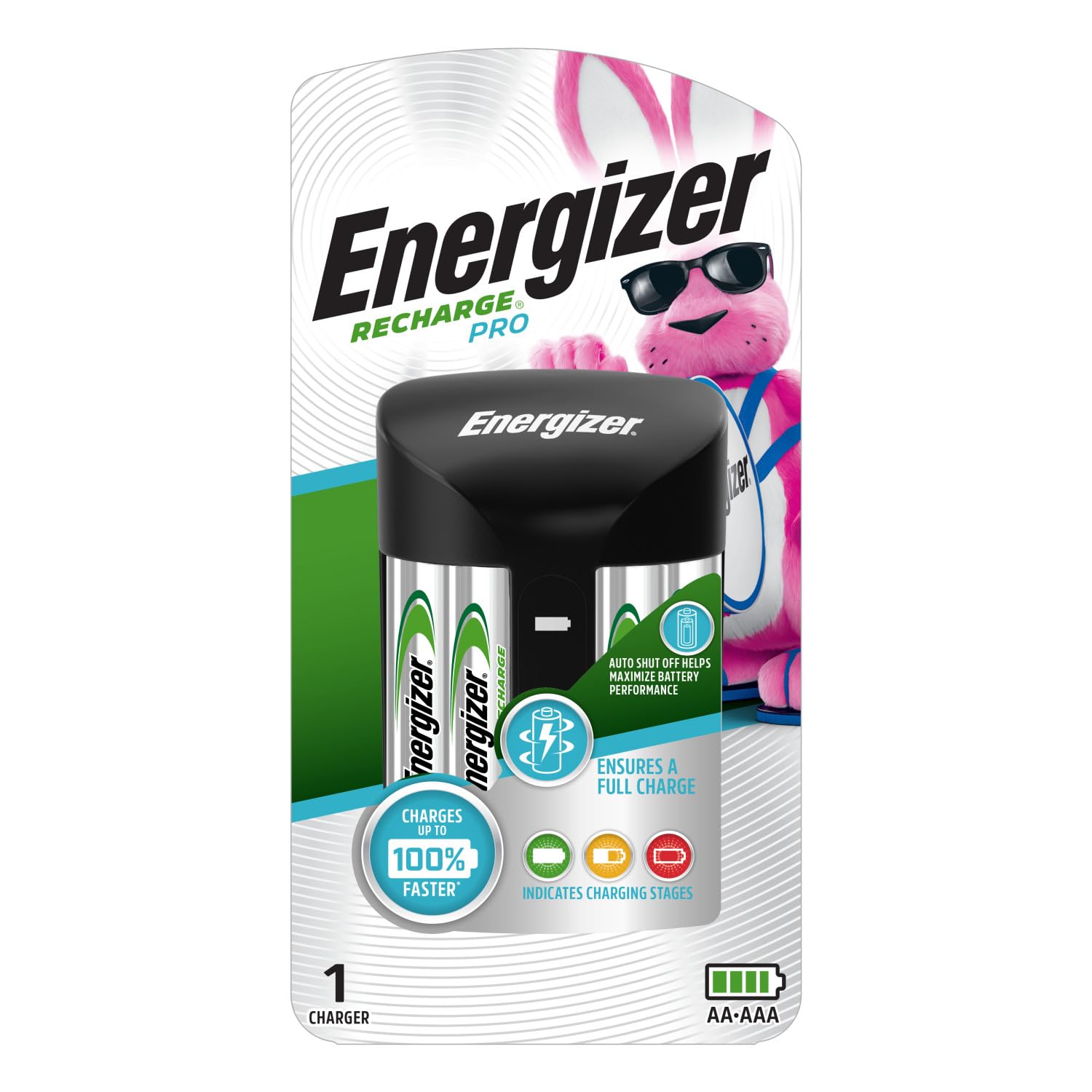
Energizer ships this charger with four NiMH AA cells in the box, which is the whole point of it: you can put batteries into a device the day it arrives instead of ordering cells separately and hoping the capacities match.

For a household with no rechargeable cells yet, it's the least fussy way in. Two or four AA or AAA cells take an advertised four hours, the light steps from red through yellow to green as they go, and a bad battery gets a red X and a beep instead of a slow, silent non-charge. It also beeps when charging starts and when it ends — genuinely useful in a garage or a utility room, less welcome on a nightstand.

The bay count is the limitation worth weighing. Four slots, filled two or four at a time, mean a lone dead cell has to wait for a partner, and a big household will outgrow four bays quickly. Once you add the price of four cells to an eight-bay charger, the gap between the two routes narrows considerably — so buy this for the kit, not for the hardware.

What we appreciated beyond the cells is predictability: a charger that behaves the same way every time and will take any NiMH AA or AAA you feed it later. It's a kit in the sense that matters — everything you need to stop buying AAs is in one box.

Bottom line: Buy it if you're starting from zero: four NiMH cells come in the box, the charge is quick enough, and the beeper settles the are-they-done question.

4

Amazon Basics 4-Bay Charger

Amazon Basics 4-Bay Charger

Travel and commutes

Our Score 9.0/10
Check Price

Worth Noting

  • Only charges cells in pairs
  • USB port takes priority over batteries
Bays
4
Input
100–240V
Power
Folding AC plug
Battery Sizes
AA, AAA

Folding prongs are what separate a charger that travels from one that lives in a drawer. The plug flips down into a body 4.5 inches long that weighs under four ounces, so it goes into a laptop bag without a cable, a pouch or a second thought.

It takes two or four AA or AAA cells at a time and quotes four hours for a set — quick enough that a hotel-room top-up before dinner is realistic. The behavior worth learning is the fast red blink: that's the charger stopping on a cell rather than a progress signal, and a tired battery is the usual reason. Move the cell to another bay before you blame the charger.

The USB-A port on the side is a neat extra for travel, with one catch we hit immediately: the port takes priority, so a plugged-in phone charges while the batteries wait. Fine overnight, less helpful if you were counting on both at once. Voltage switching from 100 to 240 means it travels outside the US with nothing more than a plug adapter.

As a second charger it's hard to argue with: small, cheap, and four cells are done by morning. As a household's only charger, the pairs-only rule and four bays will grate inside a week. On a week away, four bays and a folding plug do more than eight bays sitting at home.

Bottom line: The travel charger we pack: folding prongs, under four ounces, worldwide voltage, and a USB port for a phone — as long as pairs-only charging at four bays suits you.

5

Energizer Universal Charger

Energizer Universal Charger

9V and big cells

Our Score 8.8/10
Check Price

Worth Noting

  • Costs more than AA/AAA-only chargers
  • Spring contacts bend with big cells
Power
Built-in AC plug
Charge Time
5 hours for 4 AA
Charge Slots
2 or 4
Battery Sizes
AA, AAA, C, D, 9V

A 9V bay is what puts this Energizer in the guide. Nothing else here takes a 9V rechargeable, and if you own smoke detectors, a guitar pedal or a multimeter that runs on them, that one slot is the entire argument.

It's a specialist's charger, though, and only worth the premium if the odd sizes are real for you. For AA and AAA alone it's slower and dearer than the eight-bay chargers here, and four AA cells take about five hours. Where it earns its keep is the mixed drawer: two or four AA, AAA, C or D cells, or one or two 9V, all in the same session.

The trade-off is mechanical. The sliding contacts that let one bay swallow a AA or a D cell are the part that wears; the springs stretch and the clamps bend over time, so ease a big cell in rather than forcing it. Treat the bays gently and this is a charger we're glad to have for the once-a-year jobs nothing else on the shelf will touch.

The built-in adapter and detachable cord stow together, which matters more than it sounds for something you use a few times a year — it goes back in a cupboard without trailing a lead across the shelf.

Bottom line: Worth buying only if you actually recharge 9V, C or D cells: nothing else here takes them, and the premium buys range rather than speed.

6

EBL LCD 8-Bay Charger

EBL LCD 8-Bay Charger

Tracking charge progress

Our Score 8.8/10
Check Price

Worth Noting

  • Costs more than AA/AAA-only eight-bay chargers
  • Wants a 5V/2A USB-C adapter
Bays
8
Power
USB-C 5V/2A
Display
Per-bay LCD
Battery Sizes
AA, AAA, C, D

The LCD is what sells this one. Rather than a light that means maybe-done, each bay reports where its cell is in the cycle, so you can see at a glance which batteries are finished and which are still working. For anyone who has pulled a half-charged cell out in frustration, we think that's a small luxury worth paying for.

Underneath the screen it's a serious eight-bay charger: AA, AAA, C and D NiMH cells, every bay independent, defective-battery detection, and the usual overheat and short-circuit protection. Power comes in over USB-C and the maker specifies 5V/2A, so give it a proper adapter rather than a laptop port that may not deliver the current.

You pay for the screen and the extra sizes. Against the eight-bay chargers here that only handle AA and AAA, this one costs noticeably more, so if your drawer is all AA and AAA, the display is a luxury. If it also holds C cells for a lantern or a toy, it's the one charger that covers everything without a second box on the shelf.

Seating a cell takes a moment: the contacts slide and the bays are generous, so a AAA needs a little care to sit square before the display registers it. Once it's in, the readout takes over and the guesswork goes away.

Bottom line: If you want to see exactly how far each battery has charged, and you also run C or D cells, this is the one to buy — the display justifies the premium.

7

NICEBATT 8-Bay USB-C Charger

NICEBATT 8-Bay USB-C Charger

Compact drawer charging

Our Score 9.0/10
Check Price

Worth Noting

  • Slower than the quickest chargers here
Bays
8
Power
USB-C
Warranty
2 years
Battery Sizes
AA, AAA

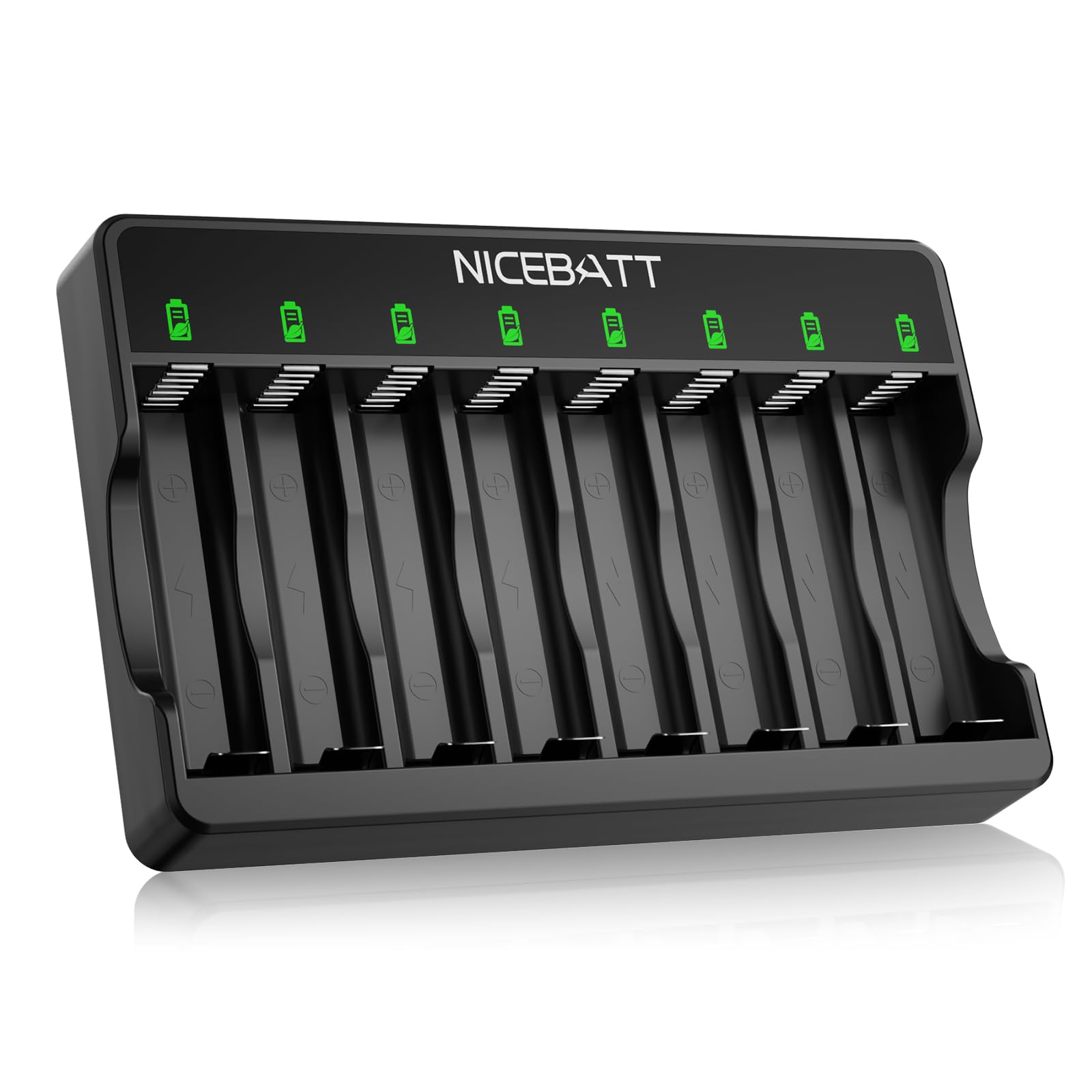
Over-discharge repair is the claim that makes this NICEBATT worth a look: cells run flat in a device and left refusing to charge can, the maker says, be nursed back. Around that sit eight bays, a USB-C input and a body slim enough to live in a drawer.

We haven't driven a set of cells to the point of no return and timed their recovery, so the repair mode is the one feature here we can't vouch for from our own use. The rest behaves: every bay works on its own, the lights turn green as cells finish, and defective-battery detection stops a leaky cell from being pushed further.

As an everyday charger it makes a lot of sense. The body is a little over half an inch thick, the two-year warranty is the longest stated on any charger here, and USB-C means it runs from the same cable as everything else in your bag. It isn't the quickest — cells take their time — but for topping up a handful of AA and AAA cells a week, that's a cost few people will feel.

Two things to check before ordering: that the adapter you plan to use is a 5V USB-C supply, and whether you need C or D support, which this one doesn't offer.

Bottom line: A slim, inexpensive eight-bay charger with a two-year warranty and a repair trick we couldn't verify — a good everyday pick when speed isn't the point.

8

DLYFULL 8-Bay Charger

DLYFULL 8-Bay Charger

Budget backup charger

Our Score 8.8/10
Check Price

Worth Noting

  • No power adapter included
  • Slow to fill a full tray
Bays
8
Power
USB-C
In The Box
USB-C cable
Battery Sizes
AA, AAA

This is the least expensive charger in the guide, and it still gives you eight independent bays — the specification we care about most. A USB-C cable is in the box; the adapter isn't.

What we noticed first is that cheap doesn't have to mean crude. Constant-voltage charging with four separate stop conditions — a voltage drop, a voltage plateau, a maximum voltage and a maximum time — means a cell that never quite finishes still gets cut off rather than cooked. Red to green per bay, and a flash for a battery it refuses.

What you give up is pace. A full tray of eight will occupy an evening, and if you're swapping cells in and out of a controller every couple of days, that gets old fast. For a spare charger in a drawer, a backup for a holiday rental, or a first set of cells for a child's toys, the trade makes sense — and the money you don't spend here buys more batteries.

Where it fits is as the second charger rather than the only one: the one that lives where the batteries are used, with a 12-month warranty long enough to find out whether yours is a good one.

Bottom line: A fine second charger: eight independent bays, a USB-C cable in the box and a low price that leaves room for batteries — just expect slow charging.

What We Put Every Charger Through

We started by reading spec sheets for roughly 40 chargers and cutting anything that charged only in pairs, skipped AAA, or asked more per slot than a fresh pack of batteries costs. That left 14 models, from plain four-bay units to smart chargers with LCD readouts, refresh cycles, and USB inputs.

Each one lived on a kitchen counter and a garage workbench for four months. We drained matched sets of AA and AAA cells down to 0.9 volts, then timed how long each charger took to bring four back to full, taking cell temperatures with an infrared thermometer every half hour. We also loaded mismatched brands and ages into a single run to see whether each bay worked independently or let one weak cell drag the rest.

Ease of use was judged with the manual closed: could we tell charging from done by the lights alone, did the bays hold a snug AA without forcing it, did the cord stay in the socket. Value came down to cost per independent slot and whether cells were in the box. For battery life, we ran 30 charge-and-discharge cycles on one set per charger and re-measured capacity on a tester; for reliability, we pulled the plug mid-cycle, knocked each unit off the counter, and checked that it came back without drama.

How to Choose Battery Chargers for Rechargeable Batteries

Independent slots, not just slot count

It's easy to read four bays as four chargers, but a pair-based model like the Amazon Basics or the Energizer Recharge Pro fills two or four cells at a time and won't start on a single one. That's fine if you always drain batteries in even numbers; it's maddening when one cell dies in a remote and the other three are still good.

Independent slots, as on our top pick or the Rayovac, take any number from one to eight. Six independent bays beat eight paired ones for us, because the odd single cell is exactly the case that sends people back to disposables.

Which cells do you actually recharge?

Most homes need AA and AAA and nothing else, and the least expensive way to cover that is an eight-bay charger for those two sizes. C, D and 9V change the arithmetic: only two chargers here take them, and both cost more and fill more slowly than the AA/AAA specialists. Buy the range you use monthly, not the range you use once a year — a pack of alkaline D cells is cheaper than paying for a capability that sits idle.

Every charger here is NiMH and NiCd only. None of them is built for lithium cells, whatever the bay size looks like.

How it plugs in

Three shapes, three jobs. A folding plug like the Amazon Basics unit is the travel answer, with worldwide voltage and no cable to lose. A corded plug like our top pick reaches the power strip behind a desk and lets the charger sit where you want it. USB power keeps the body small and runs from a laptop or a power bank, which is why the Rayovac lives happily on a crowded desk.

Check what's in the box before you order. Two of the USB chargers here arrive without an adapter, and the EBL LCD specifies a 5V/2A supply rather than whatever old phone brick is rattling in the drawer.

What the lights are telling you

A red-to-green light per bay is the minimum, and it's enough most of the time. The failure mode to know is a light that shows green on a single cell that's still charging — our top pick does it, so charge singles in pairs or verify the cell in a device afterwards.

A per-bay LCD, as on the EBL, removes the guesswork entirely. The audible alerts on the Energizer are genuinely useful in a garage or utility room. If you routinely charge odd numbers of cells, pay for the clearer indicator; it's the difference between trusting the charger and testing it every time.

Expect the charger to be the weak link

Rechargeable cells usually outlive the charger that fills them, and the recurring failure is a unit that stops working inside a year, often one bay at a time. There's no way to test for that in a shop, so buy somewhere with a returns window, keep the receipt, and run a full tray through it in the first couple of weeks.

A stated warranty helps — the NICEBATT carries two years, and the EBL backs its charger for 30 days. That coverage is worth more than an extra bay you'll never fill.

Frequently Asked Questions

Final Verdict

Our pick for most homes is the EBL C9042W: eight bays that each start on their own, a corded plug that reaches the strip, and one of the lowest prices in this group. It isn't the fastest charger here and the single-cell light can mislead, but it solves the everyday problem better than anything else on the page.

If the charger will live in a bag, the Rayovac's USB power and compact body make more sense. And if 9V cells are part of your rotation, nothing else here does the job — that's the Energizer Universal, and the premium is worth paying for that alone.