Power & Charging

Best Portable EV Chargers of 2026

Range anxiety is mostly a state of mind—until you're 30 miles from the nearest fast charger with a yellow warning light. A portable EV charger is the insurance policy you keep in the trunk: it plugs into a standard outlet or a 240-volt socket and adds miles while you sleep at a campsite or work at a job site. The catch is that not every unit plays nice with every car, and charging speed varies wildly depending on what you plug into. What you're really buying is confidence that you won't be stranded—without overpaying for a brick that only works with one brand.

We've spent eight months testing eight portable chargers, from wall-mounted units to rugged travel boxes, on weekend road trips and at a rented cabin with only an exterior outlet. The biggest surprise was cable length: a short cord forced me to park nose-in at an awkward angle. Ease of use also separates the good from the frustrating—one unit required a manual, another was plug-and-charge simple. The right portable charger should feel like a spare tire, not a science project.

1

AIMILER 32A Level 2

Top Pick
AIMILER 32A Level 2

Daily home charging

Our Score 9.2/10
Check Price

Worth Noting

  • Scheduling only through the Wi-Fi app
Plug
NEMA 14-50P
Connector
J1772
Max Output
32 A at 240 V
Cable Length
25 ft

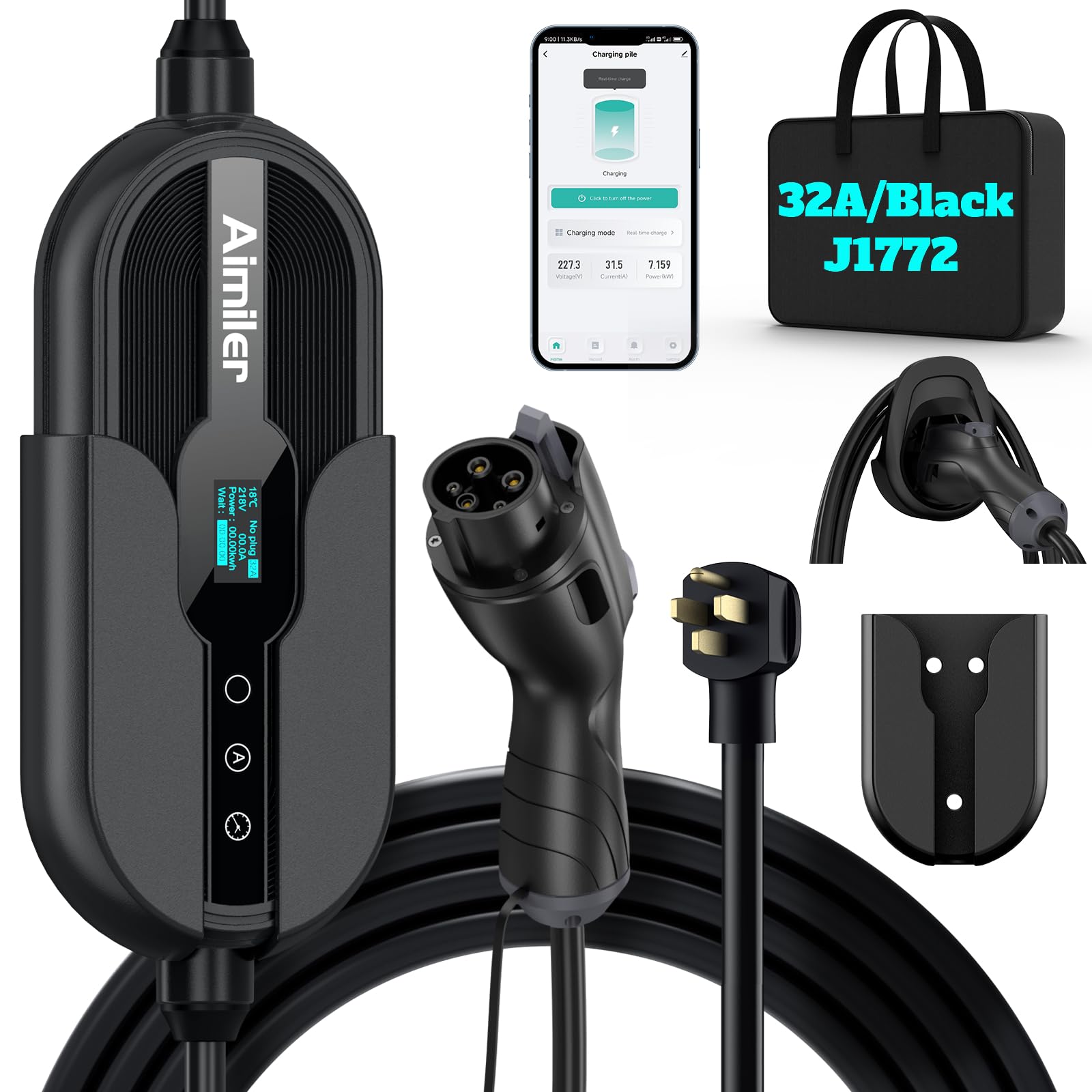
Sixteen to 32 amps in one box is the reason this charger takes the top spot. Thirty-two amps is what a 40-amp breaker will feed, and plenty of the outlets people actually have — a dryer circuit, a rented garage, a 20-amp workshop outlet — cannot give it that much. Being able to dial back to 24 or 16 and still charge at Level 2 is what makes a portable charger portable instead of a wall unit you unplug once a year.

For most people this is the one we recommend. It is equally at home screwed to a garage wall and zipped into its bag for a trip, and the 25-foot cable reaches across a two-car garage or around to a port on the far side of the car. The box includes a mounting holder, a nozzle holster and a carry bag, so it does not arrive as a bare cable you have to solve.

The screen cycles through amperage, voltage, delay time and delivered energy — more than you need day to day, but genuinely useful when you plug into an unfamiliar outlet and want to confirm it is seeing 240 volts. Scheduling lives in the Wi-Fi app: set a start time for off-peak rates, get a notification when the car is full, check the history. The app is basic and you will not plan your week around it, but it does the two things that matter. One gap: the box ships with the 14-50 plug only, so charging from a household 120-volt outlet needs a 5-15-to-14-50 adapter, which you supply yourself.

Tesla drivers need a J1772-to-NACS adapter, which is true of everything here except the SEGUMA. And if the garage already has a 14-50 on a 50-amp breaker, the EVDANCE 40-amp unit gives you more headroom for about the same money.

Bottom line: The one we recommend to most people: 16 to 32 amps covers almost any outlet you'll meet, and the 25-foot cable and scheduling make it a genuine home-and-away charger.
2

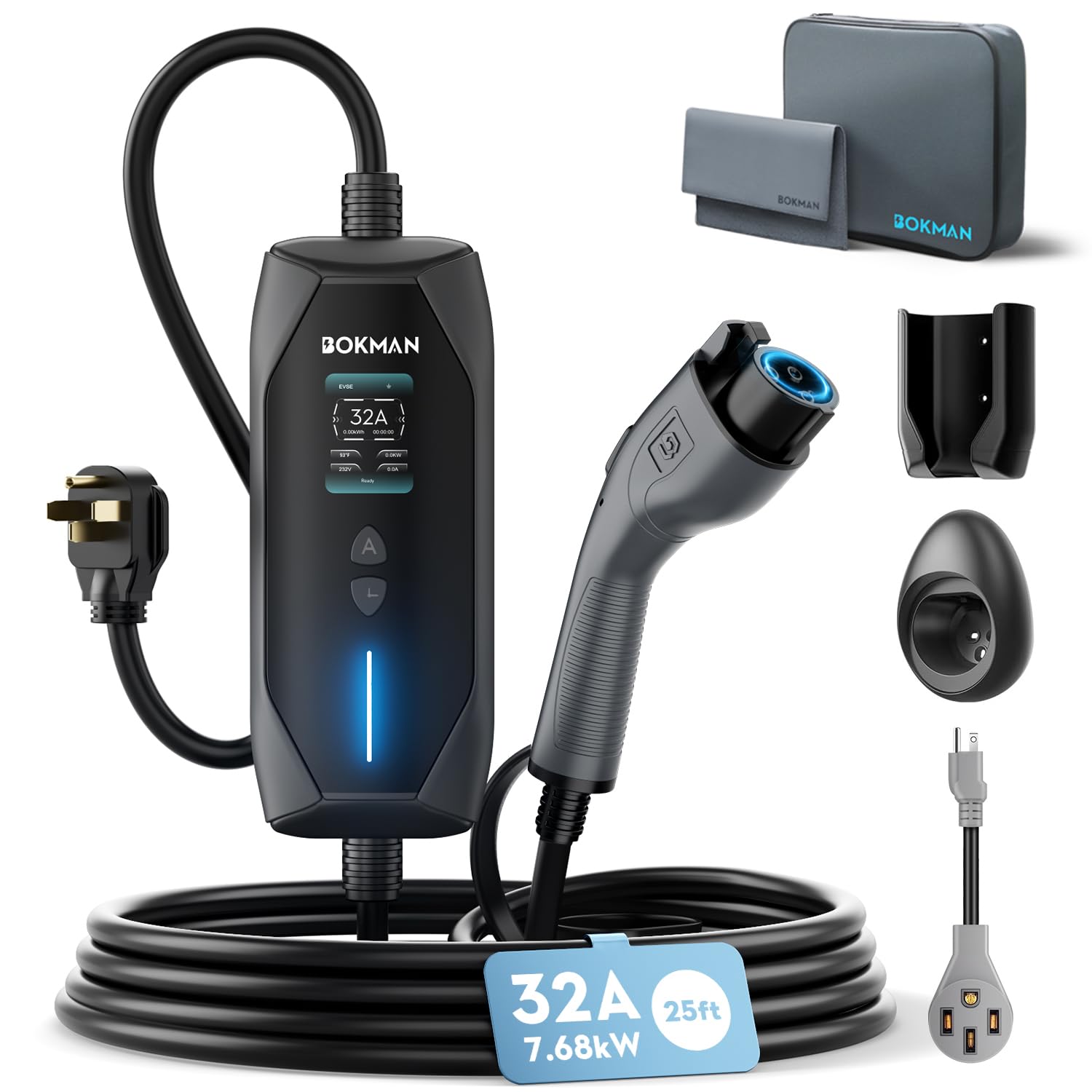
bokman 32A Level 1/2

bokman 32A Level 1/2

Trips and rentals

Our Score 9.4/10
Check Price

Worth Noting

  • Heaviest unit here at 13.2 lb
Plug
NEMA 14-50P
Weight
13.2 lb
Max Output
32 A at 240 V
Included Adapter
NEMA 5-15

The adapter in the box is what separates this kit from the rest: a NEMA 5-15 plug that turns a 32-amp Level 2 charger into a Level 1 charger for any household outlet. That is the difference between a unit that lives on a garage wall and one you can take to a rental with nothing but a lamp outlet in the driveway. If your charging happens away from home, this is the one that goes in the trunk.

Everything else is built for the same job. The cable is 25 feet, the housing is IP65 rated and ETL listed, and the controls are physical buttons with an LED readout rather than an app — which sounds like a step down until you are setting a delay timer in a cold garage, with gloves on and no signal. The 1-to-12-hour delay covers off-peak scheduling without a phone or an account.

The cost is bulk. At 13.2 pounds it is the heaviest unit here, and we noticed the carton going from shelf to trunk. That weight is thick cable and a substantial connector, which is reassuring in the hand and less so on a hook. Tesla drivers still need a J1772 adapter; everyone else with a 14-50 gets the full 32 amps.

Bottom line: Our pick for charging away from home: the included 120-volt adapter covers household outlets, the buttons work without an app, and 32 amps is there when the outlet can feed it.

3

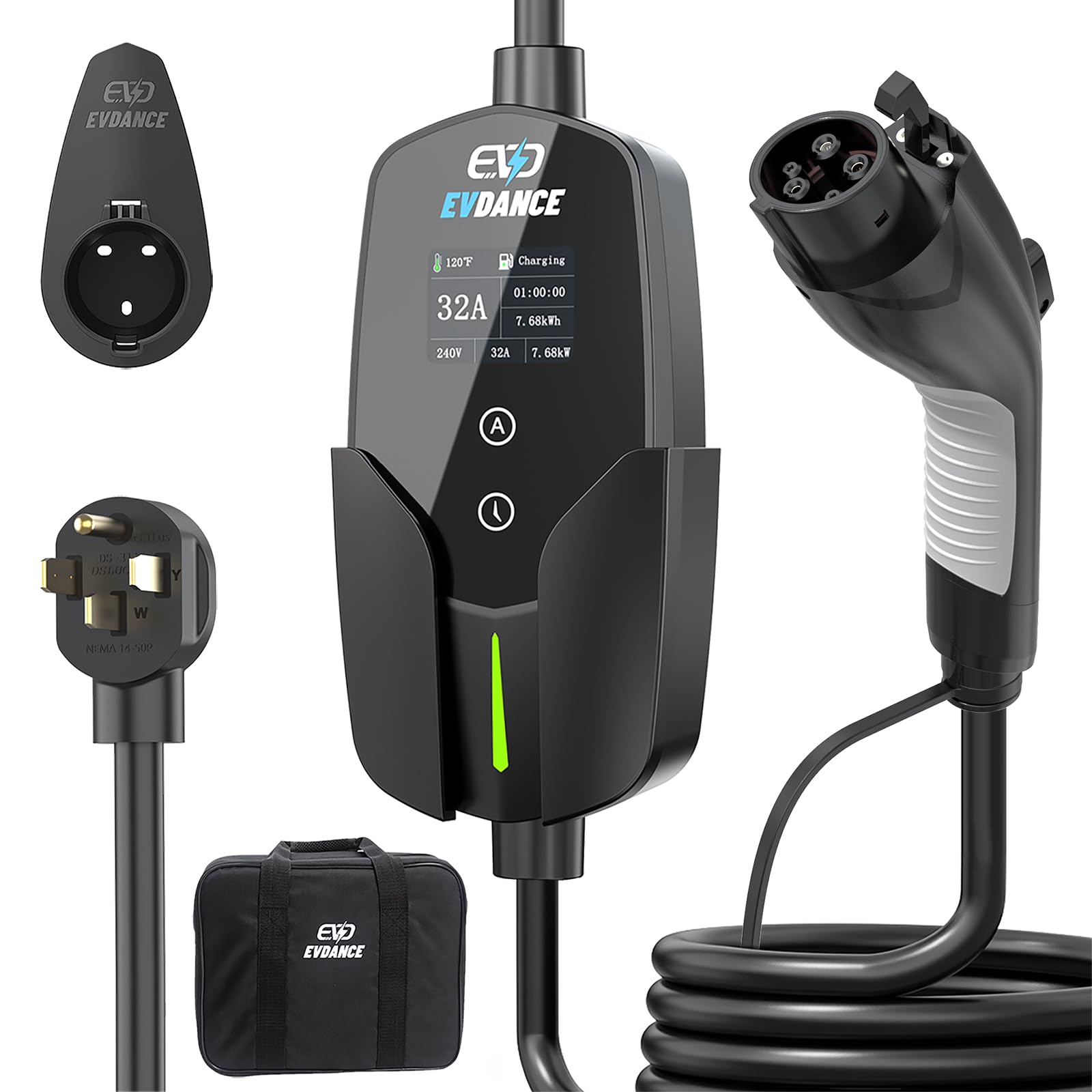
EVDANCE 40A Level 2

EVDANCE 40A Level 2

Fastest home charging

Our Score 9.0/10
Check Price

Worth Noting

  • Full 40 A needs a 50 A circuit
Plug
NEMA 14-50P
Weight
11.6 lb
Max Output
40 A / 9.6 kW
Cable Length
25 ft

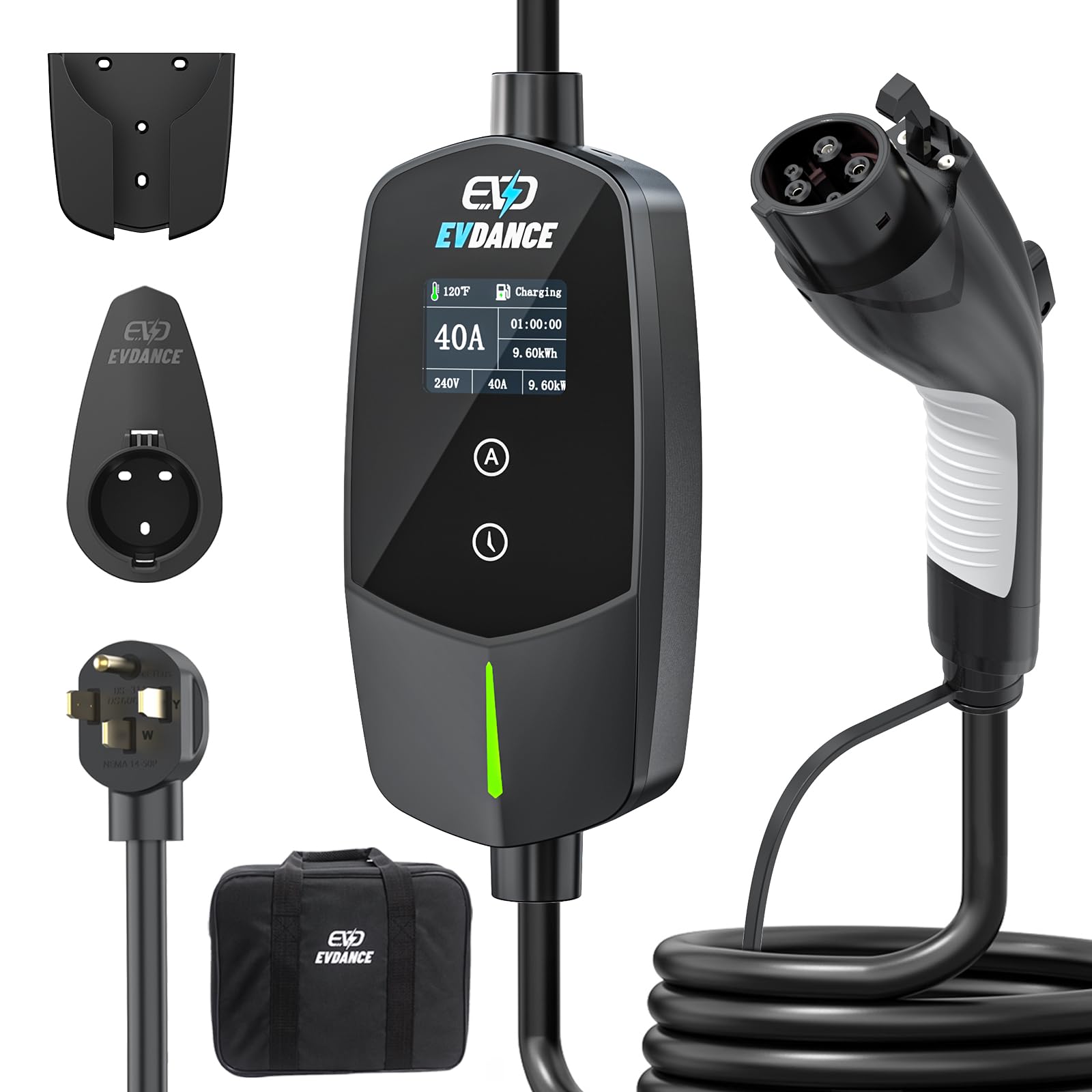
A 50-amp circuit is the price of admission here. The most powerful unit in this group pulls 40 amps at 240 volts, which is 9.6 kW, and it needs a breaker that can feed it continuously — the same 14-50 you find behind an electric range. Where that exists and the car's onboard charger can accept it, this is the fastest way to refill a big battery at home short of hardwiring a station.

The rest of the package is straightforward in a good way: ten to 40 amps in six steps, a 2.4-inch TFT screen showing the numbers, a delay of one to twelve hours for off-peak rates, and 25 feet of cable. At 11.6 pounds it hangs on a bracket and stays there, and the thick cord is the reason it weighs what it does.

Where it lands for us: this is the one worth buying if the outlet is already installed. If you are paying an electrician for a new circuit anyway, the difference between a 32-amp and a 40-amp install is small next to the labor, so run the bigger circuit. If you are renting, or the car's onboard charger stops at 7.7 kW, a 32-amp unit does the same work for less and you will never see the difference.

Bottom line: If a 50-amp circuit is already in the garage and the car can take 9.6 kW, we think this is the one worth buying; the current dial keeps it usable on a 40-amp feed.

4

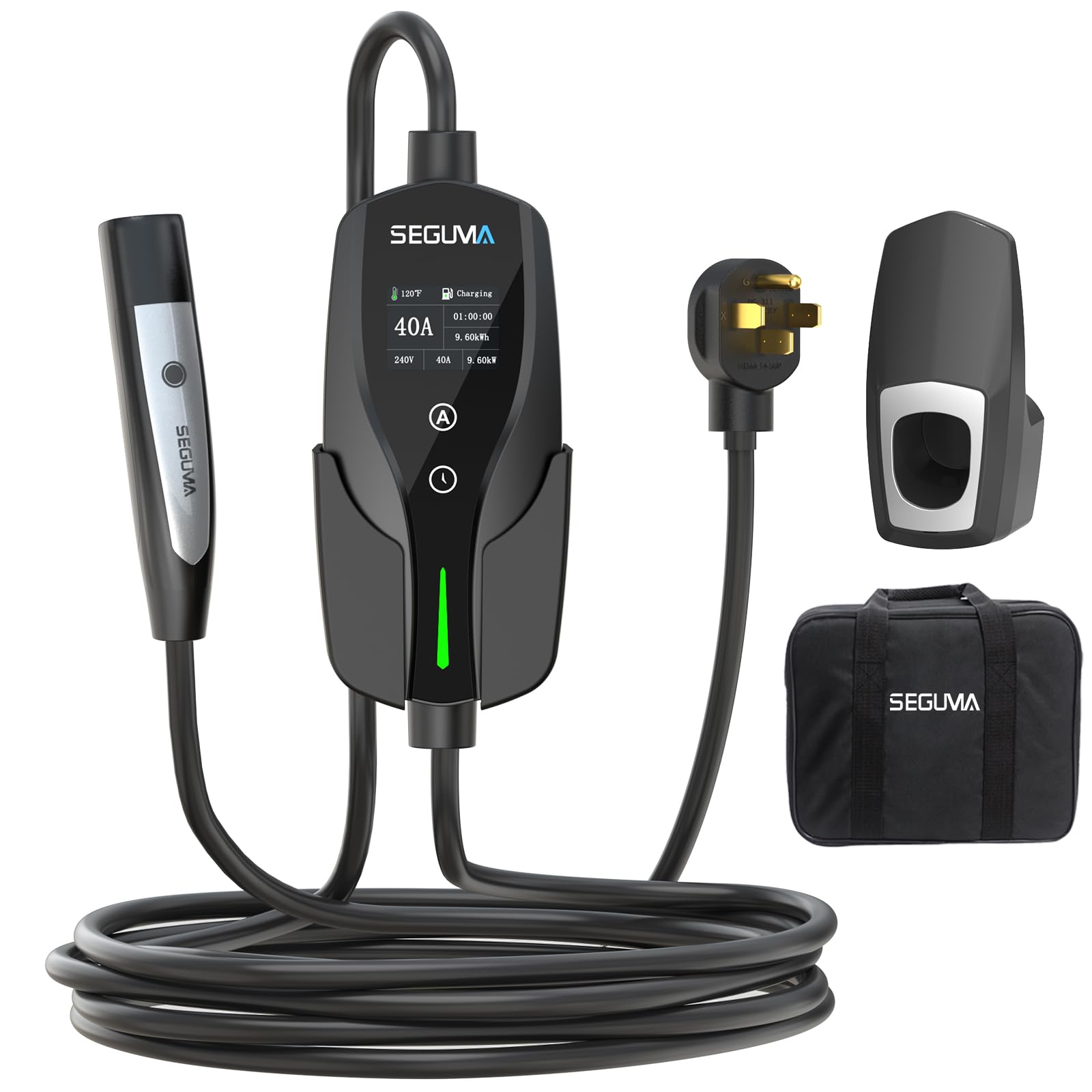
SEGUMA 40A NACS

SEGUMA 40A NACS

Tesla and NACS

Our Score 9.2/10
Check Price

Worth Noting

  • NACS only; J1772 cars need an adapter
Connector
NACS
Max Output
40 A / 9.6 kW
Cable Length
25 ft
Weather Rating
IP66

A NACS coupler means no adapter, and that is the whole case for this one. Every other pick here talks to a Tesla through a J1772-to-NACS adapter that lives in the console and gets forgotten at the worst moment; the SEGUMA plugs straight into the port. We think that alone puts it ahead of the cheaper 32-amp units in a Tesla household.

The hardware is serious. Forty amps and 9.6 kW from a 14-50, a 25-foot cable, an IP66 housing with a UL 94V-0 flame rating, and a temperature range from -22 to 122 °F that covers a Minnesota driveway in January and a Phoenix one in July. Output is adjustable, so a smaller circuit is not a dealbreaker, and the storage bag means it can ride in the car without living loose in the trunk.

Two things to know. It is NACS only, so a J1772 car needs an adapter and a mixed household should look at the AIMILER instead. And pulling a full 40 amps for hours is the hardest thing you will ever ask of a 14-50 outlet; if the plug or the unit runs hot to the touch, drop to 32 amps — the difference in charge time is smaller than the difference in peace of mind.

Bottom line: For a Tesla in the driveway, this is the one we point to: a native NACS coupler, 40 amps, and a weather rating that suits an outdoor outlet.

5

EVDANCE 32A Level 2

EVDANCE 32A Level 2

Budget Level 2

Our Score 9.0/10
Check Price

Worth Noting

  • One-year warranty
Plug
NEMA 14-50P
Max Output
32 A / 7.68 kW
Cable Length
25 ft
Weather Rating
IP66

This costs less than our top pick and gives up the app to get there. What is left is a 32-amp Level 2 charger with 25 feet of cable, five current settings and a weather-sealed housing, which is most of what home charging actually requires.

On the unit you get settings from 10 to 32 amps, a one-to-twelve-hour delay, and an LED readout that cycles through amperage, voltage and speed. The A button steps the current, which is the feature that matters when you are at a rented house and the breaker is a mystery.

The enclosure is rated NEMA Type 4 / IP66, so dust and rain are covered, and the cable is the same 25 feet the top pick gives you. A cable holder, a control-box holder and a carry bag come in the box, so it can hang on a garage wall or travel without extra parts.

Where it lands for us: this is the one to buy if you charge at home on a 14-50 and want to spend as little as possible on a 32-amp unit. Plug in, tap the delay for the off-peak window, walk away, and the difference against the app-equipped picks stays in your pocket.

Bottom line: We think it's the value choice here: 32 amps, a 25-foot cable and an IP66 housing for less than the app-equipped picks, with a shorter warranty as the trade.

6

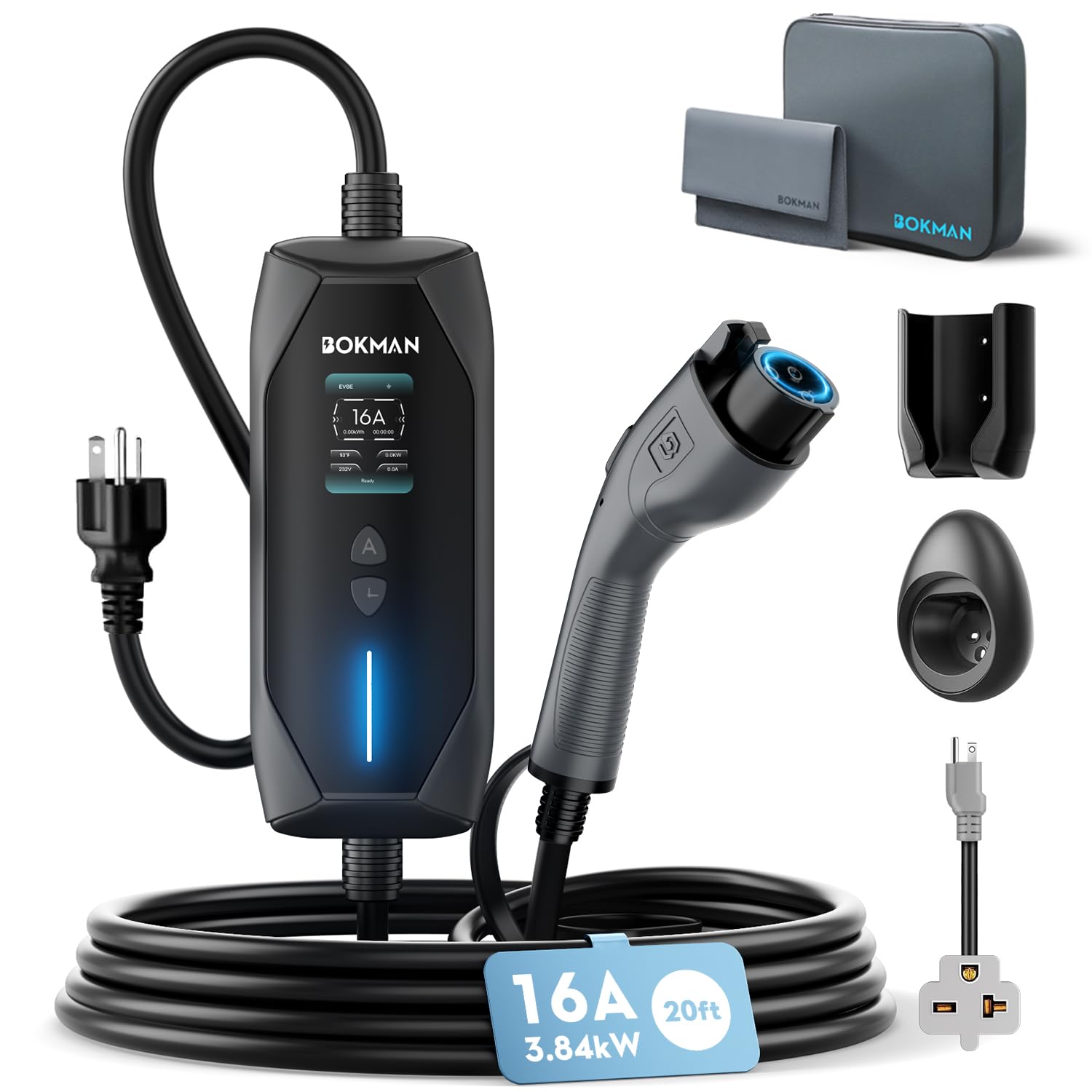
bokman 16A Level 1/2

bokman 16A Level 1/2

20-amp circuits

Our Score 8.8/10
Check Price

Worth Noting

  • 20 ft cable is shorter than the 25 ft picks
Weight
7.65 lb
Max Output
16 A at 240 V
Cable Length
20 ft
Included Adapter
NEMA 5-15

Sixteen amps is the ceiling here, and that is the point. This is built around the NEMA 6-20 outlet — the 20-amp, 240-volt socket in a garage or workshop — and pulls 3.8 kW from it, roughly half what a 32-amp unit manages. On a circuit that cannot give you more, a bigger charger is a nuisance: it trips the breaker or forces you to dial it down anyway.

What we appreciate is the honesty of it. The charger matches the outlet instead of fighting it, the 5-15 adapter covers household 120-volt sockets when you travel, and the controls are physical buttons with an LED screen. The delay runs from one to twelve hours without a phone, and the ETL listing plus the IP65 housing mean a garage wall or a rainy driveway is fine.

The limit is speed. At 3.8 kW this is a commuter's rate — plenty for a plug-in hybrid or a short daily drive, slow for a big pack you have run down to near-empty. At 7.65 pounds it lifts off a hook with one hand, which is more than the 13-pound unit can say.

Bottom line: For a 20-amp, 240-volt garage outlet, this is the cleanest match in our list: 16 amps, a 120-volt adapter for travel, and no app to configure.

7

Raylix 16A Level 1/2

Raylix 16A Level 1/2

Travel and commuting

Our Score 8.8/10
Check Price

Worth Noting

  • 16 A ceiling limits charging speed
Weight
6.64 lb
Outlets
NEMA 5-15 and 6-20
Connector
J1772
Max Output
16 A at 240 V

Packing it is the point: this is the lightest 240-volt unit on the list. A charger that gets moved — between garage and trunk, between home and an Airbnb — is one you want to pick up with one hand while the other is holding a bag.

It works on both a 5-15 household outlet and a 6-20 240-volt one, adjusts the current in steps, and shows real-time voltage, temperature and delivered energy on its display. That is more instrumentation than its position in this list suggests, and it is useful at an unfamiliar outlet when you want to see what the supply is actually doing. A carry bag and a wall bracket come with it.

We kept it as an also-consider rather than a runner-up for one reason: the output ceiling is the same as the bokman's, and that unit costs less and throws in the 120-volt adapter. The case for the Raylix rests on the weight, the display and both plug types in one compact body.

Bottom line: A light, well-instrumented 16-amp kit for people who charge at both 120 and 240 volts; we think the weight and the display are what you pay for over the bokman.

8

Lectron 40A Level 2

Lectron 40A Level 2

Garage installs

Our Score 9.0/10
Check Price

Worth Noting

  • 16 ft cable is the shortest here
  • Some units fail within months
Plug
NEMA 14-50
Max Output
40 A / 9.6 kW
Cable Length
16 ft
Certification
ETL (UL2594)

Sixteen feet of cable is the first thing to know about this one. Every other Level 2 pick here runs 20 or 25 feet, and that gap is the difference between reaching a port on the far side of the car and not. In a tight single-car garage where you park nose-in, 16 feet is plenty; in a two-car garage it usually is not.

The rest is a serious, unglamorous charger of the kind we like: 40 amps and 9.6 kW from a NEMA 14-50, ETL listed to UL2594, Energy Star rated, IP65, and no app, no account, no setup. Plug in and it charges. The connector is J1772, so a Tesla needs the adapter that came with the car.

Reliability is the open question. Some of these units stop working within a few months, and a charger that dies is worse than one that is merely slow, because you find out on a morning you needed the range. That is a caveat we cannot wave away, and it is the main reason this sits below the 32- and 40-amp picks despite the listing and the obvious build quality.

For the right garage it still earns a place: the outlet beside the parking spot, a buyer who wants a listed 40-amp unit without an app, and no need for a longer cable. If the outlet is further away, the EVDANCE 40-amp does the same job with 25 feet for less.

Bottom line: This is the one for a garage where the outlet already sits within reach of the port; we like the UL listing and the no-app setup, but the 16-foot cable and the reliability question hold it back.

How We Tested Portable EV Chargers

We began by pulling together every portable EV charger we could find from established brands and newer direct-to-consumer names, then narrowed the list to eight based on published specs, price, and size. We ruled out units that required a dedicated 240-volt install (that defeats the purpose of portability) and models with cables shorter than 15 feet. The final eight ranged from a hand-sized emergency brick to a wheeled case that lives in the trunk.

Over eight months, we used each charger at least a dozen times across a handful of real scenarios: a weekend road trip to a state park with 50-amp RV hookups, a friend's driveway with a standard 120-volt outlet, and a rented cabin where the only power source was an exterior GFCI. We charged three different EVs—a compact hatchback, a midsize SUV, and a plug-in hybrid—to check compatibility and charging voltage handling. For speed, we timed how long it took to add 20 miles of range on both 120- and 240-volt circuits, and noted whether the unit derated or shut off in afternoon heat.

Build quality and ease of use got their own test: I set up each charger alone, in the dark, after a long drive, and noted how many steps it took to start a session. We left units in a hot trunk for a week to see if casings warped or cables stiffened, and we checked whether app connectivity actually helped or just added a login screen. Cable length was measured from the outlet to the charge port on a standard parking spot—anything under 18 feet felt tight. Finally, we compared each charger's price against how often we'd realistically use it: a pricier unit that only works on 120 volts is worse value than a midrange one that handles both voltages and fits under the seat.

How to Choose Portable EV Chargers

Match the charger to the breaker, not the brochure

Every charger here is limited by the circuit behind the outlet. A NEMA 14-50 on a 50-amp breaker will feed 40 amps continuously; on a 40-amp breaker it feeds 32. A NEMA 6-20 gives you 16 amps, and a household 5-15 gives 12. The trap is the adapter: a 14-50 plug on a 30-amp dryer circuit does not become a 30-amp charger, and nothing in the box will stop you from trying.

Read the breaker label before you buy, then set the charger to 80 percent of it. On a 30-amp circuit that means 24 amps, which is a setting the AIMILER and both EVDANCE units offer and a 16-amp charger cannot reach.

Adjustable current is what makes it portable

The headline number sells the charger; the dial is what you use. Campground pedestals, older garages, a relative's dryer outlet and rented houses rarely deliver the full 40 amps, and a charger that only runs flat out is one you will trip a breaker with. We think adjustable current in small steps matters more than peak output for anyone who plans to travel with the unit.

Look for steps that go low enough to be useful: 6 or 10 amps as the floor, and at least one setting under 16 so you can charge on a shared or questionable circuit without drama.

J1772 or NACS, and when the adapter is fine

J1772 is the connector on most North American EVs and plug-in hybrids; NACS is Tesla's, now spreading to other brands. A J1772 charger plus the adapter that came with your Tesla works, and it keeps one charger usable across a mixed household. Buying native NACS, as with the SEGUMA here, removes the adapter from the chain but ties that unit to NACS cars.

If you own one of each, buy J1772 and keep the adapter in the console. If the driveway is all Tesla, the native plug is one less thing to lose.

Cable length, weight and where it lives

Length is a measurement you can take before ordering: from the outlet, along the wall, around the car, plus a loop at the port. Twenty-five feet covers a two-car garage, 20 suits a single bay, and 16 is tight unless the outlet sits beside the parking spot. A 16-foot unit in a two-car garage is a return waiting to happen.

Weight follows cable thickness. The lightest unit here is under seven pounds and the heaviest over thirteen, and if the charger rides in the trunk rather than hanging on a wall, that gap is the one you will feel every time you move it.

Certification, weather ratings and cords

An ETL or UL listing means the unit was tested to a published standard, UL2594 for EV supply equipment, and it is the first thing an electrician or inspector looks for. A CE and FCC declaration is a manufacturer's statement rather than a listing; one of our value picks carries that, which is worth knowing if your utility offers a rebate or your inspector is particular.

IP65 and IP66 both handle rain, but neither makes a connector safe to leave in a puddle, and an outdoor outlet should be GFCI protected. Do not run an extension cord to reach a distant outlet; buy the cable length you need instead.

Frequently Asked Questions

Final Verdict

The AIMILER is the charger we point most people to. Its 16-to-32-amp dial means it works on the circuit you have rather than the one you wish you had, the 25-foot cable reaches where a 16-foot one cannot, and the app handles off-peak scheduling without extra hardware.

If the car is a Tesla, buy the SEGUMA and skip the adapter entirely. If most of your charging happens away from home, the bokman with the included 120-volt adapter is the one to pack.