Tools & DIY

Best Borescope Inspection Cameras of 2026

A borescope is a tiny camera on the end of a long, semi-rigid cable: you feed it into a wall cavity, a drain line, or a spark plug hole and see what you'd otherwise have to cut open to find. That sounds simple until you're staring at a grainy, blown-out image and can't tell a hairline crack from a shadow. The right one turns a guessing game into an answer — leak or old caulk, blockage or slow drain — and tells you who to call, if anyone.

I've fed cheap ones through my own crawlspace and regretted it before the cable was halfway in. Over the past seven months, we put 11 borescopes through walls, drains, engine bays, and one very unfortunate dryer vent. The lesson that surprised me most: brightness separates these cameras far more than resolution does. A stiff probe that won't turn a corner wastes a good sensor, and an app that drops its connection makes a phone-based scope useless. The picks below earned their place.

1

Teslong NTS300

Top Pick
Teslong NTS300

Walls, ducts, engines

Our Score 9.2/10
Check Price

Worth Noting

  • 720p video trails the stills
  • Body and 16.5-foot cable are bulky
Cable
16.5 ft
Lenses
Dual front/side
Screen
5 in
Battery
4.5 hr

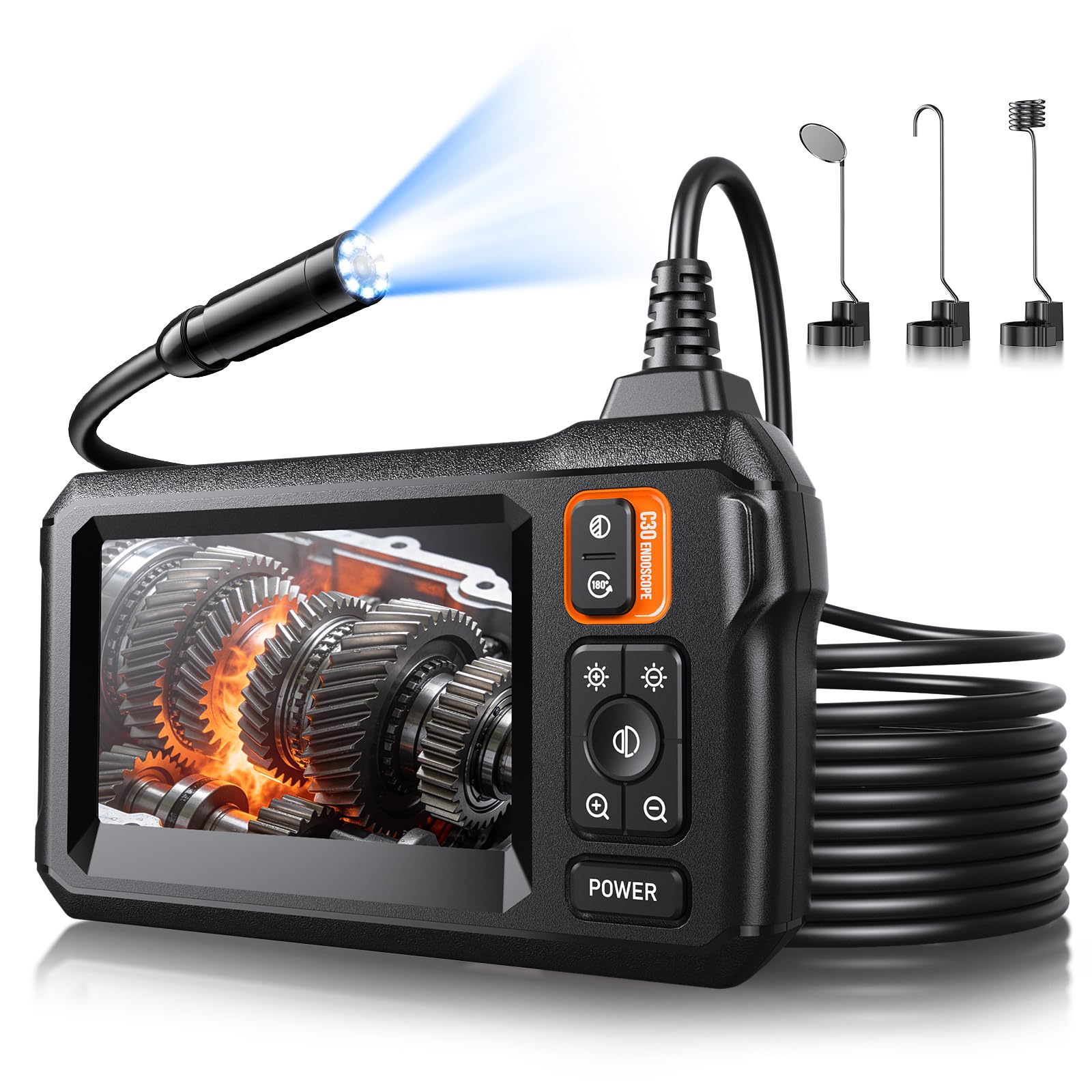
The NTS300 is the borescope we recommend first because it solves the two things that spoil most inspections: reach and angle. The 16.5-foot semi-rigid cable gets you into wall cavities, ducts, and drain lines, and the front-and-side lenses let you see down a pipe and then look at its wall without fitting a mirror. On a 5-inch screen, that side view is easy to read while you're feeding cable with the other hand.

The headline spec is the dual lens, but the practical win is that each lens has its own LEDs. We found the side camera especially useful in ductwork and behind drywall, where a forward-only scope shows you a lot of nothing. The 4.5-hour battery is enough for a long afternoon, and the 5-inch screen is bright enough to read in a dim crawlspace.

The semi-rigid cable is the part that takes technique. It holds a bend, so you can push it into a duct and let go while you check the screen, but it isn't a steering probe. For looking around an obstacle, you still need to rotate the cable or step up to an articulating model.

For homeowners, HVAC work, and mechanics who need one scope for everything, this is the one that earns its space in the toolbox. If your work is mostly engine cylinders, the articulating TD450S is more precise; for long runs and side views, we keep coming back to the NTS300.

Bottom line: For most buyers, this is the borescope to get: dual lenses, a readable 5-inch screen, and enough cable for walls, ducts, and engine bays.

2

Teslong TD450S

Teslong TD450S

Engine cylinder work

Our Score 9.0/10
Check Price

Worth Noting

  • Articulating head needs careful handling
Cable
5 ft
Screen
4.5 in
Resolution
1080p
Articulation
Two-way 210°

A 5-foot cable sounds limiting until you see what the articulating head can do. The TD450S puts a two-way, 210-degree joystick-controlled tip on the end of a semi-rigid gooseneck, so you can feed it into a spark-plug hole and then steer the camera toward a valve or cylinder wall instead of wiggling the whole cable and hoping.

That steering is the reason we recommend it for engine work. The joystick sits under your thumb, the 4.5-inch screen is easy to read one-handed, and the 32GB card is included, so you can grab evidence without a phone. We also like the adjustable LEDs; in a dark cylinder, turning them down often shows more surface detail than blasting full brightness.

It's the scope we choose when the question is what's behind this valve rather than how far does this duct run. The shorter cable keeps the kit compact, and the articulating head does work a long cable can't. If you inspect walls or drains all day, the NTS300's reach is a better fit.

The TD450S is a precision tool, and it rewards a careful hand. Keep the head out of grit and sharp bends, and store it in its case rather than loose in a toolbox. For engine diagnosis, that care buys you a view that a fixed camera simply can't match.

Bottom line: If you need to look back at valves or cylinder walls, the joystick-controlled head earns its keep; just accept the shorter 5-foot reach.

3

FOXWELL Y400

FOXWELL Y400

Tight engine ports

Our Score 9.2/10
Check Price

Worth Noting

  • 5.3-foot cable is short for walls
  • 720p video only
Probe
6.2 mm
Screen
4.3 in
Battery
5-7 hr
Articulation
220° two-way

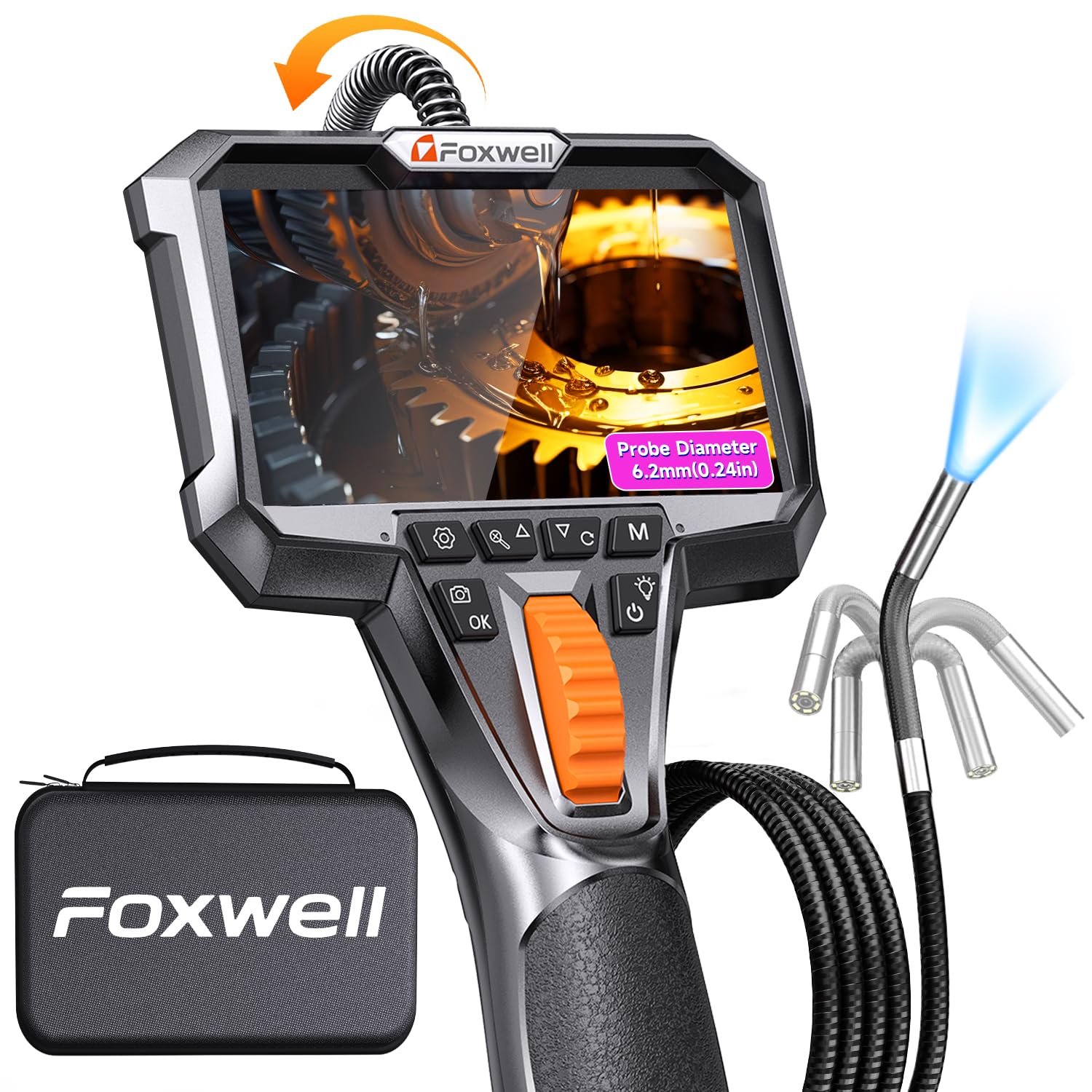
The Y400's 6.2mm probe is slim enough for tight engine ports, small castings, and narrow cavities where an 8mm scope won't go. The two-way 220-degree thumb wheel lets you steer the head without rotating the entire cable, which is the difference between seeing a valve seat and guessing at it.

On the 4.3-inch IPS screen, the image is crisp enough for close-up inspection, and the 4x zoom helps when you can't move the probe closer. The 5-to-7-hour battery is generous for a scope this small, and the included 32GB card keeps files on board.

This is a specialist, not the all-rounder. If your problem is a small opening and a part you can't see, the slim probe and smooth steering make the Y400 the one we reach for. That's a narrow brief, and it's exactly the brief this scope is built for.

What we appreciate most is the control. The thumb wheel moves the head in small increments, so you can sweep a cylinder wall without overshooting, and the slim probe doesn't block the view once it's inside. For tight-port work, that precision matters more than another foot of cable.

Bottom line: The slim probe and smooth 220-degree steering make this the specialist for small engine ports and tight cavities.

4

DEPSTECH DS620

DEPSTECH DS620

Multi-angle inspections

Our Score 9.2/10
Check Price

Worth Noting

  • Battery runs only 2-3 hours
  • Cable is stiff in tight bends
Cable
16.5 ft
Lenses
Triple
Screen
5 in
Resolution
1080p

Three lenses on one head is the DS620's whole argument. Instead of fitting a mirror to see sideways, you switch between forward and side views on the 5-inch screen, which saves a lot of cable twisting when you're checking a pipe wall, a duct joint, or the inside of a cylinder.

We think that makes it the best value in this group for multi-angle work. The 1080p image is crisp, the 16.5-foot semi-rigid cable reaches into walls and drains, and the 5-inch IPS screen is easy to read without a phone. The 2MP stills have enough detail for cracks, part numbers, and pipe joints.

For ductwork or engine bays, the three lenses cover more angles than a single probe. If you need to steer around an obstacle rather than just see three directions, pay for articulation; if you want multiple angles on a budget, this is the pick. It's also the one we hand to a helper who has never used a borescope, because there's no app to explain.

The DS620 earns its place by making multi-angle inspection feel routine. You don't have to stop and screw on a mirror, and you don't have to guess which way the camera is pointing. That simplicity is why it stays in the kit even when a more specialised scope is available.

Bottom line: Three lenses for the price of a dual-lens scope make this the value pick for multi-angle inspection.

5

MugEasy Endoscope

MugEasy Endoscope

Budget standalone use

Our Score 9.0/10
Check Price

Worth Noting

  • 4.3-inch screen is smaller than 5-inch picks
  • Cable can be stubborn in tight elbows
Cable
16.5 ft
Screen
4.3 in
Resolution
1080p
Waterproof
IP67

The MugEasy is the simplest scope here: a 4.3-inch screen, a 16.5-foot semi-rigid cable, and no phone, app, or Wi-Fi in sight. Turn it on and look. That sounds basic, but it's exactly what you want when you're standing on a ladder with one hand in a ceiling cavity.

The 1080p camera and eight adjustable LEDs are good enough for drains, wall cavities, and engine bays. The 1.29-inch short lens helps in narrow pipes, and the included hook, magnet, and mirror cover the usual retrieval jobs. We found the screen bright and easy to read, and the cable holds its shape when you push it through insulation. The 170-degree viewing angle also gives you useful context around the camera.

For a first borescope, the simple controls and self-contained screen are the point. It's the one we hand to someone who wants to look behind a wall without a phone, an app, or a manual.

It won't satisfy someone who needs articulation or a huge display, but it doesn't pretend to. The MugEasy is a straightforward inspection camera that works out of the box, and that's a surprisingly rare thing at this end of the market.

Bottom line: A no-phone, no-app borescope with a bright screen and long cable, and the one to buy if you want to spend the least.

6

Kinpthy W400-B

Kinpthy W400-B

Phone-first inspections

Our Score 8.6/10
Check Price

Worth Noting

  • App connection can be finicky
  • No standalone screen
Cable
16.4 ft
Probe
7.9 mm
Connection
iOS/Android
Resolution
1920P

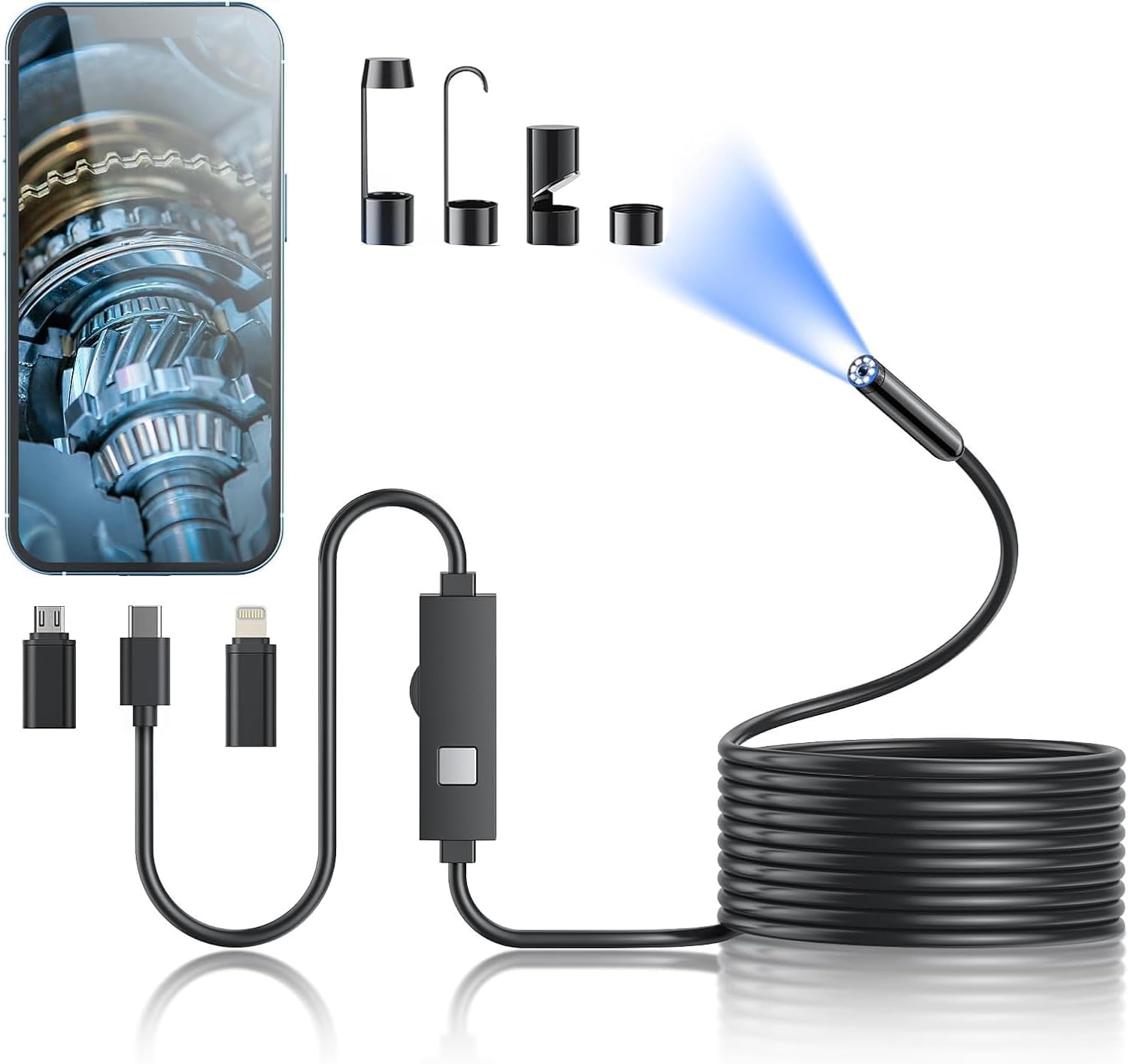
The Kinpthy is a phone-first scope: a 7.9mm camera on a 16.4-foot semi-rigid cable, with adapters for USB-C, Micro-USB, and Lightning. You plug it in, open the app, and your phone becomes the screen. That keeps the kit small and the cost low.

The 1920P resolution is the headline, and it's genuinely useful for reading small cracks, threads, and wiring labels. The cable holds a bend, the eight LEDs are adjustable, and the included hook, magnet, and mirror make it a complete inspection kit. For a first borescope or a glovebox tool, it covers a lot of ground.

Brightness is the compromise: the LEDs are fine in close quarters, but in a wide dark space they run out of reach faster than the camera does. The cable is also stiff enough to push but not to steer, so you feel the lack of articulation in a tight elbow.

We still recommend it for budget-minded DIYers who already carry a phone and don't mind an app in the loop. For occasional inspections around the house, it earns its place in the glovebox.

Bottom line: The phone-first pick: it puts a 1920P view on the screen you already carry, provided you check the app connection before you rely on it.

7

TGJOR G50

TGJOR G50

Budget dual-lens

Our Score 8.8/10
Check Price

Worth Noting

  • Cable is too soft for long drain pushes
  • 3x digital zoom adds little detail
Cable
16.4 ft
Lenses
Dual
Screen
5 in
Resolution
1080p

The TGJOR G50 gives you a 5-inch screen and a dual-lens head for about the same money as the budget single-lens scopes, and that combination is why it's worth a look. The forward camera handles general inspection; the side camera lets you check a pipe wall or a cylinder without fitting a mirror.

The 1080p image is clear enough for drains, ducts, and engine work, and the 16.4-foot semi-rigid cable reaches into the usual homeowner spaces. The eight LEDs are bright and adjustable, and the no-app operation keeps setup simple. The 5-inch screen is a real step up from the 4.3-inch displays on many budget scopes. The 170-degree wide-angle view also shows enough context to tell a pipe joint from a shadow.

For occasional inspections around the house, the simple controls and big screen are the draw. It's the budget scope we point to when someone wants dual lenses without paying for a premium articulating model.

It isn't a specialist's tool, but it doesn't need to be. The G50 is the one we keep for quick looks in a wall, under a sink, or around an engine bay, where a second lens and a readable screen do more than another page of specs.

Bottom line: A big 5-inch screen and a second lens for not much more than the cheapest standalone scopes; the soft cable is the trade-off.

8

Klein ET19

Klein ET19

Long narrow runs

Our Score 8.8/10
Check Price

Worth Noting

  • Premium price for a niche reach
  • Wi-Fi app adds a setup step
Cable
9.8 ft
Probe
5.5 mm
Screen
4.3 in
Connection
Wi-Fi

The ET19 is built around a 5.5mm armored snake that runs 9.8 feet, which makes it the long-reach specialist in this group. The armored jacket is aimed at conduit, gutters, and narrow cavities, and the camera tip stays slim enough for openings that stop a larger probe.

The 4.3-inch screen and dual-lens head cover the usual forward and side views, and the Wi-Fi link lets you send images and video to a phone for sharing. The whole thing weighs 8.64 ounces, so it's easy to hold overhead or work one-handed. For HVAC, gutters, and long narrow runs, that combination is genuinely useful.

The 4.3-inch display is smaller than the 5-inch models here, but the light weight makes up for it when you're holding the scope overhead. The armored cable is the part that justifies the specialist tag; it's aimed at conduit and gutters rather than a shelf.

We see it as a specialist for trade work rather than a first borescope. The light weight and armored cable are the details that matter when you're working above your head, and the Wi-Fi sharing is a real convenience for documenting a job. For the right narrow run, it's the one that stays in the van.

Bottom line: A light, long-reach armored scope with Wi-Fi sharing, and a sensible choice when the inspection run is narrow and awkward.

How We Tested Borescope Inspection Cameras

We started with more than 40 borescopes and filtered hard: would the camera head fit through a half-inch gap, was the screen built in or did the unit lean on your phone, how long was the probe, and what the money actually bought you. That left 11 units — a mix of handheld models with their own displays and plug-in cameras that run off an app. We spent seven months with them, and each one went into the same four situations: a wall cavity, a clogged drain, an engine bay, and a dryer vent.

Picture quality got judged on real targets, not spec sheets. We taped a printed serial-number label inside a dark cardboard box and asked whether we could read it on screen without zooming, then repeated the check on a corroded pipe joint and a stamped engine block. Brightness we tested twice, once in a lightless cavity and once in a sunlit bay, noting whether the LEDs blew out close-up surfaces into white glare or left the corners of the frame black. Usefulness came down to whether the image actually answered the question — leak or no leak, blockage or no blockage.

Cable behavior turned out to matter as much as the sensor. We pushed each probe through a 90-degree PVC elbow and counted the attempts before it made the turn, then coiled it back into its case to see how much shape it held. Every screen got tilted, every mirror and hook swapped, and each app got paired with an iPhone and an Android phone to see whether the feed held through a wall at ten feet. Finally, we dropped each unit from waist height onto concrete, rinsed the models rated for it under a faucet, and wiped the lenses with a shop rag to see how the coating held up.

How to Choose Borescope Inspection Cameras

Match the Cable to the Route

Start with distance and bends, not resolution. A 16-foot semi-rigid cable is the useful range for wall cavities, ducts, and drains; a 5- to 10-foot scope is easier in an engine bay. Cable stiffness matters just as much: a semi-rigid snake pushes through a straight run but can fight a tight elbow, while a soft cable coils neatly but won't push far.

Check the probe diameter for narrow openings. A 6.2mm probe slips into small engine ports and castings; 7.9mm and 8mm probes suit drains, walls, and most automotive work. Measure the run and count the turns before you buy, then choose the shortest cable that still reaches. The NTS300's 16.5-foot reach suits walls and ducts; the TD450S keeps its 5 feet for engine bays.

Articulation or Extra Lenses?

These are two different ways to see around a corner. An articulating head steers the camera with a joystick or thumb wheel, so you can look back at a valve, a cylinder wall, or the far side of a bend. A dual- or triple-lens head gives you forward and side views without moving the cable, which is faster in a pipe or duct but doesn't let you steer around an obstacle.

Choose articulation if your main job is engine diagnosis or anything where you need to look back at the probe. Choose extra lenses if you're inspecting walls, ducts, and drains and want more coverage per push. The TD450S and Y400 are the articulating picks here; the NTS300 and DS620 use lenses to cover angles. Neither approach replaces a steady hand, but they solve different problems.

Screen or Phone?

A standalone screen is the easier tool to live with. There's no app to pair, no phone to mount, and no notification to interrupt an inspection. That matters when you're on a ladder, under a sink, or holding a cable with one hand. The trade-off is bulk and, usually, a higher price.

A phone-connected scope is smaller, cheaper, and puts the image on a screen you already know. The catch is the connection: app compatibility and a stable handshake are the difference between a quick inspection and a dead cable. If you choose phone-first, test the app before you need it and keep a charged phone with the kit. The Kinpthy W400-B is the phone-first value pick here.

Light, Resolution, and Runtime

1080p and a 2MP sensor are plenty for inspection; higher numbers help with cropping, not with finding a leak. What matters more is adjustable LED brightness. Full power can wash out a shiny pipe or a piston crown, while a lower setting often reveals surface detail. Look for a screen you can read outdoors and a light you can dim.

Battery runtime separates a quick look from a full job. The scopes here range from about 2 to 7 hours, and a 5-inch screen draws more than a 4.3-inch one. If you'll be working all day, choose a model with USB-C charging and a runtime closer to 5 hours; for occasional checks, 2 to 3 hours is workable.

Build, Waterproofing, and Care

IP67 waterproofing is the rating to look for if you'll be in drains, wet pipes, or engine bays. It protects the probe, not the screen or the handle, so keep those dry. The cable is the wear item: avoid sharp bends, don't use the scope as a pry bar, and coil it loosely after use.

Articulating heads are the most delicate part of any borescope. Keep grit out of the mechanism, don't force the joystick, and store the scope in its case. A 1- or 2-year warranty is worth checking, especially on the pricier articulating models. If the scope is going to live in a toolbox, a hard case and a protected cable are more valuable than another lens.

Frequently Asked Questions

Final Verdict

Most people should buy the Teslong NTS300. Its dual front-and-side lenses and 16.5-foot cable cover the widest range of jobs here, including walls, ducts, drains, and engine bays, and the 5-inch screen keeps the image readable without a phone. If your work is mostly engine cylinders and you need to steer the camera, the Teslong TD450S is the better specialist; its shorter cable is the cost of that precision. On a tight budget, the MugEasy is the standalone scope we recommend to a first-time buyer.