Power & Charging

Best Cable Raceway Kits of 2026

The cords behind a TV have a way of multiplying until the whole setup looks like a mistake. A cable raceway is the unglamorous fix: a slim channel that gathers cords into one line along the wall or baseboard, making the run look intentional instead of accidental. The category splits into adhesive-backed channels that go up in minutes and screw-mounted ones that need a drill but hold firm; the wrong pick shows up as peeling tape or a sagging run. I've spent the past three months living with 14 raceways in my own living room, and the differences are more practical than cosmetic.

Paintable and trim-style options can disappear against a wall, but only if the adhesive actually grabs. I paid attention to how each one cut, how much pressure the tape needed, and whether the channel stayed put after a week of bumping and dusting. Since a raceway is a small purchase, value matters: the best ones did their job without extra clips, messy glue, or a second hardware-store run. The picks below reflect those real-world tradeoffs.

1

A+ Electric Cord Cover Full Kit

Top Pick
A+ Electric Cord Cover Full Kit

Whole-room cable runs

Our Score 9.0/10
Check Price

Worth Noting

  • More coverage than small jobs need
  • Adhesive needs a clean flat surface
Pieces
20 channels
Connectors
29 included
Total Length
315 in
Channel Width
1 in

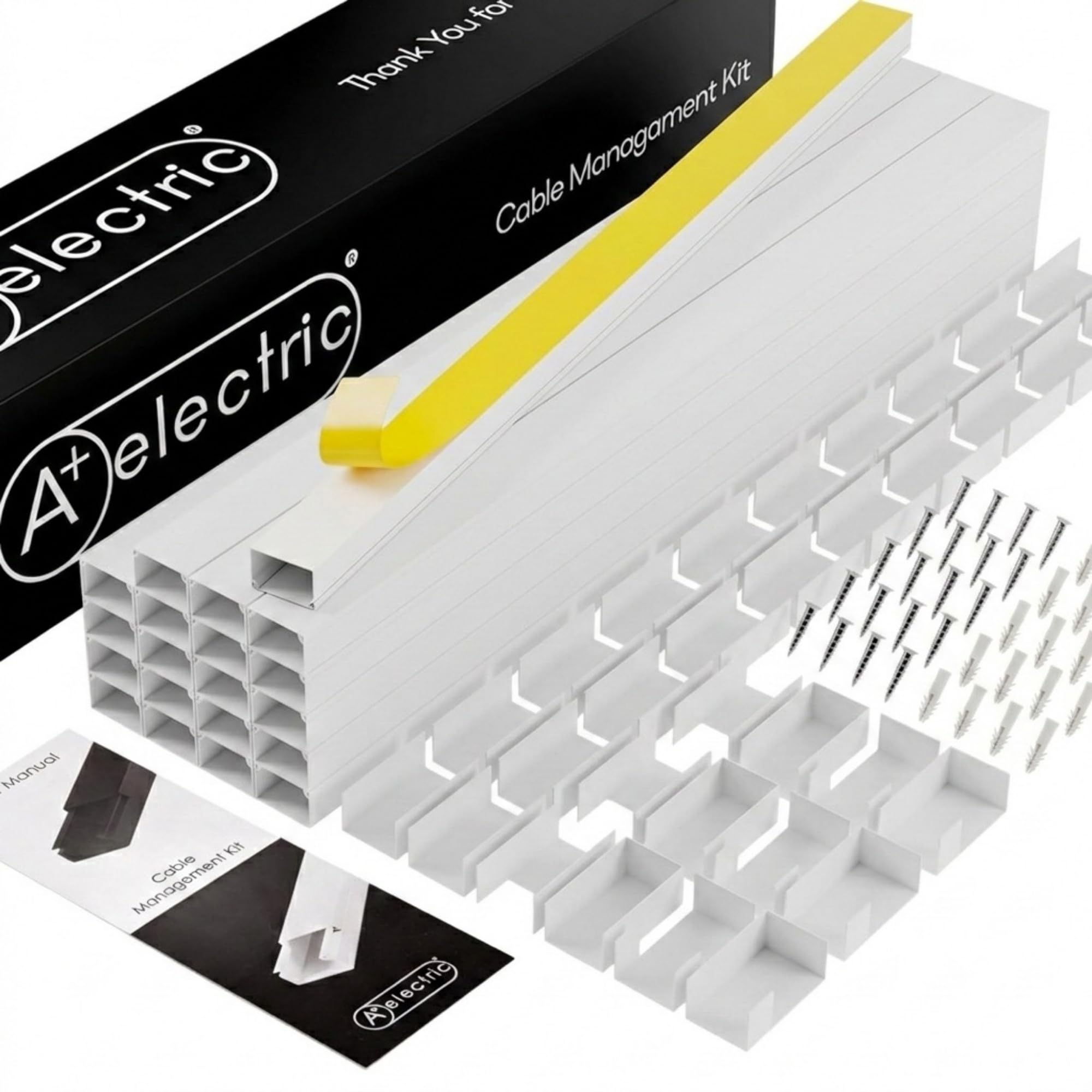
The first thing we noticed about the A+ Electric kit is how much of it there is: 20 channels totaling 315 inches, plus 20 straight connectors, three inside corners, three outside corners, and three T connectors. That is the difference between a kit that finishes a wall-mounted TV and one that sends you back for a corner piece. We recommend it first because it covers the whole job without a second order.

The 1-inch-wide channel takes a typical power cord and a couple of signal cables, and the snap-on cover presses down cleanly enough to read as trim rather than a plastic strip. We appreciate that the tape is pre-applied for a quick stick-on job, while screws and anchors are there for a heavier bundle or a wall that has just been painted. The surface is paintable, so the white channel can disappear into a cream wall or a colored office.

Coverage is what earns it top billing: 315 inches reaches from the TV down to the outlet and around a corner with fewer seams than the 157-inch and 113-inch kits here. It is more kit than a single lamp cord needs, and the adhesive still wants a clean, flat surface; press it firmly and let it set before you load the channel. The extra connectors are what we keep coming back to: they turn a box of channels into a kit you can finish in one afternoon.

Bottom line: For a whole-room cable cleanup, this is the raceway kit we recommend: long coverage, useful connectors, and a snap-on cover that looks finished.
2

EVEO Cable Hider Wall Kit

EVEO Cable Hider Wall Kit

Long wall runs

Our Score 9.2/10
Check Price

Worth Noting

  • Short sections add visible seams
Pieces
20
Warranty
6 years
Channel Size
16 L x 0.95 W x 0.5 H in
Total Length
306 in

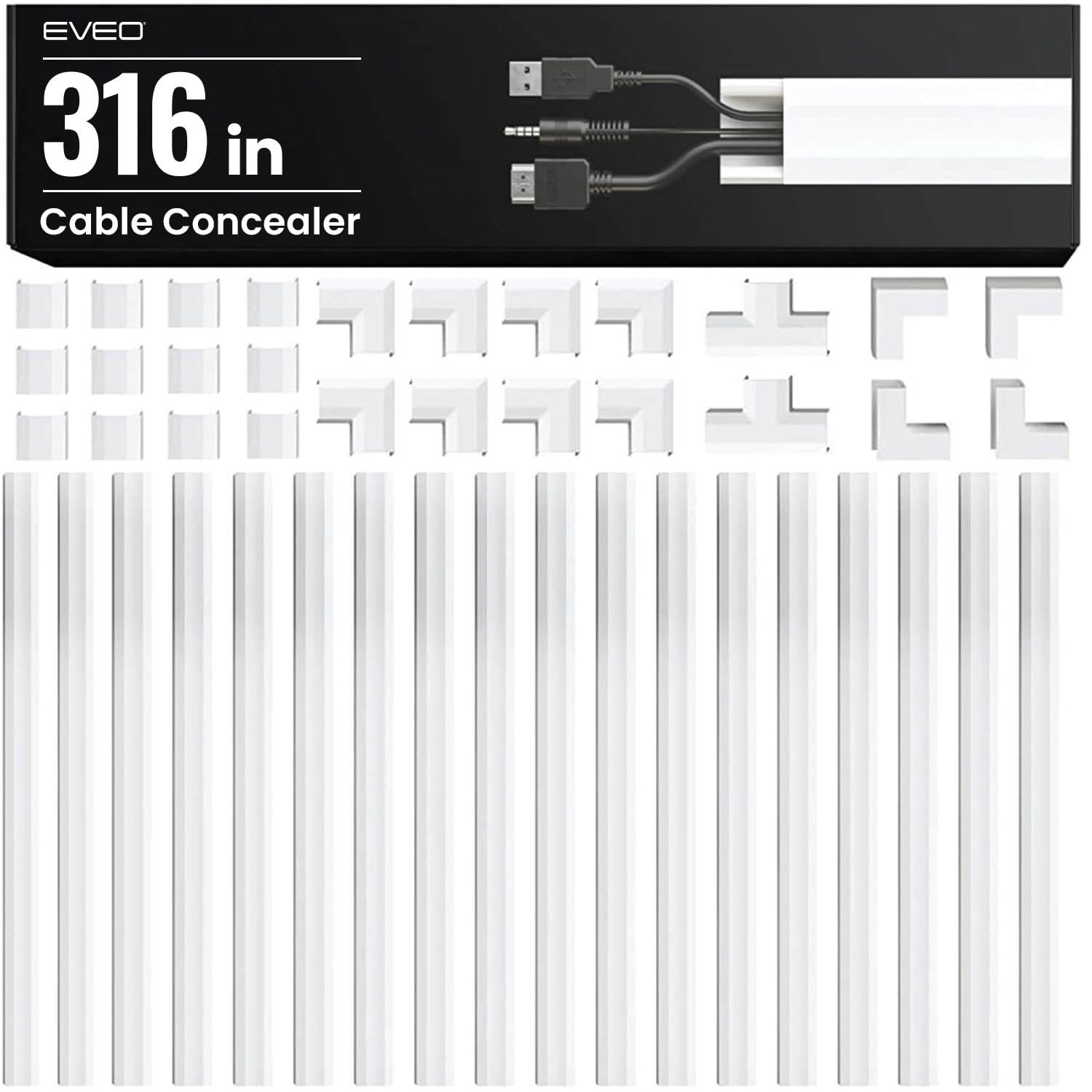
Three hundred six inches is the number that makes this kit worth a look, and the six-year warranty is the reason to keep looking. That is 20 lengths of 16-inch channel, enough to run from a wall-mounted TV to the floor and then along a baseboard without ordering a second box. It is the longest covered wall run we would choose when the job is mostly straight.

We came away thinking the EVEO is the best long-wall kit in this group. A 0.95-inch width is slim enough to sit against white trim, and the paintable surface means it can blend into a colored room. The short sections make corners and trimming less wasteful; line up the joins carefully and they read as part of the design.

The adhesive is the weak point. It holds well on clean, flat paint, and the included screws are the safer choice for a heavy bundle or a wall with texture. The low profile also leaves little room for a thick power cord plus several signal cables; it is happiest with a normal TV bundle. The 16-inch lengths are easier to cut and store than a single long extrusion, which matters if you are working alone.

Bottom line: We recommend this for a long, paintable wall run: 306 inches and a six-year warranty make it the low-drama choice for coverage.

3

Delamu Cord Hider

Delamu Cord Hider

Starter TV setup

Our Score 9.0/10
Check Price

Worth Noting

  • Can lift paint on removal
  • Fits only two to four wires
Channel Size
0.95 W x 0.55 H in
Installation
Self-adhesive or screw-in
Total Length
157 in
Cable Capacity
2-4 wires

For a first raceway project, 157 inches is usually enough, and this is the kit we hand over when the job is one desk or one TV. It gives you 0.95-inch-wide channel and a snap-on cover that is simple to work with. As a starter raceway, it is hard to argue with.

We appreciate the two mounting options: the pre-applied adhesive for a quick, renter-friendly install, or screws when the run carries more weight. The adhesive is the part to respect. On clean, flat paint it stays put; on fresh or glossy walls it can let go, so test a hidden spot first. The white finish also blends into trim, though it is not the widest channel here.

Coverage is the limit: 157 inches does a desk leg or a single TV drop, not a whole wall with corners. We like it best for a first project precisely because a modest run is forgiving; one bad corner does not waste a whole room's worth of channel. If you are hiding several thick cords, step up to a wider kit.

Bottom line: The budget starter kit we point first-time buyers to: enough length for a desk or one TV, simple snap-on covers, and a low-risk way to try a raceway.

4

Yecaye J-Channel Cable Management

Yecaye J-Channel Cable Management

Under-desk cables

Our Score 9.2/10
Check Price

Worth Noting

  • Open side is not for visible walls
  • Capacity drops with stiff cables
Pieces
6
Channel Size
15.7 L x 0.99 W x 1.55 H in
Total Length
94.2 in
Channel Style
J-channel, open side

Cables under a desk change more often than the ones behind a TV, which is why the open-sided shape here makes sense. Instead of a closed tube that you thread cables through, each 15.7-inch channel has an outward-facing opening that lets you press cords in from the side. For under-desk work, that is a small design choice that turns into a large convenience every time you add a monitor or swap a dock.

We reach for this one for the space between a desktop and the floor, where cables change often and nobody is grading the finish. Six channels give you 94.2 inches total, and the open side makes it easy to pull one cord without dismantling the whole run. The tape holds well on clean plastic and sealed wood, and the black finish disappears under a dark desk.

Under a desk, the open side is a feature rather than a finish issue: you can add a cable without unclipping a cover, and the black plastic is less conspicuous than a bundle of loose cords. The six-pack also gives you spare pieces for a second desk or a later move. This is the one we choose when access matters more than a seamless wall look.

Bottom line: For the mess under a sit-stand desk, this J-channel kit is the one we choose: open-sided, easy to load, and simple to reach into when a cable changes.

5

YesBes Cord Hider Kit

YesBes Cord Hider Kit

Multi-room coverage

Our Score 8.8/10
Check Price

Worth Noting

  • Many pieces mean many seams
  • Tight fit for thick power bricks
Pieces
40
Channel Size
15.7 L x 0.96 W x 0.57 H in
Installation
Self-adhesive
Total Length
630 in

Six hundred thirty inches is a lot of raceway; it is aimed at the person with a whole apartment's worth of cords and no interest in ordering twice. The kit splits that into 40 lengths of 15.7 inches, which is more than twice the coverage of our top pick.

The channel is 0.96 inches wide and 0.57 inches high, so it takes a normal TV or computer bundle without becoming a fat stripe on the wall. It is paintable and cuttable, and the pieces go up with pre-applied adhesive. We like that the 40-piece format lets you use a short run in one room and still have enough for another; the leftovers are useful, not clutter.

We make this the pick when one order has to cover several rooms. The caveat is the adhesive: it does well on clean, flat drywall and less well on textured or glossy surfaces, so plan on screws or extra surface prep if the wall is not smooth. The 40 short lengths are also a cutting-friendly format: trim one badly and you lose 15.7 inches, not the whole run.

Bottom line: We recommend this for multi-room cleanups: it is the longest kit here, and the piece count keeps you from running out mid-project.

6

ZhiYo 2-Inch Cable Raceway

ZhiYo 2-Inch Cable Raceway

Heavy cable bundles

Our Score 9.2/10
Check Price

Worth Noting

  • Industrial look on visible walls
  • Bulky for a single cable
Pieces
6
Channel Size
2 W x 2 H in
Installation
Screws or foam strips
Total Length
99 in

This is less a wall molding than a piece of industrial wire duct, and that is the point. Each of the six channels is 2 inches wide and 2 inches high, with slot openings along the bottom for cables to exit. It is built for racks, cabinets, and the thick bundles that make slim raceways bulge.

We recommend it when capacity matters more than disguise. A 2-inch square section swallows several power leads or a network bundle, and the slotted openings let you branch a cable out where it needs to go instead of cutting a new exit. The matte black finish keeps it from looking like shiny conduit, but it still reads as equipment, not trim.

The kit includes screws and foam strips, and we prefer the screws for anything that will hang for years. At 99 inches total, it covers a desk or a small rack rather than a whole room.

We keep this for behind a rack or under a workbench, where the open slots save time and nobody expects furniture. The screws make it feel permanent, and the 99-inch total is enough for a desk or small rack. If the run is on a living-room wall, choose a slim paintable channel instead.

Bottom line: We reach for this heavy-duty square raceway when a server rack or thick under-desk bundle is too much for slim wall channels.

7

Yecaye One-Cord Raceway

Yecaye One-Cord Raceway

Single cable

Our Score 9.0/10
Check Price

Worth Noting

  • Single-cable capacity only
  • Thick cords can be tight
Pieces
8
Channel Size
0.59 W x 0.4 H in
Total Length
113 in
Cable Capacity
One low-voltage cable

One cable is the whole brief here: 0.59 inches wide, 0.4 inches high, and eight pieces that add up to 113 inches. It is not trying to hide a TV's power cable, HDMI, and optical lead at once. It is for the single wire that still shows after everything else is managed.

We like it for a hanging lamp cord, a speaker run, or an alarm wire, where a full-size channel would look like overkill. The snap-on cover sits close to the wall, the pre-applied tape holds on clean paint, and the white finish disappears against trim. The narrow opening is the trade-off: thick power cords can be a squeeze, and the channel is meant for one cable.

That focus is why it stays on our list. A single-cable job does not need 315 inches of kit or a box of T connectors, and the smaller profile is easier to run straight. If you are hiding a bundle, choose a wider channel; if you have one cord, this is the neatest solution here. The eight pieces give you room to route around a door frame or a ceiling hook without unrolling a long coil.

Bottom line: We choose this narrow raceway for a single lamp, speaker, or low-voltage wire; it barely shows and costs little.

8

EVZA Cord Hider 315 in

EVZA Cord Hider 315 in

Simple TV drop

Our Score 8.8/10
Check Price

Worth Noting

  • Thin plastic can crack at joins
Paintable
Yes
Channel Size
1 W x 0.63 H in
Installation
Self-adhesive
Total Length
315 in

White, paintable, and 315 inches long, this kit is aimed at the simple TV drop rather than the whole-room reroute. The channel is 1 inch wide and 0.63 inches high, enough for a typical TV power cord and one or two signal cables, and the white finish blends into trim before you even open a paint can.

The channel is cuttable and paintable, which is the main reason to consider it. We like the idea of painting it before mounting, not after, so the cover and the wall match without brush marks along the edges. The self-adhesive backing makes a quick job of a clean, flat wall.

Where it asks for care is the surface. Smooth, clean drywall gives the tape its best chance, and a heavy bundle is better served by screws; on a textured wall, plan on extra prep or a different mounting method.

Still, the value case is real for a simple TV drop or a single wall run. We look at the EVZA as the kit for the reader who wants enough length to finish the job without paying for a connector library they may not use. Paint it, mount it on a smooth wall, and it does the job.

Bottom line: We see this as a value alternative for a simple TV drop: paintable, 315 inches long, and easy to fit on a clean wall.

How We Chose and Tested Cable Raceways

We started by researching the category—comparing channel widths, lengths, bend pieces, and whether each kit included screws, clips, and extra tape—then narrowed the field by size and price so we were judging realistic options instead of specialty industrial runs. We ordered 14 raceways as regular customers and installed them over three months in a living room, a home office, and along a baseboard run. Every unit went onto clean, painted drywall prepped with rubbing alcohol, following the maker's instructions rather than our own shortcuts.

For each one, we timed the install from unpacking to the last cable pressed into place, then checked whether the channel cut cleanly and the lid snapped shut without fighting. The adhesive itself got a real test: we pressed the tape down for the recommended time and watched for lifting at 24 hours, one week, and again after a month of normal bumping, dusting, and cable adjustments. We also gave each loaded run a gentle sideways nudge to see whether the channel shifted, sagged, or pulled away from the wall.

Appearance was judged from across the room, not just up close—whether the profile sat flush, whether the finish showed fingerprints, and whether a paintable version took paint evenly. Value came down to what was in the box and what we had to supply: extra tape, drywall anchors, or a second hardware-store trip counted against a kit. We noted instructions that skipped a step and orders that arrived missing pieces, since a raceway should be a one-and-done purchase. By the end, the strongest options were the ones that stayed put and disappeared visually, not the ones with the longest spec sheet.

How to Choose Cable Raceway Kits

Start With the Bundle, Not the Length

Channel width and height decide what disappears and what fights back. A narrow 0.59-inch channel, like the Yecaye one-cord, is for a single lamp or speaker wire; a 1-inch channel such as the A+ kit takes a TV power cord plus a couple of signal cables. The 2-inch square ZhiYo is for racks and thick bundles. Count your thickest cords and leave breathing room. If you have more than three ordinary cables, start at 1 inch; if a power brick or stiff HDMI is in the run, go wider or accept that the cover will strain.

Adhesion Is a Surface Test

Tape is convenient, but it is only as good as the wall behind it. Clean, flat, dust-free paint gives these channels their best chance; textured plaster, brick, fresh paint, and glossy trim are where adhesion lets go. Test a hidden patch first, and use the supplied screws for a heavy bundle or a wall you do not trust. On a rental wall, plan the removal before the install: strong tape can take paint with it. A screw hole is easier to fill than a peeled strip of drywall.

Length and Connectors Decide the Finish

A 157-inch kit covers one TV drop or a desk leg; 306 to 315 inches reaches from the TV to the outlet and along a baseboard; 630 inches is for several rooms. Do not stop at the total length. Count inside and outside corners, because every turn needs a connector or a careful miter. The A+ kit includes 29 connectors for that reason, and it is why we favor complete kits for a wall with obstacles. A long run with too few corners ends up with gaps you notice every day.

Paint, Profile, and the Under-Desk Exception

Paintable raceways need a light scuff and two thin coats if you want the finish to last, and it is easier to paint the channel before it goes on the wall. Profile matters too: a 0.4- to 0.6-inch channel hugs the wall and reads as trim, while a 2-inch square duct reads as equipment. Under a desk, the rules change. The Yecaye J-channel's open side lets you add or move cables without removing a cover, which matters more than a seamless finish in a spot nobody sees.

Frequently Asked Questions

Final Verdict

The A+ Electric Full Kit is the one we recommend for most wall projects because the 315-inch coverage and 29 connectors let you finish the corners, not just the straight run. That is the part budget kits skimp on, and it is the part you notice every day.

If your cables live under a desk, choose the Yecaye J-channel instead; if you want a long run with a six-year warranty, EVEO is the alternative. The A+ wins because it covers the turns most kits leave out.