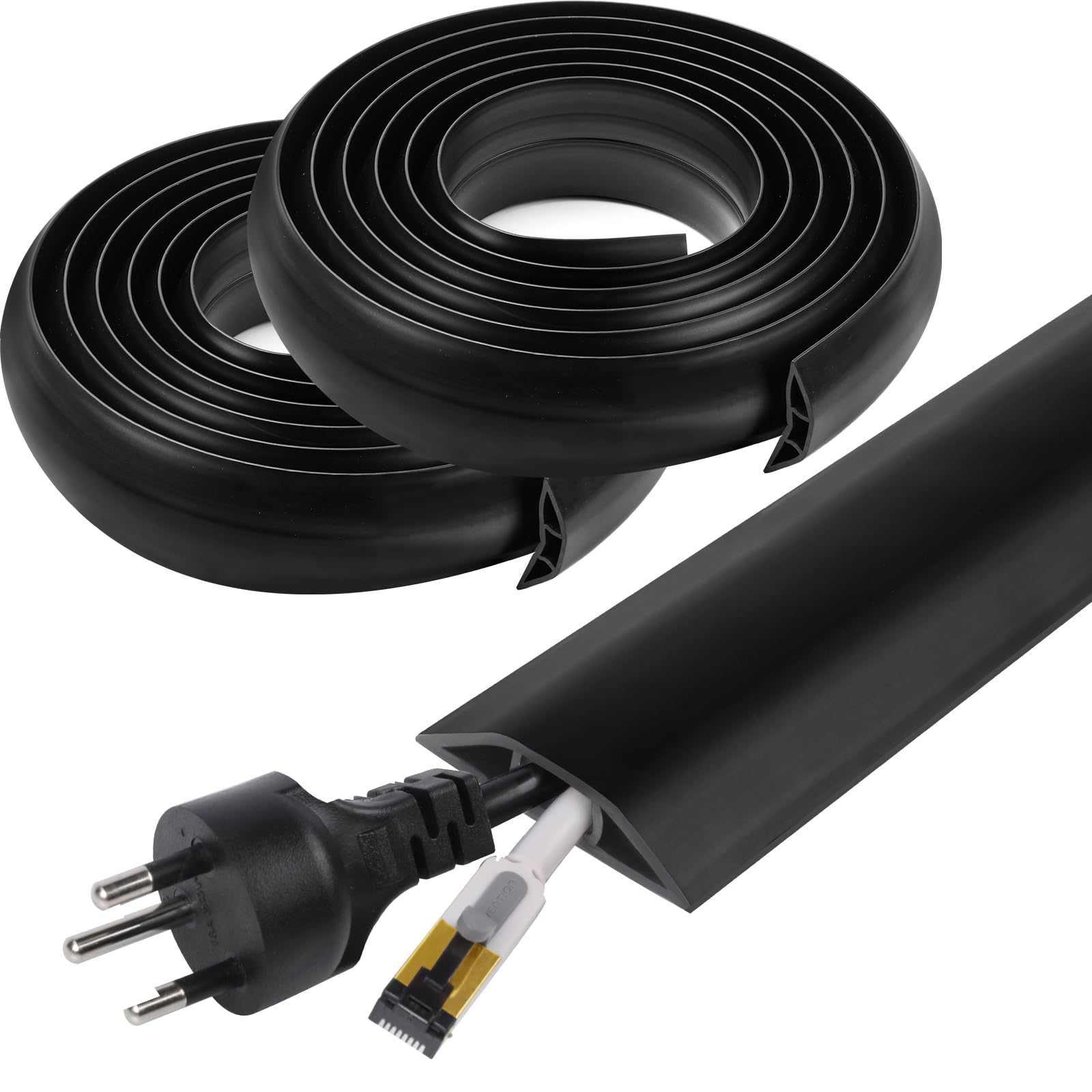
Power & Charging

Best Floor Cord Covers of 2026

A cord stretched from an outlet to a lamp across a doorway looks like a small problem until someone catches a toe on it. The obvious fix — lay down a cover and forget about it — runs into the category's built-in tradeoff: the flattest covers are the easiest to walk over and the most likely to slide out of place, while the grippiest ones sit proud enough to stub a foot on. What you're actually shopping for is a cover that lies flat, stays where you put it, and fades into the room rather than becoming a beige speed bump in the middle of the hall.

I've had a cable running along my own hallway floor for two years, and I've re-taped it more times than I'd like to admit. Over four months, my team and I laid down 16 floor cord covers on hardwood, low-pile carpet, and the thresholds between them, paying attention to how they held, how they looked, and how easy each one was to install. One thing first-time buyers always get wrong: measure the bundle, not the cord. A cover that's too narrow will hump up in the middle no matter how good the adhesive is, and the picks below are the ones that got the balance right.

1

D-Line 15 ft Floor Cord Cover

Top Pick
D-Line 15 ft Floor Cord Cover

Long indoor runs

Our Score 9.2/10
Check Price

Worth Noting

  • Costs more than any other cover here
  • Channel tops out at 0.31 inch cable
Length
15 ft
Dimensions
2.4" (W) x 0.44" (H)
Cable Cavity
0.63" (W) x 0.31" (H)
Installation
Ribbed non-slip base, pre-split rear

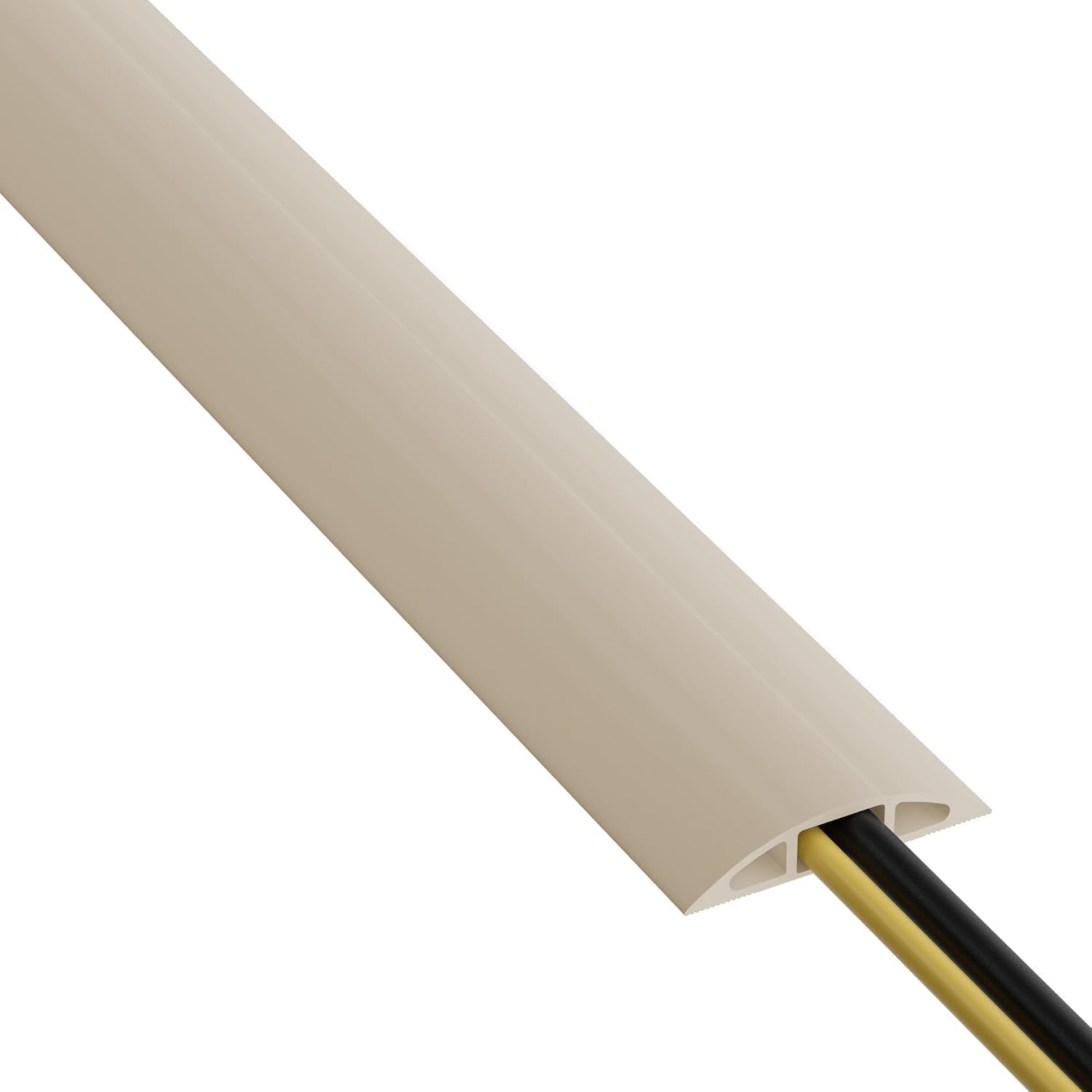
Two details decide the D-Line, and both are about installation rather than looks. The base is ribbed, so it grips carpet and most hard floors without a strip of tape, and the back arrives pre-split — you open it along its length, drop the cable in, and press it shut. No feeding a plug through fifteen feet of tube.

The channel measures 0.63 by 0.31 inches, enough for two cables of up to 0.31 inch diameter, or one thicker cord with room either side. At 2.4 inches wide and 0.44 inch tall it sits low enough that a chair caster or a vacuum passes over without a jolt. It also uncoils flat straight out of the roll; we didn't have to weight it or leave it in the sun. Fifteen feet is a long run, and a utility knife shortens it.

That combination is why it's our pick for most homes. Plenty of covers in this group will hide a cord; the D-Line is the one that stays where you put it and lets you add or pull a cable without lifting the whole strip. We also like that this variant comes in beige — on pale flooring it disappears in a way black never quite does.

Smooth sealed concrete is where it can creep, and a strip of double-sided tape along the worst few feet is the fix. If your run only crosses a doorway, a shorter cover does the same job with less left over.

Bottom line: The cover we recommend for most hallway and doorway runs: a wide channel, a split back that saves threading, and a ribbed base that grips without tape.

2

Eapele 10 ft Floor Cable Cover

Eapele 10 ft Floor Cable Cover

Garages and workshops

Our Score 9.4/10
Check Price

Worth Noting

  • No adhesive backing to anchor it
Length
10 ft
Dimensions
3.03" (W) x 0.75" (H)
Application
Indoor and outdoor use
Warning Stripes
3 yellow stripes

Some runs shouldn't be hidden, and this is the cover we reach for when that's the job. Three bright yellow stripes run the full length, so the Eapele announces itself instead of blending in — which is exactly what you want across a workshop floor, a garage bay, or a path where a cord crosses a walkway after dark.

It's a serious piece of PVC: 10 feet long, 3.03 inches wide and 0.75 inch tall, with enough internal room to take a bundle of data cables rather than a single lead. It uncoils readily, cuts with a knife or heavy scissors, and carries enough weight to sit still on its own without anything holding it down.

The height is the trade-off. At three-quarters of an inch it's the tallest cover here, and that's exactly what a robot vacuum or a caster catches on — the thing to check before you put it across a hallway. Out in the garage, or on a path where nothing rolls over it, the bulk is the point rather than a problem.

Bottom line: We reach for this one when a cord should be seen rather than hidden: yellow stripes and a heavy 10 ft body for garages, workshops and outdoor paths.

3

Amazon Basics 6 ft Floor Cord Cover

Amazon Basics 6 ft Floor Cord Cover

Short cable runs

Our Score 9.2/10
Check Price

Worth Noting

  • Six feet only covers a short run
  • 0.35 inch limit rules out heavy cords
Length
6 ft
Diameter
2.6"
Installation
Self-adhesive
Cable Capacity
2 power cords up to 0.35" dia.

Six feet of black PVC, a split channel you press the cable into, and a roll of double-sided tape in the box. It's the size and shape of the job most people actually have: a lamp, a charger, or a router cable crossing a few feet of floor behind a couch.

What we appreciate is how the tape turns the flatness problem into a non-issue. Rolled covers want to spring back, but a short strip taped at both ends settles quickly, and the 2.6 inch width tucks neatly against a baseboard or under the front edge of a sofa. For a first cover, or a rental where you want it to come up clean later, that's the whole argument.

Bottom line: For a short indoor run and a tight budget, this is the cover we hand people: six feet, tape in the box, and no threading.

4

LZEOY 4 ft Wood-Grain Cord Cover

LZEOY 4 ft Wood-Grain Cord Cover

Hardwood living rooms

Our Score 9.2/10
Check Price

Worth Noting

  • Only 4 ft per length
  • 0.24 inch channel height limits cords
Finish
Walnut wood grain
Length
4 ft
Dimensions
2" (W) x 0.4" (H)
Cable Cavity
0.47" (W) x 0.24" (H)

Wood grain is the entire pitch here, and it's a better one than we expected. The walnut finish has a directional grain rather than a flat brown print, so at two inches wide it reads more like a floor transition strip than a cable cover — and over hardwood the effect is close to invisible from standing height.

Soft PVC is both the reason it works and the reason it needs patience. It's flexible enough to hug a floor and cut cleanly with a knife, and the 0.47 by 0.24 inch channel swallows one thick power strip. But softness plus rolled packing means it can arrive wanting to curl, and the fix is a reverse roll: bend it the other way and let it sit before you lay it down.

Adhesion is where experiences divide, so test before you commit. The double-sided tape it ships with holds hard — sometimes hard enough that lifting it again takes a plastic scraper rather than a fingernail. On a floor you plan to rearrange, press a short offcut down first and see how it lets go.

Where it earns its place is a living room or hallway where the floor is the point and the cable is one run — a lamp, a router, a TV feed. In a garage or workshop the finish is wasted and the softness works against it. Buy it for the room, not for the utility.

Bottom line: We think this is the one to buy when the floor is hardwood and the cable has to disappear into it — walnut grain, soft PVC, four feet at a time.

5

YesBes 20 ft Floor Cord Cover

YesBes 20 ft Floor Cord Cover

Very long runs

Our Score 8.8/10
Check Price

Worth Noting

  • Can slide on smooth floors without tape
  • Slim channel suits thin cables only
Length
20 ft
Dimensions
1.97" (W) x 0.45" (H)
Environment
Indoor
Cable Cavity
0.47" (W) x 0.29" (H)

Twenty feet in a single piece is the whole reason to look at this one. At 1.97 inches wide and 0.45 inch tall, with a 0.47 by 0.29 inch channel, it's a slim cover that will run the length of a hallway, a basement or an event floor without a break in the middle.

We found the length genuinely useful in a way the shorter covers aren't: a join is where these things fail, and one continuous run removes the failure. The PVC cuts with scissors, the black finish disappears against dark flooring, and loading a cord through the split back is straightforward.

What you give up is patience. It arrives coiled tight and takes longer than most here to relax, so unroll it, reverse the curl, and let it sit under something heavy before you commit to the final position. Do that and it lies down properly.

Bottom line: Our pick for a genuinely long run: twenty feet in one piece, so there is no join in the middle to lift and catch a foot.

6

Bates 6 ft Floor Cord Cover

Bates 6 ft Floor Cord Cover

Budget hard floors

Our Score 9.2/10
Check Price

Worth Noting

  • No tape included for slick floors
Length
6 ft
Dimensions
63mm (W) x 12mm (H)
Cable Cavity
0.6" (W) x 0.31" (H)
Installation
Ribbed non-slip base, pre-split rear

The widest channel in a short cover: 0.6 by 0.31 inches inside a strip a touch under two and a half inches across. That's room for two normal electrical cords side by side, or four thinner cables if you slice the side ribs, and it undercuts every other cover here on price.

It's built like the D-Line at a smaller scale, with a ribbed non-slip base and a pre-split rear, so there's no tape to mess with. We kept coming back to it for tight spots because the low, wide shape sits flatter than a round cover and doesn't rock underfoot. The ends can hold a set from the roll for a while; a weight or a piece of tape sorts that out. When budget is the deciding factor, this is the one we point to.

Bottom line: Wide channel, low profile, small price — the short-run cover we keep recommending when the budget is the deciding factor.

7

vilmon 6 ft 5-Channel Cord Cover

vilmon 6 ft 5-Channel Cord Cover

Multiple thin cables

Our Score 9.2/10
Check Price

Worth Noting

  • Thick cords can work loose from the seam
Length
6 ft
Channels
5 (one large, four small)
Dimensions
2.62" (W)
Middle Channel
0.53" (W) x 0.38" (H)

Five channels is the unusual part. One large hole in the middle measures 0.53 by 0.38 inches, and four smaller ones run alongside it, so a speaker cable, an ethernet run and a lamp cord can each take their own lane instead of being bundled into one slot.

It's rated for indoor and outdoor use, comes in black with a yellow line along the front, and measures 2.62 inches across a 6 ft length. The PVC cuts with a knife, though it needs a stretch unrolled and flattened before it behaves — unroll it, reverse the curl, and let it sit a while.

We wondered whether the extra channels would earn their keep, and for a desk or a home studio with several thin cables running to one spot, they do. For a single thick extension cord they don't: only the centre channel is wide enough, and that cord can work its way out of the split seam while you're pressing the cover closed. Count your cables before choosing this over a single-slot cover.

Bottom line: We keep it in the list for one job: several thin cables converging in one spot, where the five-channel layout separates what a single slot would bundle.

8

WILLBOND Carpet Cord Cover

WILLBOND Carpet Cord Cover

Office carpet

Our Score 8.2/10
Check Price

Worth Noting

  • Carpet only
Width
3.94"
Length
19.69 ft
Floor Type
Short-pile carpet
Installation
Hook and loop

This one is carpet only, and the design says so: a 3.94 inch wide hook-and-loop strip, 19.69 feet to a roll, that presses onto short-pile carpet and grips it. It doesn't enclose a cable; it bridges over one, holding it flat against the pile.

Where it works, it works well. On dense commercial loop carpet the hooks bite, the strip stays put through foot traffic, and you can peel it up, move it and press it down again without residue — the reason offices and classrooms buy it by the roll. Scissors shorten it to any length you need.

The rest of the carpet in your house is where it comes apart. Plush pile and loose loops give the hooks nothing to grab, and the strip lifts at the edges once it's walked on. Press a thumb into your carpet: if it sinks, this strip will struggle the same way. That's the test worth running before you order.

So we treat it as a workplace product that happens to be sold to homes. In a tight-loop office or a classroom it's the most forgiving cover here, and the only one you can move every few weeks without buying tape. In a living room, a PVC cover with a floor-matching finish will serve you better.

Bottom line: A workplace answer, not a living-room one: we recommend it for tight-loop office carpet and a run you need to move, and not for a plush rug.

How We Tested the Best Floor Cord Covers

We started with a list of roughly 40 covers sold at hardware stores and major retailers, then narrowed it by channel width and interior height, available lengths, material, and whether the manufacturer rated it for carpet, hard flooring, or both. Corded fabric, rubber, and rigid PVC all behave differently, so we kept a mix. That left 16 covers, ordered in the lengths that matched the runs we planned to cover.

Each cover went into a real spot: a lamp cord crossing a doorway, a desk setup running along a baseboard, and a threshold between two rooms. We timed how long installation took working alone, and noted whether we needed scissors, a utility knife, or anything beyond our hands. Then we used the doorways normally — in socks, in bare feet, carrying laundry baskets — and vacuumed over each cover twice a week to see whether the brush bar caught an edge or pulled anything loose.

Adhesion got the hardest look. On clean hardwood we pressed each adhesive-backed model down and then pulled the cord sideways through the channel to see whether the base crept. Velcro and hook-and-loop versions got the same treatment, plus a check of whether the fastener grabbed lint over time. On carpet, we watched for curled edges and rocking, and lifted each cover after a month to see what had happened underneath. Flatness we checked with a ruler and with our feet, since a quarter inch over a doorway is the difference between a smooth step and a stumble. Finally, appearance: after a month of traffic, we looked at scuffs, discoloration, and whether anything had slid out of line, and weighed that against what each cover cost.

How to Choose Floor Cord Covers

Measure the channel, not the cover

Listings lead with length and color, but the inner channel decides whether the thing works. A 0.47 inch slot will not take two 0.3 inch cords side by side; the 0.63 inch channel on the D-Line takes two of 0.31 inch diameter. Measure the fattest cable you plan to run, then add room for the second one. The outside width only tells you how much floor the cover occupies, which is a different question.

Height inside the channel matters as much as width. A shallow 0.24 inch channel swallows a flat power strip and nothing rounder, while a 0.38 inch depth takes a proper extension cord. If you are bundling cables, give each one its own space — the five-channel vilmon exists for exactly that.

Match the base to the floor you actually have

Ribbed bases rely on friction rather than glue, and they hold well on carpet and textured hard floors. On sealed concrete and some finished hardwoods they creep, and a strip of double-sided tape along the worst few feet is the answer. Adhesive-backed covers stay put on smooth floors but carry a residue risk on a finish you care about, so test a corner first.

There is a third option: hook-and-loop strips, which only work on tight loop carpet and lift on anything plush. Press a thumb into your carpet — if it sinks, skip that style.

Height decides what rolls over it

Most covers here sit between 0.4 and 0.45 inch tall, low enough that chair casters, strollers and most robot vacuums cross without a jolt. A heavy-duty cover at 0.75 inch will catch them, which is fine on a garage slab and irritating across a hallway. If a doorway threshold is part of the run, add the cover's height to the gap under the door before you commit to that route.

Decide whether the cover should hide or warn

A cover that matches the floor is trim; one with yellow stripes is signage. In a living room, choose finish and accept that matching is harder than hiding — beige on pale flooring, walnut grain on hardwood, plain black on dark floors. In a workshop, garage or outdoor path, choose the stripes, because the point is that people see the cable before their foot does.

Frequently Asked Questions

Final Verdict

We recommend the D-Line for most homes. The 0.63 inch channel takes two cables, the split back saves you threading a long run, and the ribbed base holds on carpet and most hard floors without tape.

If the cable crosses a garage, a workshop or a path outdoors, buy the Eapele instead — the yellow stripes and taller body are built for a floor where being seen is the point. On office carpet, the hook-and-loop WILLBOND is the only cover here designed for it.