Power & Charging

Best Surge Protectors of 2026

A surge protector is the most boring thing in the room, and it's quietly doing two jobs. The loud one is sacrificial: a component inside absorbs a spike and destroys itself so your laptop, your TV, and the drive holding every photo you've ever taken don't. The quiet one is space — turning one wall outlet into room for a lamp, a monitor, a charger, and the vacuum when it's finally time.

I started paying attention the afternoon a flimsy strip behind my desk died with a pop during a storm and took nothing with it. Since then my team and I have kept 14 surge protectors plugged in for six months — behind desks, under kitchen counters, on garage workbenches, in the corner where the only outlet hides behind the bed. Here's what nobody tells you first: more outlets isn't the same as more usable outlets, and a fat joule rating means little if a chunky adapter pulls the whole thing off the wall. The picks below earned their place.

1

Anker 351 Power Strip

Top Pick
Anker 351 Power Strip

Busy home desks

Our Score 9.6/10
Check Price

Worth Noting

  • 13 A rating rules out heaters and ACs
  • Three USB ports share one output budget
Outlets
12 AC
USB Ports
1 USB-C, 2 USB-A
Cord Length
5 ft
Surge Rating
2100 joules

Anker hangs a $200,000 connected-equipment warranty on this strip, and that is the detail that settles it for us. Joules are a proxy for protection; a warranty is a promise about what happens the day the protection runs out. Nothing else in this roundup carries that kind of backing, and if the point of the purchase is the monitor, the laptop and the drive plugged into it, the promise is worth more than another thousand joules printed on a box.

The layout earns it. Twelve outlets on a 13-inch body, with extra room around the wide ones, so a pair of chunky laptop bricks doesn't take the sockets either side with it. The 5-foot cord is sized for a desk four or five feet wide rather than a floor run, and the three USB ports cover the small stuff. The C port is the useful one: Anker rates it at half a phone battery in about 26 minutes, which is fast-charger territory rather than the token 5 W ports that turn up on strips like this.

One limit to know: the strip is rated 13 A where most here carry 15 A. Fine for a monitor, a laptop, a lamp and a couple of chargers; not the strip for a space heater or a window air conditioner. And if it goes up on a wall, plan on your own screws — the pair in the box is the first thing to replace.

Bottom line: Our pick for a desk of expensive gear: 12 well-spaced outlets, a 20 W USB-C port that actually fast-charges a phone, and a $200,000 connected-equipment warranty behind it all.
2

Belkin 12-Outlet Surge Protector

Belkin 12-Outlet Surge Protector

Home theater racks

Our Score 9.4/10
Check Price

Worth Noting

  • No USB ports at all
  • Two pounds hanging off a wall mount
Outlets
12 AC
Plug Style
Flat plug
Cord Length
8 ft
Surge Rating
3940 joules

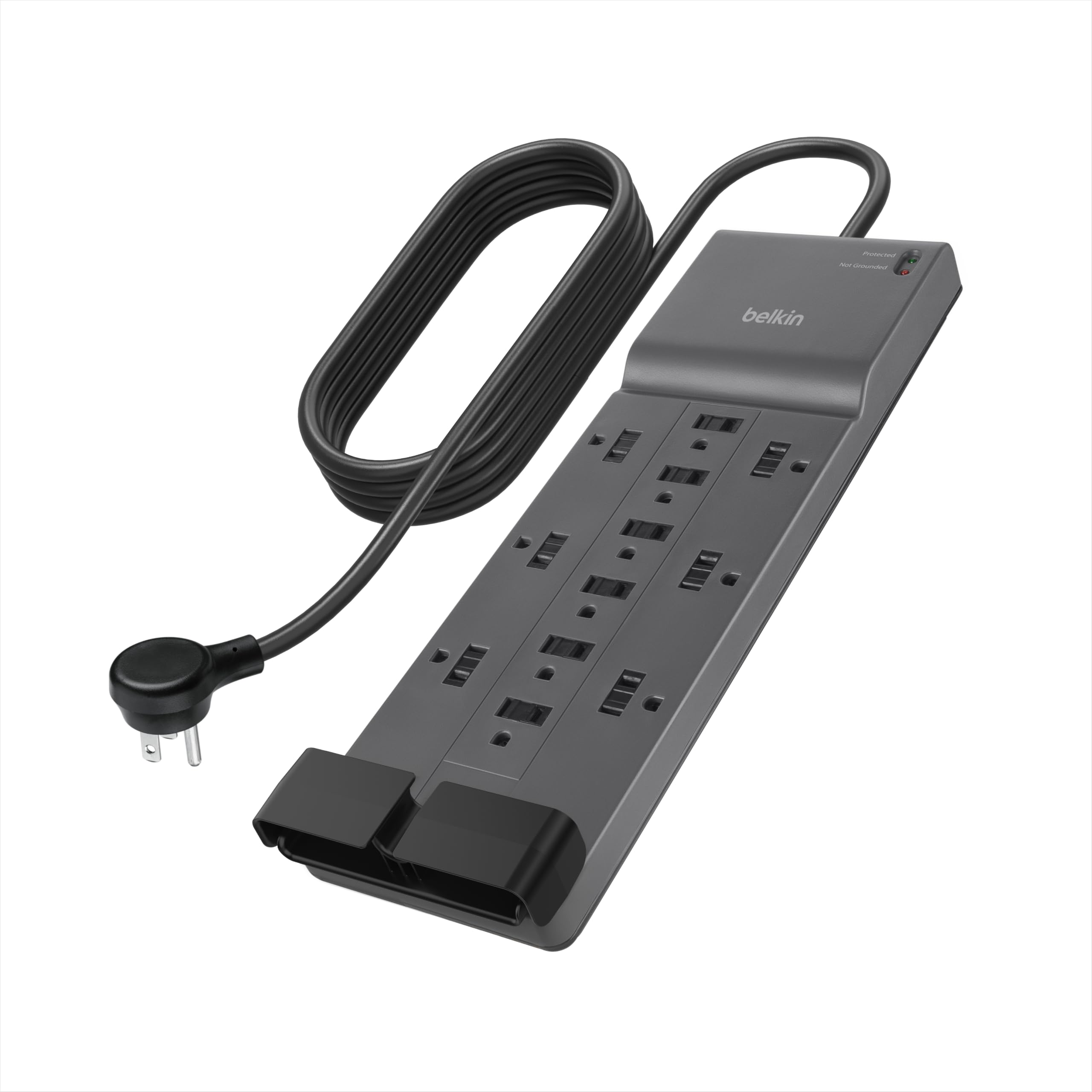
3,940 joules is the biggest surge rating in this roundup, and Belkin isn't padding a number for the box — that headroom is what a rack of equipment actually asks for.

It's why we point people here for a TV wall. A receiver, a console, a streaming box and a router are exactly the loads you don't want sharing a strip picked on outlet count alone, and the spacing is the best in this set: wide enough that a 12-outlet strip doesn't quietly become an eight-outlet one once the power bricks arrive.

There's no USB here at all, and that's a deliberate trade rather than an oversight. This is the strip for gear that brings its own supply — the TV, the amp, the sub. If your desk is phones and earbuds, you're paying for joules you'll never use.

The cord runs 8 feet, the longest here, which is what it takes to get from a floor outlet to the back of a console without an extension in between. The 13-inch body is slim enough to slide underneath and forget about.

Bottom line: For a media rack, this is the one: the highest surge rating here, generous spacing for power bricks, and 8 feet of cord to reach the wall.

3

ALESTOR 12-Outlet Power Strip

ALESTOR 12-Outlet Power Strip

High port counts

Our Score 9.6/10
Check Price

Worth Noting

  • Long-term durability is the open question
Outlets
12 AC
USB Ports
1 USB-C, 3 USB-A
Cord Length
6 ft
Surge Rating
2700 joules

Twelve AC outlets plus four USB ports is 16 places to plug something in, the highest port count in this roundup, and ALESTOR gets there for less than the premium picks.

The layout earns more credit than the price would suggest. Two outlets are cut wide enough for a 2-inch adapter, the other ten hold everything else, and the 11-inch body sits flat along the back of a desk instead of fighting for depth. Electrically it's a 15 A strip with 2,700 joules, so a tower, two monitors, speakers and a dock all fit inside the rating with room left over.

We recommend it as the volume pick — the one for the desk with the most plugs and the least budget. The two-year warranty is the longest in this group, and it covers the part you can't inspect. One habit worth having with any strip: glance at the Protected indicator now and then, because when it goes dark the strip is spent even though every outlet still works.

Bottom line: Buy it when you have more plugs than budget: 16 ports and 2,700 joules cover a full desk, and the two-year warranty is the longest here.

4

HANYCONY 8-Outlet Power Strip

HANYCONY 8-Outlet Power Strip

Small, tight desks

Our Score 9.6/10
Check Price

Worth Noting

  • USB-C ports top out at 15 W
Outlets
8 AC
USB Ports
2 USB-C, 2 USB-A
Cord Length
5 ft braided
Surge Rating
1080 joules

The flat plug is why this one is here. A right-angle plug sits against the wall instead of standing out from it, which is the difference between a desk that goes flush and one that hovers two inches off the baseboard. The body is 8 inches across with outlets on three sides, so it tucks behind a monitor arm rather than competing with it. In a small room, that is the entire argument.

It isn't only small. Eight AC outlets and four USB ports, two of them USB-C, make it a charging station for a laptop, a monitor, a lamp and a phone at once, and the braided 5-foot cord is the nicest in this group to handle.

The compromise is 1,080 joules, the lowest surge rating among the corded picks here. For a phone, a laptop and a monitor on a desk that's plenty; it isn't the strip for a media wall or a tower with a big power supply. We think of it as a desk strip that happens to protect rather than a protector that happens to sit on a desk, and it's the one we reach for when the outlet is in an awkward corner.

Bottom line: The tight-space answer: a flat plug, an 8-inch body that hides behind furniture, and two USB-C ports no other compact pick here offers.

5

QINLIANF Outlet Extender

QINLIANF Outlet Extender

Few-outlet rooms

Our Score 9.4/10
Check Price

Worth Noting

  • Covers both sockets on the wall plate
Format
Wall-mounted, no cord
Outlets
5 AC
USB Ports
1 USB-C, 3 USB-A
Surge Rating
1680 joules

There's a screw in the middle of this extender, and it's the most important thing about it. It threads into the outlet's own faceplate screw, so the unit is attached to the wall instead of hanging off two prongs by friction — the difference between a wall tap that holds five plugs and one that droops.

We recommend it for the room with two outlets and no floor space: an older apartment, a bedside, a counter end where a corded strip has nothing to sit on. Five AC outlets, spaced 2.1 inches so two bricks don't fight each other, four USB ports and 1,680 joules of protection in an octagon about five and a half inches wide.

USB charging is the soft spot. The USB-C port is a 15 W output — fine for an overnight top-up, slow when you're actually using the phone. If this is going to be your main charging spot, a strip with a 20 W port is the better buy.

Bottom line: The best wall tap in this group: it screws onto the outlet plate, turns one duplex into nine ports, and adds no cord to trip over.

6

Amazon Basics 790J Power Strip

Amazon Basics 790J Power Strip

Lamps and routers

Our Score 9.6/10
Check Price

Worth Noting

  • Standard spacing crowds two adapters
Outlets
6 AC
Max Load
15 A
Cord Length
6 ft
Surge Rating
790 joules

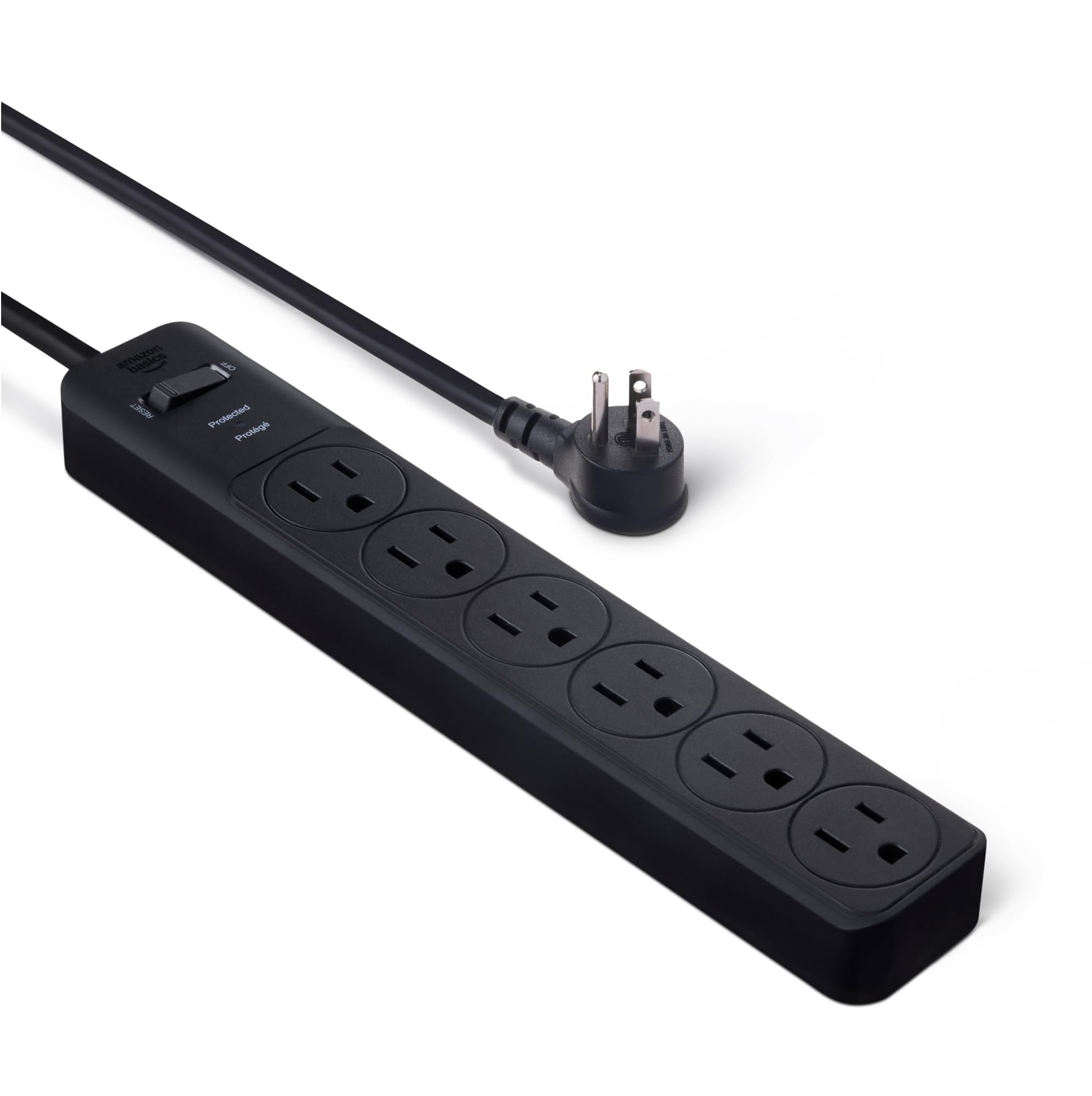
No USB ports. No angled layout. No three-sided anything. The Amazon Basics strip is six outlets in a black rectangle with a switch on the end and a six-foot cord, and for a lot of rooms that is the entire job.

The rest is quietly sensible: 790 joules, a 15 A breaker, safety shutters in every outlet and keyhole slots on the back so it can live on a wall or under a desk edge. Nothing about it asks for attention, which is much of the point of a strip that ends up behind a couch.

It's the least expensive strip in this roundup, and we're comfortable calling it the value pick for low-stakes loads — lamps, chargers, a printer, a router shelf. For a gaming PC or a TV with a console attached, 790 joules is thinner than we want, and the money the Belkin asks buys real headroom instead. The indicator light on the end is the only thing you'll ever interact with, and it tells you the protection is live.

Bottom line: The plainest strip here, and enough for lamps, chargers and a router shelf: six outlets, 790 joules, and a 6-foot cord with nothing to configure.

7

Mifaso 2-Pack Power Strip

Mifaso 2-Pack Power Strip

Two-room setups

Our Score 9.6/10
Check Price

Worth Noting

  • 900 joules is thin for a media wall
Pack
2 strips
Outlets
6 AC per strip
Max Load
15 A
Surge Rating
900 joules

Two strips in one box is the pitch, and it suits one particular errand: one for the desk, one for the bedroom, one order. If you only need one, you're buying a spare.

Each strip gives you six outlets and 900 joules, a 15 A breaker with a lighted switch, a right-angle flat plug that lets furniture sit close to the wall, and a braided cord that feels sturdier than the rest of the package. USB charging is there for phones and earbuds.

Mounting is where the design stumbles. The keyhole tabs are shallow, so a normal screw head won't clear them and the strip ends up hanging loose; pan-head screws or a washer fix it. On a desk it never comes up.

We think of these as the strips for low-draw rooms — a guest room, a bedside, a desk with a lamp and a laptop. Two of them solve the every-room-needs-one problem without a second shopping trip, and that's the honest case for the pair.

Bottom line: Two 6-outlet strips in one box — the sensible buy when two rooms need outlets at once rather than one desk needing everything.

8

Amazon Basics 200J 2-Pack

Amazon Basics 200J 2-Pack

Wall outlets only

Our Score 9.4/10
Check Price

Worth Noting

  • 200 joules is minimal protection
Pack
2 strips
Outlets
6 AC
Cord Length
2 ft
Surge Rating
200 joules

Two hundred joules, two feet of cord, six outlets and a switch. On paper this is the least strip in the roundup, and the spec sheet reads like a step down from everything above it.

In the right spot, none of that matters. Two feet is exactly enough to get from a wall outlet to the top of a bookshelf, the back of a nightstand or a workbench where a longer cord is just a coil to hide. The outlets have safety shutters, the breaker is 15 A, and a red light tells you the protection is live.

The pair is the other half of the argument: two of these cover the two places in a house where three extra sockets were all you ever needed, and one can sit in a drawer as a spare.

We recommend it for lamps, chargers, a router and a printer — loads that don't care about joules or reach. Two feet is a wall-outlet length, not a room-crossing one, so measure the gap before you commit a socket to it.

Bottom line: Two short strips for wall outlets that need a few more plugs and nothing more ambitious than a lamp, a charger or a router.

What Six Months With 14 Surge Protectors Taught Us

We started with a list of about 40 strips and cut it down from spec sheets: joule ratings, clamping voltage, cord gauge and length, outlet spacing, whether the USB ports share one power budget, and price per usable outlet. Anything with a cord under three feet got dropped, as did plugs that covered the second wall outlet. Then we bought 14 at retail so no one could send us a pre-screened unit.

Testing happened where strips actually live. Each one went behind a desk with a monitor, a laptop brick, and two phone chargers; under a kitchen counter running a coffee grinder and a stand mixer; on a garage workbench; and beside a bed where the outlet is out of reach. They stayed plugged in for six months straight, including through two storms and one brownout, and after each we checked whether the protection light still read as protected.

Along the way we noted whether a strip slid off the desk when we yanked a cord, whether the keyhole mount held on drywall with six cords pulling down on it, how long a phone took to reach 50 percent on the USB ports versus a wall brick, and whether two blocky adapters could sit side by side without a fight. We counted what actually fit, too — a 12-outlet strip that only accepts eight plugs is an eight-outlet strip with extra plastic. Price came last, divided by the outlets we could really use.

How to Choose Surge Protectors

Joules and amps: what the ratings buy you

Joules measure how much energy a strip can absorb in a surge. A 900-joule strip is reasonable for a lamp, a charger and a laptop; a desk with a tower, two monitors and a dock is better served by 2,000 joules and up, and a media wall by the highest rating you can justify — the Belkin here is rated 3,940. More is better, but only to the size of what you're plugging in.

The second number is amperage. Fifteen amps is the standard for a household strip, and 13 A or 10 A means the strip, not the breaker, becomes the ceiling on what you can run. Add up your loads before you decide the rating is enough, and treat the strip as a desk or media accessory rather than a feed for a heater.

Outlet spacing beats outlet count

Sixteen ports look like more strip than twelve until three power bricks block six sockets. Look for extra room between outlets — two inches is generous — or a three-sided body that puts adapters on different faces. The ALESTOR reserves two wide sockets for exactly this; the HANYCONY spreads all eight around three sides.

And remember that the outlet count is not the capacity. Everything plugged into the strip still shares one circuit of roughly 1,875 watts at 15 A, so the honest limit is the breaker, not the sockets. If you routinely add a heater, a kettle or a shop vac, no outlet count fixes that.

Cord length and plug style decide whether it fits

Measure the run, not the room. A 2-foot cord is a wall strip for lamps and nightstands, 6 feet reaches from a floor outlet up to a desk, and 8 feet is what gets behind a media console without an extension in between. Buying longer than you need just gives you a coil to hide.

Plug style matters as much. A flat or right-angle plug is the difference between furniture sitting flush and standing two inches off the wall — the HANYCONY's flat plug is the reason it earns a place here. If you have no floor space at all, skip the cord entirely and take a wall tap that screws onto the outlet plate.

What USB ports can and can't do

USB is convenience, not the reason to buy. On most strips the ports share a single output, so charging three devices at once slows all three, and a port shaped like USB-C tells you nothing about speed. Twenty watts will move a phone battery quickly; 5 V/3 A, which is 15 W, is an overnight top-up.

Neither replaces a laptop charger. If USB is the deciding feature for you, check the wattage of the C port rather than the count, and accept that the AC outlets are still doing the real work.

Warranty is the part of the price you can't see

Two strips can look identical and carry very different promises. A product warranty replaces the strip; a connected-equipment warranty pays toward what the strip was protecting, and Anker's covers gear up to $200,000 — the only policy-backed promise in this group. ALESTOR's two-year product warranty is the longest here.

None of that makes a simpler strip a bad buy. It does explain why a premium strip can be the cheaper insurance when the thing on the other end of the cord costs more than the strip ever will.

Frequently Asked Questions

Final Verdict

Start with the Anker 351. It doesn't have the highest joule rating here, but the combination is the most protection per dollar for a desk that matters: 12 outlets with room for the bricks, a 20 W USB-C port that behaves like a real charger, and a $200,000 connected-equipment warranty standing behind it.

If the gear lives in a media console, buy the Belkin for its headroom and its 8 feet of cord. If the outlet is buried behind furniture in a small room, the HANYCONY's flat plug is the fix that no joule rating can substitute for.