Tools & DIY

Best Electric Screwdrivers of 2026

A dozen flat-pack dressers ago, I would have told you a screwdriver was a screwdriver. Then I hand-drove 40 cam locks in one afternoon, felt my wrist ache, and never went back. What separates a good electric screwdriver from a frustrating one isn't the biggest number on the box — it's whether the clutch slips before it strips particleboard, whether the bit stays put when you tip the tool sideways, and whether the battery holds a charge three weeks later. Get those right and the most tedious, wrist-grinding part of any project quietly disappears.

We've spent the past six months with 12 of these, building furniture, swapping hinges, and working in one very dim closet. A spec sheet won't tell you that the small gyroscopic drivers aren't toys — they're gentler on cabinet hardware and far easier to hold overhead, while the chunkier ones earn their keep on long deck screws. The picks below are the ones that balance power, battery life, and one-handed convenience.

1

SKIL 4V Cordless Screwdriver SD561801

Top Pick
SKIL 4V Cordless Screwdriver SD561801

Everyday household screws

Our Score 9.2/10
Check Price

Worth Noting

  • Bits sit loosely in the holder
  • Micro-USB charging rather than USB-C
Speed
220 rpm
Torque
36 in-lb
Warranty
5 years
Bits Included
9 bits plus magnetic holder

Thirty-six inch-pounds, about 4 N·m, is the number that earns this SKIL the top spot. That is enough twist to seat a two-inch screw in a pre-drilled shelf and to work through a whole flat-pack dresser without a break, and it comes from a body just over six inches long. At 220 rpm the trigger is quick enough for a run of cabinet hinges and slow enough that you can feather it and stop exactly where you meant to.

What we appreciated most is how little gets in the way. The two-finger trigger falls where your index finger already sits, the three-inch magnetic bit holder keeps a screw pointing straight while you line it up one-handed, and the five-year warranty is the longest in this group. Set against the rest of these picks, it is the least fussy route to driving a lot of screws.

It is not a kit, though: nine bits and a holder arrive in a blister pack, so if you are starting from nothing, plan on a bit set and something to keep it in. And 36 in-lb is a ceiling. This drives screws, not holes, and a long deck screw or hardwood will stall it. Those are the edges of what it is for; inside them, it is the driver we reach for first.

Bottom line: The one we tell most people to buy: enough torque for furniture and cabinets, a magnetic holder that frees a hand, and the longest warranty here.
2

Fanttik S1 Pro Electric Screwdriver

Fanttik S1 Pro Electric Screwdriver

Furniture and cabinets

Our Score 9.4/10
Check Price

Worth Noting

  • Dim LED for dark corners
Speed
220 rpm
Battery
2000 mAh
Bits Included
16 S2 bits
Torque Settings
1.5, 3 and 4.2 N·m

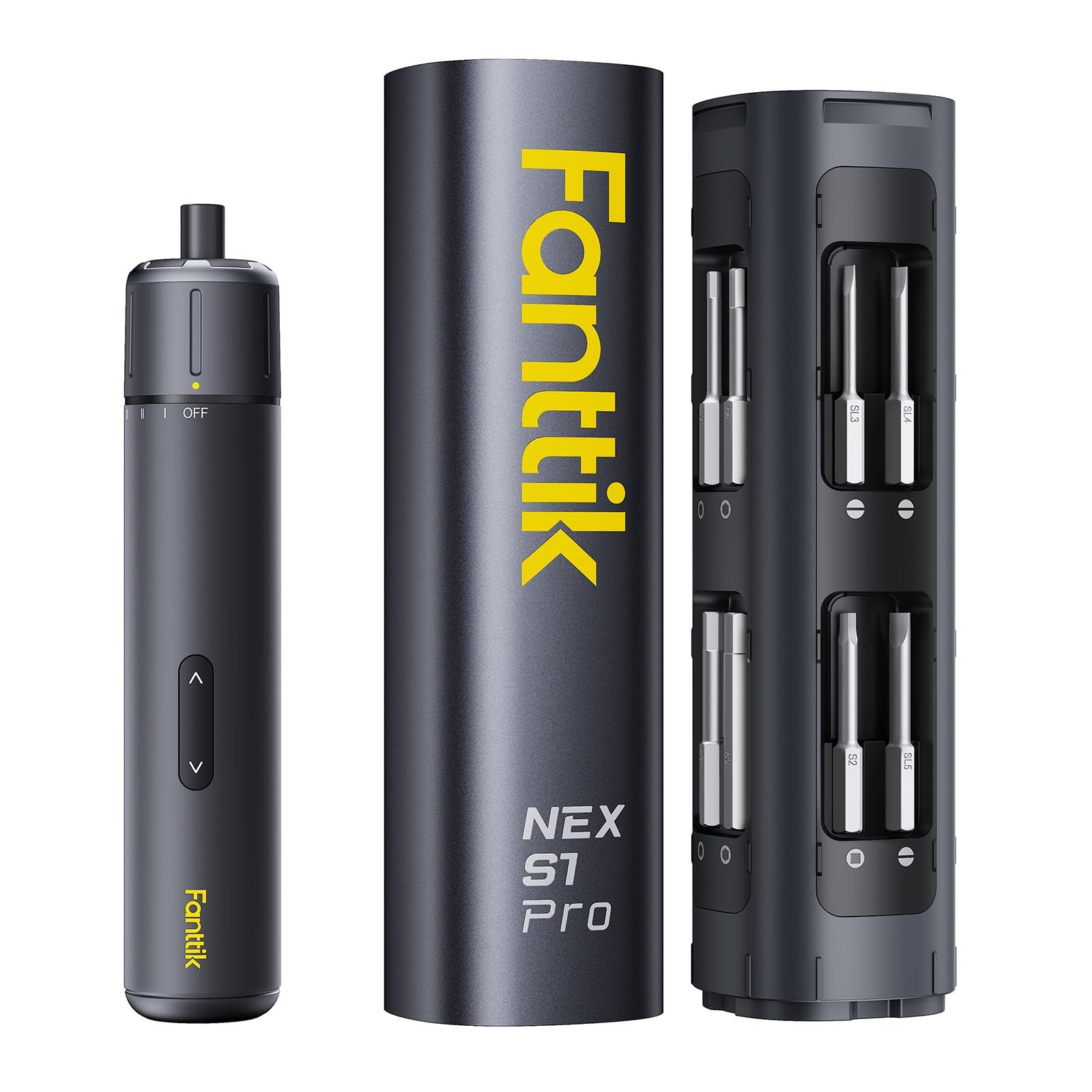
A magnetic aluminium case that clicks the driver and sixteen bits into their own slots is the kind of detail we appreciated more than we expected to. Loose bits in a drawer are how a good powered screwdriver quietly turns back into a manual one, and this one arrives with the answer built in. The bits are S2 steel, and the pop-up lid makes the whole thing feel like a tool you keep rather than a kit you raid.

The real argument for the S1 Pro is the dial. Three settings at 1.5, 3 and 4.2 N·m step the motor down so cabinet hinges and MDF get snug without being crushed, then step back up for assembly bolts. Hard torque tops out at 6 N·m and the body is rated to take 8 N·m by hand, which is how you crack a tight screw. Against the single-speed SKIL, the difference is control rather than muscle.

The battery is a 2000 mAh pack, rated for roughly 340 3.5-by-20 mm screws per charge, and it charges over USB-C. At 845 g it is the heaviest stick driver here; driving down into a cabinet we barely noticed, but working overhead it gets old. The LED is dim enough to be decoration rather than a feature.

Bottom line: Buy it if you assemble furniture often and want to stop over-driving small screws; the torque dial and magnetic case are what the extra money buys.

3

SKIL 4V Pistol Grip SD5618-03

SKIL 4V Pistol Grip SD5618-03

Flat-pack assembly

Our Score 9.4/10
Check Price

Worth Noting

  • Bulkier than a stick driver to store
  • Micro-USB charging, not USB-C
Kit
42-piece bit set and case
Speed
220 rpm
Torque
36 in-lb
Warranty
5 years

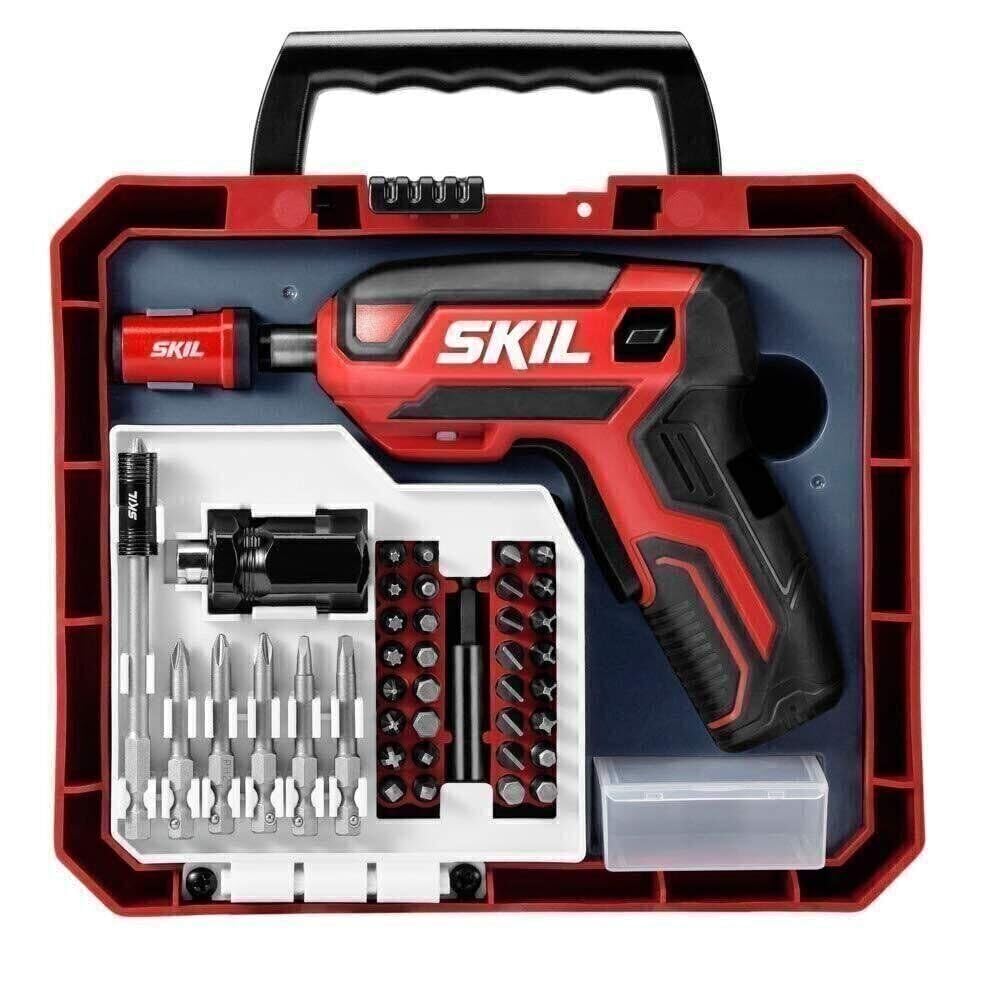
Cam screws are the annoying part of flat-pack: a fitting that has to sit square in a barrel nut buried inside a panel with no room for your fingers. This SKIL ships a cam-screw sleeve that holds one aligned, plus slim bits whose collar is rated at four times the magnetic force of a standard holder, so the screw stays on the tip while your other hand holds the panel. If you have ever taped a screw to a driver, that is the problem it solves.

The rest of the kit follows through: 42 pieces including a mini screwdriver handle, a magnetic bit holder and a carrying case, with the same 220 rpm and 36 in-lb as our top pick. The pistol grip puts your wrist at the angle a drill puts it, which is the shape that lets you lean into a screw through an hour of assembly rather than fighting it.

Of everything here, this is the one we point at anyone with a bookcase still in its box. It costs more than the stick driver it shares a motor with, and the accessories and the case are what that money buys; for someone assembling furniture more than once a year, they are the right things to spend it on.

Bottom line: The flat-pack specialist: a cam-screw sleeve, slim magnetic bits and a case that keeps 42 pieces together, at the same torque as our top pick.

4

WORX WX242L Cordless Screwdriver

WORX WX242L Cordless Screwdriver

PC builds

Our Score 9.0/10
Check Price

Worth Noting

  • Charge failures after a few months
Kit
30-piece accessory kit
Speed
320 rpm
Torque
44 in-lb
Torque Settings
7 settings

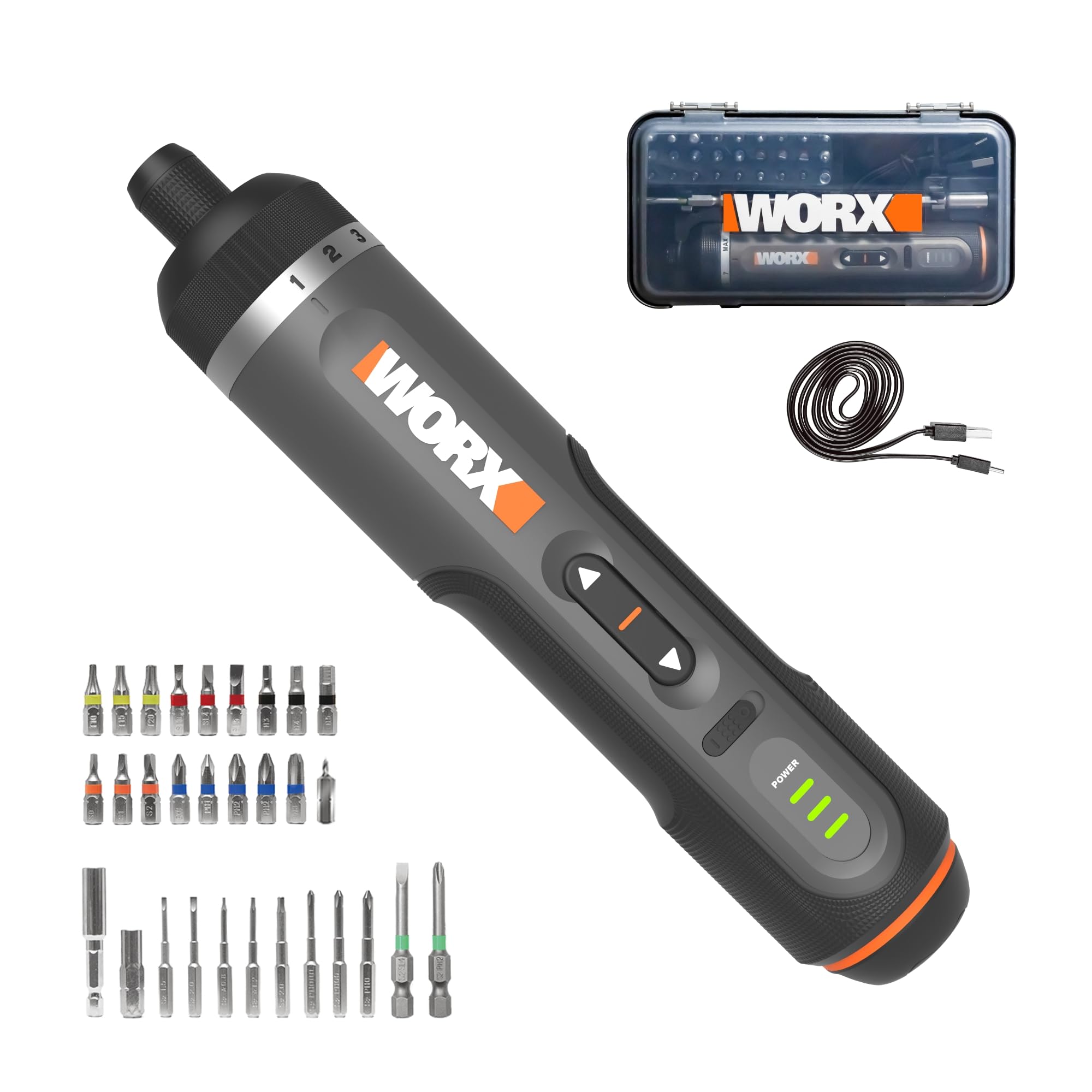
At 320 rpm this is the fastest trigger in the group, and on a run of case fans or a row of motherboard standoffs that speed is the difference between a job and a chore. It also lists the highest torque figure here at 44 in-lb, which sounds like overkill for a PC until you meet a case rail that does not want to take a thread.

What makes it our pick for small electronics is the combination of seven torque steps and a genuinely unusual kit: Phillips down to PH000, Torx, hex and slotted bits, an extended bit for recessed screws, and even a pre-drill bit. None of the other picks here carry bits that small. The steps are power levels rather than a clutch, so start low on anything threaded into plastic and feel the last turn out by hand.

The magnetic quick-release chuck is the detail we appreciated most in use: bits click in, stay put while you are working upside down inside a case, and come out with a pull. Between the chuck and the 30-piece box, you spend your time driving screws rather than hunting for the right tip.

If you open a case once a year, the cheaper SKIL is the better buy. If you are in there monthly, for fans, storage or a GPU swap, the speed and the tiny bits are what you are paying for, and nothing else here does that job.

Bottom line: For anyone who opens a PC case regularly: seven torque steps, precision bits down to PH000 and the fastest trigger in this group.

5

BLACK+DECKER BDCSFL20C 4V Screwdriver

BLACK+DECKER BDCSFL20C 4V Screwdriver

Tight, dark spaces

Our Score 9.2/10
Check Price

Worth Noting

  • Only two bits included
  • Some units stop taking a charge
Speed
180 rpm
Handle
Three-position pivoting
Weight
15.2 oz
Bits Included
2 bits

Under a sink, behind a drawer box, or in a cabinet with two inches of clearance to the wall, a straight driver simply does not fit. This BLACK+DECKER pivots into three positions, inline, pistol, and an angle in between, so the body can sit clear of the panel while the bit still meets the screw. We ended up using the angled setting far more than the other two, which is not what we expected from a three-position handle.

The front of the tool also works as a flashlight, a small thing that stops mattering right up until you drop a screw into a dark carcass. At 0.43 kg it is light enough to hold at arm's length while you work, and the LED at the tip is aimed where you are looking rather than where the body is pointing.

At 180 rpm it is the slowest of the group, and the 4V motor has modest torque, which is the trade for control: short screws, cabinet hardware and awkward angles are its territory, and a deck is not. Two bits come in the box, so plan on a set before you start a real job.

Bottom line: The one for awkward jobs: a pivoting head and a tip light that reach cabinet corners where straight drivers cannot go.

6

Hi-Spec 3.6V Mini Electric Screwdriver

Hi-Spec 3.6V Mini Electric Screwdriver

Light household jobs

Our Score 8.8/10
Check Price

Worth Noting

  • Single speed with no torque setting
  • Some units stop taking a charge
Speed
180 rpm
Weight
0.7 lb
Battery
1300 mAh
Charging
USB, 3 to 5 hours

This is the least intimidating tool here: 0.7 lb, a body that fits in one hand, and a single trigger with nothing to adjust. If someone in the house has never used a power tool and has a shelf to hang, this is the one to put in their hand first.

It is also the only driver here that comes in pink, and we do not treat that as a joke. A tool that is pleasant to leave on the counter gets picked up, and the finish is neat rather than novelty.

A 3.6V motor runs at one speed, 180 rpm, and the 1300 mAh pack charges over USB from flat in three to five hours. The bit set is broad enough to cover the Phillips, slotted and Torx fittings most household jobs ask for.

Its place is light work: shelf brackets, cabinet handles, a wobbly hinge, a toy that needs a new battery cover. There it does the job for less than anything else in this group. Ask it to drive a long screw into hardwood and it will stop, which is the honest limit of a single-speed 3.6V tool rather than a fault.

Bottom line: Buy it if the jobs are light and the budget is small: it is the easiest of these to pick up, the least expensive, and honest about its limits.

7

HOTO 25-Piece Electric Screwdriver

HOTO 25-Piece Electric Screwdriver

Compact all-in-one kit

Our Score 9.2/10
Check Price

Worth Noting

Torque
4 N·m electric, 8 N·m manual
Battery
1500 mAh
Bits Included
25 S2 bits
Torque Settings
3 settings

A single LED sitting behind the bit throws a shadow exactly where the screw head is. HOTO rings the bit with a circular array instead, so the head stays evenly lit even when the driver is between you and the light. In a dark cabinet that is the difference between guessing and seeing.

The kit is built around that idea: 25 S2 steel bits at 60HRC, one extended PH2 for recessed screws, a 60 mm extension rod, and a magnetic case that holds the driver and every bit in its own slot.

Three torque settings give 4 N·m in electric mode and 8 N·m by hand. Against the 36 to 44 in-lb tools here, roughly 4 to 5 N·m, that is mid-pack, which is where a household driver should sit. What we appreciated was the manual ceiling: a stubborn screw can be broken loose by hand before the motor takes over.

The 1500 mAh battery charges over USB-C in under 150 minutes, quick by the standards of this group, and the extension rod is what you will reach for on anything recessed. It is a small, self-contained kit that earns a place in a kitchen drawer rather than a toolbox.

Bottom line: A tidy, well-lit kit for shelf hardware and light assembly; the ring light and magnetic case are the reasons to choose it over a bare stick driver.

8

Amazon Basics by SKIL 4V Stick Screwdriver

Amazon Basics by SKIL 4V Stick Screwdriver

Budget stick driver

Our Score 8.8/10
Check Price

Worth Noting

  • Charge failures within months on some units
Speed
300 rpm
Torque
22 in-lb
Battery
2000 mAh
Torque Settings
3 settings

Three hundred rpm, three torque settings, a 2000 mAh battery and a 10.6 oz body: this is the best-value stick driver in this group, and nothing about it feels like a compromise until you reach the details.

We appreciated the three settings more than we expected at this end of the price range, since stepping down keeps small cabinet screws from being chewed, and the 1/4-inch collet takes any standard bit, so the nine in the box are a starting point rather than a limit. The 22 in-lb ceiling is the lowest here, though, and it is the number that decides whether this is your tool: fine for handles, hinges and flat-pack, out of its depth on anything already tight.

The charging cable is the giveaway. It is USB-A to USB-C, and the driver will not charge from a C-to-C cable, so the brick you use for a laptop does nothing. Keep the supplied cable with the tool. Otherwise it is a light, quick driver that asks very little of you.

Bottom line: The value pick of the group: three torque settings, a 2000 mAh battery and 300 rpm in a slim body, for light household work.

How We Tested the Best Electric Screwdrivers

We started with roughly 30 drivers and narrowed the field using spec sheets, chuck and bit-retention type, torque ratings, clutch settings, weight, and charging setup, then weighed what each price tier actually buys you so nobody pays extra for features they'll never touch. That left 12 models spanning small gyroscopic drivers, pistol-grip mid-size tools, and a few 12-volt compacts, all from brands we'd trust to honor a warranty.

Each driver lived in a toolbox for six months rather than on a bench. We assembled three flat-pack dressers and a bookshelf, hung curtain rods into drywall anchors, tightened more than 60 cabinet hinges in one kitchen, and swapped outlet covers in a dark hallway closet. Along the way we counted how many screws each tool drove in five minutes of steady work and noted whether Phillips heads cammed out or came away crisp.

Battery life got its own test: we charged every driver fully, then drove 3-inch screws into scrap pine until it quit and counted the total, and we left each one in a drawer for a month to see which held a charge on its own. For durability, each tool was dropped from waist height onto concrete and spent a week rattling around a tool bag with loose bits, so we could watch for cracked housings, sloppy chucks, and motors that ran hot after a few minutes.

For ease of use and convenience, we paid attention to the small stuff — whether we could swap a bit one-handed, whether the onboard light actually lit a dim closet corner, and how the tool felt held overhead for a full minute. A few that looked good on paper lost points for a reverse switch buried where a thumb can't reach it.

How to Choose Electric Screwdrivers

Match the torque to the screws, not the voltage

Nearly everything in this category runs a single 4V lithium-ion cell, so voltage tells you almost nothing. Torque is the number that matters, quoted in inch-pounds or newton-meters. The picks here land between 22 and 44 in-lb, roughly 2.5 to 5 N·m, and that band covers cabinet hardware, flat-pack cam locks, switch plates and case screws.

The practical test is the fastener, not the figure. If a screw needs a pilot hole, is long, or is going into hardwood, you want a drill. If it is a machine screw, a pre-drilled hole or a cam fitting, a 4V driver is lighter, faster and far less likely to crush what you are fixing.

Know what a torque setting actually does

Three settings is the useful minimum, and several picks here have them. They step the motor's output down so a small screw in MDF or plastic does not get chewed, but on most of these tools they are electronic power levels rather than a mechanical clutch: the driver will not slip and ratchet when it meets resistance, so you still judge the final quarter-turn by hand. Start low and step up.

That is why the trigger matters as much as the dial. A slow, controllable 180 to 220 rpm is easier to feather than a fast one, and feathering is how you stop flush with the surface instead of two threads deep.

Bits, holders and what keeps them together

The bit count matters less than how the bit is held. A magnetic collar or a slim magnetic bit holder lets you put a screw on the tip and drive it with one hand, which is the entire reason to own one of these instead of a manual driver. A loose holder that drops bits is the most common small annoyance in this category.

Look at the storage too. A case that keeps the bits with the driver is the difference between a tool you grab and a drawer of loose steel. If a driver ships with two bits and no box, plan on buying a set before you start a real job.

Shape, reach and weight

Stick drivers are short and get inside cabinet carcasses; pistol grips put your wrist at a drilling angle and are easier to lean on through a long flat-pack session. A pivoting head splits the difference and is the only shape that works when the panel sits inches from a wall.

Weight only becomes a problem overhead. A heavier driver is fine pushing down into furniture and tiring at arm's length above your head, so think about where you actually work before paying for a metal body.

Battery, charging and the cable in the box

Charge times vary widely, from a couple of hours on USB-C to the better part of an afternoon on the slowest USB charger, and the connector matters more than the capacity for most households. USB-C is the one you can borrow a cable for at a desk.

Check whether the cable is USB-A to USB-C only, because a driver built that way will not charge from a C-to-C laptop brick. Whichever you buy, put it to work in the first weeks so a dud surfaces while returns are still straightforward.

Frequently Asked Questions

Final Verdict

Buy the SKIL SD561801. It has the torque for furniture and cabinet hardware, a magnetic holder that makes one-handed work possible, and the longest warranty in this group, and it skips the extras you may not want to pay for.

If flat-pack is a regular event, the SKIL SD5618-03 and its cam-screw sleeve are worth the step up. If you want to stop over-driving small screws, the Fanttik S1 Pro and its three torque settings are the answer. None of them drill holes; for that you need a drill.