Tools & DIY

Best Engraving Pens of 2026

An engraving pen is a small motor spinning a carbide point fast enough to cut a permanent line into metal, glass, wood, or hard plastic — simple in principle, maddening in practice when the pen is a cheap one. The tip skates, the motor bogs down the second you lean into it, and the letters you meant to be neat come out a shaky scrawl. I've labeled my share of socket sets, coolers, and loaner tools over the years, and whether a mark survives a decade of garage life or rubs off with a thumb comes down to control, not power.

Over the past four months, my team and I worked through 16 engraving pens on steel, glass, oak, aluminum, and plastic. A fine tip and a slow, steady low setting beat raw speed every time — you're drawing, not drilling, and most slips happen on the first pass. Compact size counts for more than you'd guess, since the tool has to sit in your hand like a pen for twenty minutes of lettering. Here's what we'd buy, whether you're marking a socket set or writing names on jam jars.

1

AM ARROWMAX Mini Engraving Pen

Top Pick
AM ARROWMAX Mini Engraving Pen

Detail work

Our Score 8.6/10
Check Price

Worth Noting

  • Battery life drops at top speed
Battery
500mAh LiPo, up to 2 hours
Rotation
Forward and reverse
Speed Range
15,000–30,000 rpm
Bits Included
30 diamond bits

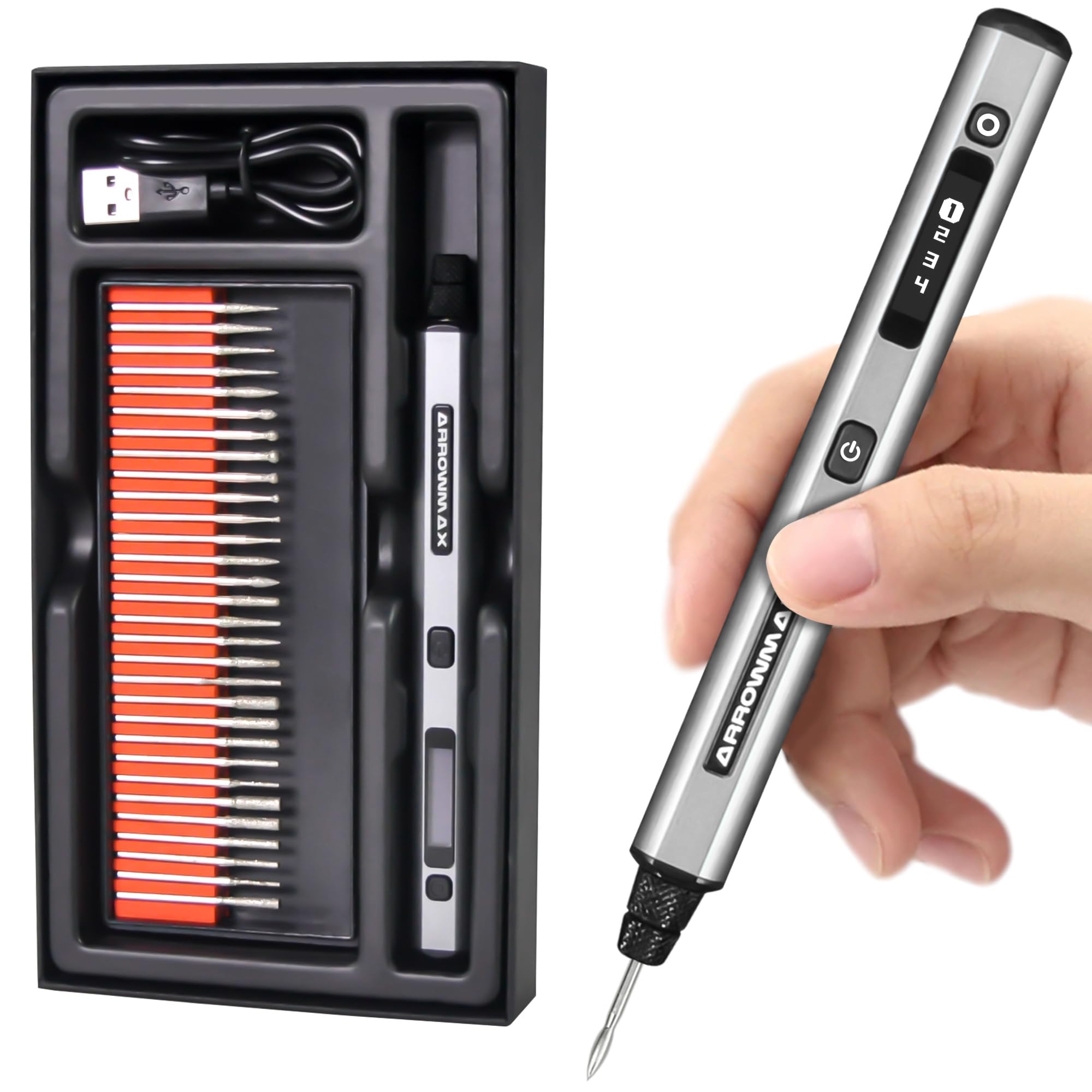
The forward/reverse switch is the first thing we show people, because it changes who can use this pen comfortably. Left-handed engravers usually fight the rotation of a rotary bit; the AM ARROWMAX lets you flip direction with a click. That, plus four speeds from 15,000 to 30,000 rpm, makes it the most adjustable cordless pen in this group and our default recommendation.

The 30,000 rpm ceiling is not just a number for the box. It gives you headroom for hard wood and soft metal, while the lower settings let you slow down for plastic and glass. We also like the OLED screen: it shows speed, battery, and direction at a glance, so you are not guessing mid-line. The 30 diamond bits cover everything from fine detail to broader marks.

In the hand it feels like a pen, not a rotary tool. The compact body and light weight make it easy to follow curves and lettering, and the bit changes are straightforward once you learn the collet. The kit is generous enough to start without buying extras.

The limit is torque. On hardened steel this is a patient, light-pass tool, not a gouger; if you need deep workshop marks, a corded impact engraver is faster. That does not stop it from being the best all-around pick for detail work, but it is the reason to look at the Dremel or YEYETUO for heavy metal.

Bottom line: We recommend the AM ARROWMAX as the default cordless engraving pen: its speed range, reversible motor, and 30-bit kit make detailed work easier, and it stays comfortable in the hand.

2

Dremel 290-02 Engraver

Dremel 290-02 Engraver

Corded workshop

Our Score 8.8/10
Check Price

Worth Noting

  • Tiny set screw is easy to lose
Speed
7,200 strokes per minute
Power Source
Corded AC
Depth Settings
5-position dial
Included Point
9924 carbide point

The Dremel 290-02 announces itself before it marks anything. The 7,200-stroke motor is loud, and the vibration runs up your hand until you find a firm grip. That is the trade for a corded engraver that never asks about battery charge and keeps a steady stroke through a long batch of tools.

The five-position depth dial is the useful part. Set it shallow for a fine line on a key tag, then dial it deeper for a groove in steel. The 9924 carbide point is a single, replaceable tip rather than a box of tiny bits, which keeps the routine simple. The letter and number stencil is included, though the point is clumsy inside the smaller openings.

Where this Dremel earns its place is sustained work. On a bench full of wrenches or a stack of metal tags, the corded motor does not fade and the stroke stays consistent. We also appreciate that replacement points are easy to find and the tool feels like a shop staple rather than a craft gadget. It is the one here we trust for a long marking session.

It is not the pen for delicate glass etching or long freehand lettering. The noise is the loudest in this group, and the body is heavier than the compact cordless pens. If you need quiet detail work, choose the AM ARROWMAX; if you need a corded marker that keeps going, the Dremel is the better tool.

Bottom line: For a corded tool that stays ready and cuts a deep line, we reach for the Dremel 290-02, provided you can live with the noise.

3

TUBINOONE Engraving Pen

TUBINOONE Engraving Pen

Budget cordless

Our Score 8.2/10
Check Price

Worth Noting

  • Light torque on hard steel
Battery
6V rechargeable, up to 120 minutes
Stencils
10 stencils
Included Bits
30 diamond bits plus 3 professional bits
Speed Settings
3-speed

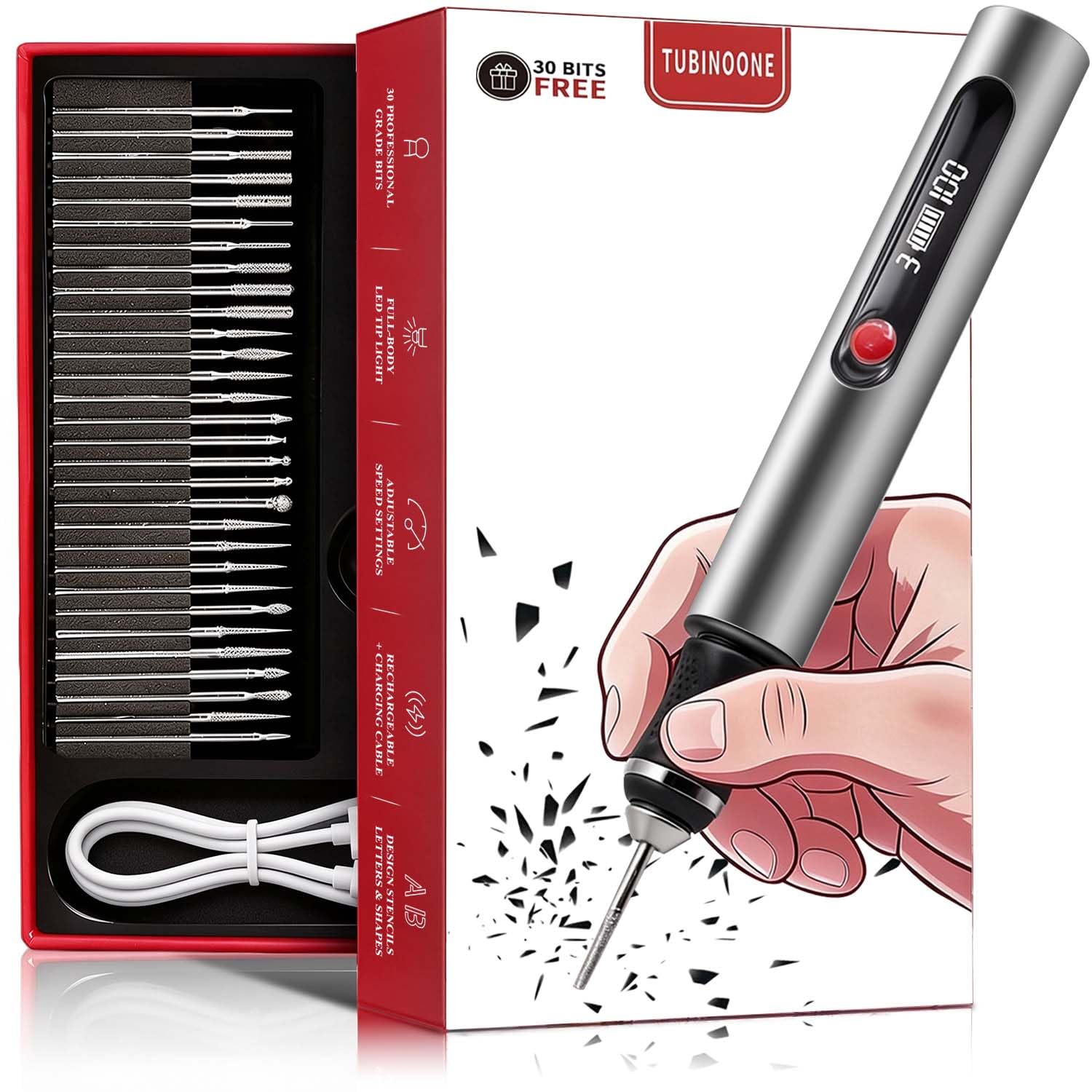
The TUBINOONE is the cordless pen we suggest when the budget is the first constraint and the jobs are personalization rather than production. It lists up to 120 minutes from a 6V rechargeable battery, which is the longest runtime claim in this group, and it ships with 30 diamond bits, three extra bits, and ten stencils.

We think that combination is the right budget trade. The three-speed motor is simple enough for a beginner, the pen weighs 7.7 ounces, and the kit gives you enough shapes to try keys, glass, wood, and plastic without hunting for extras. It is not the most precise pen here, but it is easy to live with.

The three-speed dial is the main compromise. It gives you fewer stops between plastic and metal than the five-speed pens, so you do more of the control with your hand. That is manageable for light personalization, and the low speed is gentle on glass. The pen is happiest on craft materials.

Bottom line: We think the TUBINOONE is the cordless pen to buy on a tight budget, with a long claimed runtime and enough bits for light marking.

4

YEYETUO Engraving Pen

YEYETUO Engraving Pen

Deep marks

Our Score 8.8/10
Check Price

Worth Noting

  • Tied to a 110V outlet
Tips
2 tungsten carbide tips
Power
25W, 110V corded
Speed
6 speeds, 7,200 strokes per minute
Weight
12.7 oz

A 25W motor and 7,200 strokes per minute put the YEYETUO in a different class from the pen-shaped cordless tools. This is a workshop marker: it plugs into 110V, hits harder, and uses two tungsten carbide tips rather than a box of diamond burrs. We reach for it when the job is a wrench, a trailer hitch, or a piece of shop equipment that needs a mark you can see.

The six-speed dial and soft rubber grip make it more controllable than its size suggests. The body is heavier at 12.7 ounces, so you brace your hand and let the tool do the work. On metal it cuts a broader, more visible line than the cordless pens; on wood and plastic you need a light touch or it digs.

The two tungsten tips are a practical choice for a marking tool. There are no tiny collets to fuss with, and the replacement routine is simple. The trade is that you do not get the fine detail of a rotary pen; this is for identification marks, not decorative lettering.

We recommend the YEYETUO for the buyer who wants a corded, no-battery marker for tough surfaces and does not mind the weight or the noise. It is the opposite of the AM ARROWMAX: less precise, more forceful, and happier on a workbench than a craft table. If your engraving is mostly gifts and glassware, choose the cordless pen instead.

Bottom line: We recommend the YEYETUO when the job is workshop marking rather than delicate artwork: it hits hard, runs on mains power, and asks for a firm hand.

5

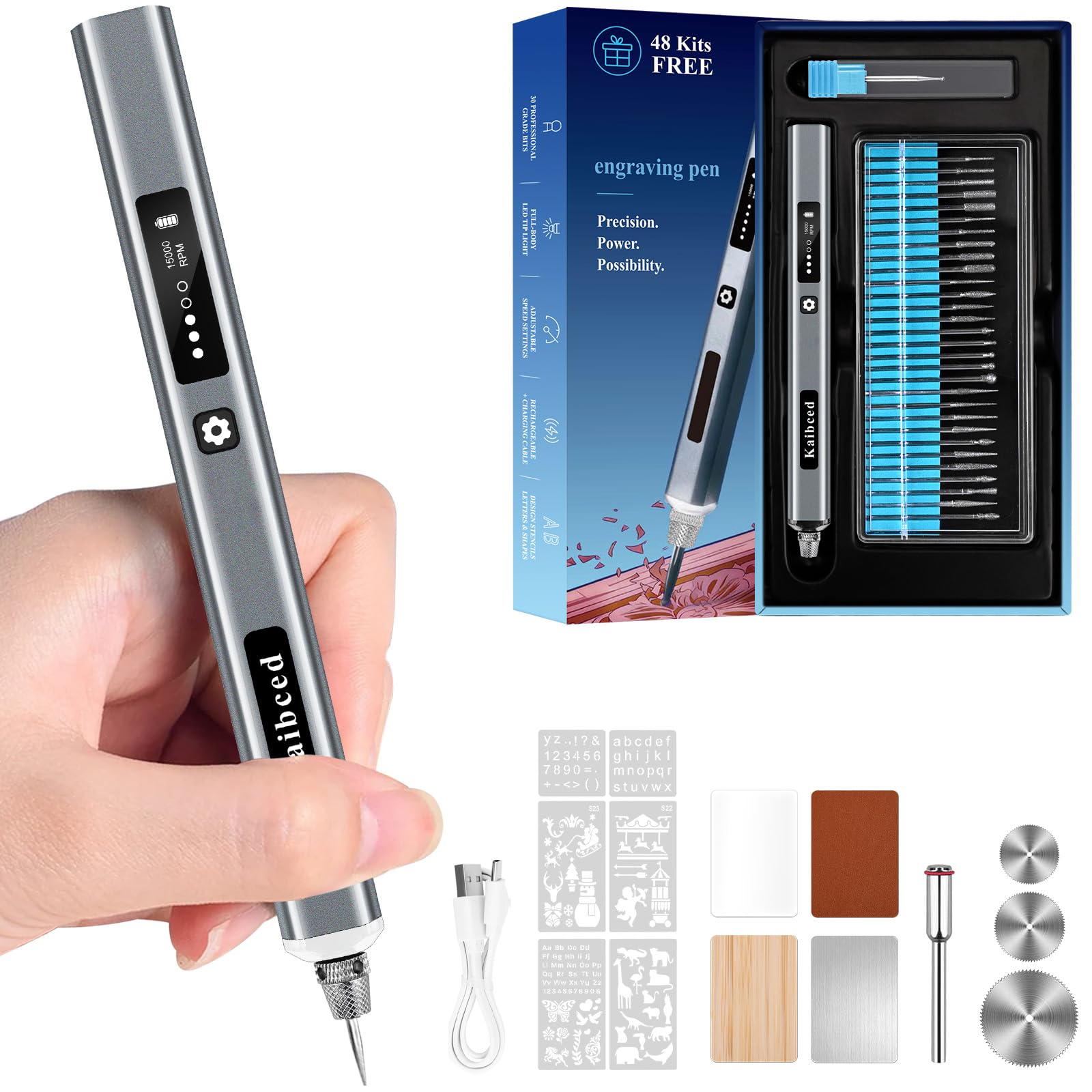
Kaibced 48-Kit Engraving Pen

Kaibced 48-Kit Engraving Pen

Starter kit

Our Score 8.4/10
Check Price

Worth Noting

  • LED ring has no separate switch
Weight
49g pen body
Speed Range
7,500–20,000 rpm
Included Bits
30 engraving bits plus 3 saw bits and carbide burr
Speed Settings
5-speed

The 48-piece kit is the reason to look at the Kaibced, but the LED ring is the detail we ended up valuing more. It lights the work surface without a separate lamp, which matters when you are following a stencil on a dark key or a small tag. The pen body is a claimed 49 grams, so it handles like a marker rather than a power tool.

The five-speed motor runs from 7,500 to 20,000 rpm. That is a lower ceiling than the fastest pens here, but the range is well spaced for plastic, wood, and soft metal. The kit includes 30 engraving bits, three saw bits, a carbide burr, practice materials, and stencils, so a beginner can start without a second order.

We like the two-year warranty and the storage case as much as the accessories. The case keeps the bits sorted, and the warranty is longer than most here. The pen is light enough for long lettering sessions, and the LED ring makes fine work easier to see.

The 20,000 rpm ceiling is the real limit. On hardened steel, this pen takes more passes than the AM ARROWMAX or a corded engraver. For a first kit, a gift, or a crafter who wants everything in one box, it is an easy recommendation. For production metal marking, choose more power.

Bottom line: The Kaibced 48-kit is the one we hand to a beginner who wants everything in one case, from the LED ring to the five-speed dial.

6

General Tools Cordless Engraving Pen

General Tools Cordless Engraving Pen

Light marking

Our Score 8.4/10
Check Price

Worth Noting

  • AAA batteries add ongoing cost
Body
Aluminum
Power
2 AAA batteries
Speed
20,000 rpm
Weight
3.5 oz

The General Tools pen is the one that disappears into a drawer until you need it. It runs on two AAA batteries, weighs 3.5 ounces, and has an aluminum body with a tri-lobal grip that sits like a pen. That makes it a handy labeling tool for plastic cases, keys, and glassware.

The 20,000 rpm motor is enough for light marking, and the cordless format is genuinely convenient. There is no charging routine and no proprietary battery to replace; you drop in two AAAs and go. The tip is a single point, so there is no box of bits to sort through.

We keep it for light-duty work because that is where it makes sense. On plastic and glass it scratches a clean, permanent line; on hard metal it is a scriber, not a carver, and you need to accept a shallow mark. The tip is also the weak point, so let the tool do the work instead of bearing down.

The simple format is the appeal. There is no charger to lose and no case to keep track of. If you mark a lot of hard tools, the Dremel or YEYETUO will save you time; if you want a tiny pen for occasional labels and craft projects, this one is easy to keep around.

Bottom line: We keep the General Tools pen for light-duty labeling on plastic and glass; it is tiny, simple, and not the tool for deep metal work.

7

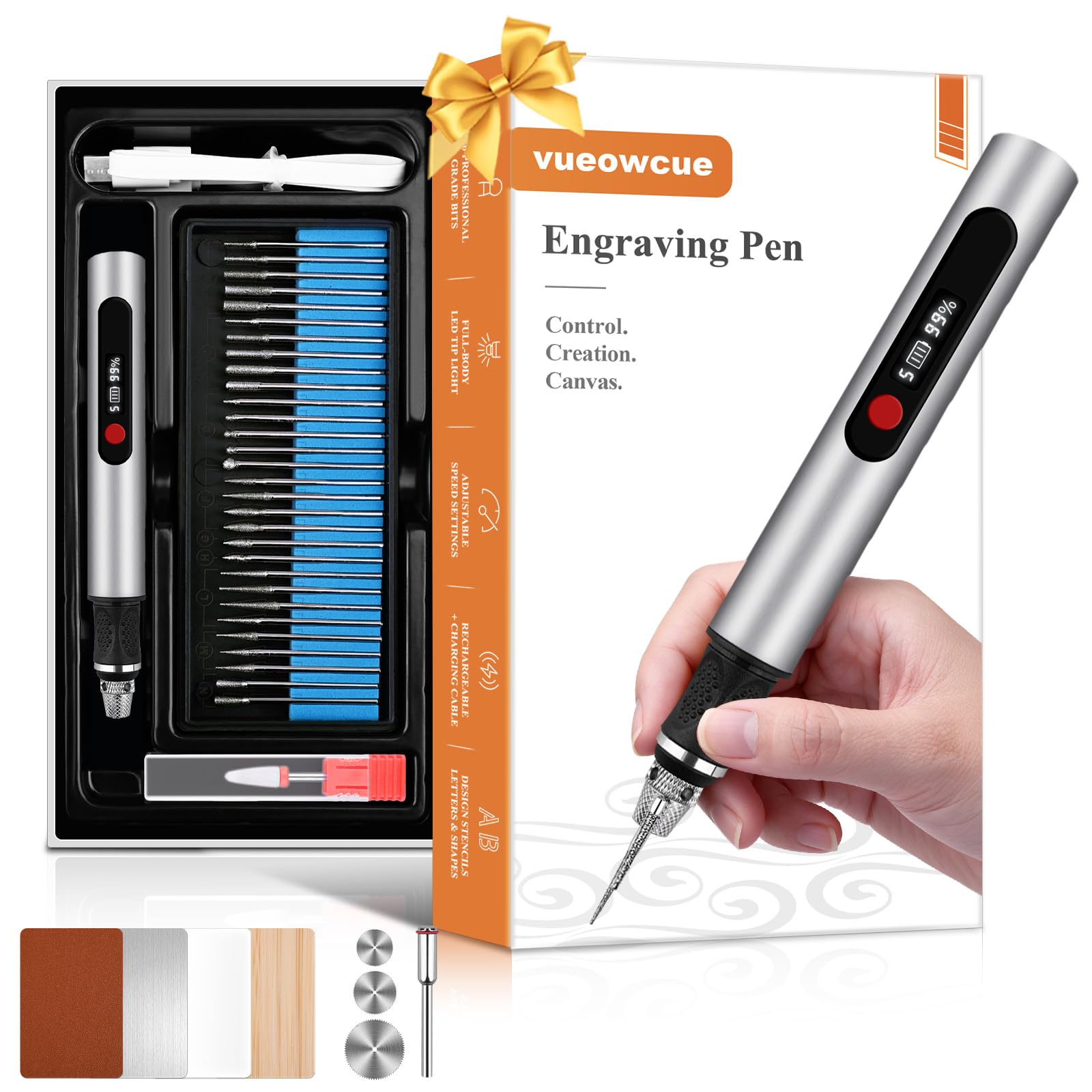
vueowcue Cordless Engraving Pen

vueowcue Cordless Engraving Pen

Compact control

Our Score 9.0/10
Check Price

Worth Noting

  • Screw-lock collet slows bit changes
Display
LCD screen
Charging
USB-C
Included Bits
30 bits plus 3 saw bits and carbide burr
Speed Settings
5-speed

The LCD screen is what makes the vueowcue feel more modern than most budget pens. It shows the speed setting and battery level, so you are not guessing when the charge is about to go. The five-speed dial and the screw-lock collet are the other details that separate it from a generic cordless pen.

We like it for compact control. The body is 5.91 inches long and slim enough to follow small lettering, and the rubberized grip stays secure when your hand is warm. The kit includes 30 bits, three saw bits, a carbide burr, practice materials, and stencils, which is a solid starting set.

The screw-lock collet holds the bit firmly, and the USB-C charging is convenient and matches the cable you already carry. The pen is light enough to use for a whole stencil without your hand cramping, which is not true of the heavier corded tools.

The main caveat is that this is a newer, less proven pen. The specifications are strong for the price tier, but the body of use is thinner than the AM ARROWMAX or Dremel. Buy it for light detail work and display-driven control; if you need a tool with a long track record, choose one of the established picks.

Bottom line: We like the vueowcue for compact control: the LCD and five speeds make it easy to dial in, though the kit is newer and less proven.

8

VQVYBXN USB Engraving Pen

VQVYBXN USB Engraving Pen

Metal cards

Our Score 8.4/10
Check Price

Worth Noting

  • Short runtime between charges
Weight
11.3 oz
Battery
USB rechargeable, up to 30 minutes idling
Speed Range
5,000–20,000 rpm
Kit Contents
30 diamond bits, 12 grinding bits, 10 metal cards, 3 stencils

The ten metal business-card blanks are the reason this kit exists. Instead of buying a pen and then hunting for blanks separately, you get the cards, 30 diamond bits, 12 grinding bits, and three stencils in one box. That makes it a neat starter set for personalized tags and cards.

The three-speed motor runs from 5,000 to 20,000 rpm, and the USB-rechargeable body is compact in the hand. The lower speed is useful for starting a line without skidding, and the higher settings give you enough speed for soft metal. The kit has enough shapes to experiment.

The power is the limitation. On hard steel and glass, this pen scratches rather than engraves, and you need light passes and patience. The bits are serviceable, but they are not the strongest here, and the motor is not built for constant hard-metal work. The pen is happiest on the metal cards and soft materials the kit is built around.

We recommend the VQVYBXN when the metal cards and the all-in-one kit are the point. For a small business making tags, it is a tidy way to start. For a shop that needs deep marks or long sessions, the AM ARROWMAX or a corded Dremel is the better purchase.

Bottom line: We recommend the VQVYBXN only when the metal business-card blanks are the point; otherwise its power and durability hold it back.

How We Tested 16 Engraving Pens on Steel, Glass, Oak, and Plastic

We started with a shortlist of about 40 pens and cut it down by reading spec sheets — top speed, corded versus battery power, how the bit was held, and what came in the box — then bought 16 that covered the range of sizes and designs shoppers actually choose between. Testing ran for four months. Every pen got the same first job: a straight line, a small letter R, and a filled-in square on a scrap of stainless, so we could compare depth, control, and whether the tip wandered off course.

From there they went into real use. On the shop bench, we etched initials into a socket set, a set of router bits, and a handful of wrenches, paying attention to which pens were steady enough to follow a curve on a round shaft. At the kitchen table, we marked glass canning jar lids, a ceramic mug base, and an oak cutting board, then wiped each with a wet cloth to see what faded. In the garage, plastic storage totes and a metal toolbox got the same treatment, and one pen spent a week in an apron pocket to test how it handled being carried.

We timed how long each cordless pen ran on a full charge under continuous use and watched whether it slowed before it quit. We leaned hard on stainless to see if the motor stalled, then felt the housing after ten minutes to see how hot it got. We changed bits with a stopwatch, checked whether the power switch could be worked one-handed, weighed each pen, and measured the grip. Two pens went off the bench onto concrete to see what a drop does to the tip and housing. And we counted the bits, stencils, and templates in every box, then tracked how many we actually reached for — variety only counts if the extras are usable.

How to Choose Engraving Pens

Cordless Freedom vs. Corded Consistency

A cordless pen is the right choice when you move around the house, mark a few keys at the kitchen table, or personalize gifts. It is also easier to control for fine lettering because there is no cord pulling at your wrist. The trade is runtime: the cordless pens here list up to two hours, 120 minutes, or as little as 30 minutes of idling, and those numbers drop when you run at top speed. A corded engraver such as the Dremel or YEYETUO stays ready for a bench session and does not fade halfway through a drawer of tools. Choose cordless for occasional detail; choose corded for repeatable workshop marking.

Speed Control and the Material in Front of You

Rotary pens and impact engravers do not work the same way. A rotary pen spins a diamond bit at 15,000 to 30,000 rpm and scratches a fine line; an impact engraver drives a carbide point at around 7,200 strokes per minute and cuts a broader mark. For plastic and glass, start low and use light pressure so the tip does not skid. For soft metal, a midrange setting gives you control; for hardened steel, a high-speed rotary pen or a corded impact tool saves time. The useful feature is not the top number but a dial with enough low-end control. Five speeds beat three when you switch materials often.

Bits, Collets, and Replacement Cost

The bit count is the least useful number on the box. What matters is whether the collet holds the bit straight, whether you can buy replacements, and whether the shanks fit the work you do. A 48-piece kit is a great start for a crafter, but a pen with a standard 1/8-inch collet is easier to feed with common bits. Compact cordless pens often use their own small shanks, so check replacement availability before you commit. Buy the kit that matches your first projects, not the one with the most pieces.

Handling, Noise, and the Workpiece

An engraving pen is a hand tool, so weight and vibration matter as much as power. A 3.5-ounce AAA pen is easy to keep in a drawer and use for a quick label; a 12-ounce corded impact engraver is tiring for long freehand work but stable on a bench. Vibration makes fine lines harder, and noise is the hidden cost of the impact design: the Dremel is the loudest tool in this group. Secure small parts with a clamp or vise before you start, especially glass and metal tags. If you work in a shared room, a compact cordless pen is the kinder choice.

Frequently Asked Questions

Final Verdict

The AM ARROWMAX Mini is the engraving pen we recommend first. Its four-speed motor, forward and reverse rotation, and 30-bit kit make it the most adaptable cordless tool here for detail work on metal, wood, glass, and plastic, and the OLED screen keeps the settings visible while you work. If your marking happens at a bench, the corded Dremel 290-02 is the stronger choice: it stays at speed and cuts a deeper line, provided you can tolerate the noise. On a tight budget, the TUBINOONE covers light personalization without asking for much.