Networking & Wi-Fi

Best Ethernet Cables of 2026

A frozen video call is rarely the router's fault. More often it's the cable — the freebie that came in the modem box, or the twenty-foot run you grabbed because it was the cheapest one on the shelf. Swapping it is the least glamorous upgrade in a home network and the one that most reliably kills the stutter, since a decent cable carries a full gigabit without dropping packets while a bad one quietly caps you well below the speed you're paying for. Over the past four months, my team and I ran 16 of them through the same house to find out which ones actually deliver.

The Cat number printed on the jacket is the least interesting thing about most cables. Copper gauge, shielding, and how cleanly the connector is crimped matter far more than whether the label says Cat6 or Cat8, and a flat cable that tucks under a rug is a genuine convenience right up until you're pushing high speeds across a long run and the thing starts dropping packets. Everything below earned its spot — some on speed, some on flexibility, some purely on price per foot.

1

Cable Matters Cat6 25ft

Top Pick
Cable Matters Cat6 25ft

Home office runs

Our Score 9.6/10
Check Price

Worth Noting

  • Round jacket is harder to hide than flat cable
Length
25 ft
Category
Cat 6
Bandwidth
550 MHz
Data Rate
10 Gbps

The 25-foot length is the first thing that makes the Cable Matters Cat6 easy to live with. It reaches from a router in one corner of a room to a desk, console, or printer on the other side without leaving a huge surplus to coil. The 24 AWG copper conductors and 550 MHz rating put it near the top of this set for headroom, and the 10Gbps rating means it will not be the weak link if your network moves beyond gigabit.

The connectors are the reason we keep coming back to it. The snagless boots protect the release tab, and the small plastic guard over the clip makes the cable easier to pull from a crowded switch or console port. That sounds minor until you have spent ten minutes trying to free a cable from a tight recess.

At the budget end of this group, the Cable Matters still feels like a proper cable rather than a thin freebie. The connectors click home with a positive stop, and the jacket has enough substance to survive being moved between apartments. The UGREEN braid is the tougher cable here; the Cable Matters is the better balance of price, speed, and handling for most people.

Bottom line: For most home or office runs, this is the cable we recommend: 25 feet of solid Cat6 with snagless plugs and a 10Gbps rating.

2

Jadaol Cat6 100ft Flat

Jadaol Cat6 100ft Flat

Long hidden runs

Our Score 9.4/10
Check Price

Worth Noting

  • 100-foot length is overkill for short links
Shape
Flat
Length
100 ft
Category
Cat 6
Bandwidth
250 MHz

Hiding a long Ethernet run is usually the hard part, and the Jadaol Cat6 makes it the easy part. The flat white jacket is designed to sit against a baseboard or tuck under a rug, and the 100-foot length gives you room to route around a doorway instead of stretching a shorter cable across the floor. For a renter or anyone who does not want to drill, that changes the job from an afternoon project into something you can finish with a handful of clips.

The flat jacket is the star: it follows a baseboard, slips under a rug, and coils into a neat loop when you move it. The included mounting clips are the sort of small extra that keeps a cable looking intentional rather than temporary. It is rated for Cat6 and 250 MHz, which is plenty for gigabit networking and ordinary streaming.

The 30 AWG conductors are thinner than the 24 AWG cable we recommend for a permanent run, so this is a surface-routing cable rather than a rough-pull one. It is not the cable for a tight, high-interference run; the flat jacket is better for clean surface routes. But for a long, visible run where neatness matters, the Jadaol is the most practical cable here. We appreciate that it comes in white, too: against a pale wall, it nearly disappears.

Bottom line: The Jadaol is the cable we choose when the run has to disappear along a wall, and its 100-foot length and included clips make a neat job much easier.

3

UGREEN Cat8 15ft Braided

UGREEN Cat8 15ft Braided

Gaming desks

Our Score 9.4/10
Check Price

Worth Noting

  • 15-foot length limits room-to-room runs
Jacket
Cotton braid
Length
15 ft
Category
Cat 8
Bandwidth
2000 MHz

The braided jacket is the first thing you notice, and it is not just decoration. The cotton braid gives the UGREEN Cat8 a soft, flexible feel that is much easier to coil behind a monitor than the stiff PVC jackets on some Cat8 cables. At 15 feet, it has enough slack to reach from a floor-level router to a desk without a coil of excess, and the shielded construction is aimed at the kind of interference you can get in a crowded entertainment center.

We think this is the best cable here for a gaming desk or a workstation that gets rearranged. The braid protects the jacket during repeated handling, the connectors feel solid, and the cable stays flexible enough to route around a tight corner. It is rated for 40Gbps and 2000MHz, which is more than most home networks can use, so the practical reason to buy it is the handling and durability rather than the headline speed.

The braided jacket costs more than the basic Cat6 picks, and you are paying for feel and longevity as much as bandwidth. For a cable that stays plugged in behind a cabinet, that premium is harder to justify; for one you move, it is worth the extra.

Bottom line: For a desk, console, or any cable you will unplug often, the UGREEN braided Cat8 is the one we reach for first.

4

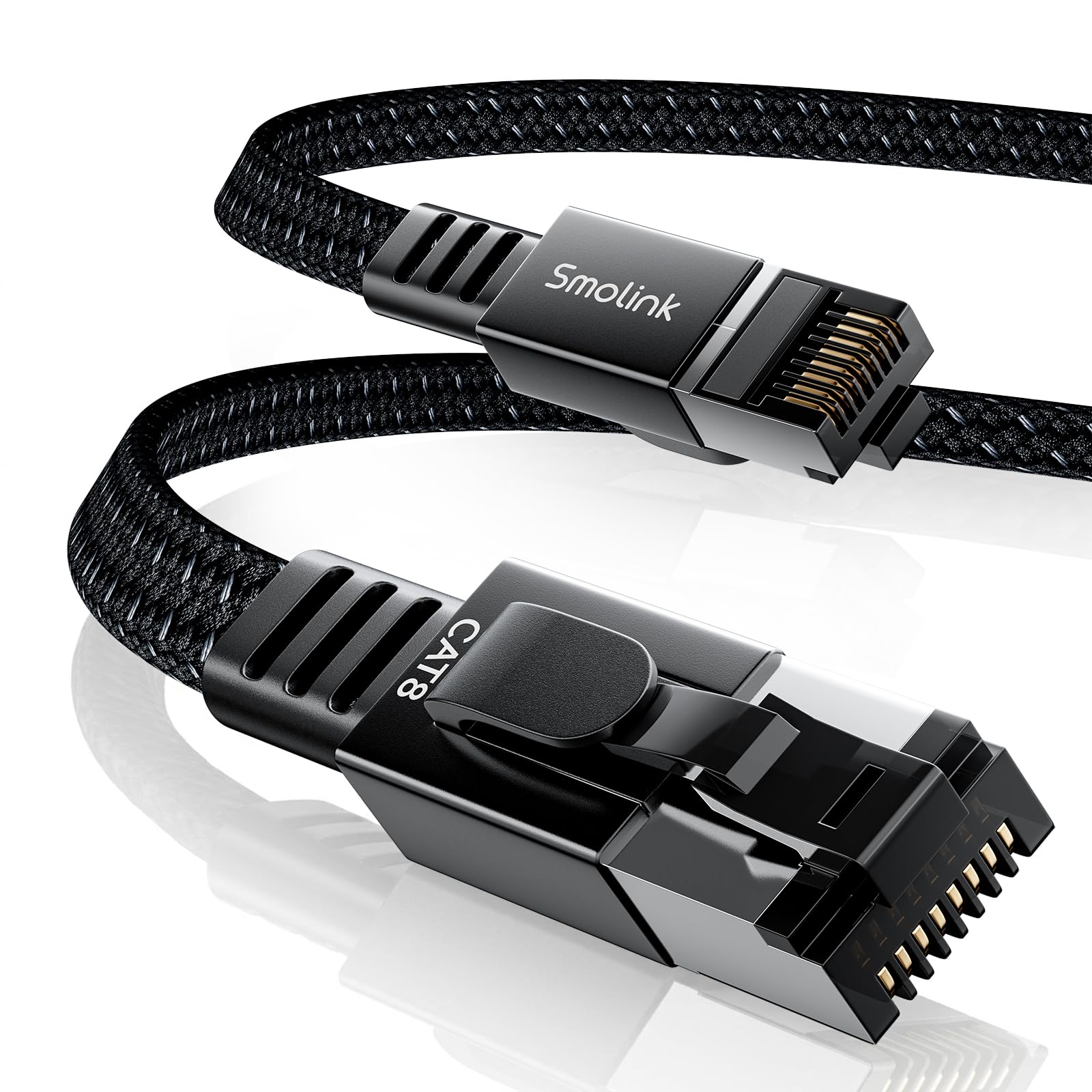
Smolink Cat8 50ft Flat

Smolink Cat8 50ft Flat

Flat room runs

Our Score 9.4/10
Check Price

Worth Noting

  • Can feel stiff near the plugs
Shape
Flat
Jacket
Nylon braid
Length
50 ft
Category
Cat 8

A 50-foot flat cable is a specific tool: it is for the run that has to go around a doorway, under a desk, and along a wall without turning into a snake pit. The Smolink Cat8 comes coiled flat, with a nylon braided jacket that is meant to stay flexible while it follows edges. The 50-foot length is generous enough for a room-to-room link, but not so long that you are left with a huge surplus.

We like this one because it solves the routing problem without making you pay for a bulky round cable. The flat profile slides under a rug or behind furniture, and the braided jacket feels more durable than the thin flat cables we have used. It is rated for Cat8 speeds, though most home networks will never touch 40Gbps; the real benefit is the shape and the reach.

The 50-foot length is a good match for a router-to-desk run in another room, and the nylon jacket resists abrasion when a cable is dragged along a baseboard. It is a surface-routing cable, not the one to bury in a wall; the flat jacket is built to be seen as little as possible, not to be permanently installed. For a long surface run, the Smolink is the cable we choose.

Bottom line: If you need a long cable that can run around a room without looking like a trip hazard, the Smolink flat Cat8 is our pick.

5

Vabogu Cat8 1.5ft

Vabogu Cat8 1.5ft

Short patches

Our Score 9.4/10
Check Price

Worth Noting

Length
1.5 ft
Category
Cat 8
Bandwidth
2000 MHz
Data Rate
40 Gbps

A 1.5-foot cable sounds almost too short to matter, but that is exactly the length that keeps a router-to-modem stack from turning into a coil of slack. The Vabogu Cat8 is built for those tight links: two shielded RJ45 plugs, a round 26 AWG jacket, and a length that reaches only as far as it needs to. If your gear sits on the same shelf, it is a cleaner solution than looping a 6-foot cable behind the furniture.

The Cat8 rating is overkill for a modem link, and that is fine. You are buying this for the size and the connector fit, not because your internet service can use 40Gbps. The 26 AWG conductors give it a substantial feel for such a short cable, and the shielded construction is a sensible extra in a crowded media cabinet.

We recommend it for the small jobs: router to modem, switch to patch panel, or a console sitting directly beside a TV. It is not the cable for reaching across a room, and the short length means you need to measure before ordering. But when the distance is genuinely short, the Vabogu is the neatest cable here.

Bottom line: For the short hop between a router and modem or a switch and patch panel, the Vabogu 1.5-foot Cat8 is the tidy choice.

6

GEARit Cat6 10-Pack

GEARit Cat6 10-Pack

Network closets

Our Score 9.4/10
Check Price

Worth Noting

  • Snagless boots can be hard to remove
Length
10 ft each
Category
Cat 6
Bandwidth
550 MHz
Pack Count
10 cables

Buying one Ethernet cable at a time gets old when you have a switch, a patch panel, and a handful of devices to connect. The GEARit pack solves that with ten 10-foot Cat6 cables, each with snagless boots and gold-plated contacts. The 24 AWG construction and 550 MHz rating are the same sort of specification we look for in a single cable, so this is not a box of thin freebies.

The 10-foot length is the right size for a network closet, a media cabinet, or a desk with a switch nearby. Ten cables also give you spares, which matters if you are the person friends call when their router needs moving. The pack comes in frustration-free packaging, and the snagless design is meant to protect the release tab when cables are pulled and reinserted.

We think the GEARit pack earns its place for multi-device setups: the per-cable cost is low, the connectors feel secure, and having spares on hand is genuinely useful. It is the pack we reach for when the job is bigger than one cable. If you only need a single run, a single cable is the better buy; this is for the person who already knows they need several.

Bottom line: The GEARit pack is for the person wiring a rack, office, or whole shelf of devices: ten 10-foot Cat6 cables for one outlay.

7

DbillionDa Cat8 6ft

DbillionDa Cat8 6ft

Short outdoor runs

Our Score 9.4/10
Check Price

Worth Noting

  • Stiffer jacket resists tight bends
Jacket
UV-resistant PVC
Length
6 ft
Category
Cat 8
Data Rate
40 Gbps

Outdoor Ethernet runs are usually either too short to reach or too long to manage. The DbillionDa Cat8 sits at the short end: a 6-foot cable with a UV-resistant PVC jacket, shielded twisted pairs, and 26 AWG conductors. It is aimed at the camera-under-the-eave or access-point-on-the-porch job, where a standard indoor cable would be exposed to sun and weather.

The jacket is the reason to consider it. It is rated for indoor and outdoor use, with resistance to UV, water, and heat. That does not make it indestructible, but it is more appropriate for a permanently exposed connection than a bare indoor patch cable. The shielded construction also helps in a location with a lot of electrical noise.

The 40Gbps Cat8 rating is mostly future-proofing here; a camera or access point will not use it. The 26 AWG conductors and shielded pairs give it a substantial feel, and the connectors are the standard RJ45 plugs you need. You are paying for the jacket and the short length, not for bandwidth you can measure on a home network.

We see the DbillionDa as the cable for a short, exposed run where the jacket matters more than flexibility. It is not the one for a long outdoor trench or a neat baseboard run; the Ultra Clarity and Jadaol are better suited to those jobs. But for a compact weatherproof link, it earns its spot.

Bottom line: For a short outdoor link to a camera or access point, the DbillionDa Cat8 gives you a weather-resistant jacket without a long coil of excess.

8

Ultra Clarity Cat6 100ft

Ultra Clarity Cat6 100ft

Long rough runs

Our Score 9.4/10
Check Price

Worth Noting

  • Bulky 100-foot coil takes more storage space
Use
Indoor and outdoor
Length
100 ft
Category
Cat 6
Bandwidth
500 MHz

A 100-foot round cable is the least glamorous product here, but it is the one that handles the ugly jobs. The Ultra Clarity Cat6 is a 100-foot round cable with 24 AWG copper conductors and a CM-grade PVC jacket. It is the sort of cable you buy for an attic, a garage, or a run along the outside of a house where a thin flat cable would be exposed or fragile.

The round jacket is tougher than the flat cables in this group, and the 24 AWG conductors give it a more substantial feel. The 500 MHz rating is above the Cat6 baseline, and the cable is ETL verified and RoHS compliant. For a long run that will be pulled through a wall or clipped along a joist, that construction matters more than a flat profile.

For a long indoor run in a finished room, the Jadaol is the easier cable to live with, and the Smolink is easier to route around a room. The Ultra Clarity is the one for a garage, attic, or exterior wall, where a round jacket is less of a problem. It also comes in a length that lets you make one continuous run instead of coupling two shorter cables.

We keep the Ultra Clarity in the also-consider tier because it is outclassed for finished rooms, not because it is a bad cable. When the job is long, round, and a little rough, it is the one we want in the bag. That is a narrower job than the Cable Matters handles, but it is a job the flat cables cannot do as comfortably.

Bottom line: The Ultra Clarity is the long round cable we choose when a flat cable would be too fragile or too visible, especially for an attic or outdoor run.

How We Tested the Best Ethernet Cables

We started by pulling spec sheets and product listings for cables sold in the lengths people actually buy — 3, 10, 25, and 50 feet — and filtered for conductor gauge, Cat rating, shielding type, and price per foot. Listings that wouldn't state a gauge or leaned on vague "high-speed" claims got cut early. That left 16 cables from eight brands, which we bought at retail so we were testing the same stock you'd get.

Each cable spent four months running real traffic in a house: from the router in the living room, across a hallway to a desktop, under a rug, along baseboards, and through a wall plate into a basement switch. We measured throughput with repeated multi-gigabyte file transfers and a local benchmark between two machines, running the same test in the morning and again at night to see whether anything changed once the house was busy. We also plugged and unplugged each connector into a crowded eight-port switch 20 times to check whether the release clip loosened or the boot got in the way of its neighbors.

Flexibility got its own round of abuse, because it's the thing flat cables are sold on. We coiled each cable 25 times, bent the flat ones around a tight corner and under a closed door, and hung a two-pound weight mid-span to see which ones sagged or kinked permanently. A few went under a rolling office chair for a week. What we noted was simple: whether the jacket stayed smooth, whether the cable still lay flat afterward, and whether it was any harder to route the second time than the first.

How to Choose Ethernet Cables

Start with the route, then pick the length

Measure the path the cable will take, not the straight-line distance between router and device: a run that goes around a doorframe and along a baseboard can need several extra feet. Leave a little slack at both ends so you can move the device without unplugging it. A 25-foot cable such as the Cable Matters is a good default for a room-to-room run, while a 1.5-foot patch like the Vabogu is the right call only when the two ports sit side by side. Buying a 100-foot coil for a short link just gives you more cable to hide.

Cat6 is the value choice; Cat8 is headroom

Most homes and small offices will not come close to the 10Gbps ceiling of a decent Cat6 cable, let alone the 40Gbps rating on Cat8. Cat6 is the sensible default for a router, console, or desktop, and it costs less for the same real-world job. Cat8 earns its place when you want extra shielding, a tougher jacket, or a braided cable that handles repeated plugging. Do not buy Cat8 expecting a faster internet connection on its own; the speed still depends on your router, modem, and service.

Flat or round changes where the cable can go

A flat cable can tuck under a rug, follow a baseboard, or slip behind furniture in a way a round cable cannot. That makes flat models such as the Jadaol and Smolink useful for visible surface runs. Round cables are generally tougher and better suited to attics, garages, or anywhere the cable will be pulled or exposed. The trade-off is neatness: a round coil is harder to hide. Choose flat for a finished room you want to keep looking tidy, and round for a rough utility run.

Connectors and boots deserve a closer look

The RJ45 plug is the part that fails first in daily use. A snagless boot protects the release tab, but a bulky boot can also be hard to remove from a crowded switch or patch panel. Look for a connector that clicks home firmly and has some strain relief where the cable meets the plug. The Cable Matters cable has a small guard over the clip that makes removal easier; the GEARit pack is the opposite reminder that snagless boots can be awkward in tight ports. If you reconfigure equipment often, test one cable before committing to a pack.

Outdoor and permanent runs need the right jacket

An indoor cable left in the sun will age badly, and a thin flat cable is a poor choice for a run that crosses gravel or gets pulled through conduit. For exposed outdoor links, choose a jacket rated for UV and water, such as the DbillionDa, and keep the run as short as the placement allows. For a long run into a garage, attic, or exterior wall, a round indoor/outdoor cable like the Ultra Clarity is easier to pull and less likely to be damaged. If the cable will be inside a wall, check the jacket rating before you commit.

Frequently Asked Questions

Final Verdict

For most people, the Cable Matters Cat6 25ft is the cable to buy. It has the best balance of speed headroom, connector quality, and length for a home office, console, or printer, and it is the one we recommend without asking you to pay for Cat8 you cannot use.

If your run has to travel along a wall or across a room, choose the Jadaol flat 100ft instead; if you need a short patch, the Vabogu is the tidy answer. The category does not reward spending more unless the jacket or the shape solves a problem you actually have.