Tools & DIY

Best Laser Distance Measurers of 2026

A tape measure works great until you need a second pair of hands. I've balanced one end on a baseboard with my chin, watched the blade fold and snap back, and guessed at the length of a hallway because nobody was around to hold the other end. A laser distance measurer fixes that: you point, press a button, and get a number on a screen—no helper, no gymnastics. The catch is that not every one earns a spot in the toolbox, so we spent six months putting 12 of them through real measuring jobs.

Accuracy is the headline—a reading that's off by half an inch makes the whole tool a novelty—but daily use lives in the details: whether the laser dot shows up in a bright room, whether the display is readable from standing height, and whether the buttons make sense without the manual. We also watched battery life, how quickly each unit threw an error code, and how it handled outdoor sun. The picks below are the ones that measured up.

1

MiLESEEY D5 Laser Measure

Top Pick
MiLESEEY D5 Laser Measure

All-around measuring

Our Score 9.0/10
Check Price

Worth Noting

  • Red dot washes out in direct sun
Range
229 ft
Memory
30 records
Accuracy
±1/16 in
Angle Sensor
±0.3°

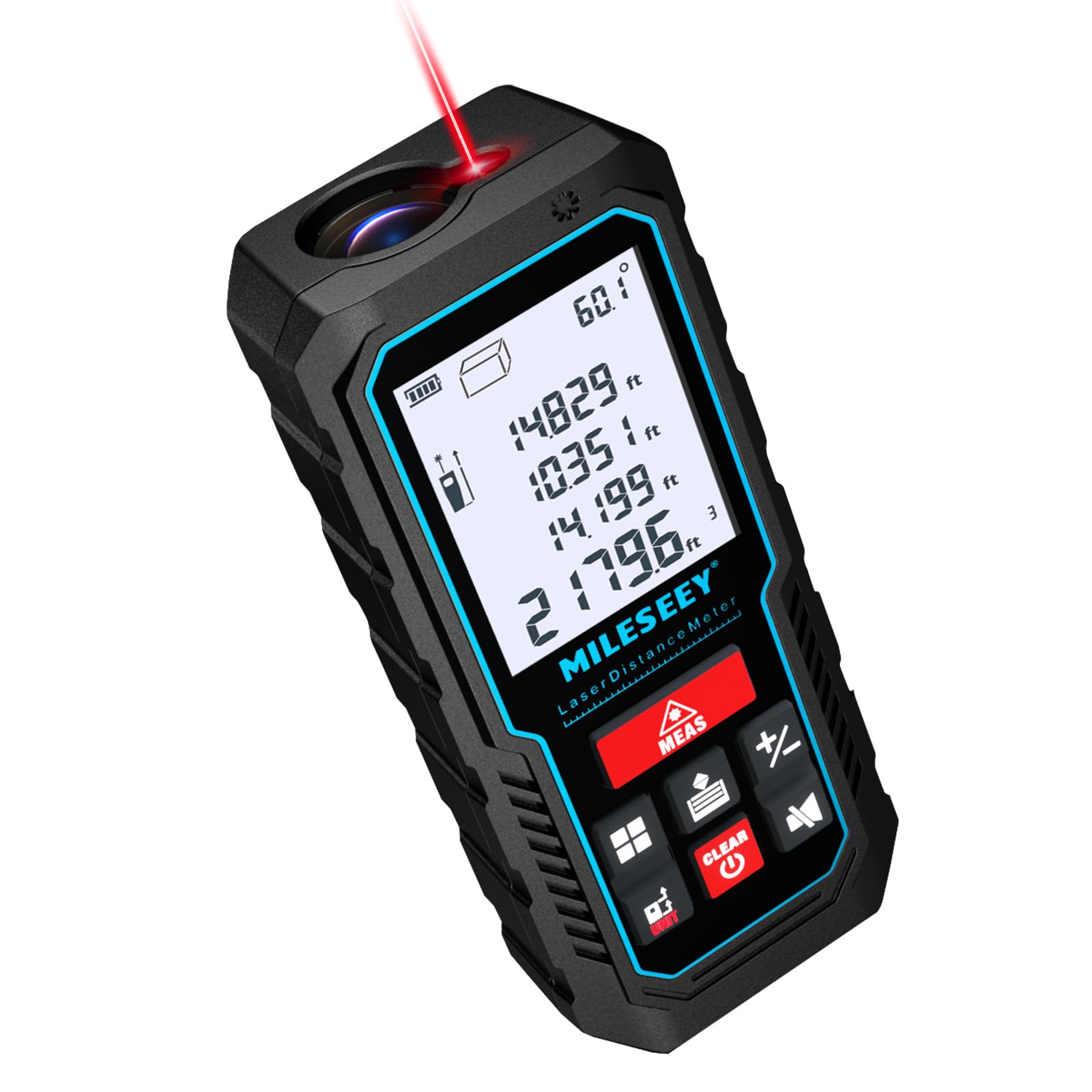
A 229-foot range and a half-second reading put the MiLESEEY D5 near the top of this group on reach, but the angle sensor is what makes it our default. We used it for room lengths and ceiling heights, and the auto-level mode takes the trigonometry out of a diagonal measurement: you line up the shot, let the tool work out the horizontal and vertical pieces, and keep your hands free for the next measurement.

The math modes cover the jobs that make a laser measure worth carrying. Area and volume calculations are built in, Pythagorean mode handles indirect heights, and the 30-record memory is more useful than the spec suggests: on a room with several openings, we took each width and subtracted later instead of writing on masking tape. The unit also switches between meters, feet, inches, and feet-plus-inches, which matters when a plan is in one system and the site is in another.

Indoors, the 180-gram body sits comfortably in one hand, and the pouch and wrist strap make it easy to keep track of between rooms. The 24-month warranty is longer than most here, which matters for a tool that lives in a bag. We also appreciated that it runs on two AAA batteries rather than a proprietary pack: fresh cells are easy to stow, and the tool is never sidelined waiting for a charge.

Bottom line: The MiLESEEY D5 is our default for most rooms, ceilings, and diagonal checks: 229 feet of range, an angle sensor, and area math without a pro-only workflow.

2

Bosch GLM165-25G Blaze

Bosch GLM165-25G Blaze

Bright-light visibility

Our Score 9.2/10
Check Price

Worth Noting

  • Premium price versus red-beam models
Beam
Green
Range
165 ft
Accuracy
±1/16 in
Ingress Rating
IP65

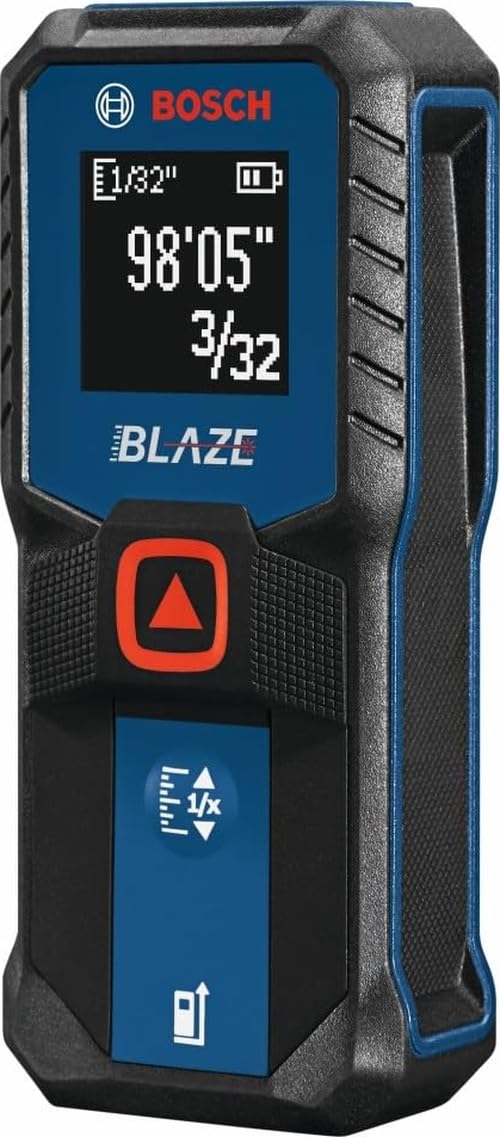
If your last laser measure disappeared against a sunlit wall, the Bosch GLM165-25G is the fix we hand people. Its green beam is the most visible dot in this group, bright enough to pick up across a room and in shade outdoors, and the rubber overmold wraps the impact points like a roll cage. This is the tool that feels like it belongs in a jobsite bag rather than a desk drawer.

The 165-foot range and ±1/16-inch accuracy are familiar numbers here, but the color display and reference-point options make the Bosch easier to live with. We could switch the measurement origin from the front, middle, or back of the housing depending on whether we were butting it against a wall or setting it on a surface—a small thing until you are measuring trim alone. Area, volume, and indirect measurements are all on board.

The catch is power. This Bosch runs on two AA cells and can drain them quickly, even when it is switched off, so we keep a spare pair in the case. That is the compromise for the bright green beam and sealed housing, and it is the part of ownership we mind most. The rubber cage and IP65 rating mean a wet concrete floor is not an emergency, which is more than we can say for the pocket models.

Bottom line: When the job is bright and the dot has to be findable, the Bosch GLM165-25G is the one we choose; its green beam and sealed housing are the most visible combination here.

3

Leica DISTO D2

Leica DISTO D2

Bluetooth floor plans

Our Score 9.4/10
Check Price

Worth Noting

  • Red dot is hard to see outdoors
Range
330 ft
Weight
4 oz
Accuracy
±1/16 in
Bluetooth
4.0

A floor-plan sketch is where the DISTO D2 separates itself. The 330-foot range covers long hallways and exterior spans, and Bluetooth 4.0 sends each measurement into compatible floor-plan and estimating apps instead of leaving you to transcribe a screen. We tested the handoff with a room sketch and found the value in the seconds saved between shots, not in a single flashy feature.

As a measuring tool, it is accurate to ±1/16 inch and compact enough to slide into a pocket at 4 ounces. The button is the part that slows us down: it takes a firm press, and when we were reaching across a room one-handed, we often braced the housing against a wall and used the other hand. That is a real annoyance in a tool built for solo work, but it does not affect the reading once the press lands.

The 10-measurement memory is modest compared with the 30-shot tools here, and the interface is built to send readings onward rather than store a long list. What you are buying is the Leica range, the app handoff, and a compact body that feels more precise than its size suggests. For a contractor, estimator, or anyone who turns measurements into drawings, that workflow is the reason to carry it; the measuring is merely very good.

Bottom line: For app-based floor plans and long interior spans, we reach for the Leica DISTO D2; Bluetooth and 330-foot range turn it into a workflow tool, not just a measuring stick.

4

DTAPE DT50 Laser Measure

DTAPE DT50 Laser Measure

Budget room measuring

Our Score 9.0/10
Check Price

Worth Noting

  • Red dot can vanish in bright light
Modes
8 modes
Range
165 ft
Accuracy
±1/16 in
Battery Life
5,000+ readings

The DT50 is the cheapest tool in this roundup, and it does not feel stripped down. You get a 165-foot range, ±1/16-inch accuracy, eight measurement modes, and a two-inch backlit display, all in a body that weighs about as much as a smartphone. The 0.4-second response is the part we noticed most: for room dimensions, you press, read, and move on before a tape measure would have locked.

Area, volume, and both single and double Pythagorean modes are here, along with continuous measurement and addition/subtraction. The 180-second auto-shutoff is long enough to set up a ladder shot without the screen going dark, and the rated 5,000-plus measurements on a set of batteries is generous for occasional DIY use. The two-year warranty is also longer than we expect at this end of the range.

Our reservation is consistency. Some units arrive with persistent error codes that stop a measurement cold, so we suggest running a few known distances as soon as it arrives, while the return window is open. If it passes that check, the DT50 covers the homeowner jobs that usually send people looking for a laser measure, and it leaves money for the tape and target card you will still want.

Bottom line: For indoor room measurements on a tight budget, the DT50 earns our recommendation: 165 feet, eight modes, and fast readings at the lowest price here.

5

Bosch GLM100-23 Blaze

Bosch GLM100-23 Blaze

Simple distance checks

Our Score 9.2/10
Check Price

Worth Noting

  • Not water- or dust-resistant
Range
100 ft
Weight
3.03 oz
Battery
2 AA
Accuracy
±1/16 in

The GLM100-23 is the laser measure we reach for when the job is simply 'how long is that?' A 100-foot range and ±1/16-inch accuracy cover most rooms, the backlit display is legible in a dark cabinet, and the two-button layout is about as uncomplicated as this category gets. One button measures; the other rounds the result.

We came to appreciate the rounding button more than we expected. Fractions of an inch are useful for trim, but they are noise when you are ordering a rug or checking whether a sofa fits; tapping the rounding button gives a cleaner number without a mental conversion. The 86-gram body disappears in a shirt pocket, and the two AA batteries are ordinary and easy to replace. That simplicity is the point: fewer modes, fewer wrong-button detours.

The trade-off is scope. This is a distance tool, and the two-button design is centered on measuring and rounding rather than area, volume, or indirect height calculations. If you are painting, flooring, or working from a ladder, one of the more feature-rich models here will save you a step. For the homeowner who measures a room once a month, the smaller feature set is easier to live with than a menu system.

Bottom line: We keep the Bosch GLM100-23 for the simplest jobs: point, measure, round, and move on. The two-button layout is the least fussy here.

6

Klein 93LDM100C

Klein 93LDM100C

Pocket indoor use

Our Score 9.0/10
Check Price

Worth Noting

  • Display is hard to read in sunlight
Range
2 in to 100 ft
Weight
2.29 oz
Display
Reverse-contrast LCD
Accuracy To 30 Ft
±1/16 in

The 93LDM100C is built around a single button and a pocket clip, which tells you most of what Klein thinks this tool is for: quick indoor readings you can take without unpacking a full kit. It measures from 2 inches to 100 feet, which is a usefully low floor when you are checking inside a cabinet or between a door and its frame. The reverse-contrast LCD is easy to read in dim rooms, and the 65-gram body disappears in a shirt pocket.

The one-button design cuts both ways. It is genuinely quick for a single distance, but changing settings means cycling through modes with presses and holds, and a press that is too quick can land you in the wrong place. We kept the cheat sheet handy until the sequence became muscle memory. For basic room measurements, the speed is welcome; for anything beyond a simple distance, the process is less direct than a keypad.

What we like most is the size-to-capability balance. A 100-foot range in a tool this small is more useful than a larger measure you leave in the truck, and the pocket clip makes it easy to keep close. The accuracy is ±1/16 inch for the first 30 feet and ±1/8 inch out to 100 feet, so it is a better fit for room checks than for finish carpentry at long range. For a tool that lives in a pocket, that trade is easy to accept.

Bottom line: The Klein 93LDM100C is our pick for pocket carry and quick indoor readings; the reverse-contrast display and 100-foot range make it an easy everyday tool.

7

ACEGMET S9 Laser Measure

ACEGMET S9 Laser Measure

Ultralight long range

Our Score 9.0/10
Check Price

Worth Noting

  • Shiny targets can block a reading
  • 18-month warranty is shorter than most
Range
229 ft
Memory
30 readings
Weight
1.76 oz
Response
0.5 sec

At 50 grams, the ACEGMET S9 is the lightest way to get a 229-foot measuring range in this group. It slips into a shirt pocket, and the two bubble levels help you hold it level when you are checking a wall or setting out a post. For a tool that costs less than most of the alternatives here, the feature list is not thin: distance, area, volume, Pythagorean mode, and 30 stored readings.

The 0.5-second response is quick enough that we stopped thinking about the button press, and the 30-record memory is generous at this end of the range. We used it for longer room dimensions and for checking the height of a ceiling span, and the small body was easy to brace against a door frame when we needed a stable reference. None of that feels like a stripped-down tool.

The catch is confidence. Accuracy is the part of the S9 we trust least; readings are consistent enough for estimating and room checks, but this is not the tool we reach for when a finish carpenter needs a number to the sixteenth at long range. Indoors, with a steady brace, it is a useful planning tool; on a job where the number has to be final, choose a model with a stronger accuracy record here.

We keep the S9 as a lightweight backup and a first laser for someone who wants long range without spending much. It is not the most precise tool here, and it is not our first choice for daily jobsite use, but it is the one that disappears into a pocket and still reaches across a warehouse. That combination earns it a place for occasional measurement, not for the measurement that has to be perfect.

Bottom line: We recommend the ACEGMET S9 when long range needs to fit in a pocket; it reaches 229 feet at 50 grams and adds area, volume, and 30-reading memory.

How We Tested Laser Distance Measurers

We built the shortlist by pulling specs and prices for two dozen laser measurers, then narrowing to 12 that covered the range of what people actually buy: compact pocket models, mid-size units with area and volume functions, and a couple of outdoor-oriented designs. Anything with a listed range under 100 feet, a display that looked like a calculator watch, or a battery door that felt flimsy on arrival got cut before testing. The 12 that remained went through six months of ordinary jobs—measuring rooms before furniture purchases, checking wall lengths for paint and wallpaper, hanging shelves, and walking a backyard fence line.

Accuracy and measurement performance got the most repetitive check: ten readings at 3, 10, and 25 feet against a steel tape, then a second round to see whether the unit returned the same number twice. I handed each one to my partner, who had never used a laser measurer, and asked for a room length with no instruction—then watched where their thumb went. Functionality came down to the area, volume, and Pythagorean modes: I used them for a paint estimate and a vaulted ceiling.

Battery life was tracked across six months—measurements per charge, whether auto-off was sensible, and whether the battery compartment survived a toolbox. Laser visibility and display readability were checked in direct sun and dim basements; I noted whether the dot showed on drywall, brick, and tree bark, and whether the screen washed out at an angle. We triggered error codes on purpose by aiming past max range, at a dark curtain, and into bright light, then judged whether the message explained the problem. Quality and reliability came down to button feel, housing creak, and whether readings drifted over a few months. The keepers stayed consistent indoors, outdoors, and in a first-timer's hands.

How to Choose Laser Distance Measurers

Start With the Longest Sightline You'll Measure

Measure the longest clear line you expect to shoot, not the largest number on the box. Most room dimensions top out well under 100 feet, so the Bosch GLM100-23's 100-foot range is enough for indoor work; 165 feet and beyond is for long rooms, warehouses, and exterior spans. Accuracy matters more than range at close quarters: ±1/16 inch is the useful benchmark, and a tool that drops to ±1/8 inch past 30 feet is still fine for room checks but not finish carpentry. If you work outdoors, judge the range claim against bright light, not the spec sheet.

Decide Whether You Need Area, Volume, and Indirect Modes

Area, volume, and indirect modes are what turn a laser measure from a distance finder into a planning tool. Area and volume give you square footage or cubic feet from two or three shots; Pythagorean modes combine shots to calculate a height you cannot reach. They need clear line of sight and a steady aim, so they are not a fix for an obstructed corner. If you paint, lay flooring, or hang cabinets, pay for these modes. If you only check lengths, the simpler Bosch GLM100-23 is easier to live with.

Treat Laser Visibility as a Jobsite Condition

Red dots are fine indoors and frustrating in direct sun. Green beams are brighter and easier to pick up in shade or a bright room, but even a green dot can disappear against a sunlit exterior wall. If outdoor work is regular, choose a green-beam model and a housing rated for dust and splashes, such as the Bosch GLM165-25G. If it is occasional, a red-beam tool is the better value, but plan to work closer or in shade. A bright screen and a clear dot matter more day to day than a long range claim.

Choose Controls You Can Run One-Handed

Most measurements are taken alone, often with one hand holding the tool and the other steadying a ladder. Two-button layouts are easier to learn; single-button tools are smaller but make mode changes a sequence of presses and holds. Check the display in dim light, and look for feet-inch-fractions if you work in imperial. A backlit screen and a front-to-rear reference switch matter more day to day than a long feature list. If you change modes often, a keypad is worth the extra size; if you mostly take one distance at a time, the pocket tools make sense.

Plan for Power, Data, and Warranty

AA and AAA cells are easy to replace, but some tools drain them even when off; keep spares in the case. Bluetooth is worth paying for if measurements go into floor plans or estimating software, not if they go into a notepad. A one- or two-year warranty is ordinary here; longer coverage is a genuine tiebreaker on a tool that lives in a bag. Data memory is the quiet convenience: 30 readings save a room walkthrough, while 10 readings fill up fast when you are sketching a whole floor.

Frequently Asked Questions

Final Verdict

We recommend the MiLESEEY D5 for most people. Its 229-foot range, angle sensor, and area and volume modes cover the room, ceiling, and diagonal measurements that send most shoppers looking for a laser measure, and the 30-reading memory keeps a multi-room walkthrough from turning into a notepad exercise.

If bright light is the obstacle, choose the Bosch GLM165-25G for its green beam and sealed housing. If your measurements need to go straight into floor-plan software, the Leica DISTO D2 is the better workflow tool. Buy for the conditions you actually work in; the longest range on the page is not automatically the most useful.