Tools & DIY

Best Laser Level of 2026

A laser level is a small box that throws a perfectly straight line across a room so you can stop squinting at a bubble vial and start trusting the wall. What separates a good one from a maddening one rarely shows up in the specs: whether the beam survives a sunlit kitchen, whether the pendulum settles on a wall that's a degree out of plumb, and whether the mount holds when your elbow catches the tripod. Get those right and hanging a shelf stops being a two-person argument.

I've hung plenty of shelves the old way, and I've also watched a green beam rescue an entire Saturday. Over the past six months my team and I ran 12 laser levels through real jobs — a bathroom tile wall, a basement framing project, a run of upper cabinets — and the keepers settled fast and stayed put. One thing nobody tells a first-time buyer: green reads brighter to the eye but drains batteries faster, so red is often the smarter call for occasional indoor work. The picks below earned their spot in the toolbox.

1

CIGMAN CM-701 3x360 Laser Level

Top Pick
CIGMAN CM-701 3x360 Laser Level

Whole-room layout

Our Score 9.2/10
Check Price

Worth Noting

  • No detector bundled for outdoor work
Beam
Green
Battery
4000 mAh rechargeable
Laser Lines
12 (3 x 360°)
Ingress Rating
IP54

Three planes at 360 degrees is why the CM-701 sits at the top of this list. One horizontal ring and two vertical rings mean you set the tool down once and read level, plumb, and square off the same box, instead of shuffling a cross line around the room for every wall. During a cabinet and baseboard run in the same room, the lines were where we needed them before the tape came out. That's what you're paying for here: coverage, not a second line.

It levels itself inside about four degrees, and when it's tilted past that the lines flash rather than quietly lying to you. Lock the pendulum and you get manual mode for stair strings and raked ceilings, which is the setting that keeps a self-leveling tool useful when the work isn't flat. The green line is easy to read across a lit room, and you notice that most on a long wall where a red beam would need shading with your hand.

The kit is the other half of the argument: magnetic L-bracket, mini tripod base, target plate, remote, and a hard case, all for roughly what a bare two-line cross laser costs. What it will not do is daylight. Sunlight swallows the beam within a few feet, so treat it as an indoor tool and plan the outdoor jobs around something else.

Bottom line: Our default for interior layout: three green 360-degree planes, a remote, and a rechargeable kit for about what a plain cross-line laser costs.

2

DEWALT DW088K Cross Line Laser

DEWALT DW088K Cross Line Laser

Everyday cross-line work

Our Score 9.4/10
Check Price

Worth Noting

  • Red beam fades in bright light
  • No 360° coverage, cross line only
Beam
Red cross line
Range
165 ft with detector
Drop Rating
1 m
Ingress Rating
IP54

Red, and that colours everything about the DW088K. Indoors against a white wall the cross line is easy to read from across the room; near a window at midday, or anywhere outside, it thins to almost nothing. If your site has daylight coming in, plan around it, because this beam won't cut through a bright room.

What you get back is the most settled two-line tool in this group. It self-levels the moment the pendulum is unlocked, the housing is IP54 with a 1-meter drop rating, and the bracket clamps to steel studs and corner bead without a second hand. Three years of warranty is the longest cover here outside the Huepar, and for someone who wants one line at a time with the least fuss, that matters more than another plane.

Range is where it separates from the cheap 360s: with a detector it reaches 165 feet, which turns it into an outdoor and large-room tool as well as an indoor one. The detector is sold separately, and that's the honest math. One warning worth passing on: a knock that throws a self-leveling unit out of calibration isn't something you fix at home, so keep it in its case between jobs.

Bottom line: The simplest laser here that still earns its keep: self-leveling, drop-rated, and backed for three years, as long as your work stays out of bright light.

3

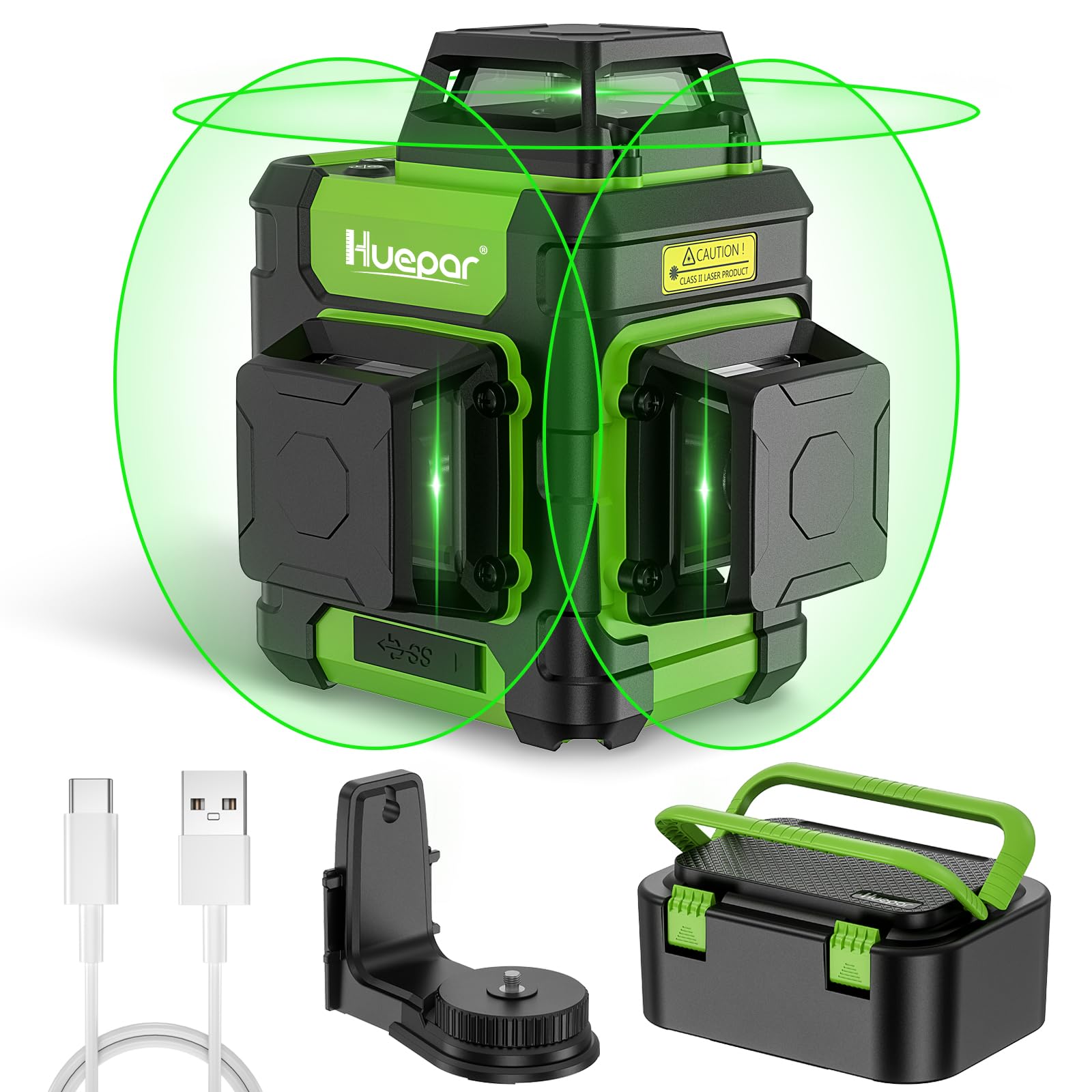
Huepar HM03CG 3x360 Laser Level

Huepar HM03CG 3x360 Laser Level

Budget 360 layout

Our Score 9.2/10
Check Price

Worth Noting

  • No remote or tripod in the kit
Beam
Green
Runtime
8 hours
Warranty
5 years
Laser Lines
3 x 360°

Open the case and there's more than you expect at this price: a magnetic bracket, a hard shell, a USB-C cord, and a rechargeable battery rated for around eight hours of use. The head projects one horizontal and two vertical 360-degree planes in green, each switchable on its own, so you can run a single ring for a floor line or all three to square a room.

Setup takes a couple of minutes of button-pressing and no manual reading. The self-leveling window is standard for the class, the lines blink when the tool is out of range, and pulse mode is there for receiver work. Across a lit room the green is bright enough to work from, which is the thing that makes a cheaper laser usable rather than a toy.

Against our top pick you give up some battery capacity and a couple of extras, and you save a substantial amount of money. We take the CIGMAN for a full renovation and this one for everything else — shelving, tile, a ceiling fan, hanging a door — because the coverage is identical and the extras are the parts you use least.

Bottom line: The best value in the group — the same three green 360-degree planes as our top pick, minus the remote and tripod, for a good deal less.

4

Huepar B03CG Laser Level with Tripod

Huepar B03CG Laser Level with Tripod

Kit with tripod

Our Score 9.0/10
Check Price

Worth Noting

  • Battery can stop holding a charge
Beam
Green
Tripod
Included, adjustable legs
Battery
5200 mAh rechargeable
Laser Lines
3 x 360°

This is the HM03CG's three-plane idea with a stand in the box: a compact tripod with adjustable legs and a crank column that lifts the lines to working height without a stack of books. For one person marking a ceiling or a long wall, that isn't a small addition. It's the difference between setting up once and chasing the tool along the floor between marks.

Weigh the tripod honestly. Topped out around 1.2 meters, it's right for floors and low walls, and for ceiling work you'll be setting it on a table or a step. Otherwise the kit is right: 5200 mAh over USB-C, a hard case with a separate pouch for the stand, and three bright green planes with pulse mode. This is the version to buy when the job is a two-hand one and there's no second pair of hands available.

Bottom line: Buy the kit if you work alone: the tripod holds the lines while both hands are free, and the level itself is the same three-plane Huepar we rate highly.

5

DEWALT DW089LG 3x360 Green Laser

DEWALT DW089LG 3x360 Green Laser

Large job sites

Our Score 9.2/10
Check Price

Worth Noting

  • Detector for the full range is sold separately
Beam
Green, 3 x 360°
Battery
12V MAX lithium-ion
Accuracy
±3 mm at 10 m
Ingress Rating
IP65

The price is the first thing to say out loud. This is the most expensive laser here by a wide margin, several times the cost of our value pick for the same three planes of coverage, and the decision only makes sense if the tool works for a living.

What the money buys is a site tool rather than a project tool. The housing is IP65 instead of IP54, which is the difference between surviving dust and spray and merely surviving dust, and the battery is a 12V MAX pack that swaps with the rest of a DEWALT kit, so a flat laser is a battery change rather than a wait. Pulse mode, a ceiling bracket, and both 1/4- and 5/8-inch threads round out a kit that slots into a truck already carrying the platform.

Green helps, and only so much: the beam is easier to pick out than the red DW088K under fluorescent light and still fights direct sun. There are units where the line splits or doubles at distance, which is worth checking across a long wall in the first week while the warranty is fresh.

Stated accuracy is plus or minus 3 mm at 10 m, a figure that only matters at the range this tool is built for. Laying out a warehouse or a commercial fit-out, the combination of range, sealing, and swappable power is worth the premium, and the three-year warranty backs it. Tiling one bathroom, our value pick does the same job for a fraction.

Bottom line: For crews using a laser every day: IP65 sealing, detector range, and a 12V pack that swaps with your other DEWALT tools — overkill for a weekend shelf.

6

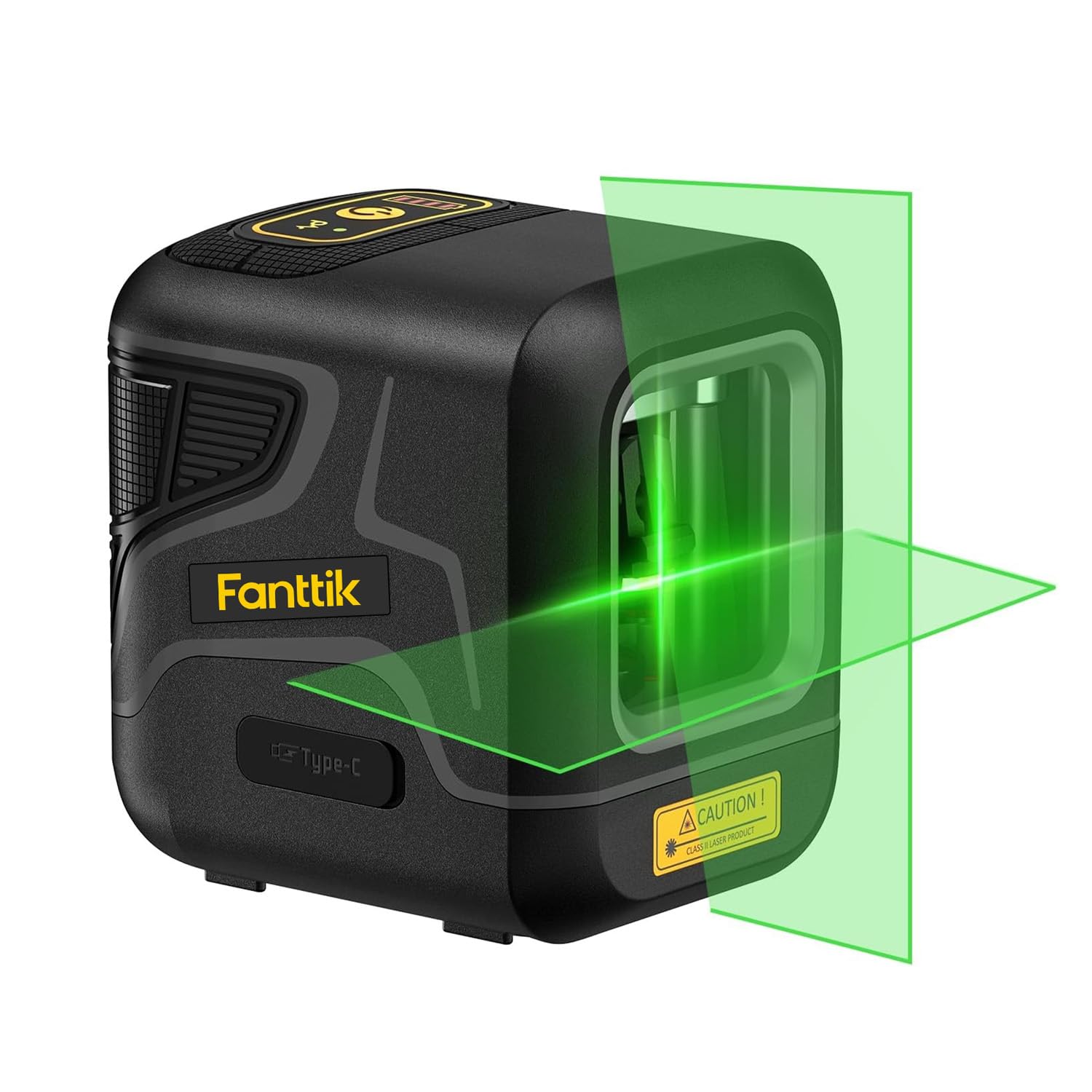
Fanttik D2 Pocket Laser Level

Fanttik D2 Pocket Laser Level

Picture hanging

Our Score 9.0/10
Check Price

Worth Noting

  • Cross line only, no 360° planes
Beam
Green cross line
Battery
2200 mAh rechargeable
Runtime
Up to 10 hours
Rotation
360°

Three inches square, rechargeable, and the one we hand anyone with an afternoon and a row of frames to hang. The D2 is small enough to live in a kitchen drawer between jobs, and its green cross line is bright at the distance that matters — a wall, a few feet away, in ordinary room light.

The details are thought through. The head rotates a full turn on its base, so you line up one frame, swing the beam to the next, and never re-level; the magnetic bracket sticks to a door hinge or a steel stud at exactly the height you want. Ten hours from a 2200 mAh cell over USB-C, plus pulse mode for a receiver Fanttik doesn't include.

Self-leveling is where to slow down. On a surface that isn't close to flat the beam blinks rather than settling, and getting a lock has been finicky on some units, so set it on something solid, check the line against a level the day it arrives, and use the returns window if it wanders. Everything else about it is the easiest buying decision on this page.

Bottom line: The one to keep in a drawer: a pocket-sized green cross line that hangs a gallery wall in minutes, as long as two lines are all you need.

7

Klein 93LCLS Cross Line Laser

Klein 93LCLS Cross Line Laser

Ceiling grid work

Our Score 9.0/10
Check Price

Worth Noting

  • One-year warranty is short for the price
Beam
Red cross line + plumb spot
Range
150 ft indoor
Weight
1.6 lb
Ingress Rating
IP54

The plumb spot is what makes the 93LCLS different: a dot dropped onto the floor so you can transfer a point from a ceiling line without a helper holding a tape. For drop ceilings, can lights, and anything that starts overhead, that single feature earns its place faster than 360 degrees of coverage ever does.

The rest is built for trade work: a 360-degree bracket with rare-earth magnets, 1/4- and 5/8-inch threads, a hang hole, and a clamp designed to sit on ceiling grid crossbars. The 150-foot indoor range and IP54 body are in the same class as the DEWALT cross line, and the hard case is one of the better ones here.

Two things hold it back. The beam is red, so a finished room with the lights on has you squinting at the wall. And the magnets, which are the part of the bracket you reach for first, are the weakest piece of an otherwise sturdy mount, so up a ladder we use the clamp or a thread rather than trusting them alone. For electricians and ceiling crews that's an acceptable trade for the plumb dot. For a homeowner it's a lot of money for two lines and a dot.

Bottom line: The trade's choice for overhead work: a plumb dot and a ceiling-grid clamp do what 360 planes can't, though the red beam wants a dim room.

8

IKOVWUK B1-12 12-Line Laser Level

IKOVWUK B1-12 12-Line Laser Level

DIY 360 layout

Our Score 9.2/10
Check Price

Worth Noting

  • Accuracy can drift out of true
Battery
5200 mAh
Runtime
Up to 8 hours
Laser Lines
12 (3 x 360°)
Self-leveling Range
±3°

Twelve lines and a remote for less than most of this group. The B1-12 lets you switch individual planes on and off from across the room, which sounds like a gimmick until you're the one up a ladder trying to find the button without knocking the tool off level.

The 5200 mAh battery is the largest capacity here, rated to about eight hours, and it charges over USB-C. Pulse mode drops the green to a weaker output for receiver work, and the L-shaped magnetic bracket plus metal sheet let you hang it off a stud, a duct, or a steel door frame.

The beam is where this one shows its price. The three planes are all there and the self-leveling window is about three degrees, but the vertical lines come out dimmer than the horizontal, and across a big room the line thins sooner than the green beams on the Huepar units.

So the advice is simple: set it up, strike a line, and check it against a long spirit level before you cut anything. If it's true, it's a great deal of tool for the money; if it isn't, send it back inside the returns window. First-time buyers are better served by the CIGMAN, and picture hangers by the Fanttik.

Bottom line: Worth a look on a tight budget: 12 lines and a remote control, provided you check the lines against a spirit level before trusting a room to it.

How We Tested the Best Laser Levels

We started with every self-leveling and manual laser level we could find in the range most homeowners actually shop, then cut the list to 12 based on working range, beam color, mounting hardware, and whether the pendulum locked for transport. The shortlist ran from the usual tool-aisle names to a couple of smaller outfits sold mostly online.

Accuracy got checked the boring way. Two of us snapped a chalk line across a 30-foot basement wall, set each level on a tripod at one end, and measured how far the beam drifted from the chalk at the far end; we repeated it at 3 feet for tile and cabinet work, then marked the line with a pencil to see if it wandered while we worked.

Brightness we judged where it counts — a sunlit kitchen with the blinds open, outdoors on a deck at midday, then again in a dim basement — noting when we had to cup a hand around the receiver to find the line. For self-leveling, we set each unit a few degrees off on an uneven floor and timed how long the beam took to stop blinking, and how far out of level it would tolerate before refusing to settle at all.

Every level took a tumble off the top of a 6-foot stepladder onto concrete and rode in a tool bag with drill bits for the rest of testing, which told us plenty about durability. We stuck each magnet mount to a steel stud, a metal door frame, and the side of a fridge, then nudged it to see if it slid. And we handed each one to a neighbor who had never used a laser level, timing how long it took from unboxing to a usable line and whether the case, bracket, and batteries justified the money.

How to Choose the Right Laser Level

Green or red, and the light it has to survive

Green reads further and clearer in a lit room; red costs less and draws less power. What buyers get wrong is the range claim. A 100-foot or 165-foot figure usually assumes a detector picking up a pulsed beam, not your eye on a wall, so a laser that claims huge reach can still be a tool you can only use indoors in the evening.

For interior remodeling, green is worth paying for. For outdoor layout, budget for a detector in the same purchase as the laser, because it isn't the kind of accessory you add later when the beam disappears at midday.

Cross line or three 360-degree planes

A cross line projects one horizontal and one vertical plane on the wall in front of you: enough for shelves, tile, outlets, and a row of cabinets. Three 360-degree planes wrap the room, so you can square a floor against two walls from a single setup without moving the tool.

Our rule is simple. One wall at a time is cross-line work; anything involving two walls or a ceiling is 360 work. The bigger units cost more, weigh more, and drain battery faster, so buy the coverage you'll use rather than the coverage that looks impressive in the listing.

Self-leveling range, and what the flashing means

Every self-leveling laser works inside a window, three or four degrees on most of the models here, and blinks when it's tipped past it. That blinking is the feature, not a fault: a line that flashes is telling you it isn't level. The tool to worry about is the one that keeps projecting a steady line from a bad position.

Lock the pendulum and most of these switch to manual mode for stair strings and drainage falls. If your work never includes a deliberate slope, you don't need to pay for it, but check that the base is stable before blaming the tool for a line that won't settle.

Mounts, power, and the setup nobody plans for

Magnets, threads, and clamps decide how quickly you get the line where it needs to be. Magnets are wonderful on steel studs and useless on wood framing, which is where 1/4- and 5/8-inch threads and a short tripod earn their place. On power, a sealed rechargeable pack ties you to a charger; a tool-platform battery such as DEWALT's 12V is the better answer if you already own the platform.

One thing we insist on is a compact tripod. It does more for a steady, repeatable line than any feature printed on the box, and it's the difference between one person setting up and one person holding.

Frequently Asked Questions

Final Verdict

The CIGMAN CM-701 is the one we buy: three green 360-degree planes, a remote, a rechargeable battery, and enough mounting hardware in the case to handle most rooms without a trip to the store. It's the shortest path from unboxing to a squared room, and nothing else here covers as much for the money.

If the budget is tighter, the Huepar HM03CG keeps the three planes and drops the remote and tripod base. If a laser pays your bills, the DEWALT DW089LG's IP65 body, detector range, and swappable 12V pack justify the jump, and its three-year warranty is the kind of cover a site tool should carry.