Tools & DIY

Best 3D Printer Filament of 2026

Filament looks like the simplest thing you can buy for a 3D printer: a spool of plastic, wound tight, sold for roughly the price of a takeout dinner. What separates a good one from a bad one never shows up in the listing photo. It's how closely the diameter holds to 1.75 mm, how dry the spool stayed before it reached your door, and whether the color wound on the reel matches the color that comes off the nozzle. Get those wrong and your evening disappears into re-leveling the bed and picking strings off a half-finished print instead of starting the next job.

I've got a shelf of spools I regret buying, and I suspect most people who print for a while end up with one. Over the past four months my team and I have run 16 spools through our machines, from plain PLA to PETG to a couple of matte and silk blends, and the pattern is hard to miss: the pricier spool isn't automatically the better one, and the soft chalky finish that photographs so well often turns out to be the fussiest about bed adhesion and layer bonding. Every pick below earned its spot on a print bed, not on a spec sheet.

1

ELEGOO Matte PLA 4KG

Top Pick
ELEGOO Matte PLA 4KG

Everyday matte prints

Our Score 9.2/10
Check Price

Worth Noting

  • Palette is four pastels with no black or white
Colors
Sakura pink, lavender purple, ice blue, sunshine yellow
Spools
4 × 1 kg
Material
Matte PLA
Diameter Tolerance
±0.02 mm

Four one-kilo spools arrive in a single box, and that arithmetic is what won us over: this is the least expensive way to buy PLA here, and it buys matte filament rather than plain gloss. The matte surface is the part we did not expect to care about. On a printed bracket the layer lines all but disappear, so a functional part looks molded instead of stacked.

Printing is where it takes the top spot. Ours fed cleanly, held dimension across a plate, and turned out the smoothest surfaces in this group — the finish hides exactly the small artifacts a glossy spool amplifies. The colors are all soft pastels: sakura pink, lavender purple, ice blue, sunshine yellow. Lovely on a shelf, useless for a black bracket, and a genuine limitation for anyone printing as much utilitarian black as we do.

First layers on a smooth plate can be fussy with matte PLA, and a textured PEI sheet with a slower first layer is what settled it for us. Winding is the other variable: if the filament starts tugging at the extruder mid-print, stop and rewind rather than letting the extruder fight the spool. Neither is a dealbreaker, and the four kilos here are the ones we reach for first when a print has to look finished.

Bottom line: Our default PLA: four kilos that swallow layer lines, at the lowest cost per kilo of PLA in this guide.

2

SUNLU PLA 1KG Black

SUNLU PLA 1KG Black

Cheapest daily driver

Our Score 9.0/10
Check Price

Worth Noting

  • Consistency varies from spool to spool
Spools
1 × 1 kg
Material
PLA
Nozzle Range
200–230 °C
Diameter Tolerance
±0.02 mm

A single black kilo is the least glamorous thing in this guide and the spool most printers will spend the most hours eating. At the lowest spool price here, it is what you buy when a printer has just landed on the bench and you want to be printing rather than comparing bundles.

The numbers behind it are unremarkable in the right way: 1.75 mm with a ±0.02 mm tolerance, a 200–230 °C nozzle window, and a spool 8 inches across with a 2.2 inch hub that drops onto every common holder in our workshop. Nothing about that is a compromise; it is the standard the rest of the category is measured against.

Bed adhesion is the variable to plan for. On glass it either grabs hard or barely at all depending on first-layer squish, and a glue stick sorts that out faster than changing settings. What we keep this spool for is grunt work — jigs, fit tests, the prototypes that get sanded or thrown away — and a cheap black kilo that behaves is exactly the right tool for that.

Bottom line: This is the spool we hand to a new printer owner: cheap, dependable black PLA that gets you printing tonight.

3

Creality PLA 2-Pack

Creality PLA 2-Pack

Black-and-white utility

Our Score 9.0/10
Check Price

Worth Noting

  • Only black and white, no other choices
Colors
Black and white
Spools
2 × 1 kg
Material
PLA
Warranty
1 year

Black and white are the colors that vanish into a project: the bracket, the jig, the knob that broke on a Sunday. Creality sells them as a two-kilo pair, and that is the whole idea — one box covering the prints that never get photographed.

The specifications carry this one, because there is not much else to say about black PLA. Both spools are 1.75 mm at ±0.02 mm, the material is starch-derived, and the listing claims compatibility with FDM and FFF printers that have a heated bed, which covers everything we had on the bench. White earns its place too: diffusers, labels and two-tone faces are all easier with a roll of it sitting next to the black.

In use it is ordinary in the way a good utility filament should be — square corners, plain gloss, no surprises, and you stop thinking about it two layers in. The reason to pick this over a cheaper single kilo is the pairing rather than the plastic, since buying white on its own usually means a second order. A one-year warranty on a consumable is the detail that tips it: if a spool arrives wet or badly wound, you have somewhere to go.

Bottom line: We like this pair for the brackets and jigs nobody photographs, and for the one-year warranty behind them.

4

SUNLU PETG 4KG

SUNLU PETG 4KG

Tough, outdoor parts

Our Score 9.2/10
Check Price

Worth Noting

  • Four kilos of one color only
Colors
Black
Spools
4 × 1 kg
Material
PETG
Diameter Tolerance
±0.02 mm

The part that fails first on a PLA print is usually the one in a hot car or at the bottom of a toolbox: PLA softens, then cracks. This is the spool we load when a part has to survive that, and it is the only PETG in the guide. It sits between PLA and ABS in the useful way — tougher than one, easier to print than the other — and it is sold as UV and moisture resistant, which is what makes it the outdoor choice rather than the indoor one.

Four kilos, all black, held to ±0.02 mm, with layer adhesion as the headline property. It prints hotter and slower than PLA and it strings while you dial it in; a dry spool and a little more retraction handle most of that, and once the settings settle it runs as predictably as anything here.

The finish is the surprise. It comes off the plate glossy, close to semi-gloss, which flatters a bracket and makes a figurine look like a hardware-store part. That is a fair summary of what this spool is for: things that get bolted, clipped or left outside, where the shine is the last thing anyone notices.

Bottom line: Our pick when a part has to survive heat, sun or a drop — four kilos of tough PETG, all in black.

5

ELEGOO PLA Plus 8-Pack

ELEGOO PLA Plus 8-Pack

Color sampling

Our Score 9.0/10
Check Price

Worth Noting

  • Fixed eight-color set, no swaps
Colors
Eight, black through sea green
Spools
8 × 250 g
Material
PLA+
Diameter Tolerance
±0.02 mm

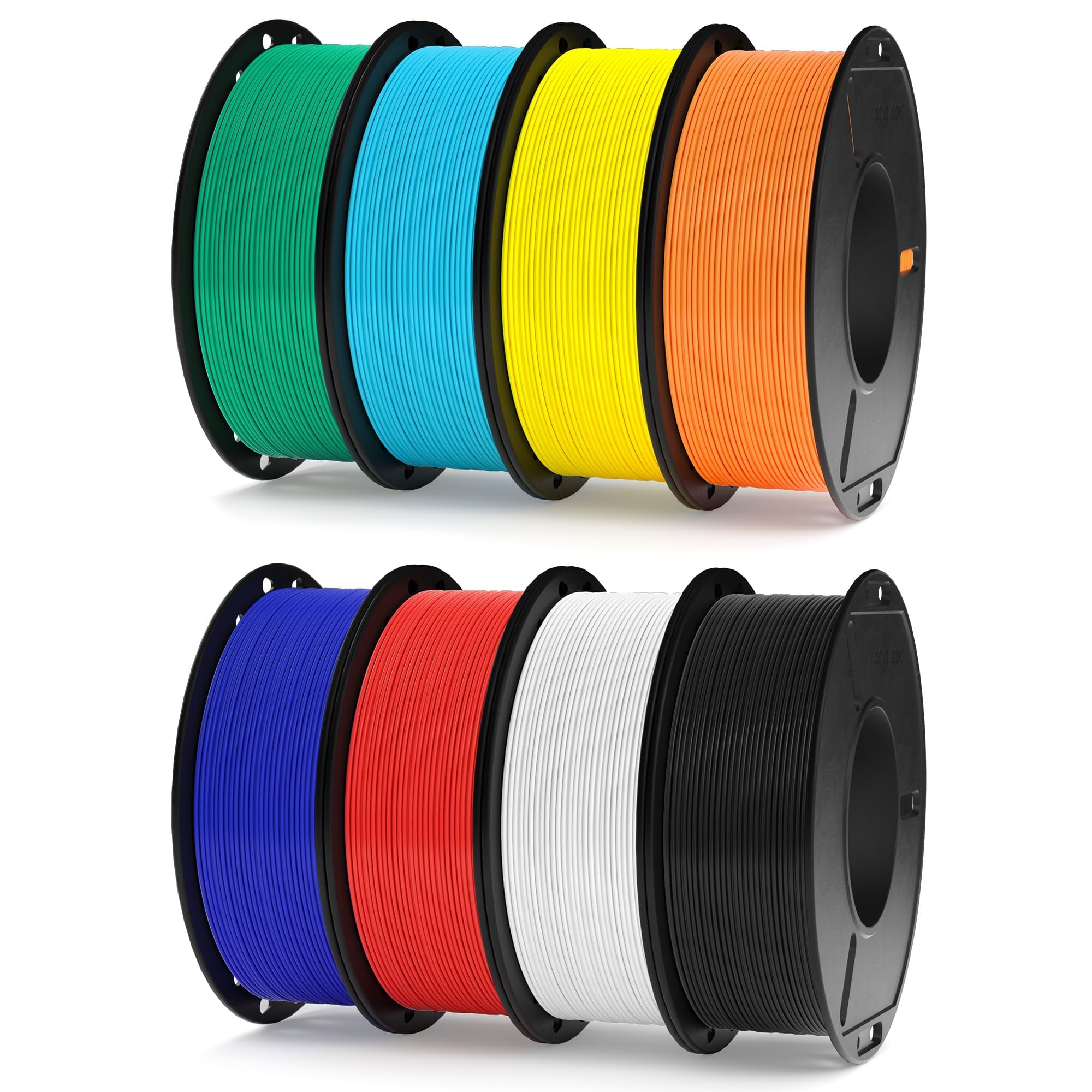
Eight colors is easy to want; eight kilos is not. This bundle splits the difference with eight 250 g spools, so you get a full palette without dedicating a shelf to it, or spending a kilo of plastic on a color you turn out not to like.

The material is PLA+, formulated for more impact strength than standard PLA — the difference you notice when a printed clip flexes instead of snapping. Diameter is held to ±0.02 mm and each spool is vacuum sealed with desiccant, so an unopened color is still good when the project that needs it finally arrives.

Small spools are their own skill. A 250 g roll is light enough that the free end gets away from you, and once it loops under a later wind it jams hours into a print, so clip the end to the spool every time you unload. Handle that and the small format stops being a hazard and starts being the point.

The palette is the practical middle — black, white, red, dark blue, orange, yellow, sky blue, sea green — with no glitter, no pastel and nothing you have to design around. For a printer that mostly makes toys, brackets and school projects, that is a more useful set than any four-kilo box of two colors, and it is why this one stays loaded on our color shelf.

Bottom line: We reach for this when a project wants color: eight 250 g spools, enough palette without a kilo of anything you will regret.

6

ERYONE Silk PLA

ERYONE Silk PLA

Decorative silk models

Our Score 8.8/10
Check Price

Worth Noting

  • Brittle
Spools
1 × 1 kg
Material
Silk PLA
Nozzle Range
190–220 °C
Diameter Tolerance
±0.03 mm

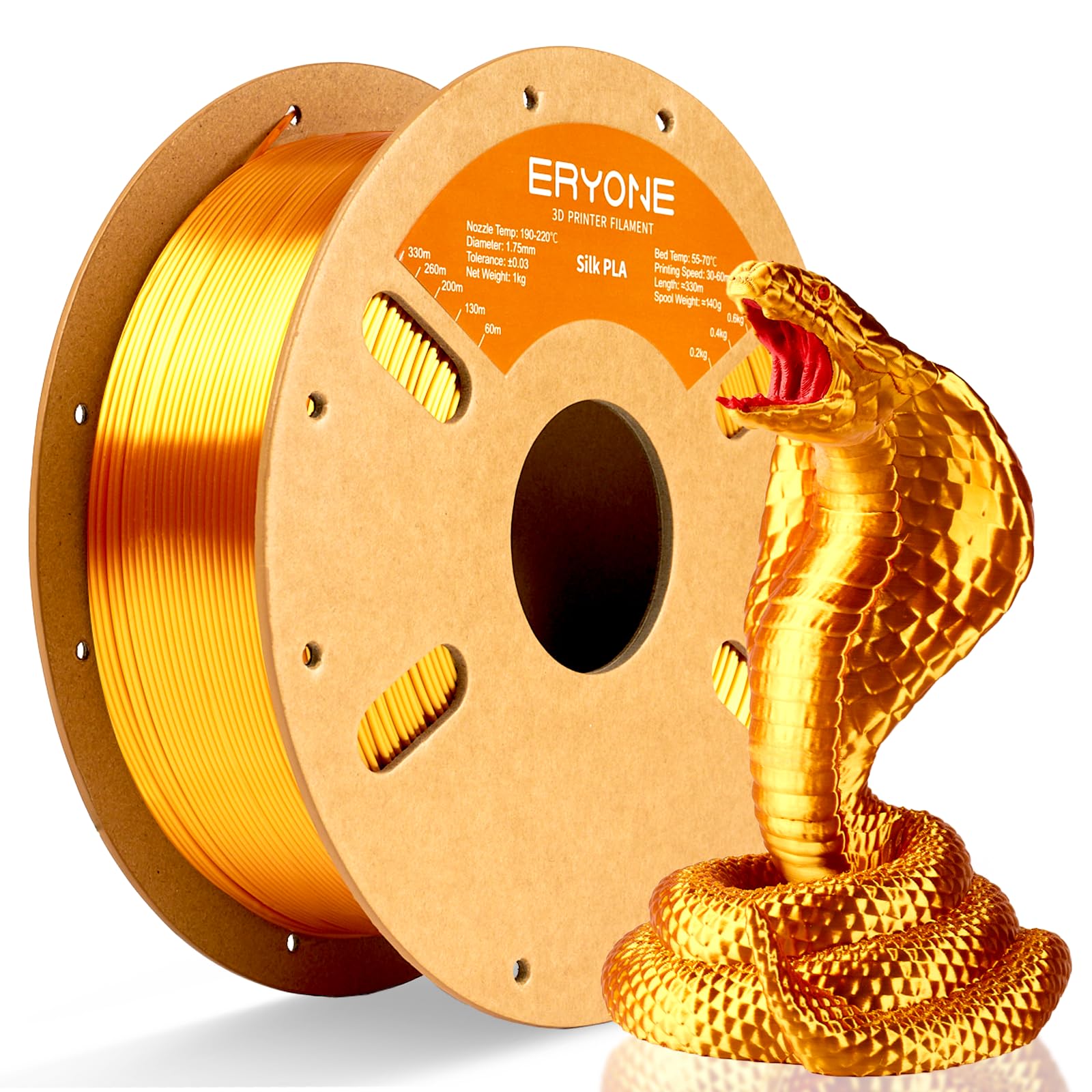
Silk PLA is a look, not an upgrade. Liquid Gold prints as a warm, shifting gold with a sheen that reads as metal under a desk lamp, and no sanding or painting gets you there — which is exactly why a spool of it lives next to the ordinary black on our shelf. If a model is going on a shelf rather than into a hinge, this is the finish we choose.

It behaves like PLA otherwise: a 190–220 °C nozzle window, low warp, minimal odor, and a full kilo on the spool rather than a sample. For decorative work that is all you need, and the printing has been smooth enough that we stopped treating silk as a temperamental material.

Where it gives ground is detail. The sheen catches layer lines that matte quietly hides, so a silk print needs a finer layer height to look as good as the same model in matte. The ±0.03 mm tolerance is also looser than the ±0.02 mm most of this guide holds, and on a part that has to fit another part, that is the margin to watch. Decorative pieces, not assemblies.

Bottom line: We keep a spool of this for display pieces: a convincing metallic gold that needs no paint.

7

YOOPAI PLA+ 8-Pack

YOOPAI PLA+ 8-Pack

Bambu AMS users

Our Score 8.8/10
Check Price

Worth Noting

  • 250 g per color means changeovers
Spools
8 × 250 g
AMS Fit
Spool adapter included
Material
PLA+
Diameter Tolerance
±0.03 mm

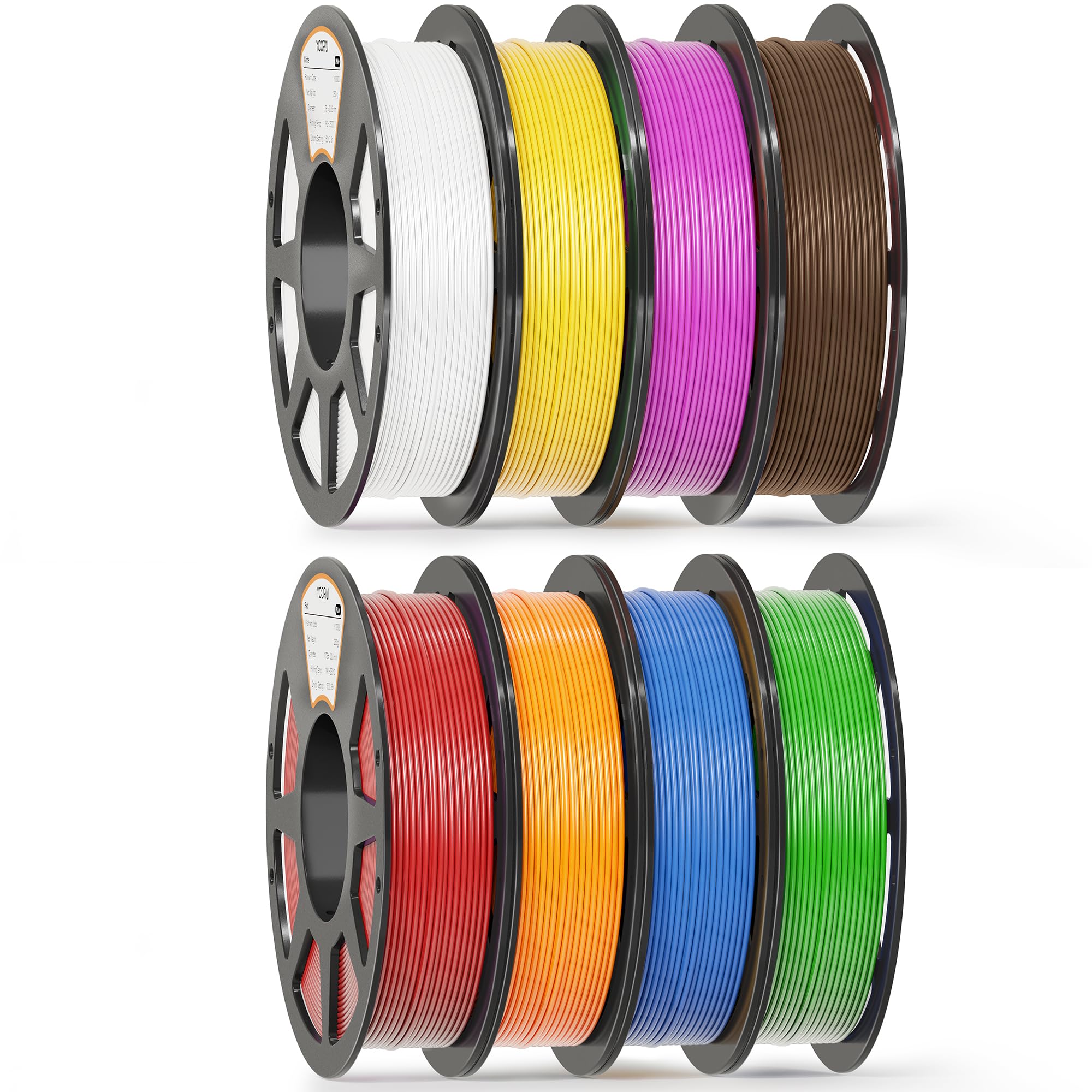
There is a small plastic adapter in the box, and it is the first thing to fit. These are 250 g spools, and in a Bambu Lab AMS a spool that light and narrow can sit loose and bind instead of rotating; YOOPAI ships the adapter specifically so it seats properly. Fit it once and the small format stops being an issue.

Eight colors, and they run warm: cocoa brown, pumpkin orange, magenta, mistletoe green, plus white, yellow, red and cyan. This is the bundle we reach for when a print wants to look like a toy rather than a prototype. The material is PLA+, so it takes a flex where plain PLA would crack, which matters on anything with a clip or a snap fit.

Each spool is individually vacuum sealed, so the colors you are not using stay dry, and generic PLA+ profiles get you a usable first print — which counts for more than any figure on the listing when a new bundle lands and you want to see it work. Between this and the cooler ELEGOO eight-pack, the choice is palette and machine: AMS owners take this one, everyone else can go either way.

Bottom line: We point Bambu owners here first: eight warm-toned PLA+ spools that fit the AMS once the included adapter is on.

8

Meuymeu Glow & Silk 8-Pack

Meuymeu Glow & Silk 8-Pack

Glow and effects

Our Score 8.2/10
Check Price

Worth Noting

  • 200 g spools, the smallest here
  • Glow needs a strong charge to show
Spools
8 × 200 g
Material
Tricolor silk and glow PLA+
Diameter Tolerance
±0.03 mm

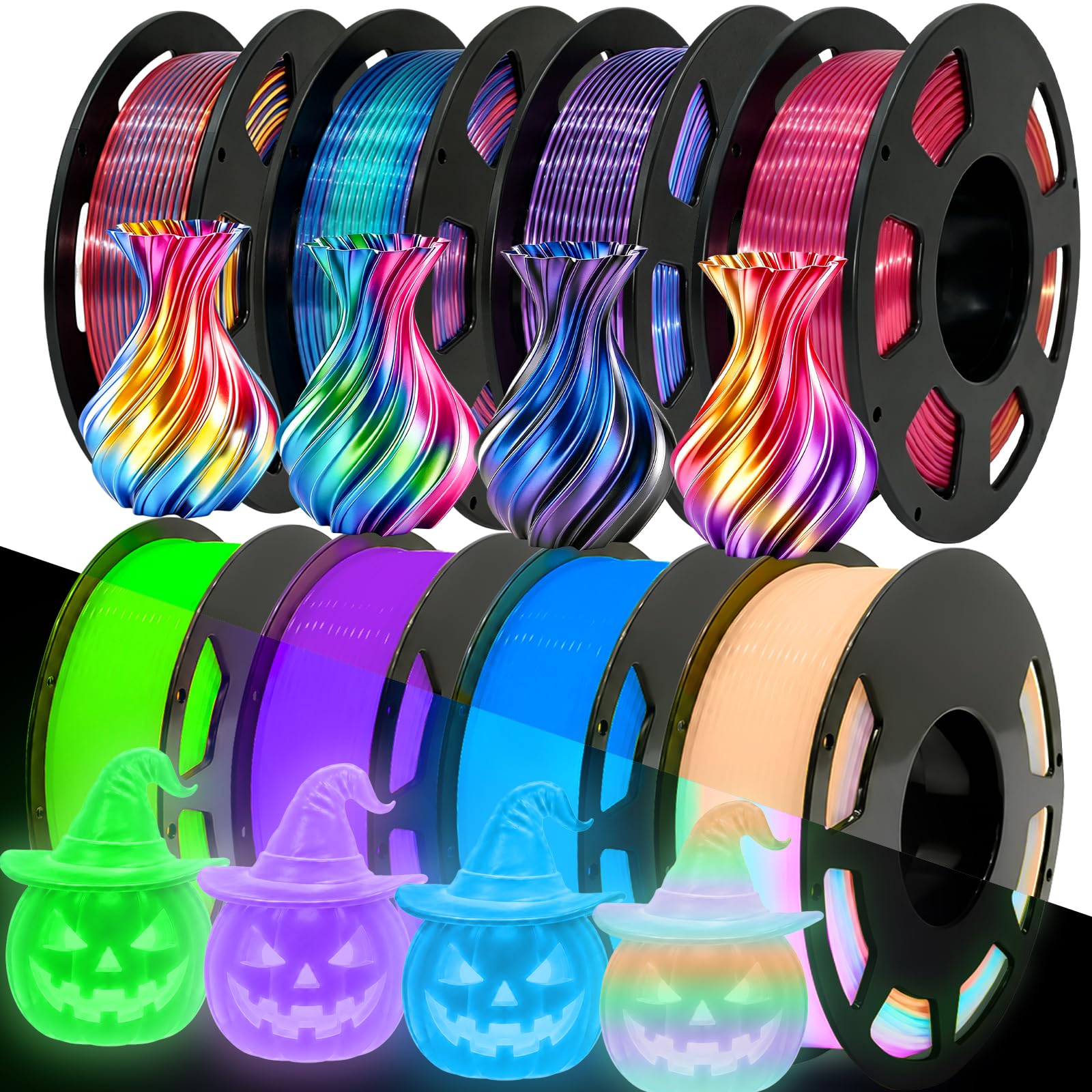
Two visual tricks share one box: four spools of tricolor silk and four that glow in the dark, 200 g each. Neither is a material anyone builds a bracket from, and that is fine — this is the bundle for the print someone picks up off the shelf and turns over in their hands.

The silk spools are coextruded, with three colors running through a single strand rather than blending along the length. A single spool shifts through red, blue and gold as a curved surface turns away from the light, which is the effect a multi-material unit normally gets you, without owning the unit.

The glow spools charge under sunlight or UV and then emit light in the dark, and they come in the four colors you want for it: rainbow, purple, sky blue and light green. Both halves are held to ±0.03 mm, the loosest tolerance in this guide, which tells you what they are for — objects that are looked at, not objects that are measured.

Our honest read is that the effects are real and the spools are small. Anyone printing functional parts will run through 200 g before the trick gets old; anyone printing keychains, dragons and lanterns will find this is the box they keep reaching into. Buy it as a treat alongside a working spool, not as the working spool.

Bottom line: We keep this for the fun shelf: four tricolor silk spools and four that genuinely glow, in the smallest spools here.

How We Tested 16 Spools of Filament

We started with everything we could find in stock in a standard 1.75 mm diameter, about 60 candidates across PLA, PETG, matte, and silk blends, then narrowed by price per kilogram, published diameter tolerance, spool type, and the size of the color range each line offered. Sixteen made the cut, and each one stayed in our print room for the full four months rather than getting a single test print and a send-off.

Every spool printed the same three jobs: a 20 mm calibration cube, a small articulated figure loaded with retraction moves, and a phone stand with a wide flat footprint. We ran the stand on a textured PEI sheet and on bare glass to see which spools grabbed the bed on the first layer and which needed a brim, then checked back after six hours for lifted corners. Calipers came out at ten points around each spool to see how far the diameter wandered, and we logged every clog, skipped extrusion, and tangle that killed a print overnight. Each spool got weighed before and after, too, since a kilogram spool that yields 850 usable grams isn't the bargain it looks like.

Color and appearance had their own pass. We printed the same model from two different spools of the same color to catch batch-to-batch drift, then photographed the matte and silk options under one lamp to see which ones genuinely softened layer lines and which made them louder. Finished prints sat on a sunny windowsill for a few weeks and got flexed, dropped, and shoved around a workbench. The question we kept coming back to was dull and decisive: did the printer finish the job without me standing over it?

How to Choose the Right 3D Printer Filament

Start with the material, then pick the spool

PLA is the default because it prints cool, warps little and looks clean, and it is what most models, toys and light brackets want. PLA+ is the same family with more impact strength — the difference you feel when a printed clip flexes instead of snapping. PETG is the step up for parts that live outdoors or take a knock: tougher, and sold as UV and moisture resistant, but stringier and glossier than PLA. Print one thing and print PLA; print things that get used and keep a PETG spool beside it.

Compare grams per dollar, not price per spool

Bundles make the arithmetic slippery. A four-kilo box of 1 kg spools and an eight-pack of 250 g spools can look similarly priced while one delivers four times the filament, so divide what you pay by the grams in the box before either looks like a bargain. The other half of the sum is time: 250 g disappears mid-print on anything large, and a changeover on a nine-hour job costs more than the small saving it bought. Weight matters more than the headline on the listing.

Tolerance and winding decide how it feeds

Diameter tolerance is the figure worth checking. ±0.02 mm is the tighter and more common number in this set; ±0.03 mm is perfectly workable for decorative prints but leaves an extruder more to compensate for on parts that must fit together. Winding is just as important and much harder to judge online. Neatly cross-wound spools feed at even tension, while a spool with strands crossing over each other snags and either slips at the extruder or grinds a flat spot into the filament. Stop the print if you feel a tug, and check the spool's width and hub against your holder before you buy a bundle.

Finish and color are where the money actually goes

Matte PLA hides layer lines and makes a print look molded. Silk shifts and shines, shows layer lines more, and is more brittle. Glow and tricolor effects belong on objects that get handled and shown. Then read the color list itself, because that is where bundles surprise people: four pastel shades will not print a black bracket, and a set built around pink and lavender is a poor fit for anyone printing replacement parts. Match the palette to the prints you actually make rather than to the photograph on the listing.

Frequently Asked Questions

Final Verdict

If you print PLA and want one decision made for you, load the ELEGOO matte bundle. Four kilos that feed cleanly, hide layer lines and work out to the lowest cost per kilo of PLA here is a straightforward trade for giving up black. Keep a single SUNLU black kilo for jigs and fit tests, and move to the SUNLU PETG the moment a part will sit outside or take a knock.

Silk, glow and eight-color boxes are for the prints people pick up off the shelf. Buy them after the everyday spool is sorted, not instead of it.