Tools & DIY

Best Multimeters of 2026

A multimeter's whole job is to tell you the truth, and a meter that reports a confident wrong number is worse than no meter at all. I've used them to chase dead outlets, sort out a flickering light, and figure out whether a car battery was actually flat, and the difference between a good one and a frustrating one shows up fast. What you're really buying is a safe, accurate answer when something electrical isn't behaving, plus the ease of use to get that answer before you lose patience.

Over the past six months, my team and I worked through 14 multimeters, from simple auto-ranging models to feature-heavy handhelds, and kept asking whether the extra functions justified the price. We checked accuracy against a reference meter, lived with each one on home repairs, automotive troubleshooting, and small electronics projects, and paid attention to the stuff that rarely makes the spec sheet: test leads that kink or slip, dials that feel vague, and casings that don't survive a drop. A first-time buyer tip: more functions don't automatically mean a better meter—if the display is hard to read or the leads are stiff, you'll use it less. The picks below are the ones that earned a spot in the toolbox.

1

Crenova MS8233D

Top Pick
Crenova MS8233D

All-round home and auto

Our Score 9.2/10
Check Price

Worth Noting

  • One-year warranty trails several rivals here
Ranging
Auto and manual
Included
Carry case, test leads, alligator clips
Safety Rating
CAT III 600V
Display Counts
6000 counts

The Crenova arrives with a case, a set of test leads, and a set of alligator clips, which is the kind of completeness that decides whether a meter gets used or ends up in a drawer. Clips earn their keep more than they sound like they will: they hold the probes on a battery terminal or a terminal block and leave both hands free while a reading settles.

The specification that sold us is 6000 counts with True RMS at a mid-group price rather than a premium one. True RMS is not decoration. On a dimmer, an inverter, or a motor circuit the waveform is not a clean sine, and an averaging meter can report the wrong voltage on exactly the loads people most want to check. Ranging switches between auto and manual, so a quick check takes one dial turn and a wandering reading can be locked down.

Safety is where this one is stronger than several meters here: CAT III 600V, overload protection on every range through two built-in fuses, and non-contact detection with a sound and light alarm for finding a live wire before you put a probe near it. The 6000-count display is clear with the backlight on, and the rated operating window runs from 32 to 104 degrees Fahrenheit, which covers a cold garage as well as a hot one.

The body is chunky, at 0.55 kg and close to an inch and a half thick, so this lives in a toolbox rather than a shirt pocket. That is not a complaint about how it handles. Weight on a bench is a small virtue when a stiff lead is pulling at the meter, and nothing about the size gets in the way of taking a reading.

Bottom line: For anyone who wants one meter for household, automotive, and light bench work, this is the one we point to: True RMS, 6000 counts, and a case with clips included.
2

Klein Tools MM325

Klein Tools MM325

Home wiring checks

Our Score 9.4/10
Check Price

Worth Noting

  • 2 MΩ resistance ceiling
  • No capacitance, frequency, or temperature
Current Range
10A DC
Safety Rating
CAT III 600V
Voltage Range
600V AC/DC
Test Lead Alert
LED indicators

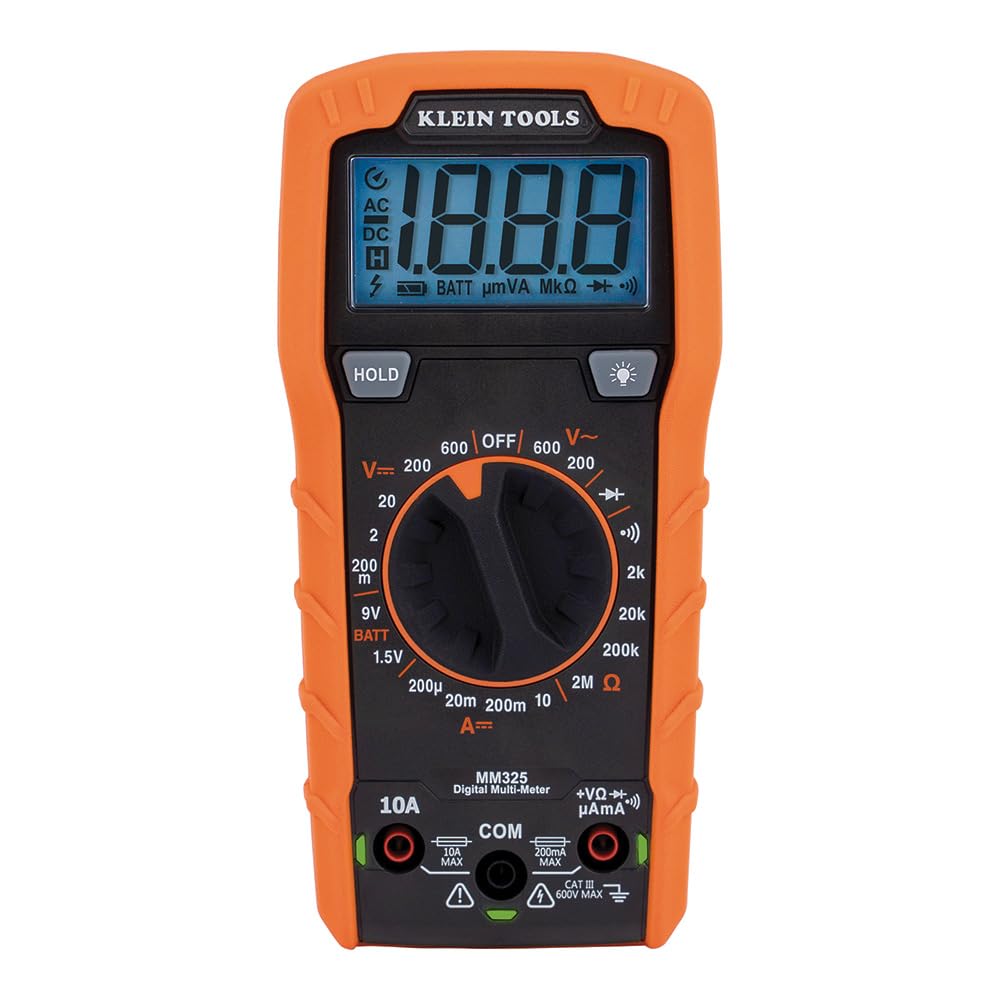
Plug a lead into the wrong jack on the MM325 and a pair of LEDs lights up before you take a reading. It sounds like a small courtesy until you are working near a live panel and the meter is quietly telling you which socket your hand just went to.

Everything else is deliberately plain: manual ranging, 600V AC/DC, 10A DC current, continuity with a buzzer, diode and battery test, a backlit display, a kickstand, and slots on the back that hold the test leads. The shell is the sturdiest here, a rubberized case that does not flex when you squeeze it.

Where it gives ground is range, which makes this a wiring and automotive meter rather than a bench instrument. We reach for it for outlets, switches, continuity, and a car battery, where manual ranging is an advantage: the range you pick stays picked, with no display hunting while the meter makes up its mind. The magnetic hanger that makes it genuinely hands-free is a separate Klein accessory rather than part of the box, so add one if the meter is going to hang on a panel.

Bottom line: A wiring-first meter we trust: lead-alert LEDs, a CAT III 600V rating, and the sturdiest shell here, as long as you don't need capacitance or high resistance ranges.

3

AstroAI TRMS 6000

AstroAI TRMS 6000

Bench and automotive

Our Score 9.2/10
Check Price

Worth Noting

  • One of the heavier meters here at 492 g
Fuses
F400mA/600V and F10A/600V ceramic
Weight
1.08 lb
Functions
Capacitance, frequency, temperature
Display Counts
6000 counts

The display is why this AstroAI stays within reach: a large backlit LCD on a kickstand, readable in a dim corner without hunching over it. It is the meter we grab when the reading has to be taken under a dash or inside a cabinet, where a small screen means a phone flashlight held in your teeth.

The rest of the package is the broadest here short of the Fluke 117: AC/DC voltage and current, resistance, capacitance, frequency, duty cycle, diode, continuity, and temperature through the supplied socket. Auto-ranging, data hold, and auto shut-off are all present, and a magnetic strap on the back hangs the meter off a metal enclosure. That strap is the accessory we appreciated most, because it turns a two-hand job into a one-hand one.

Two ceramic fuses, F400mA/600V and F10A/600V, sit behind the overload protection, which is the right specification at this level. The leads are the part most likely to let you down first, so a spare set is worth having in the bag before you need one.

Bottom line: The most capable meter here before you reach Fluke prices: temperature, capacitance, frequency, and a display you can read across a dark garage.

4

Fluke 117

Fluke 117

Professional daily use

Our Score 9.6/10
Check Price

Worth Noting

  • No case or magnetic hanger in the box
  • 689 g is heavy in a belt pouch
True RMS
Yes
VoltAlert
Non-contact AC detection
Low-Z Mode
Yes
Battery Life
400 hours typical

VoltAlert changes how you work. Run the meter's tip along a cable or hold it near an outlet and it tells you AC is present with no lead plugged in, so finding the breaker that feeds a receptacle becomes a two-minute sweep instead of a walk back to the panel.

Low input impedance is the second trick, and the one electricians pay for: it drains ghost voltage so a conductor that is actually dead stops reading a phantom voltage. AutoVolt picks AC or DC for you, True RMS keeps non-linear loads honest, and the backlight is bright enough for a dark basement.

Battery life is rated at 400 hours typical without the backlight, which is the kind of figure that makes you stop thinking about batteries. It is a substantial meter, at 689 g and a little under seven inches tall, with a ceramic HRC fuse protecting the current ranges and a case that you will have to supply yourself.

We recommend it to people who use a meter as a tool rather than a curiosity: it is the fastest of these to deploy on a live panel and the safety margin is real. For a homeowner checking batteries and outlets a few times a year, the Crenova measures the same things for a fraction of the outlay. The Fluke is what you buy when the meter pays for itself.

Bottom line: The meter we trust on a live panel: VoltAlert, low-Z ghost-voltage rejection, True RMS, and a build that survives daily use, worth it if the meter earns its living.

5

AstroAI M4K0R

AstroAI M4K0R

First true-RMS meter

Our Score 9.4/10
Check Price

Worth Noting

  • No temperature or frequency functions
  • No case in the box
Battery Test
1.5V, 9V, 12V
Safety Rating
CAT III 600V
Voltage Range
600V AC/DC
Display Counts
4000 counts

Dedicated battery settings for 1.5V, 9V, and 12V cells are what separate this AstroAI from the rest of the budget meters here. When a smoke alarm starts chirping at two in the morning, the question is whether the battery is flat or the detector is at fault, and a battery mode answers it faster than a voltage range and a mental conversion.

This is the meter we hand to someone learning the dial rather than letting the meter decide: 4000 counts, True RMS, auto-ranging, non-contact detection with a sound and light alarm, capacitance, a backlit display, and a small light built into the top edge. At 219 g and just under six inches tall, it disappears into a glovebox or a toolbag.

Safety is CAT III 600V with two ceramic fuses, the rating we look for on anything that will see household wiring. For a meter this light, that is the combination worth having: it can sit in a car for a year and still be the right tool when something quits.

Set against the Crenova, it gives up 2,000 counts and the alligator clips, and gains a lighter body and a lower outlay. For a hobbyist, a first meter, or a second one for the car, that is a trade we make without hesitation.

Bottom line: The best value in this group for a first true-RMS meter: battery test modes, non-contact detection, and a backlit screen in something light enough to leave in the car.

6

TESMEN TM-510

TESMEN TM-510

Absolute beginners

Our Score 9.2/10
Check Price

Worth Noting

  • CAT II 600V rating rules out panel work
Weight
3.53 oz
Included
Storage bag, test leads, AAA batteries
Safety Rating
CAT II 600V
Display Counts
4000 counts

If the person holding the meter has never used one, this is the one we suggest. The TM-510 smart auto mode reads whatever the probes touch and picks the measurement itself, so there is no dial position to get wrong, which is the most common reason a first reading comes back as a confusing near-zero.

It is light, around 100 g, and comes with a storage bag, test leads, and AAA batteries, so it can live in a kitchen drawer or a glovebox without anyone worrying about it. Non-contact detection with an audible alarm, a backlight, a flashlight, data hold, and auto shutdown round out the package. Outlets, batteries, continuity, and 12V automotive checks are all within reach without a manual.

Two boundaries are worth knowing before you buy. The safety rating is CAT II 600V, a step below the CAT III meters here, so it is for outlets, cords, and bench work rather than anything inside a distribution panel. And in auto mode a voltage under 0.8V is treated as resistance instead of volts, so a completely dead cell reads as a resistance value rather than zero. Once you know that, it makes sense; until then, it looks broken.

Bottom line: The meter we hand to a first-timer: smart auto mode picks the measurement for you, so an outlet check or a battery test needs no dial decision at all.

7

KAIWEETS KM100

KAIWEETS KM100

Glovebox spare

Our Score 9.0/10
Check Price

Worth Noting

  • No AC current measurement
  • AC accuracy is the least dependable here
Current
DC only
Display
Backlit LCD
Included
Carry case, 2 AAA batteries
Safety Rating
CAT III 600V

The KM100 is the least expensive meter here, and it is shaped to that brief: a compact body, a backlit screen, a carry case, and AAA batteries already installed. For a meter that lives in a kitchen drawer and comes out twice a year, that is a sensible thing to be.

On paper it covers the basics properly: AC/DC voltage, DC current, resistance, continuity, and diode test, with data hold, double fuses, and a CAT III 600V rating that matches meters further up this list.

Treat it as a spare rather than a primary, and that is not a slight. A second meter that lives in the car is the reason you do not have to walk back to the bench, and this one carries the safety rating and the case to do that job. For a fault you will have to explain to someone else, the True RMS meters above earn their extra.

Bottom line: A glovebox spare rather than a primary meter: small, case-equipped, and cheap, but its AC accuracy is the least dependable in this group.

8

Fluke 101

Fluke 101

Pocket electronics

Our Score 9.4/10
Check Price

Worth Noting

  • Ships without a case
Weight
5.64 oz
Safety Rating
CAT III 600V
Maximum Voltage
600V
Basic DC Accuracy
0.5%

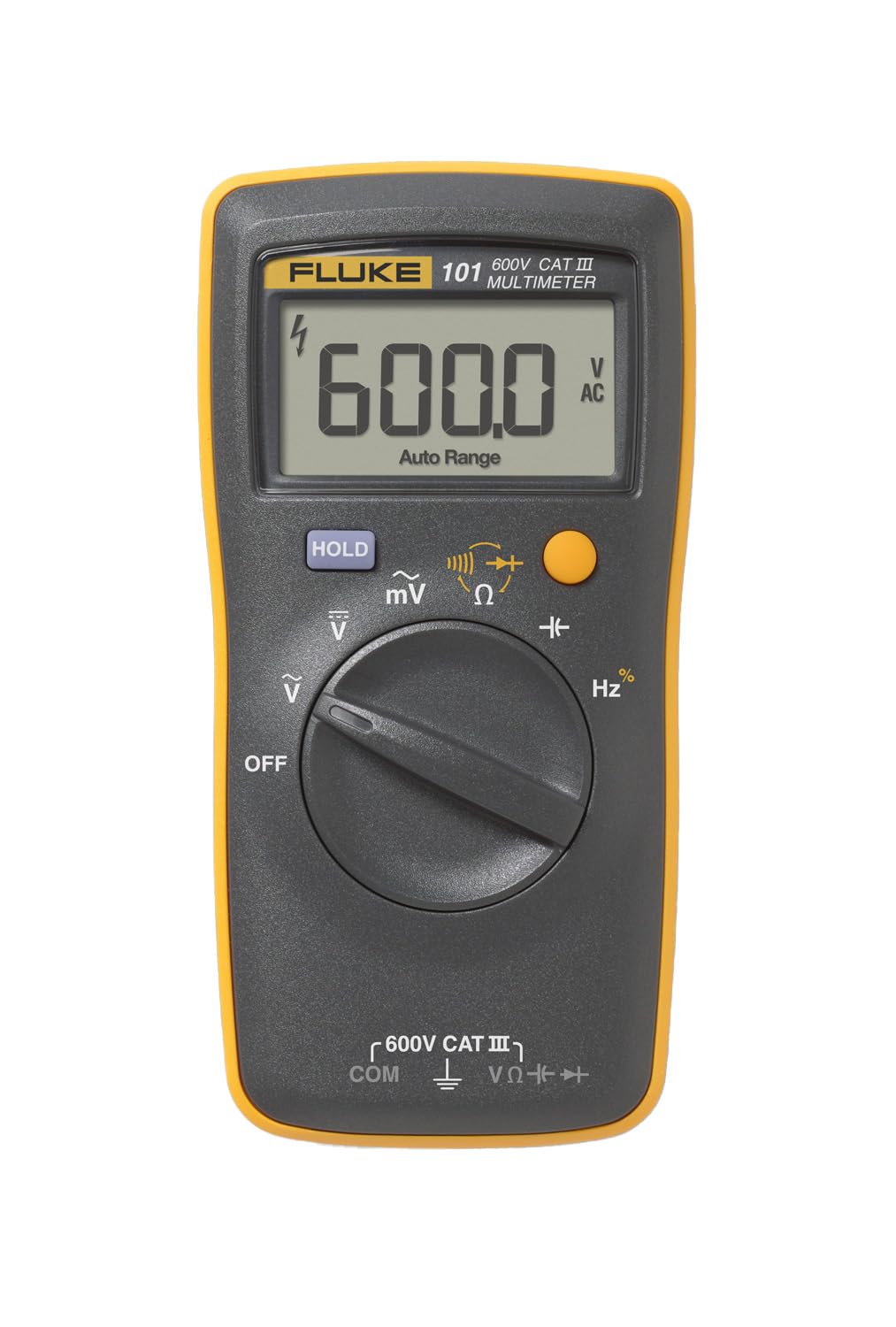
The 101 is the Fluke you buy when you want the name, the accuracy, and nothing else. It is palm-sized, 160 g, with a fixed dial, diode and continuity test, and a basic DC accuracy of 0.5%.

It is CAT III 600V rated, rugged, and small enough to disappear into a shirt pocket. For voltage, resistance, and continuity, which is most of what anyone actually does, it is as pleasant as anything here: one dial, one clear reading, no menus to page through.

The catch is what is not there. The 101 does not measure current at all, AC or DC, so it cannot tell you what a motor is drawing or run a parasitic-drain test on a car. If current is on your list, and for most people buying a general-purpose meter it is, this is not the one.

The leads are the other soft spot. They work, but they are the part of this meter that gets replaced, and a set of fine-tipped silicone leads is worth adding if you are probing boards rather than terminals.

That leaves two buyers: the electronics tinkerer who already owns a current-capable meter and wants Fluke accuracy in a pocket, and anyone who would rather have a meter that is always with them than one that does everything. If a single meter has to cover the whole house, the Crenova or the AstroAI 6000 covers more ground.

Bottom line: Fluke accuracy in a pocket-sized body for voltage, resistance, and continuity work, as long as you can live without current measurement, which this one skips entirely.

9

Klein Tools MM320KIT

Klein Tools MM320KIT

New-home outlet checks

Our Score 9.4/10
Check Price

Worth Noting

  • Meter is manual-ranging only
Included
Multimeter, two voltage testers, case
Current Range
10A DC
Voltage Range
600V AC/DC
Voltage Tester Range
12 to 1000V AC or 70 to 1000V AC

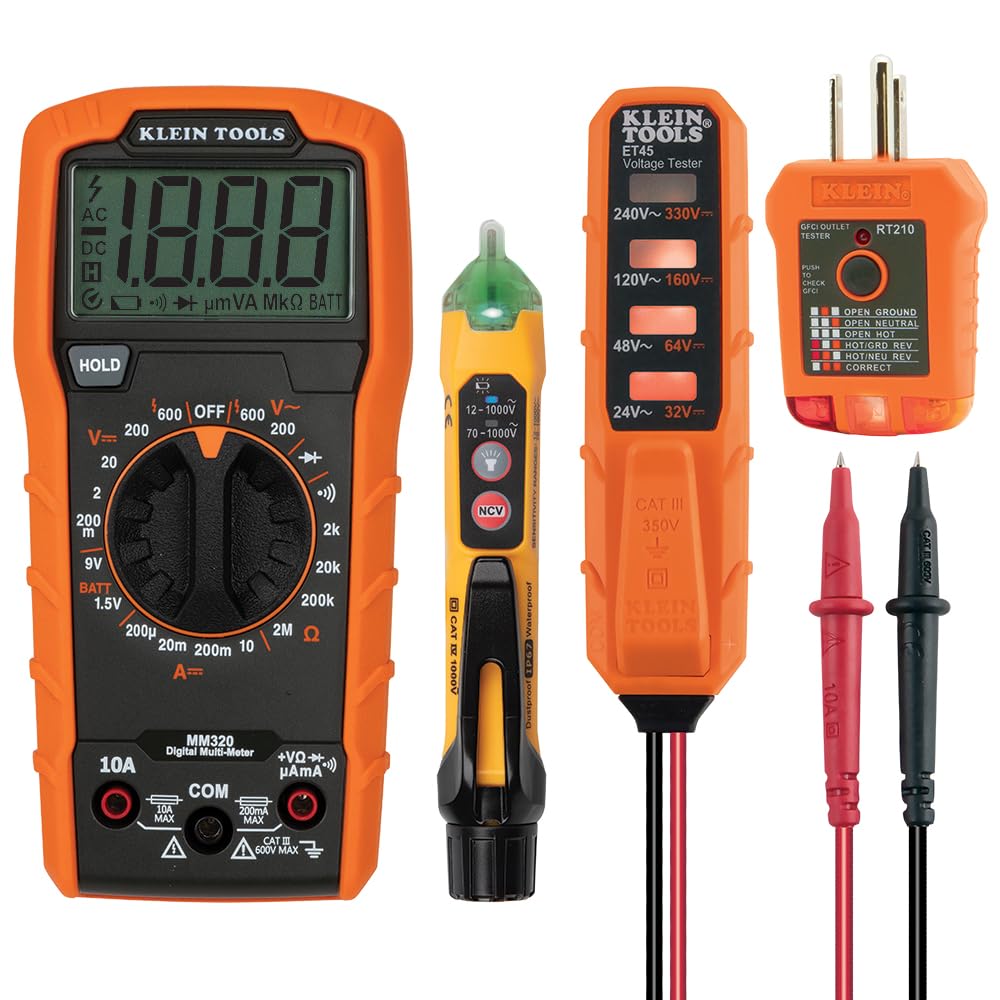
This is a kit rather than a meter, and the extra pieces are the point: a manual-ranging MM320 multimeter, a non-contact voltage tester with its own flashlight, a plug-in voltage tester, and a case that holds all three. If you have just moved into a place with questionable wiring, that is a more useful bundle than a fancier meter on its own.

The meter half is plain: 600V AC/DC, 10A DC current, continuity, diode and battery test, a backlit display, and manual ranging. It does the measurements, and it is the half of this kit that will feel most basic if you came for electronics work.

The non-contact tester is the piece that earns the kit its place. It detects from 12 to 1000V AC, carries its own flashlight, and works independently of the meter, so you can sweep a wall for a live cable before drilling without carrying the meter with you. The plug-in tester then tells you at a glance whether an outlet is live.

The kit makes sense for homeowners working through a fixer-upper, where outlet checks and a wire sweep are the actual jobs and a case keeps the pieces from scattering across a workbench. If what you mostly need is a meter, the MM325 is the better instrument for less outlay; the kit's value sits in the two testers and the bag.

Bottom line: A kit for someone working through a house: a solid manual-ranging meter plus a non-contact tester, a plug-in tester, and a case that keeps all three together.

How We Tested 14 Multimeters

We started by pulling together the meters that show up again and again in electrician forums, hardware-store aisles, and the kits friends actually keep in their garages, then filtered by price, safety ratings, and the functions a home user or budding electronics tinkerer is likely to need. That left us with 14 meters, which we used for six months across outlets, switches, appliance repairs, car batteries, and a bench full of low-voltage projects.

At the bench, we compared each meter's DC voltage, AC voltage, and resistance readings against a calibrated reference meter, then checked continuity on the same known-good fuse and a deliberately broken wire. We noted whether the display was readable in a dim basement, how quickly auto-ranging settled, and whether the dial clicked into detents or drifted between settings. Test leads got their own workout: we flexed them at the strain relief, tugged gently at the probe ends, and checked whether the tips stayed put on a terminal or slipped off.

For current monitoring, we measured the draw on a small space heater, a battery charger, and a shop vac using a line splitter, watching for stable readings and any sign the meter ran warm. Durability and build quality showed up in the less glamorous tests: each meter went into a tool bag, got dropped from workbench height onto concrete, and spent a few weeks in a hot garage; we also noted battery doors that felt flimsy, stands that tipped, and cases that scuffed but held up. At the end, we weighed what each one could do against what it cost, because a meter with every function in the catalog is still a bad buy if the leads fail or the readings wander.

How to Choose Multimeters

Start with the measurements you actually make

Every meter here does voltage, resistance, and continuity, so those don't separate them. What does: current measurement, capacitance and frequency for electronics work, temperature for HVAC and automotive jobs, and battery test modes for anyone with a drawer full of half-dead cells.

Write down the three things you'll test this month before you compare anything. If current isn't one of them, you can skip a whole class of complexity and even buy a Fluke 101 that has no current ranges at all. If it is, check that the current jacks and fuses cover the range you need, because a 10A limit is something you meet on the first serious job, not the tenth.

Counts, accuracy, and when True RMS matters

Counts describe resolution rather than accuracy. A 2000-count meter shows roughly three digits, a 6000-count meter shows four, which is the difference between watching a battery sit at 12.4 volts and watching it fall through 12.38. For most household checks the extra digit is a nicety.

True RMS is the more consequential specification. On a dimmer, a variable-speed tool, an inverter, or anything with a switching supply, the waveform isn't a clean sine, and an averaging meter reports a number the circuit isn't running at. True RMS costs little now, and both the Crenova and the AstroAI M4K0R have it, so buy it unless you are strictly checking batteries and continuity.

The safety rating comes first

CAT II and CAT III describe where a meter is designed to be used, not how well built it is. CAT II covers plug-in appliances and portable tools; CAT III covers distribution wiring and panel work, where a transient can be far larger. A CAT II meter is fine for a lamp cord and wrong for a breaker box.

The rating is printed on the front of the meter, so look for it before you look at anything else. Ceramic fuses and overload protection on every range are the second layer, and lead-alert lights such as the ones on the Klein MM325 are the third: they tell you a probe is in the wrong jack before you take a reading.

Auto-ranging, or a dial you set yourself

Auto-ranging picks the range for you, which is faster and harder to get wrong. Manual ranging holds the range you chose, which keeps a drifting reading stable and is one less circuit to fail. Most people are best served by auto-ranging, or by a meter that does both, as the Crenova does.

A smart auto meter such as the TESMEN goes further and picks the measurement type as well. That is a gift for a first-timer and a nuisance when you want to force a specific mode, so be honest about which person is holding it.

What's in the box changes how you'll use it

A case, alligator clips, and a spare set of leads are the difference between a meter you reach for and one you don't. Clips hold probes on a terminal so both hands stay free; a case means the leads don't tangle into a knot in a drawer. On a meter that lives in a vehicle, both matter more than an extra function you'll never select.

Read the small print as well. The Klein MM325's magnetic hanger is a separate accessory, and Fluke ships the 117 without a case. Warranty runs from a single year to three across these picks, which is worth weighing if the meter is going into a work van.

Frequently Asked Questions

Final Verdict

Buy the Crenova MS8233D if you want one meter that covers the house, the car, and a bench project without a second thought: True RMS, 6000 counts, a case, and clips, at a mid-group outlay. If your work is mostly wiring, the Klein MM325's lead-alert lights and sturdier shell make it the safer-feeling choice for outlets, switches, and the occasional panel.

And if the meter pays your bills, the Fluke 117's VoltAlert and low-Z mode are worth the premium, because they save minutes on every live circuit you walk up to.