Tools & DIY

Best Heat Guns of 2026

A heat gun earns its keep the day a bolt won't budge, the paint on a windowsill cracks into flakes, or a sheet of vinyl refuses to lie flat. It's a narrow tool that solves a dozen unrelated problems, and it can scorch a workpiece while you glance at your phone. I've used them to loosen seized exhaust bolts and soften caulk gone hard as stone, and the ones I keep reaching for make real heat fast and hold it steady instead of surging and sagging.

Heat gun specs lead with wattage, which tells you almost nothing about how a tool behaves in your hand. Over the past seven months my team has put 12 of them through real work — paint, plastic, and a lot of rusted hardware — and the pattern held: the guns that got paint bubbling fastest weren't always the ones that stayed comfortable and controllable an hour in. The picks below are the ones worth the shelf space, whether you're stripping a whole porch or freeing one stubborn fitting.

1

SEEKONE 1800W Variable Temp

Top Pick
SEEKONE 1800W Variable Temp

General workshop use

Our Score 9.2/10
Check Price

Worth Noting

  • Heater is the likeliest failure point
  • Dial scale printed backwards on some units
Power
1800 W
Weight
1.98 lb
Included Nozzles
4
Temperature Range
122–1202 °F

Plenty of heat guns claim 1,200 degrees; very few will also run at 122°F, and that low end is why this SEEKONE leads our list. A dial sweeping from 122°F to 1,202°F covers the whole span we care about, from easing vinyl wrap and embossing cardstock to stripping paint and loosening a rusted bolt. We chose it as the default for a first heat gun because you won't come back in a month needing a second, gentler tool for craft work.

The four nozzles in the box do more for real work than the 1,800W figure. The concentrators are what make heat-shrink tubing and small vinyl patches behave, and the deflector keeps heat off the glass or trim beside whatever you're working on. Airflow runs in two bands, roughly 190 to 210 liters per minute on low and 250 to 500 on high — enough for wrap and tubing without the hurricane blast that lifts a decal off the panel. At 1.98 pounds it's light enough to hold at chest height through a long patch.

Two things to know before you order. The printed scale on the dial has gone on the wrong way round on some units, so calibrate against a scrap of your actual material rather than trusting the numbers. And this is a plastic-bodied tool at an entry price: the heater is the part that gives out when something does. Buy it for the range and keep the receipt — if the gun is going to run every week, the Porter-Cable is the safer long haul.

Bottom line: We recommend the SEEKONE as the one heat gun to buy if you're buying one: a 122°F to 1,202°F dial, four nozzles, and enough power for paint and pipe work.

2

PORTER-CABLE PC1500HG

PORTER-CABLE PC1500HG

Long-term daily work

Our Score 9.4/10
Check Price

Worth Noting

  • No nozzles or accessories included
  • No stated temperature range, so settings are by feel
Power
1500 W
Weight
2.5 lb
Fan Speeds
2
Temperature Control
Variable dial

Where the SEEKONE gives you a number for every temperature, the Porter-Cable gives you a feel: a red dial for heat, a two-speed selector for air, and a body that sits in the hand like a tool rather than an appliance. At 2.5 pounds it's the heaviest corded gun here, and the weight is the point — the flat back end stands it upright between passes, and the whole thing stays planted when you set it down still hot.

This is the one we hand to someone who will still own it in five years. Build quality is the strongest in this set, the switch is a rocker rather than a trigger so you aren't squeezing for the length of a job, and the variable dial with two fan speeds covers stripping, thawing, and shrink work without a menu of presets to learn. What it doesn't give you is a stated temperature range on paper or a single nozzle in the box: you set heat by eye and buy the concentrator separately. For a working gun rather than a craft gun, that's a fair trade.

Bottom line: This is the gun we hand to someone who will still own it in five years — the best build in the group, with a variable dial and two fan speeds.

3

DEWALT D26960K

DEWALT D26960K

Precision temperature work

Our Score 9.6/10
Check Price

Worth Noting

  • Premium price bracket
  • Twist-lock nozzle ring is a fragile point
Power
1550 W
Weight
2.3 lb
Case And Kit
Hard case with accessory kit
Temperature Control
LCD, 50-degree steps

The DeWalt sits in a different price bracket from everything else here, so it has to justify itself with more than yellow plastic. It does: an LCD that sets temperature in 50-degree steps, a kickstand that holds the gun steady, a cord protector where the cable leaves the housing, overload protection, and a hard case with an accessory kit that stops the nozzles from migrating across a workshop.

For temperature-sensitive work — shrink sleeves on a run of cables, vinyl lettering on gelcoat, anything where a scorch mark costs you the piece — the display removes the guesswork, and that's why it earns a place in a guide full of cheaper guns. We think of it as the tool for someone doing the same job repeatedly and needing the same result each time, rather than for the household that needs one stuck bolt loosened.

Two reservations. At 2.3 pounds it's a bench tool, not something you hold overhead for twenty minutes. And the twist-lock ring that holds the nozzles is the fragile point on this gun — check that all four retainers are intact the day it arrives, while a return is still easy.

Bottom line: For work that has to come out the same every time, the DeWalt's LCD earns its price; home users with one odd job a year can save the money.

4

Wagner HT1000

Wagner HT1000

Simple household jobs

Our Score 9.4/10
Check Price

Worth Noting

  • 750°F minimum is too hot for vinyl and crafts
  • Ships without any nozzles
Power
1200 W
Fan Speeds
2
Certification
ETL listed
Temperature Settings
750 °F and 1000 °F

If your idea of a heat gun is a tool that lives on a shelf and comes out twice a year, the Wagner HT1000 is built for you. Two settings — 750°F and 1,000°F — plus two fan speeds, an integrated stand, and no dial to interpret. Plug it in, pick a switch position, and work.

The details suit that job. The handle stays cool through a long spell of use, the cord is heavy enough to survive being dragged around a garage, and a small hook on top lets it hang off a bench edge instead of rolling around a drawer. It's ETL listed, which counts for something on a tool that reaches 1,000°F, and the nozzle is corrosion resistant.

Where it falls short is anything delicate. A 750°F floor is too hot for vinyl wrap, embossing powder, or thin craft plastic, so this isn't the gun for a resin habit — the SEEKONE's 122°F start covers that ground. It also ships with no nozzles, and it takes a while to cool down after you switch off. For caulk, shrink tubing, loosening adhesive, and thawing, we found it the easiest of the full-size guns to live with.

Bottom line: For a household that needs one simple gun for caulk, shrink wrap, and a stuck bolt, the Wagner is the one we point to first.

5

BLACK+DECKER HG1300

BLACK+DECKER HG1300

Overhead one-hand work

Our Score 9.6/10
Check Price

Worth Noting

  • Only two heat settings, nothing in between
  • Plastic nozzle guard wears first
Power
1350 W
Handle
3-position side handle
Weight
1.63 lb
Temperature Settings
750 °F and 1000 °F

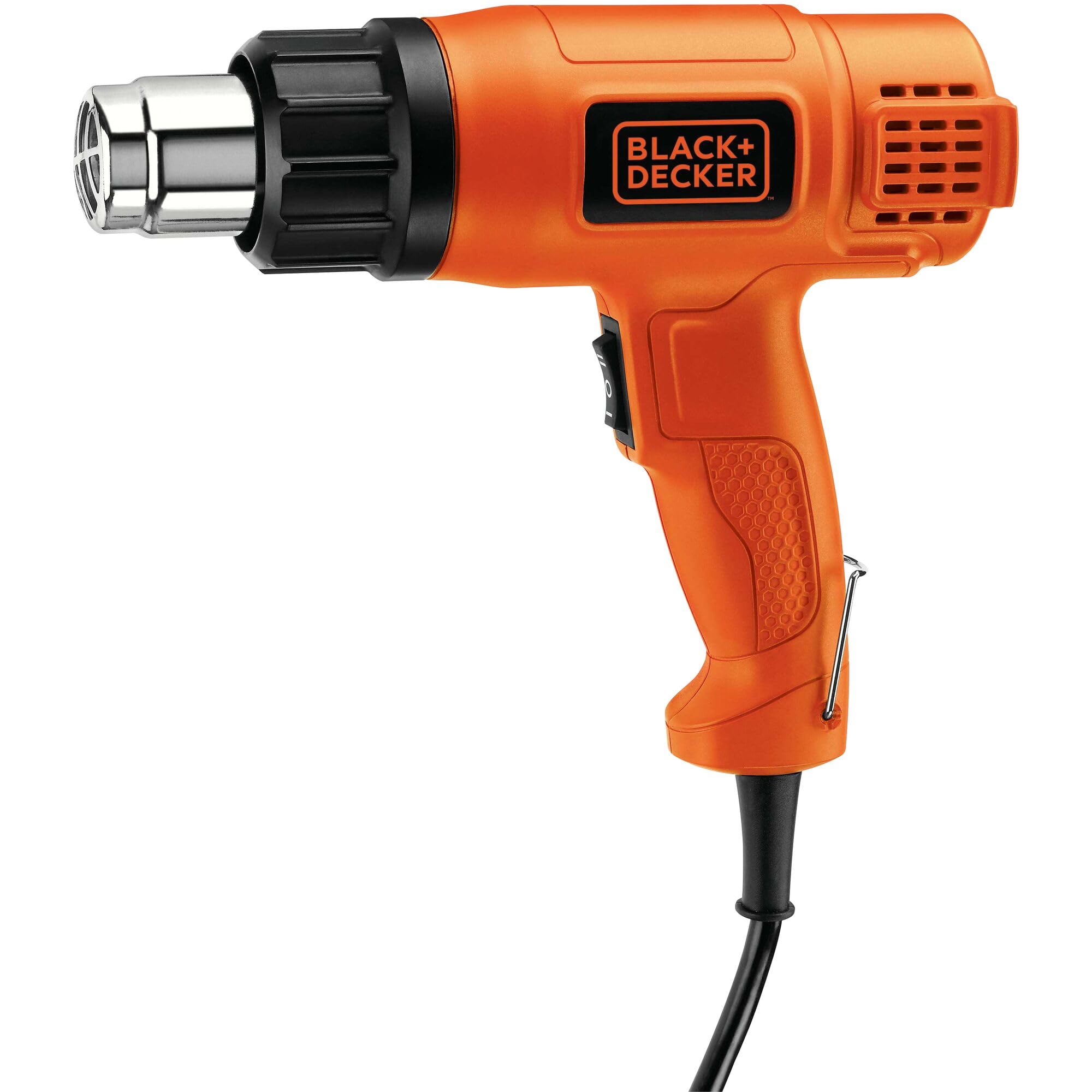
Holding a heat gun above your head changes what matters. At 739 grams — around 1.6 pounds — the Black+Decker is the lightest full-size gun here, and the three-position side handle rotates until your wrist stops complaining. For soffits, ceiling trim, overhead pipe work, or anything where your other hand is holding material in place, that combination is worth more than a few hundred extra watts.

The rest is deliberately plain: two settings at 750°F and 1,000°F, 1,350W, a built-in stand for cooldown, and a body that turns in a tight corner. You give up any fine control, because there is nothing between the two settings, and the plastic nozzle guard sits close enough to the heat that it's the first thing to show wear. Neither gets in the way of stripping a sill or shrinking a connector on a trailer harness.

This is our pick for anyone whose heat-gun jobs happen at arm's length. It also ties the DeWalt for the highest buyer rating in this group, which for a tool this simple is the reassurance most people want. If your work sits on a bench at waist height, the Porter-Cable's extra heft is the better call.

Bottom line: We reach for the Black+Decker when the work is overhead: it's the lightest full-size gun here, and the rotating side handle keeps it steady.

6

SEEKONE 350W Mini

SEEKONE 350W Mini

Tight-space detail work

Our Score 9.2/10
Check Price

Worth Noting

  • 842°F ceiling rules out stripping and thawing
  • Push-on shield works loose mid-job
Power
350 W
Weight
13.7 oz
Cord Length
1.5 m
Temperature Settings
500 °F and 842 °F

An 842°F ceiling rules this gun out of paint stripping, pipe thawing, and anything that wants a wall of heat. We still keep it in the roundup, because for small work it's the handiest tool here: 350W, 13.7 ounces, and a nozzle small enough to get behind a dashboard or into the corner of a freezer. If your jobs are heat-shrink connectors, 3D-print cleanup, embossing, and vinyl patches the size of a coin, this is the one we reach for.

Two settings, 500°F and 842°F, cover more ground than the numbers suggest — heat-shrink tubing with built-in adhesive wants a slow, moderate bake rather than a blast, and the low setting delivers that without scorching the insulation beside it. Airflow is 300 liters per minute, gentle enough not to blow a decal out of position, and overheat protection cuts the element if you lean on it.

The weak spot is the push-on shield, which works loose and shifts mid-job; when that happens it's too hot to reseat with bare fingers, so a pair of pliers lives next to ours. Long runs also heat the housing more than a full-size gun does, which suits short bursts better than a marathon. Neither quibble touches the connector work it was bought for.

Bottom line: We keep the mini for shrink tubing and tight corners — the handiest detail gun here, as long as the job stays below 842°F.

7

DIAFIELD 1850W

DIAFIELD 1850W

Budget vinyl work

Our Score 9.2/10
Check Price

Worth Noting

  • 572°F minimum is too hot for delicate material
Power
1850 W
Weight
1.54 lb
Included Nozzles
4
Temperature Settings
572 °F and 1202 °F

Vinyl wrap and resin work are where this gun makes sense: 1,850W, a high setting of 1,202°F for stretching film around a curve, and four nozzles including the flat spreader that keeps heat even across a panel. For the money it's the most gun per dollar in this guide.

It stands on its flat rear cover, so it waits upright on the bench between passes instead of lying hot on its side, and at 700 grams it's light enough to work one-handed while the other hand holds the film. The cord is UL listed and there's an anti-scalding sheath near the nozzle — small things that count when you're working a few inches from a surface you can't replace.

The trade sits at the bottom of the range. The low setting is 572°F, which is hot for thin craft plastic, embossing, or anything you're easing rather than pushing, and heat output is where experiences split on this gun: jobs that want a slow bake sometimes get a fast one. The temperature chart for the dial isn't printed on the tool, so note the settings down before you start rather than squinting at a screen with a hot nozzle in your hand.

We recommend it to someone whose work is wrap, resin bubbles, and thawing, where the top end is what's wanted. If you need a gun that starts gentle, the SEEKONE's 122°F floor is worth the small step up in price.

Bottom line: A budget gun with a genuinely hot top end: we point wrap and resin work here and steer delicate craft jobs to a variable-temp model.

How 12 Heat Guns Held Up Over Seven Months

We started by gathering corded heat guns sold at every price point, from hardware-store house brands to the big tool names, then filtered by the things that actually change how the tool works: a variable temperature dial rather than a two-setting switch, an overload cutout, a body that rests nozzle-up on a bench without tipping, and a nozzle kit worth owning. Twelve made the cut, and each spent seven months in rotation.

Most of that time went to real jobs rather than a bench. We stripped six layers of paint off a porch railing, loosened exhaust bolts on a 20-year-old truck, shrank heat-shrink tubing onto trailer wiring, softened caulk around a bathtub, and bent PVC conduit in the garage. Every gun did the same jobs so the comparisons were like for like, and we noted how each felt after 20 minutes of continuous use, how hot the grip got, and whether the cord dragged or stayed out of the way.

We also measured what you can't eyeball. A thermocouple held in the nozzle airflow recorded how long each gun took to reach its stated temperature on low, medium, and high, and whether that number held over a 15-minute run or drifted. Each was dropped twice onto concrete from waist height to check for cracked housings and switches that went mushy, and we weighed what came in the box — extra nozzles, scrapers, cases — against what the tool cost to judge value.

How to Choose Heat Guns

Range Beats Wattage

Every gun here makes heat. The useful question is where the heat starts and stops. A 750°F floor is fine for stripping paint and thawing a pipe, and useless for vinyl wrap, embossing powder, or easing resin, because the low setting is already hot enough to curl the material. Our rule: write down your coolest job and your hottest job, then check the gun covers both. The SEEKONE's 122°F to 1,202°F span covers the widest spread in this guide; the DIAFIELD reaches the same 1,202°F top but starts at 572°F, which is why we send craft work elsewhere.

The trap is a big wattage number sitting next to a narrow range. An 1,800W gun that stops at 932°F still can't strip paint, and one that won't drop below 500°F will scorch the vinyl you bought it for.

Variable Dial or Two Switches

Two settings are not a compromise if your work is one thing. A gun that lives on a garage shelf and comes out for caulk, a seized bolt, and a shrink connector does everything you ask with 750°F and 1,000°F, and there's less to go wrong. Pick a variable dial when the work changes — someone who embosses one evening and shrinks tubing the next needs the numbers in between. The Porter-Cable's dial paired with two fan speeds is the middle ground we like best for a mixed workload, and the DeWalt's LCD goes further by naming the temperature in 50-degree steps so a repeat job comes out the same way twice.

Nozzles and Airflow Do the Precise Work

A concentrator nozzle puts heat on a connector or a patch; a deflector shields the glass or trim beside what you're heating; a spreader evens heat across a panel. Four nozzles in the box, as on the SEEKONE and the DIAFIELD, save you a second order and a week of waiting. Two fan speeds matter as much as temperature: high airflow pushes heat deep into thick material, low airflow keeps a decal from lifting.

The trap is reading airflow as power. On vinyl, a wide-open fan blows the film out of position before the heat has done anything at all. Start on low air and add speed only when the material resists.

Weight, Build, and Where It Cools Down

Full-size guns in this group run from 739 grams to 2.5 pounds, and the difference shows the moment you work above shoulder height. Buy light for overhead and one-handed jobs, heavier for bench work where the mass steadies the nozzle. Every gun here has a stand or a flat back to rest on, and using it matters — a hot nozzle set down on a bench is how you mark the surface you were protecting. None of these are cordless, so plan your reach from a 120V outlet before you start.

On build, the heating element and the housing are the parts that give out, so an easy return matters as much as the finish on the plastic.

Frequently Asked Questions

Final Verdict

The SEEKONE 1800W variable temp is the gun we point most people to, because 122°F at the bottom and 1,202°F at the top means one tool handles a shrink connector in the morning and a painted sill in the afternoon. If you'll use it weekly and want the thing to outlast the job, the Porter-Cable's build is worth the step up. If temperature has to come out the same every time, the DeWalt's display is the reason to spend. Buy for your hardest job, not your first one.