Tools & DIY

Best Rotary Tool of 2026

A rotary tool is the pocketknife of the workshop: it cuts, grinds, sands, polishes, and drills in spots a full-size tool can't reach. That versatility is exactly why the wrong one is so irritating—you feel the weak motor when you're cutting a rusted bolt, the bulky body when you're detailing a tight corner, and the skimpy accessory kit when the one bit you need is missing. The right rotary tool puts controlled power in a hand-sized package, with a battery that lasts through the job and accessories that actually fit the work.

I've kept one within arm's reach of my workbench for years, for small repairs and craft projects. Over the past six months, my team and I tested 12 rotary tools across weekend fixes, garage cleanup, and detail work, weighing each one in hand and noting where quality showed up in the cut. We also paid attention to value—because a cheap tool with a useless accessory kit is no bargain. The picks below are the ones that balanced size, power, and durability without making me fight the tool.

1

Dremel 4300-5/40

Top Pick
Dremel 4300-5/40

Corded all-round work

Our Score 9.4/10
Check Price

Worth Noting

  • Corded only
Bit Change
Universal 3-jaw chuck
In The Kit
5 attachments, 40 accessories
Speed Range
5,000–35,000 RPM
Power Source
Corded, 120V

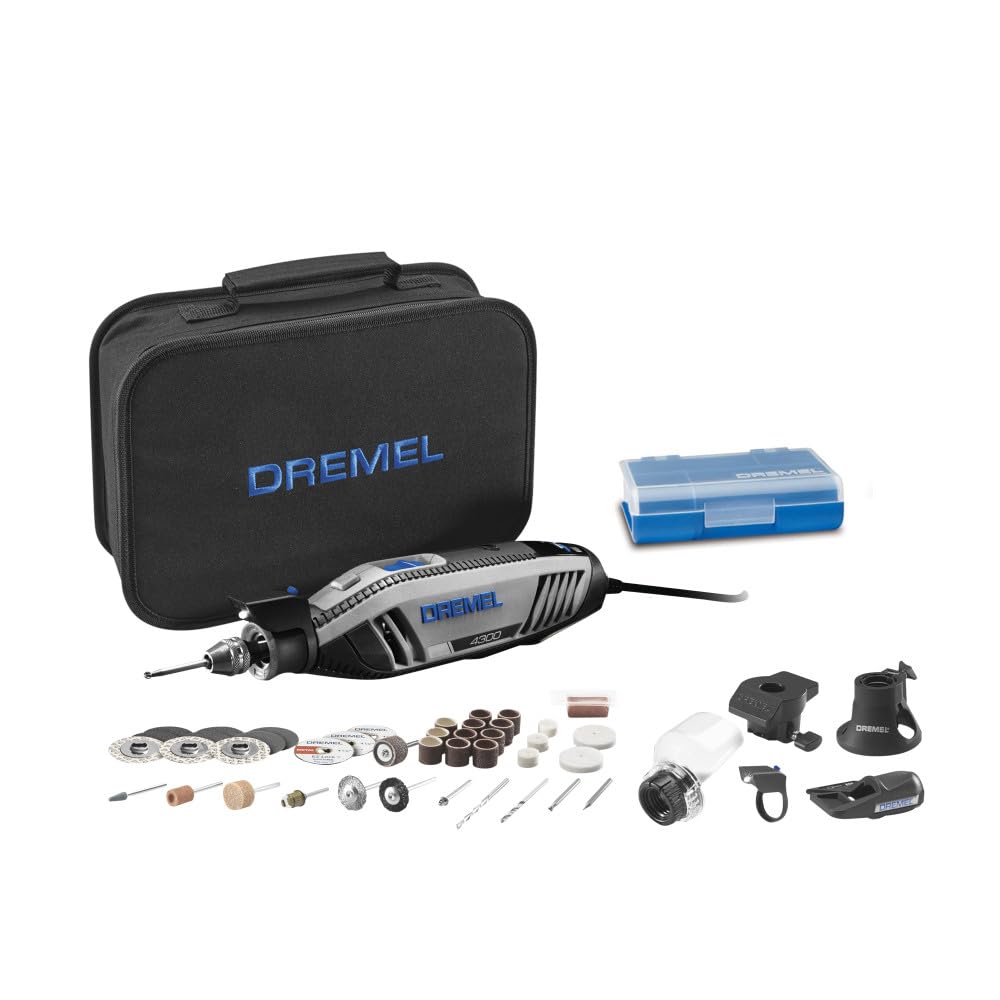
Thirty-five thousand RPM is the headline on the 4300-5/40, but the electronic feedback underneath it is the more interesting number. The motor measures its own speed and adds torque as a cut-off wheel loads up, which is the difference between a wheel that keeps slicing and one that glazes and skates. Then there's the three-jaw chuck, which closes on any Dremel shank — 1/8-inch wheels, 3/32-inch burrs — with no collet to hunt for mid-job.

That combination is why it's our top pick for most people. Rotary tool work is usually small, awkward and intermittent: a stripped screw, a burr on a cut pipe, a hinge that won't sit flush. The 4300 handles all of it without the tool becoming the limiting factor, and at 1.2 pounds it's light enough to hold like a pen for the few minutes a job actually takes. Corded also means the last cut of a session is as strong as the first.

The kit is unusually well chosen for a bundle. The pivot light rotates to throw light sideways into a channel you can't see around, the A550 shield keeps sparks off your knuckles, and the cutting and sanding guides turn a freehand wobble into something repeatable; the garden-tool sharpener is the odd one out, but it earns its slot. Longevity is the one thing we can't call — these tools do sometimes die early, within the first hour in the worst cases — so run yours hard in the first week, buy where returns are easy, and lean on the two-year limited warranty if it goes wrong.

Set it against the 8250-5 and the decision is clean: the corded tool costs noticeably less and never asks for a charger. Set it against the cheaper cordless kits and it's the difference between a motor that holds 30,000 RPM under load and one that loses speed the moment you lean on it.

Bottom line: We recommend the 4300-5/40 to anyone with a bench and an outlet: the motor holds its speed, the chuck takes any bit, and the kit covers five jobs.

2

Dremel 8250-5

Dremel 8250-5

Cord-free heavy work

Our Score 9.2/10
Check Price

Worth Noting

  • Chunky grip in smaller hands
  • Only five accessories in the box
Motor
Brushless, 12V cordless
Battery
3.0Ah Li-ion, charger included
In The Kit
5 EZ Lock accessories, tool bag
Speed Range
5,000–30,000 RPM

This is the most expensive tool on the list, and the only one that justifies the jump. Dremel's own figure puts the brushless 12-volt motor 20% ahead of the 4300 on power, and the 3.0Ah battery is the reason it can claim that: a bigger pack holds its voltage under load instead of sagging as it drains. A 5,000–30,000 RPM dial covers the range, from polishing acrylic to cutting a slot in sheet metal.

The tool itself is 13.76 ounces with EZ Lock accessories that change without a wrench, and it carries the longest warranty in this group — a limited lifetime cover, against two years on the corded models. That matters, because a rotary tool is the sort of thing that sits in a drawer for three weeks and then gets hammered for an afternoon; a generous warranty is the difference between an expensive tool and a cheap one that failed.

Whether it's worth the money depends entirely on where you work. On a bench, the corded 4300 gives you more top speed for less and never asks for a charger, which is why it stays our top pick. Away from an outlet — an engine bay, a stairwell, a piece of furniture you can't unbolt — the 8250 is the cordless one we reach for when the work is heavy rather than fussy, and the brushless motor is why it doesn't feel like a step down.

Bottom line: Our pick when the work has no outlet near it — we think the brushless motor and 3.0Ah battery are worth the premium over a corded kit.

3

WORKPRO 12V Rotary Kit

WORKPRO 12V Rotary Kit

Cordless value kit

Our Score 8.8/10
Check Price

Worth Noting

  • Ten-inch body is awkward in tight spots
Weight
1.4 lb
Battery
12V, 2.0Ah, replaceable
In The Kit
114 accessories
Speed Range
7,500–32,000 RPM

Some jobs never have an outlet near them: a hasp on a shed door, a rusted bolt under a car, the edge of a worktop you can't unbolt. That's the WORKPRO's territory, and it gets there for well under the premium cordless pick while turning the same 32,000 RPM at the top of its range.

The rest of the specification reads like a bigger tool's. Five speeds run from 7,500 to 32,000 RPM, a 2.0Ah battery feeds the 12-volt motor, and the box includes a universal chuck, 2.3 mm and 3.2 mm collets, and 114 accessories in a bag. Top speed is what earns it a place here: a mini cordless tool that stops at 18,000 RPM can sand and engrave but won't cut, and this one will. Speed selection is a push-button cycle, and the low end is slow enough to polish without burning a finish.

Where it gives ground is stamina. Charge holding varies between units, and a 2.0Ah pack covers a couple of light sessions rather than a day of work — but the pack is replaceable, so a spare is the sensible add-on instead of a new tool. As a first cordless rotary tool, the one that lives in a drawer and comes out for the odd small job, we think it's the smart buy.

Bottom line: If you want one cordless tool for the odd job, we think this is the one: 32,000 RPM, 114 accessories, and a battery you can replace.

4

HARDELL Mini Cordless

HARDELL Mini Cordless

Fine detail work

Our Score 8.6/10
Check Price

Worth Noting

  • Power button sits where a choked-up grip catches it
Collets
1.0, 1.6 and 2.3 mm
Charging
USB-C, 3.7V
In The Kit
69 accessories
Speed Settings
5, from 5,000 to 18,000 RPM

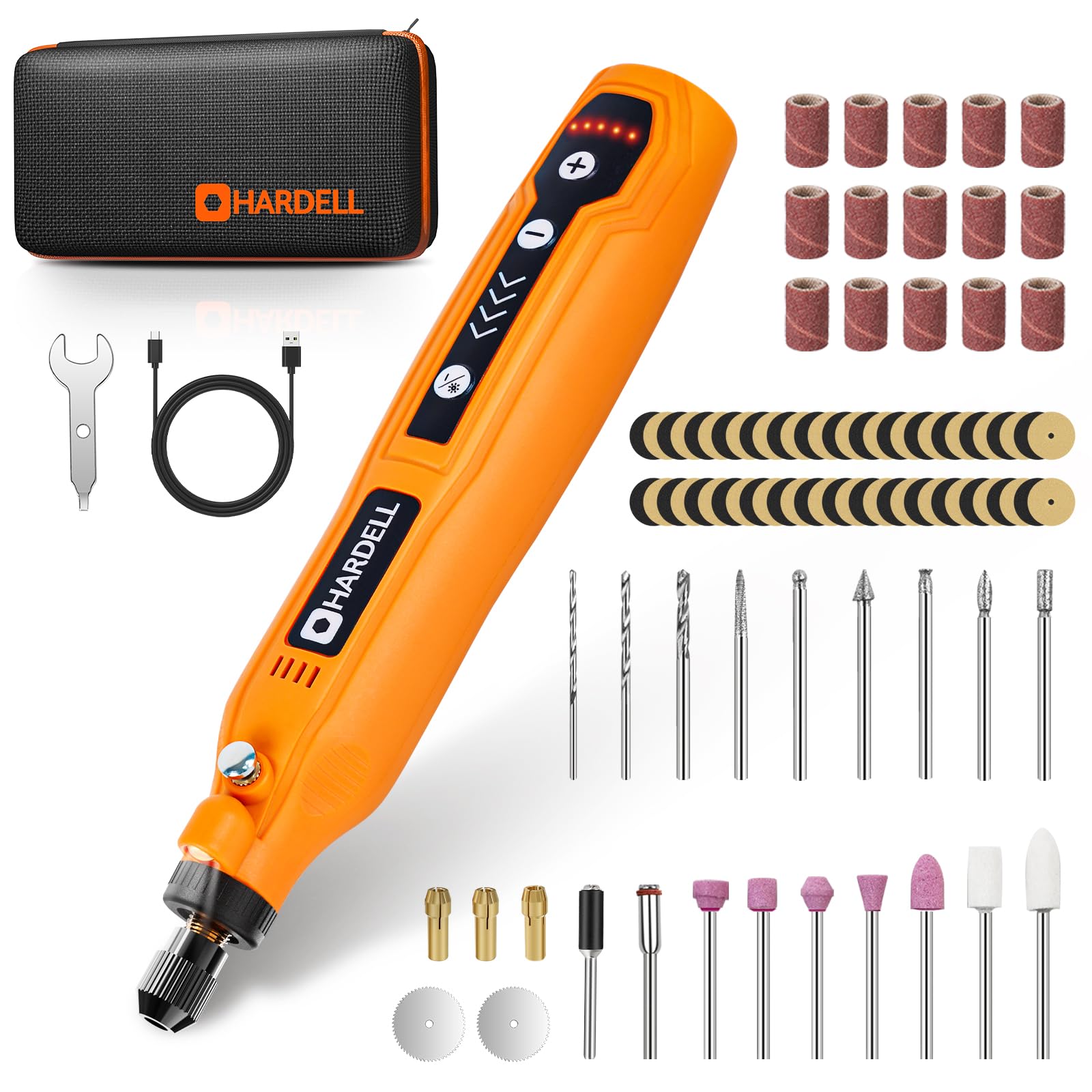
Eighteen thousand RPM is the number that defines the HARDELL: this is a detail tool, not a cutter, and once you accept that, the rest of the package makes sense. Five speeds step from 5,000 to that ceiling, the body weighs 0.14 kg and handles like a fat pen, and the LED sits at the nose where it lights the bit instead of your knuckles. We think it's the right first rotary tool for work that fits in one hand.

The kit is what makes it easy to say yes. Sixty-nine accessories, three collets at 1.0, 1.6 and 2.3 mm, and a USB-C port that means one cable in a bag instead of a proprietary charger. HARDELL quotes 200 minutes of running time, which is honest only at light pressure — treat it as a session or two of polishing rather than a day of sanding, and keep the cable nearby.

What it won't do is cut. Aluminum sheet, a hardened screw, a tile: the motor stalls and the battery drains without much to show for it, and that's the point where the corded tools earn their keep. Read the HARDELL as the tool for the last five percent of a job, the part a bigger tool scratches — a chamfer, a burr, a polish, a printed model's layer lines.

Bottom line: We keep coming back to this one for engraving, polishing and light sanding; it's the least expensive pick here and still easy to control.

5

Fanttik F2 Pro

Fanttik F2 Pro

Tidy bench setup

Our Score 9.0/10
Check Price

Worth Noting

  • Top speed trails the cheaper cordless pick
Case
Aluminum case with rotating magnetic hub
In The Kit
55 accessories
Speed Settings
5, from 5,000 to 25,000 RPM
Charge Indicator
Rear, red below 30%

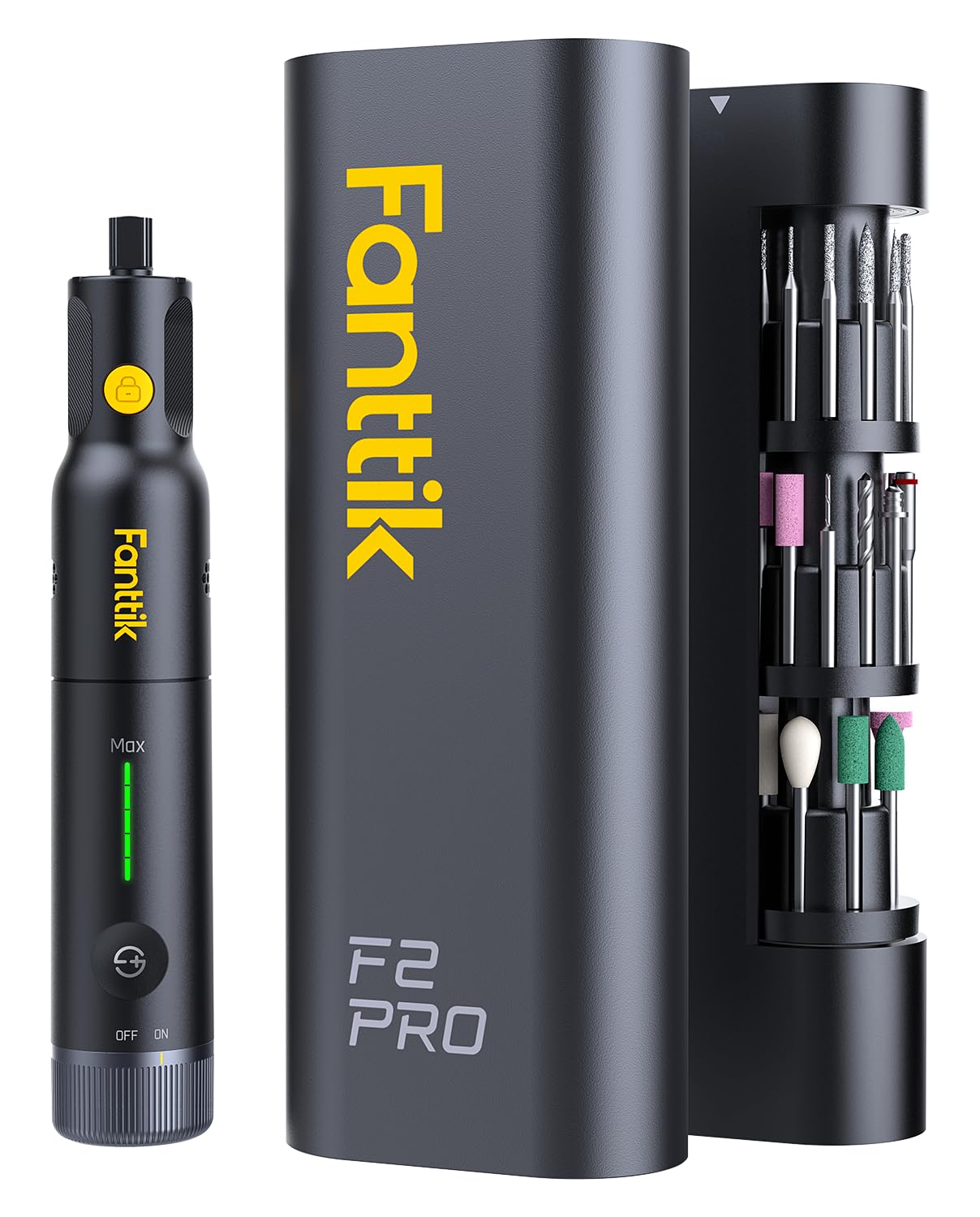
What caught our attention first is the RevoStor hub: a 360-degree rotating magnetic holder inside an aluminum case, so the 55 accessories stand upright where you can read them instead of living in a bag you have to tip out. The rest of the design follows the same instinct — a seamless pressure-sensitive switch with nowhere for dust to collect, a rear indicator that warns below 30 percent charge, and a shadow-free LED at the nose.

Five speeds cover 5,000 to 25,000 RPM, which handles polishing, engraving and light cutting, though it gives away top speed to the cheaper WORKPRO. That's the trade: you're paying for the case, the light and the tidiness rather than for grunt. On a bench where the tool stays out and bits get swapped constantly, we think that's money well spent; in a toolbag that gets thrown in a van, less so.

One thing worth knowing before you commit: 55 pieces is a starter set, not a lifetime supply, and the wheels and bands are the parts that vanish first. The hub at least makes it obvious what you've run out of, which is a small convenience that saves a lot of rummaging mid-project.

Bottom line: Buy the F2 Pro if your rotary tool lives on a bench and you want every bit visible; we think the case, not the motor, is what you're paying for.

How We Tested Rotary Tools

We started by pulling together a shortlist of 12 rotary tools from the specs that matter for real work: collet sizes, speed ranges, corded versus cordless, kit contents, and whether the body looked small enough to fit inside a cabinet or along a baseboard. We ruled out tools with proprietary accessories that would be hard to replace and kits that padded the count with bits no one uses. Then we used each one for six months in the same rotation—cutting PVC and rusted bolts in the garage, sanding a chair leg on the back porch, polishing a scratched watch case at the kitchen table, and grinding a stubborn screw head in a tight hinge.

We timed every battery from full charge to cutoff while cutting 1/4-inch hardwood dowel, noted how much the motor bogged down when we leaned into a cut, and weighed each tool with its battery or cord attached to see how it felt after 20 minutes overhead. We swapped accessories repeatedly, checking whether the collet held small bits without wobble and whether the wrench or lock button made changes quick or fiddly. Size got judged in real spots: inside a cabinet, along a window frame, and in a drawer.

Durability came from living with them—dropping one off a bench onto concrete (accidentally and, later, on purpose), letting them run through long sanding sessions, and watching for hot housings, loose seams, or switches that got vague. We compared each kit against what the tool could actually do, because a case full of bits doesn't add value if half of them chatter or don't fit. The tools that stayed in rotation earned their place by cutting cleanly, holding speed under load, and feeling balanced whether the job took two minutes or twenty.

How to Choose the Right Rotary Tool

Corded or Cordless: Start With the Outlet

Decide this first, because it's the one choice you can't change later. A corded tool holds the speed you set no matter how hard the bit bites. A cordless one gives up RPM as the load climbs and the battery drains, and the headline number on the box is its unloaded speed. That gap shows up in cutting and grinding, where a wheel that slows down stops cutting and starts polishing instead. Bench work with a socket nearby: buy corded. Installed work, a car, a ladder: cordless, and accept the trade.

Read the Speed Range From the Bottom Up

Everyone quotes the top figure; the bottom one decides what you can finish. Cutting metal and hardwoods wants 25,000 RPM and up, while plastics, polishing and engraving want 5,000 to 15,000 — a tool that won't go slow will melt the edge it's meant to clean up. Both Dremel kits here start at 5,000 RPM, which is a large part of why they cost more. Our budget cordless pick starts at 7,500 and stops at 18,000: fine for burrs and polish, out of its depth on a cut-off wheel in steel.

Collets, Chucks and Bit Changes

Bits are held two ways. Collets are split sleeves in fixed sizes, so a bit only fits the matching one — the HARDELL ships 1.0, 1.6 and 2.3 mm, which covers most small shanks but not all. A three-jaw chuck, like the one on the 4300, closes on anything, so a 1/8-inch cut-off wheel and a 3/32-inch burr swap without changing parts. If you change bits a dozen times in a session, the chuck is worth paying for; if you keep one burr loaded, collets are fine.

Attachments Do More Than Accessory Counts

A hundred bits is a marketing number; the attachments are what change the tool's job. A cutting guide turns freehand curves into something repeatable, a spark shield keeps your knuckles intact, and a pivoting light reaches into a channel you can't see around — the 4300 bundles all three. A flex shaft, which hangs the motor and leaves a pen-sized handpiece in your fingers, is the one that turns a rotary tool into a carver, and none of our picks includes one, so price it in separately if you plan to carve.

Hand Fit, Weight and Body Length

These tools get held like a pen and worked like a grinder, so the body matters. Weight steadies a cut and tires a wrist: the corded 4300 is 1.2 pounds, the 12-volt WORKPRO 1.4, and the little HARDELL is light enough to forget. Length matters as much — a ten-inch body wants two hands where a mini wants fingertips. If you have small hands or work overhead, hold the tool before you buy; a bulky grip you can't choke up on ruins detail work.

Frequently Asked Questions

Final Verdict

The Dremel 4300-5/40 is the rotary tool we point people to first. Thirty-five thousand RPM from a corded motor that doesn't sag under load, a chuck that swallows every shank, and five attachments that make it a cutter, a sander and a sharpener in one bag — that's the whole job covered.

Buy it if you have an outlet and a bench. If you don't, the 8250-5 is the same idea with a battery, and the premium buys freedom rather than power.