PC Components & Storage

Best MicroSD Cards of 2026

A micro SD card is the cheapest part of a camera, phone, or handheld—and the one most likely to erase a trip. The fear isn't speed; it's a card that reports 512GB, accepts your files, then quietly corrupts half of them three weeks later. That's why I don't treat these tiny cards as an afterthought. Over the past four months, I've rotated 16 cards through a Switch, a dash cam, a drone, and a security camera—the places where a failure actually costs you something—to find the ones that store what they promise and keep it.

A good card fixes that by doing unglamorous things well: it reports its true capacity, holds a steady write speed, and survives the device it lives in. Two cards with identical 'A2 V30' labels can behave differently after a summer of dash-cam loops or a full Switch library. I reformatted every card in the device it was meant for—exFAT in the drone, FAT32 in the dash cam—because a card that won't format won't work. The picks below passed; the rest went back.

1

SanDisk Ultra 256GB

Top Pick
SanDisk Ultra 256GB

Phones and Switch

Our Score 9.4/10
Check Price

Worth Noting

  • V10 write class limits long 4K recording
Capacity
256 GB
Warranty
10 years
Read Speed
Up to 150 MB/s
Speed Class
Class 10, U1, V10, A1

The fastest card on this page is not the one we recommend, and that is the most useful thing we can tell you about buying a microSD card. The SanDisk Ultra 256GB handles what a card usually gets asked to do — a phone that keeps running out of room, a tablet, a Switch, a laptop that needs overflow storage — and it does it with the steadiest reliability showing in this group and a ten-year warranty that outlasts most of the devices it will live in.

That 150 MB/s figure deserves a caveat. SanDisk quotes it alongside its own MobileMate USB 3.0 reader, and in a phone slot or a laptop's built-in reader you'll see a good deal less. The same is true of every card here — the host sets the ceiling — but it's worth knowing before you buy expecting headline speed out of whatever port you already own.

Where the Ultra gives ground is the write class. It's a V10 card: fine for storing 4K files and for 1080p capture, not the card for a drone or an action cam recording long 4K takes, which is where the PNY and the High Endurance come in. A1 rather than A2 tells the same story for running apps from the card. In a phone, a tablet or a laptop, none of that comes up.

What's left is the boring part that actually decides it. 256GB covers a couple of years of phone photos, the ten-year warranty is the longest cover here after the lifetime cards, and the midrange price makes the choice easy. We keep coming back to it because it is the card that asks the least of the person buying it.

Bottom line: We recommend the Ultra for phones, tablets and Switch: 256GB, quick reads and a ten-year warranty, with a write class that only matters if you record long 4K takes.
2

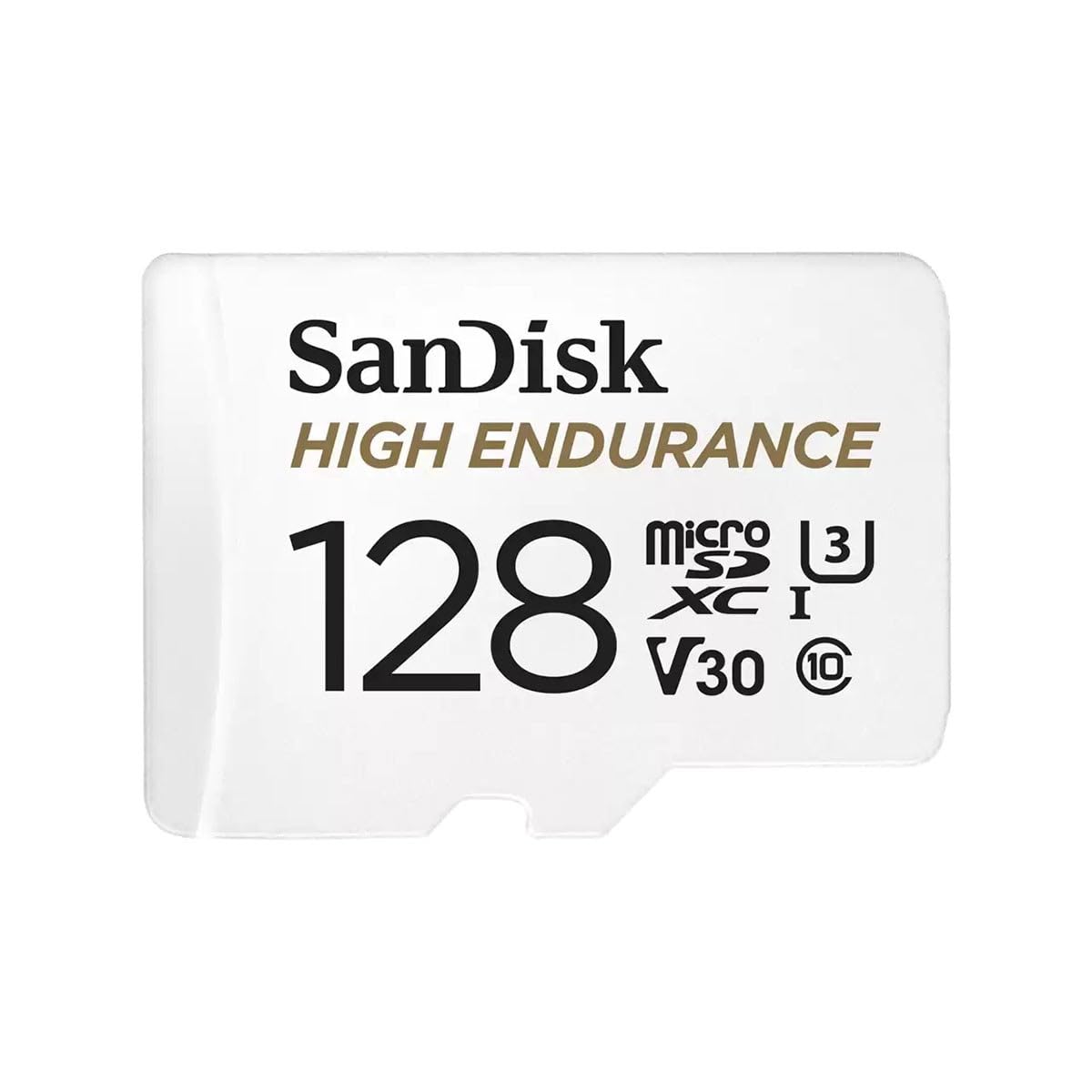
SanDisk High Endurance 128GB

SanDisk High Endurance 128GB

Dash cams

Our Score 9.4/10
Check Price

Worth Noting

  • 10,000-hour rating assumes Full HD
  • Read speed trails the cheaper Ultra
Capacity
128 GB
Endurance
Up to 10,000 hours recording
Read Speed
Up to 100 MB/s
Speed Class
Class 10, U3, V30

A dash cam doesn't read its card so much as rewrite it, day after day, until an ordinary card gives up — which is why the High Endurance is the one we recommend for anything that records in a loop. SanDisk rates it for 10,000 hours of recording, and it carries the V30 write class a 4K dash cam needs, so it's not trading speed away to get that durability.

The lifetime warranty matters more here than on a phone card, because the failure mode is a camera that quietly stops recording rather than one that complains. That's a large part of why we keep pointing people at this one for anything mounted in a car or screwed to a ceiling. Add the temperature, water, shock, humidity and magnet ratings and it's a card built for a hard life.

The compromise is read speed: 100 MB/s is slower on paper than the cheaper Ultra, and if the card is going in a phone or a Switch there's no reason to pay for endurance you'll never use. The 10,000-hour figure is also a Full HD number — 4K recording eats into it. Put it where the device runs hot and writes constantly and it's exactly right.

Bottom line: For dash cams and security cameras this is the card we trust: an endurance rating built for constant rewriting rather than a fast headline number.

3

PNY PRO Elite 256GB

PNY PRO Elite 256GB

4K recording

Our Score 9.2/10
Check Price

Worth Noting

  • Read speed tops out at 100 MB/s
Capacity
256 GB
Warranty
Limited lifetime
Speed Class
U3, V30, A2
Read / Write Speed
Up to 100 MB/s read, 90 MB/s write

Two numbers stand out on the PNY's specification sheet: a 90 MB/s write speed and A2 app performance. The write figure is the highest stated write speed in this group, and it clears the V30 floor that 4K recording needs with room to spare. For a card that records rather than simply stores, that is the number that matters, and it is not the number most shoppers look at.

The A2 rating is the other half of the argument. PNY quotes 4,000 IOPS on reads and 2,000 on writes, which is what Android's adoptable storage and a handheld's game installs actually use; that makes this a card you can put apps on rather than only files. There's an SD adapter in the box and the warranty is limited lifetime, both of which are more than the price suggests.

That combination makes the PNY our pick for anyone whose card records rather than simply stores. The compromise is read speed: 100 MB/s against the Ultra's 150, so emptying a full card takes longer, and a slow reader widens the gap. We can live with that, because the write speed is what the camera feels and the lifetime warranty covers the years afterward.

Bottom line: The PNY is our value pick for 4K recording: V30 and A2 with 90 MB/s writes, at a midrange price and with lifetime cover behind it.

4

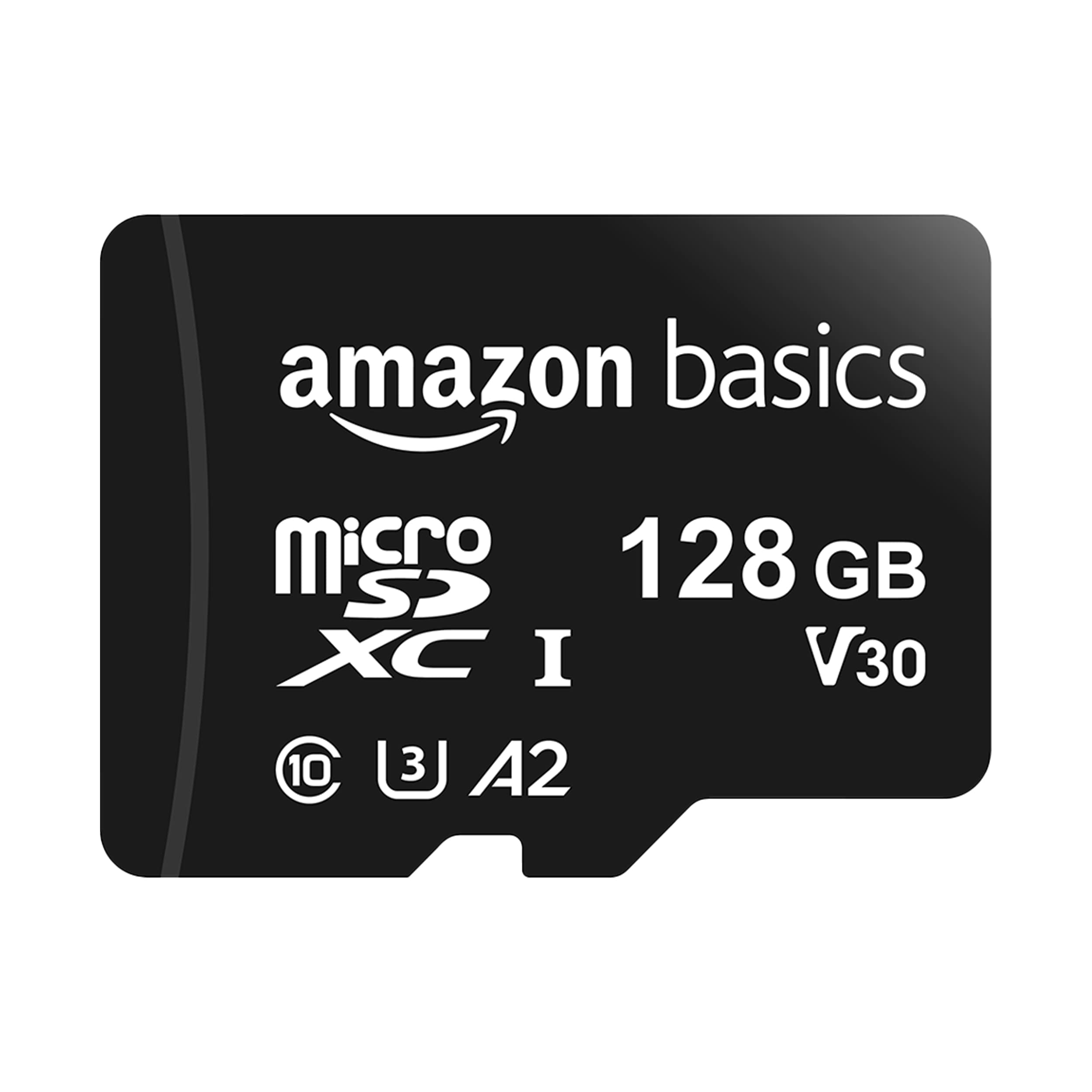
Amazon Basics 128GB

Amazon Basics 128GB

Everyday storage

Our Score 9.4/10
Check Price

Worth Noting

  • Formatting failures and dropped detection occur
  • Twelve-month warranty is the shortest here
Capacity
128 GB (≥116 GB usable)
Warranty
12 months
Read Speed
Up to 100 MB/s
Speed Class
U3, V30, A2

Two problems trail this card: units that stop being detected, and units that refuse to format. We're leading with that because the rest of the package is genuinely good — A2 and V30 classes, a 100 MB/s read speed, and the lowest price of any A2 card in this group.

Credit where it's due on one detail: Amazon publishes usable capacity, which most listings here don't. The 128GB label gets you at least 116GB once the file system takes its share. It's rated for shock, water and temperatures from −10°C to +80°C, and it will sit happily in a Switch, a phone or a dash cam.

The warranty is twelve months, against ten years on the Ultra and lifetime on the PNY. That's the tell. This card is priced as a consumable and it should be treated as one — a card you replace without drama rather than one you build a library on.

Treat it as a working card rather than an archive. In a dash cam, a kid's tablet, or the glovebox as a spare, it earns its keep. Anything you can't re-shoot belongs on a card with a longer warranty.

Bottom line: The Amazon Basics is the least expensive way here to get A2 and V30 in one card, and we recommend it for a dash cam, a tablet or a spare.

5

Patriot EP 64GB

Patriot EP 64GB

Low-cost spares

Our Score 9.0/10
Check Price

Worth Noting

  • 64GB fills quickly with video
  • Three-year warranty trails the other cards
Capacity
64 GB
Warranty
3 years
Read Speed
Up to 90 MB/s
Speed Class
V30, A1

Sixty-four gigabytes is the right size for a card that lives in a dash cam, a trail camera or the glovebox, and the Patriot EP is priced accordingly. It's a V30 and A1 card with a 90 MB/s read speed, an SD adapter in the box, and a three-year warranty — which is the sort of thing that matters on a card you'll forget about for years.

V30 at this price is the interesting part. It means sustained video writing is rated rather than hoped for, so a 1080p dash cam or a phone shooting 4K has the headroom it needs, and A1 keeps app performance reasonable if the card ends up in an Android tablet. Reads of 90 MB/s are enough to pull a cardful of clips onto a laptop without a long wait.

For a cheap device that records, this is the card we reach for. The limit is capacity: 64GB disappears quickly if you shoot 4K or never delete anything, and the three-year warranty is shorter than the SanDisk and PNY cover. For a dash cam loop or a second card in a bag, neither limitation costs you anything.

Bottom line: The Patriot EP is the cheapest route here to V30 speed and a real warranty, and the right card for a low-cost device that records.

6

Patriot LX 32GB

Patriot LX 32GB

Small devices

Our Score 9.0/10
Check Price

Worth Noting

  • 32GB and a V10 rating rule out 4K
Capacity
32 GB
Read Speed
Up to 80 MB/s
Speed Class
Class 10, V10

Thirty-two gigabytes doesn't go far with video, which is exactly why this card is the cheapest thing on the page. It's a Class 10, V10 card with an 80 MB/s read speed, and Patriot lists it for phones, tablets, cameras, consoles, dash cams and drones — the broadest device list here, for whatever that's worth.

Our use for it is narrow and real: a device that needs a card, doesn't need much room, and gains nothing from speed. A music player, a stills camera, a 1080p dash cam with a short loop, a spare that lives in a laptop bag. At that job it's fine, it's cheap, and the magnet, shock, temperature and water ratings are the same claims the expensive cards make.

Push it and the limits arrive quickly. V10 is a 1080p rating, so 4K recording is out, and a 32GB card of 4K footage is a very short session even if it could keep up. If your device records video for more than a few minutes at a time, the Patriot EP above is the better place to put your money.

Bottom line: Buy the LX when 32GB is genuinely enough and the price is the point; for anything that records video for long, the EP above is worth the step up.

How We Chose and Tested the Best Micro SD Cards

We started with dozens of cards from established memory brands, then filtered by advertised speed class, capacity, warranty, and price per gigabyte until 16 remained—a mix of budget 64GB cards, high-capacity 512GB and 1TB options, and endurance models built for constant rewriting. Before device testing, I ran a full-capacity write-and-verify test on each card, copying large video files until it was full, then reading every file back and comparing advertised capacity to what actually stored without errors. That step alone eliminated two cards that claimed more space than they could reliably hold.

Each of the 16 cards spent four months in rotation. One lived in a Nintendo Switch, where I downloaded and deleted games until the card was nearly full; another looped 24/7 in a dash cam through summer weeks, and I checked the footage every Friday for skipped or corrupted files. A third flew in a drone recording 4K clips until it filled, and a fourth ran continuous overwrite in an indoor security camera. I also copied a 20GB photo library onto every card and timed each transfer, noting which ones slowed to a crawl once they were more than half full.

Formatting got its own pass: I reformatted each card in the device it was intended for—exFAT in the drone, FAT32 in the dash cam—and recorded any card that refused or threw an error. For durability, I ejected and reinserted each card daily, left a few on a dashboard for a week, and checked the plastic shell and gold contacts for wear. At the end, I compared price per usable gigabyte—not advertised gigabyte—against four months of clean reads and writes. The cards that made the list never lost a file, never needed a second format, and never reported more capacity than they delivered.

How to Choose MicroSD Cards

Match the speed class to what you record

Read speed is printed largest and matters least when you're capturing. A camera needs sustained write speed, expressed as U3 or V30 for 4K, and U1 or V10 for 1080p and for plain storage in a phone. Our top pick is a V10 card, which is exactly why we don't point a drone or an action cam at it. A card that reads at 150 MB/s can still stutter on a long 4K take.

So buy by write class first, then compare read speeds for offloading. If your device only stores photos and files, the slower class costs you nothing.

Work out usable capacity before you buy

Every card gives you less than the label, and a few listings admit it: the Amazon Basics 128GB is quoted at 116GB usable once formatting takes its share. The second limit is your device — plenty of phones, dash cams and handhelds cap the card size they'll address, and anything above that ceiling is money spent on nothing. Check the maximum, then buy the largest card inside it rather than the largest card you can afford.

Endurance is the number that matters in a dash cam

A dash cam or a security camera doesn't read its card so much as rewrite it, over and over, until a general-purpose card wears out. Endurance-rated cards are built for that cycle; the SanDisk High Endurance is rated for 10,000 hours of recording. If your device records continuously, buy for endurance and accept a slower read speed. If it stores photos and saves files, that rating buys you nothing at all.

A2 is worth paying for only if apps live on the card

Application performance class covers random reads and writes rather than big file transfers. A2 cards are rated at 4,000 and 2,000 IOPS, which is the kind of access Android's adoptable storage and a handheld's game installs actually make; A1 is plenty for photos, music and video. Expanding a phone's camera roll? Save the difference. Putting games or apps on the card? A2 is the specification to check.

The warranty is a fair summary of confidence

Cover in this group runs from twelve months to a lifetime, and the spread tells you something: makers put long warranties on the cards they expect to last. It also turns a failure into a replacement instead of a loss. Keep the proof of purchase and buy from a seller who takes returns, because the warranty covers the hardware and never the photos on it.

Frequently Asked Questions

Final Verdict

The SanDisk Ultra 256GB is the card we point most people to: the capacity a phone or handheld actually needs, the steadiest reliability showing in this group, and a ten-year warranty, with a write class that only becomes a limitation in a device shooting long 4K takes.

Recording continuously in a dash cam or security camera, the High Endurance is the better buy. Shooting 4K and moving big files often, the PNY's 90 MB/s writes and lifetime cover make it the one worth the extra.