Tools & DIY

Best Network Cable Testers of 2026

A dead cable run is a special kind of frustrating: the jack is punched down, the port is live, and the link light still refuses to come on. A tester answers the question you actually have — is this the right cable, are the pairs in the correct order, and where does the other end land — without walking between floors to guess. It won't fix a bad punch-down for you, but it points straight at the problem in about four seconds.

My team and I spent six months with 12 of them, labeling a rat's nest of patch cables in a server closet, chasing a miswired keystone jack in a home office, and checking long exterior runs before committing to conduit. What separates the good ones isn't the spec sheet — it's whether the screen is readable on a dim closet floor, whether the remote stays paired 300 feet away, and whether the thing still works a year later instead of eating a battery in the drawer. The picks below are the ones we kept reaching for.

1

Klein Scout Pro 3

Top Pick
Klein Scout Pro 3

Whole-home wiring

Our Score 9.4/10
Check Price

Worth Noting

  • Bulky at about a pound - tool-bag, not pocket
Display
Backlit LCD with wiremap
Cable Types
RJ11/12, RJ45, coax
Length Range
Up to 2,000 ft (610 m)
Included Remotes
5 LANMap, 5 CoaxMap

Ten locator remotes is why this kit sits at the top. Plug the LANMap units into five wall jacks, walk to the patch panel, and the Scout Pro 3 tells you which one you're holding. In a pre-wired house or a small office, labeling runs is the job that eats an afternoon, and nothing else here shortens it as much.

It's also the most complete kit on faults. RJ11/12, RJ45 and coax all connect directly, and it flags opens, shorts, miswires and split pairs, then puts length, wiremap and the remote's ID on a backlit screen. Split pairs are the fault a plain LED tester cannot show you and the one that quietly costs you speed.

Length is the number we lean on after wiremap. It confirms that a run reaches the room you think it does instead of dying in a ceiling box, which is worth knowing before you pull a replacement cable through. The kit weighs about a pound with batteries, so it rides in the tool bag rather than a pocket.

The gap is toning. It generates the tone, but hearing it takes Klein's VDV500-123 probe, sold separately. If most of your work is chasing unidentified cables behind drywall, the FNIRSI kit below ships with a receiver in the box; for verifying and labeling runs where you can reach both ends, the locator remotes already do that job.

Bottom line: We reach for the Scout Pro 3 first: it names the fault, the pair and the run's length, then labels a whole patch panel in one pass.

2

Klein LAN Scout Jr 2

Klein LAN Scout Jr 2

Pinpointing bad pairs

Our Score 9.6/10
Check Price

Worth Noting

  • RJ45 only - no phone, coax, or length test
Weight
4.32 oz
Display
Backlit LCD, pin-to-pin
Cable Types
RJ45 (CAT5e/6/6A)
Fault Detection
Open, short, miswire, split pair, shield

Small enough to lose in a jacket pocket, the LAN Scout Jr 2 answers one question well: is this Ethernet cable good, and if not, which pair is wrong?

The backlit screen shows pin-to-pin wiremap, so a swapped pair reads as a specific pair in a specific position rather than a bare miswire. Opens, shorts, split pairs, crossover wiring and a missing shield all show up too. Three buttons, one obvious result - we didn't need the manual the first time.

It's built for data cabling only, and that focus is what buys the size and the price, which is a fraction of the Scout Pro 3's. On a panel that is all Ethernet, the features it leaves out are ones you would never plug in anyway.

The remote stores in the tester body, so the far end doesn't disappear into a bag between jobs, and the interface is simple enough to hand to someone who has never tested a cable. That is most of what we want from a tester that travels.

Bottom line: Ethernet-only work is where this one wins: a pin-by-pin screen in something you can forget in a jacket pocket.

3

FNIRSI LPM-10A

FNIRSI LPM-10A

Tracing unknown runs

Our Score 8.6/10
Check Price

Worth Noting

  • RJ45 and RJ11 only - no coax or fiber
Power
Rechargeable, USB-C
Tests
Continuity, wiremap, length, PoE
Extras
NCV, port flash, flashlight
Link Check
10/100/1000 Mbps

This one arrives as a proper two-piece kit: a transmitter that clips onto a cable or a wall plate, a handheld receiver with earphones, and a bag to keep them together. That is a different purchase from a tester that leaves you to buy a probe afterwards.

We rate it highest here for chasing cables where you cannot see both ends. Receiver sensitivity adjusts, so you can tighten onto one cable in a bundle instead of hearing the whole rack, and the port-flash function lights the switch port so a run gets a name at both ends. In a ceiling full of unidentified drops, that is the difference between a morning and an hour.

The rest of the kit is unusually generous at this price: continuity and crimp checks, cable length, PoE detection that separates standard from non-standard feeds, a 10/100/1000 Mbps link check, non-contact voltage detection, and a flashlight for the ceiling void. Both halves recharge over USB-C, so there is no drawer of AA batteries to keep stocked.

Two things hold it below the top step. It covers RJ45 and RJ11 only, so coax and fiber are out, and it is a newer tool with a much shorter record than the Kleins - we are less sure how it looks after a year in a van. As a tracer that also tests, it does more than the LAN Scout Jr 2 for the same money.

Bottom line: If tracing is half your job, start here: transmitter, receiver and PoE checks arrive in one case.

4

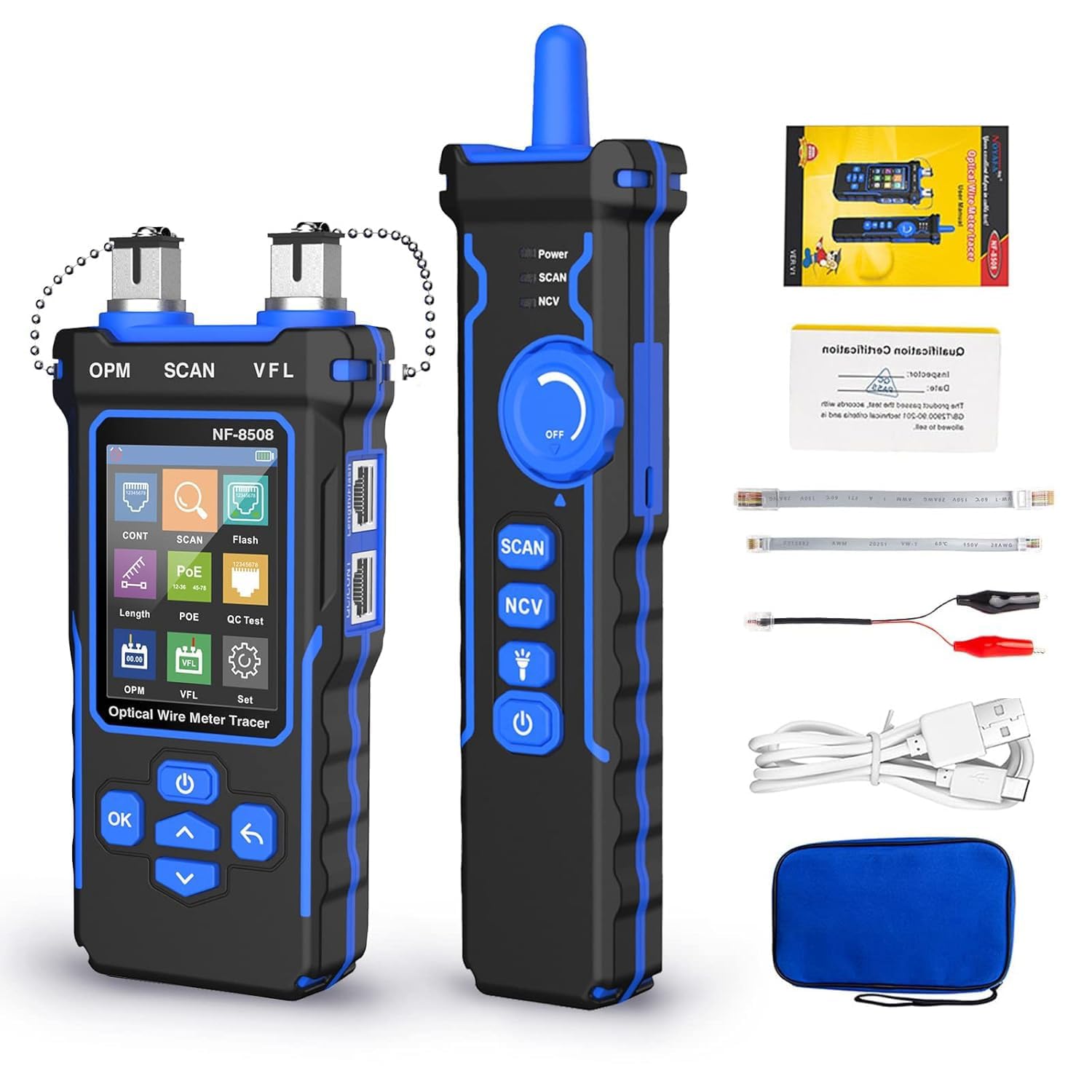
NOYAFA NF-8508

NOYAFA NF-8508

Fiber plus copper

Our Score 8.6/10
Check Price

Worth Noting

  • Length readings drift on long runs
  • Heavy and boxy at 0.59 kg
Weight
1.3 lb
PoE Test
Up to 60V DC
Functions
Continuity, scan, port flash, length
Optical Power Meter
7 wavelengths, -70 to +10 dBm

An optical power meter in a cable tester looks like an odd extra until you are the person who has to prove a fiber strand is actually lit. This one reads seven wavelengths from 850 to 1650 nm across a -70 to +10 dBm range, and pairs that with a visual fault locator for breaks, poor splices and tight bends.

The copper side isn't an afterthought. Continuity, cable scan, port flash, length measurement and PoE testing up to 60V DC are all here, so a mixed building - fiber between floors, copper inside them - can be worked with one box instead of three.

Where it earns its place is that mixed job: a small ISP, a CCTV install, a school with a fiber backbone. Carrying one instrument that finds a kinked strand and then verifies the copper feeding the camera is the entire argument, and the fault locator has spared us a second trip more than once.

If you never touch fiber, skip it. The power meter and the locator are what you are paying for, and on a copper-only job the cheaper testers here do the same wiring checks without the extra weight in the bag.

Bottom line: Fiber is the reason to buy it: the power meter and fault locator here do what nothing else on this page can.

5

TESMEN TLP-123A

TESMEN TLP-123A

Budget pass-fail

Our Score 9.2/10
Check Price

Worth Noting

  • No length measurement or tone output
Design
Detachable remote unit
Batteries
2 AAA included
Indicators
LED wire order, fast/slow
Cable Types
RJ45, RJ11

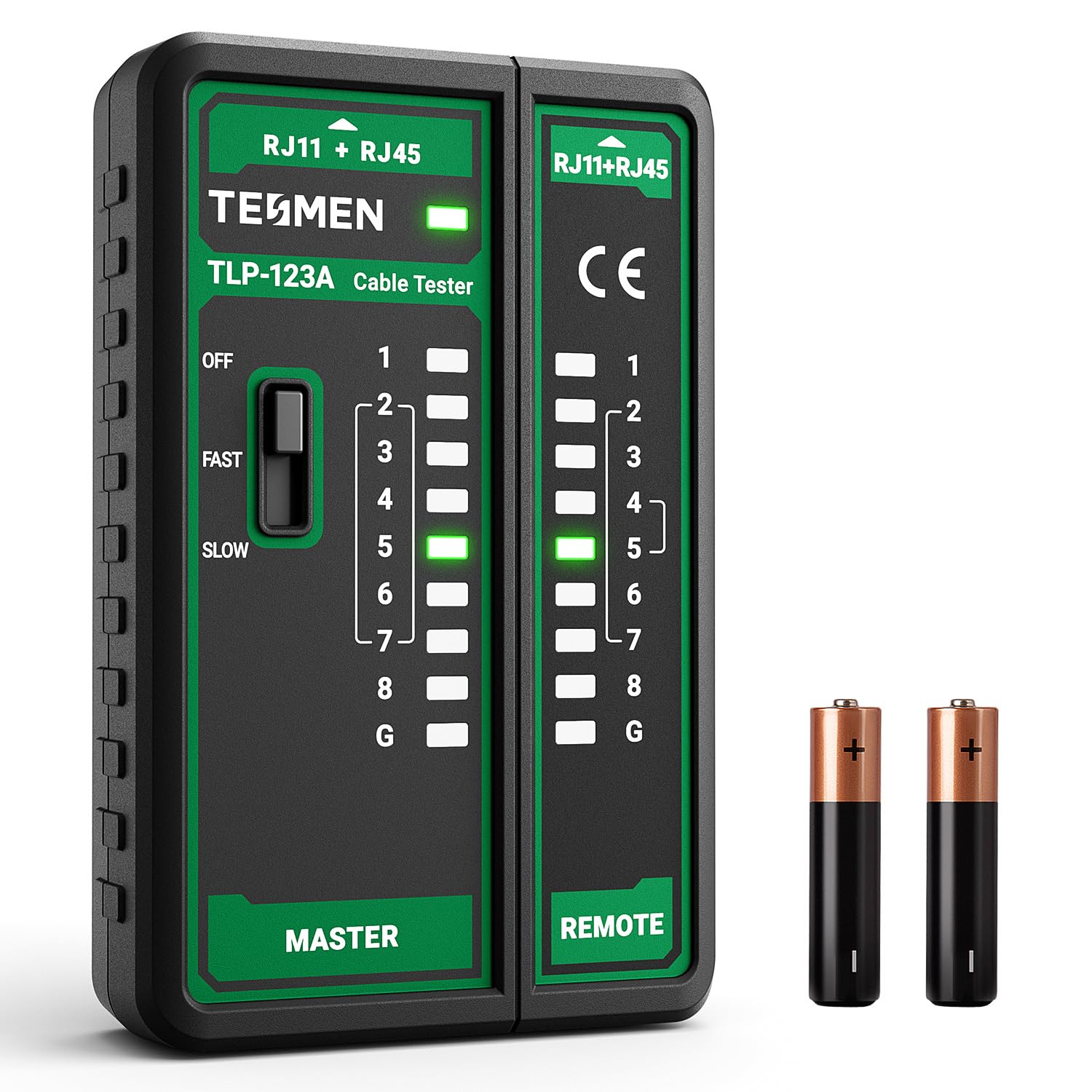
For a dozen jacks and one suspect patch cord, this is all the tester most of us need: one button, a row of LEDs, and a straight answer about whether a cable is wired through or crossed.

The two halves split apart, which is the feature that earns it a place in a bag. Clip the remote to a wall plate across the house, carry the main unit down to the basement, and the lights step through the pairs on both ends. The fast/slow gear slows that sequence when you are squinting at eight LEDs in a dim closet, and two AAA batteries come in the box.

It is also the tester we hand to someone who doesn't want to learn a menu - no screen to interpret, no modes to page through, nothing to misread under pressure. Check a handful of runs once and put it in a drawer; the batteries are the only part that ages.

What it asks in return is that you already know what you are looking at. Eight lights in the right order means a good cable, and reading a wrong order takes a minute of counting the first time you do it.

Bottom line: The least expensive tester here that gives a clear pass or fail, and enough for a dozen jacks and one bad crimp.

6

Fluke MicroScanner2

Fluke MicroScanner2

Daily pro use

Our Score 9.0/10
Check Price

Worth Noting

  • Plastic loopback connector can come apart
Toning
Built-in IntelliTone
Link Test
10/100/1000Base-T, VoIP
Cable Types
RJ11, RJ45, coax
Screen Data
Length, wiremap, cable ID, distance to fault

One screen, four answers: length, wiremap, cable ID and distance to fault. Nothing else here will tell you how many feet along the run the break sits, which is the difference between opening one ceiling tile and opening six.

Toning is built into the handset, so there is no separate probe to buy or lose, and it also runs 10/100/1000Base-T and VoIP link tests. One instrument covers the whole call: find the port, name the run, check the pair order, then shoot the tone.

The price is many times what anything else on this list costs, and that is the decision rather than a footnote. For a tech who bills for the time, a single avoided return trip covers the gap; for a homeowner with six jacks it never will. The plastic loopback connector is the part to treat gently, because the wiremap adapter is what every test leans on.

Bottom line: A working tech's tool: distance to fault, built-in toning, and a price that only makes sense if you bill for the time.

How We Tested the Best Network Cable Testers

To build the shortlist, I started with the models that turn up in electricians' and IT techs' toolbags — brands sold through networking suppliers and the ones that keep resurfacing in forum threads — then narrowed by what actually comes in the box: a remote terminator, numbered far-end identifiers, tone generation, and support for both RJ45 and RJ11. That left 12 testers, which my team and I used for six months across an office relocation, a home-office rewire, a 24-port rack cleanup, and a long exterior run out to a detached garage.

Accuracy came first, because a tester that lies is worse than no tester at all. I built one known-good 300-foot run and one deliberately miswired run, then noted which units flagged the split pair and which waved it through. For cable identification, I timed how long it took to label 24 unmarked patch cables in a live rack, and the units with numbered remotes finished in under ten minutes. I also recorded whether each one reported cable length within a few feet of a known measurement, whether it showed link and PoE status on an active connection, and how legible the display was when I was crouched behind a desk.

Then I abused them. Each tester rode loose in a toolbag for the whole test, got dropped off a stepladder at least once, and sat powered on overnight to see where the battery stood by morning. Ease of use got judged one-handed, in a dark hallway, halfway up a ladder — the buttons you can't find by feel are the ones you stop pressing. Value came down to how much of a job a single unit could finish before I had to walk back to the truck for something else.

How to Choose Network Cable Testers

Wiremap detail beats a pass-fail light

Every tester here will tell you a cable failed; what separates them is how much it says next. A basic LED unit steps through the pins and shows a light out of sequence, which is enough to know a termination is bad and not enough to know which end to open. A pin-by-pin screen names the pair and its position, and that is usually the difference between one re-crimp and two trips up a ladder. If you terminate your own connectors, pay for the screen; if you're checking patch cords, the lights are fine.

Toning takes two halves

Tracing a cable through a wall takes a generator at one end and a probe at the other, and several testers here ship with only the generator. Read the box before you buy: both Klein testers need a separate probe, while the FNIRSI kit includes the receiver and earphones. Identifying runs you can already reach is a different job, and the Scout Pro 3 handles it with locator remotes that sit in five jacks at once and report which one the tester is seeing.

Length is a guide, not a measurement

A tester that reports footage is timing a signal, not proving the cable will carry a gigabit. Use the number to confirm a run reaches the room you think it does, or to work out which end of a break you're nearer. Accuracy varies widely: the Fluke puts distance to fault on screen and is the only one here that does, while the less expensive multifunction units drift on long runs. Treat the footage as a rough bearing rather than a figure to quote to anyone.

PoE and fiber, only for the jobs that have them

If you look after cameras, access points or VoIP handsets, PoE testing earns its keep: the FNIRSI separates standard from non-standard power, and the NF-8508 goes further, reporting polarity and voltage up to 60V DC. Fiber is a separate purchase. A visual fault locator finds breaks and tight bends in a strand; an optical power meter tells you whether light arrives at all. Buy either only if fiber is genuinely part of your week, because on copper-only jobs it is weight and cost you never use.

What keeps it usable in a year

Power and accessories decide whether a tester stays in the bag. Rechargeable units end the AA cycle but age; AAA units run forever and cost little to feed. A remote that stores in the tester body doesn't get left in a wall plate, and a case that holds the adapters means you're not hunting for the RJ11 lead at the bottom of a rucksack. Our rule: buy the tester whose parts all live inside it.

Frequently Asked Questions

Final Verdict

For most people wiring or repairing a home network, the Klein Scout Pro 3 is the one to buy. It names the bad pair, reports the run's length, and tells you which of five jacks you're holding, all on a screen that reads in a dark basement. The tone probe is the only real gap, so add it if your work runs through walls.

If tracing unidentified cables is the main job rather than an occasional one, the FNIRSI LPM-10A is the better starting point: the receiver, the PoE checks and the rechargeable power all come with it. On a tight budget, the TESMEN TLP-123A answers pass or fail on a dozen jacks for the least money here.