Smart Home & Security

Best Security Cameras Without a Subscription of 2026

A security camera that only works while you keep paying for it isn't really yours. Most big-name models look like a bargain up front, then bill you monthly for the storage that makes recorded footage useful at all — cancel the plan and you're left with a live view and little else. I wanted cameras that keep clips on a card or a hub you own, so the thing works in month eighteen exactly the way it did on day one. No fee, no footage held hostage.

The catch is that going subscription-free narrows the field fast, and that's where the compromises hide. Over the past eight months, my team and I have lived with 12 of these cameras — porches, garage doors, back steps, a second-floor window — and the gaps showed up in boring places, like a unit that fell off the Wi-Fi whenever the microwave ran, or one that pinged me about every passing car and missed the actual delivery. Mount yours where the signal is strong, not where the angle looks best. The ones worth your money are below.

1

eufy C31

Top Pick
eufy C31

24/7 local recording

Our Score 8.4/10
Check Price

Worth Noting

  • 1080p, where several picks offer 2K
Power
Plug-in, 6.5 ft cable
Resolution
1080p
Local Storage
microSD up to 256 GB
Weather Rating
IP66

A card in the camera plus a stream out over RTSP is the whole subscription story for the C31, and it is why this is the one we recommend first. eufy does not put continuous recording behind a plan: the camera writes to microSD up to 256 GB around the clock, and if you already run a NAS you can point it at that instead. That distinction matters more than any specification here — a camera that only wakes for motion hands you the seconds after a trigger, not the minute before it.

The night picture is what we watched most closely. The C31 produces color without a spotlight, using an f/1.2 aperture and a backside-illuminated sensor, so a porch stays readable after dark without a lamp snapping on and announcing the camera to everyone on the street. Person, vehicle, pet and crying detection all arrive free, and the head pans a full 360°, which means one unit covers a room or a driveway corner that would otherwise take two fixed cameras. The pan motor is quiet enough that we stopped noticing it.

You buy the card separately, and the attribute that matters is endurance rather than speed — a card sold for dash cams or security cameras survives constant rewriting far better than a phone card pulled out of a drawer. Power is the other thing to plan. There is a 6.5-foot cable and a USB adapter in the box, so the honest first step is measuring from the outlet you intend to use to the bracket you intend to drill. A long eave is no help if the nearest socket is in the garage.

Where the C31 asks for patience is Wi-Fi. It is a 2.4 GHz camera, which is the right band for pushing through walls, but the dual external antennas only help if there is signal at the mount to begin with. If your phone shows one bar at the far corner of the yard, that is the camera's problem too, and a mesh node or a closer bracket does more for your footage than any setting in the app.

Bottom line: Our pick for anyone who wants the footage on their own card, recording around the clock, with no account sitting in the middle.

2

aosu 2-Cam Kit

aosu 2-Cam Kit

Outdoor two-camera kit

Our Score 8.6/10
Check Price

Worth Noting

  • Detection range falls short at distance
  • Battery life drops with heavy motion traffic
Resolution
2K
Battery Life
Up to 240 days
Field Of View
166°
Local Storage
32 GB base hub

Thirty-two gigabytes live inside the aosu base unit rather than in a cloud account, and every clip the two cameras capture travels there and stays. Each camera takes in a 166° view, wide enough to hold a driveway and the gate beside it without panning, and the footage is encrypted on the base with no plan attached to it.

For a front path and a back door, this is the most complete package here, and it is the kit we point to when a house needs two outdoor cameras rather than one. The spotlight and siren on each unit mean a camera does more than watch: you can light the driveway from the app and talk through the speaker before deciding whether to get out of bed.

Understand one thing before ordering. 32 GB holds a lot of event clips, but it is not a continuous timeline — what you get is every motion event the cameras catch, not a film of the whole day. Motion also has to happen close enough to register, so distant movement at the far edge of that wide frame is the least convincing part of the kit, and a busy pavement in front of the lens shortens the battery interval well below the 240-day figure.

Bottom line: We recommend the aosu kit when two outdoor cameras need to work far from the router, with the footage sitting in the hub and no monthly bill.

3

HITELLARCAM CB54W

HITELLARCAM CB54W

Budget outdoor camera

Our Score 8.4/10
Check Price

Worth Noting

  • Battery life swings with how busy the view is
  • Motion alerts need tuning in busy scenes
Wi-Fi
2.4 and 5 GHz
Resolution
2K
Battery Life
1 to 6 months
Local Storage
microSD plus free cloud

The CB54W is the cheapest camera in this roundup, and it does not behave like it. There is 2K video, a spotlight and siren, IP66 sealing, and — unusually for the budget end of this group — both 2.4 GHz and 5 GHz Wi-Fi. That last point is the detail we did not expect: most inexpensive outdoor cameras are 2.4 GHz only, and the 5 GHz band gives a cleaner link when the router sits on the same side of the house.

Free cloud storage is the other reason it earns a place. Cloud clips are usually the tier you pay for; here they come alongside microSD recording, so you get an off-site copy of the events that matter without a plan. Setup was the quick part in our testing — pairing through the app took minutes — and the daytime picture was sharper than the price suggests, with the 2K detail holding up when we zoomed into a frame.

The mount is a straightforward screw-in bracket, and at 2.25 inches square the body disappears under an eave or onto a fence post. Night vision reaches roughly 26 feet, which covers a door and the step in front of it but not a long driveway; for that reach, the wider aosu view or the eufy's pan does more. A camera this small and this cheap is the one we suggest for a shed, a side gate, or a first camera you are not ready to spend much on.

Bottom line: We keep the CB54W on this list for one reason: it is the least expensive way here to get 2K, free cloud clips and dual-band Wi-Fi outdoors.

4

SensForge SF-C2

SensForge SF-C2

Indoor room watching

Our Score 8.8/10
Check Price

Worth Noting

  • Infrared night vision is black and white
  • Cards capped at 64 GB
Wi-Fi
2.4 and 5 GHz
Resolution
2.5K
Field Of View
360° pan, 90° tilt
Local Storage
64 GB card included

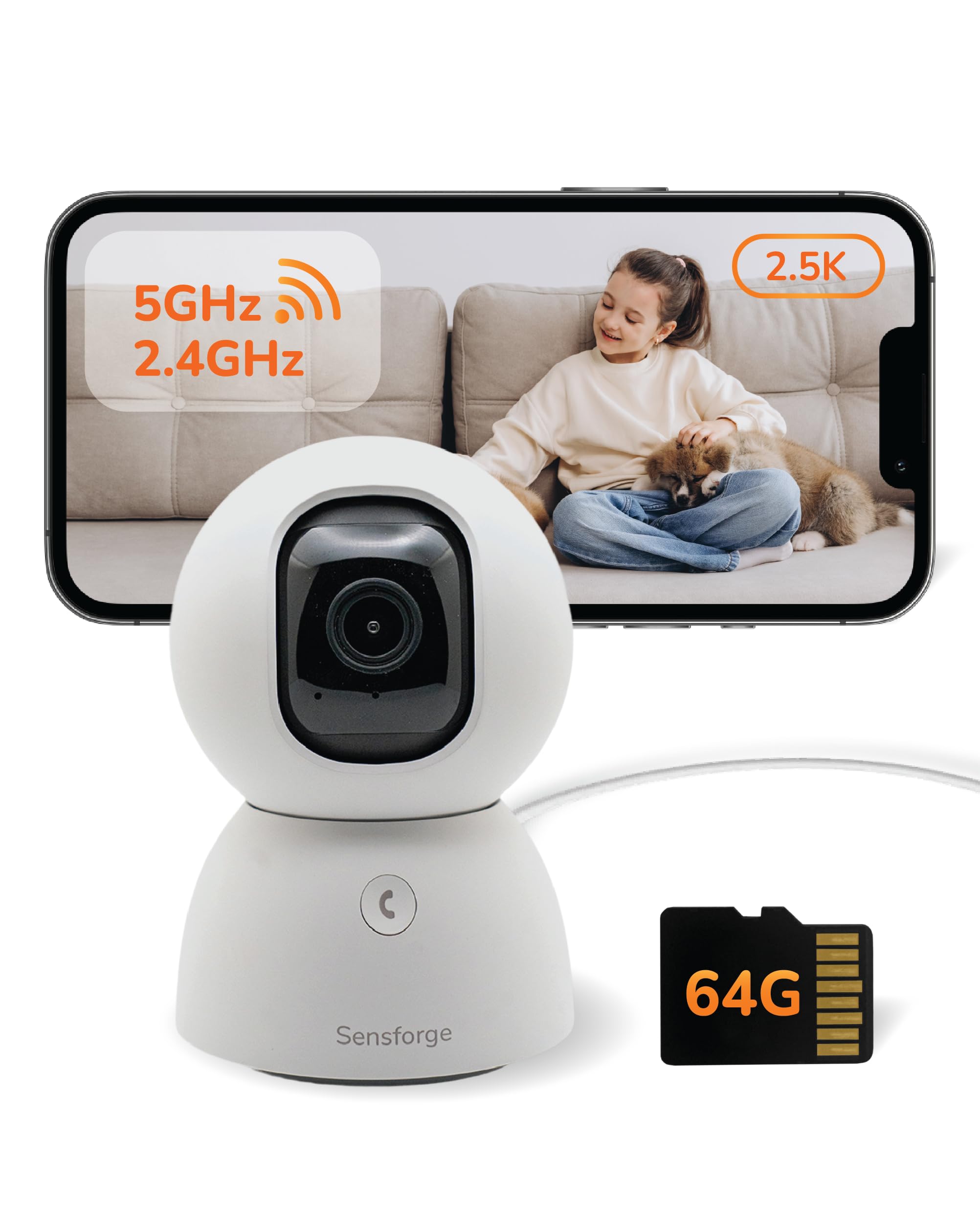
A 64 GB card arrives pre-installed in the SF-C2, which sounds minor until you have ordered a camera, waited for delivery and discovered you cannot record anything until a separate card turns up. Plug it in, pair it, and it is writing to local storage with no account in the loop. That is the entire setup, and it is the reason this one suits a gift or a household that does not want a project.

The picture is the best of the indoor cameras here: 2.5K from a head that pans a full 360° and tilts 90°, so a single unit on a shelf can cover a living room and the hallway door without a second camera. Dual-band Wi-Fi helps in a room where the 2.4 GHz band is crowded by everything else in the house, and human and pet detection arrive without a plan, which is the point when you are watching a dog or a parent rather than a perimeter.

We like it most for renters and for anyone watching a room instead of a yard. It sits on a tabletop mount, so no drill and no landlord conversation, and the feed stays in the room it is watching. That is also the boundary of what it is for: indoors, close up, with the camera pointed at something you actually care about. If the same money has to cover a driveway, the plug-in eufy does that job instead.

Bottom line: If the camera is going in a room rather than a yard, this is the one we choose: the card is already inside and no account sits between you and the footage.

5

Tapo C400

Tapo C400

Wire-free outdoor use

Our Score 8.6/10
Check Price

Worth Noting

  • Battery falls well short in busy views
  • Detection at distance struggles after dark
Resolution
1080p
Battery Life
Up to 180 days
Local Storage
microSD up to 512 GB
Weather Rating
IP65

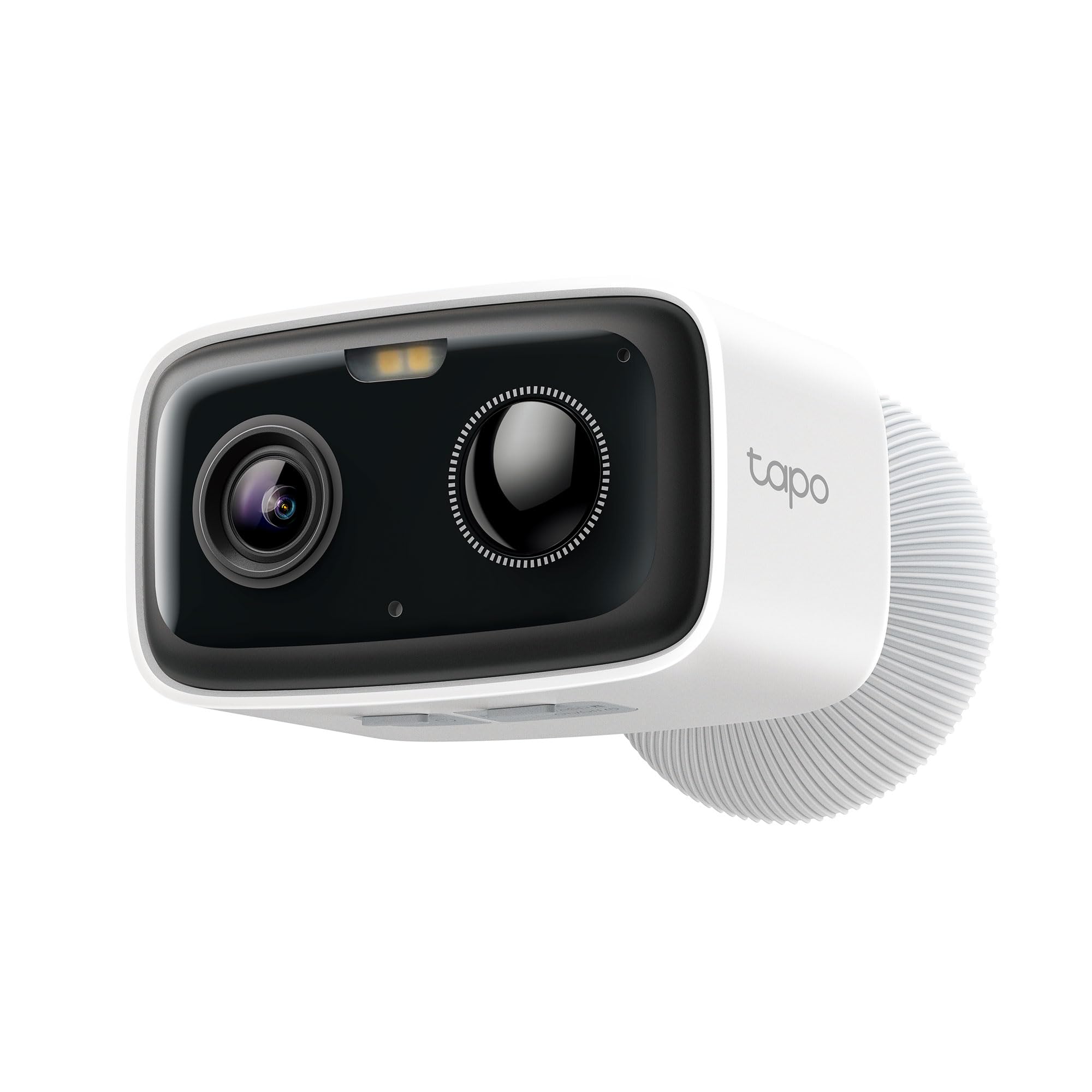
Six months is the headline on the C400's battery, but the number we care about is 512 — the card size it accepts. Nothing else in this group takes a card that large, and for a camera you mount under an eave and then try to forget about, leaving months of clips on one card matters more than squeezing out a few extra weeks between charges.

We recommend it for the spot with no outlet and no easy ladder access. Person detection inside zones you draw is free — no plan, no trial, no nag screen — and the app is the part of this camera that impressed us most, walking through pairing without a manual. The 1080p picture will not win a resolution argument against the 2K picks, but it is clean, and the color night mode with the two spotlights gives you an image you can actually identify someone in.

It is a small body, roughly three inches tall, so it tucks under an eave or onto a fence rail without drawing attention, and the IP65 rating covers rain and dust rather than immersion. Like every battery camera here it records events rather than a continuous timeline, so if a full day of footage is the requirement, the plug-in eufy is the one to look at.

Bottom line: An outdoor camera with no outlet nearby is exactly what the C400 is for, and it takes the biggest memory card of anything here.

6

Vivideye Solar 2-Cam Kit

Vivideye Solar 2-Cam Kit

Solar property coverage

Our Score 8.8/10
Check Price

Worth Noting

  • Pairing a camera to the hub can stall
  • Least proven kit in this group
Power
5 W solar panel, 8,000 mAh battery
Resolution
4MP
Field Of View
360° PTZ
Local Storage
128 GB hub included

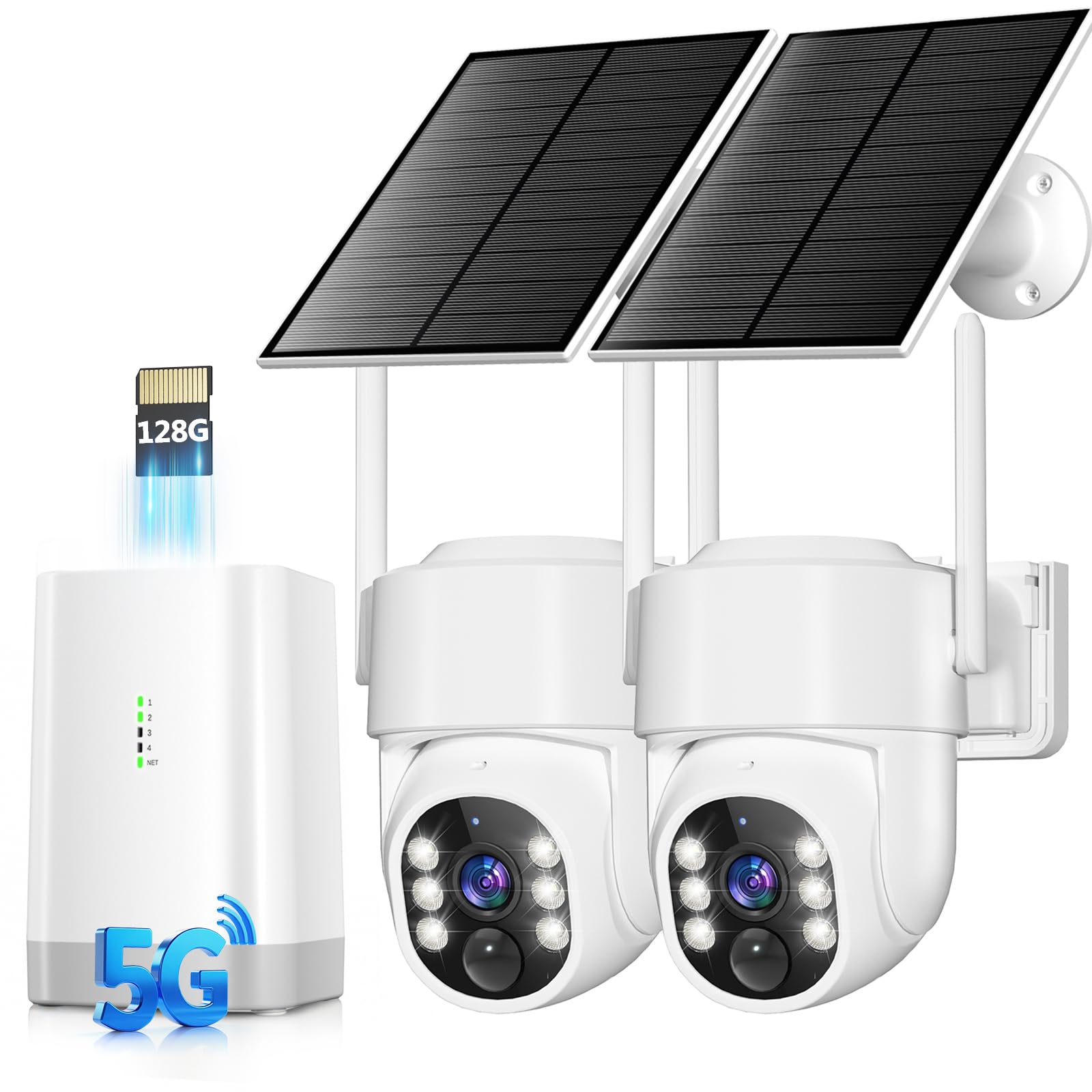
Two 5 W solar panels and an 8,000 mAh battery in each camera mean this kit never needs a ladder for a recharge, which is the entire argument for spending more than the battery kits cost. Put the panels where they see a few hours of direct sun and the cameras keep running without you touching them.

The hub carries a 128 GB card — the largest storage included with any pick here — and it spans four channels, so a kit that starts with two cameras can grow to four without a new base. The cameras shoot 4MP and pan a full 360°, and tracking is designed to hand a moving subject from one camera to the next, which is the right shape for a driveway that runs past the side of a house.

We are recommending it with an asterisk, for two reasons. The first is the setup quirk: 360° auto-tracking ships switched off and has to be enabled in the app, so a camera that seems to ignore movement is usually a camera waiting for a toggle. The second is longevity — a solar camera lives outside through frost, heat and ultraviolet light, and this is the least proven kit here, so the seals and the battery are the parts nobody can vouch for yet. Where nothing else fits, that trade is still worth making.

Bottom line: We recommend it for a property where running power outdoors is impossible: solar panels, a 128 GB hub and a 360° view from each camera, with one pairing caveat.

7

Jooedi Security Cam2

Jooedi Security Cam2

Cheap two-camera kit

Our Score 8.6/10
Check Price

Worth Noting

  • Reliability record is still short
Pack
2 cameras
Free Cloud
1-day rolling
Resolution
2K
Local Storage
microSD up to 128 GB

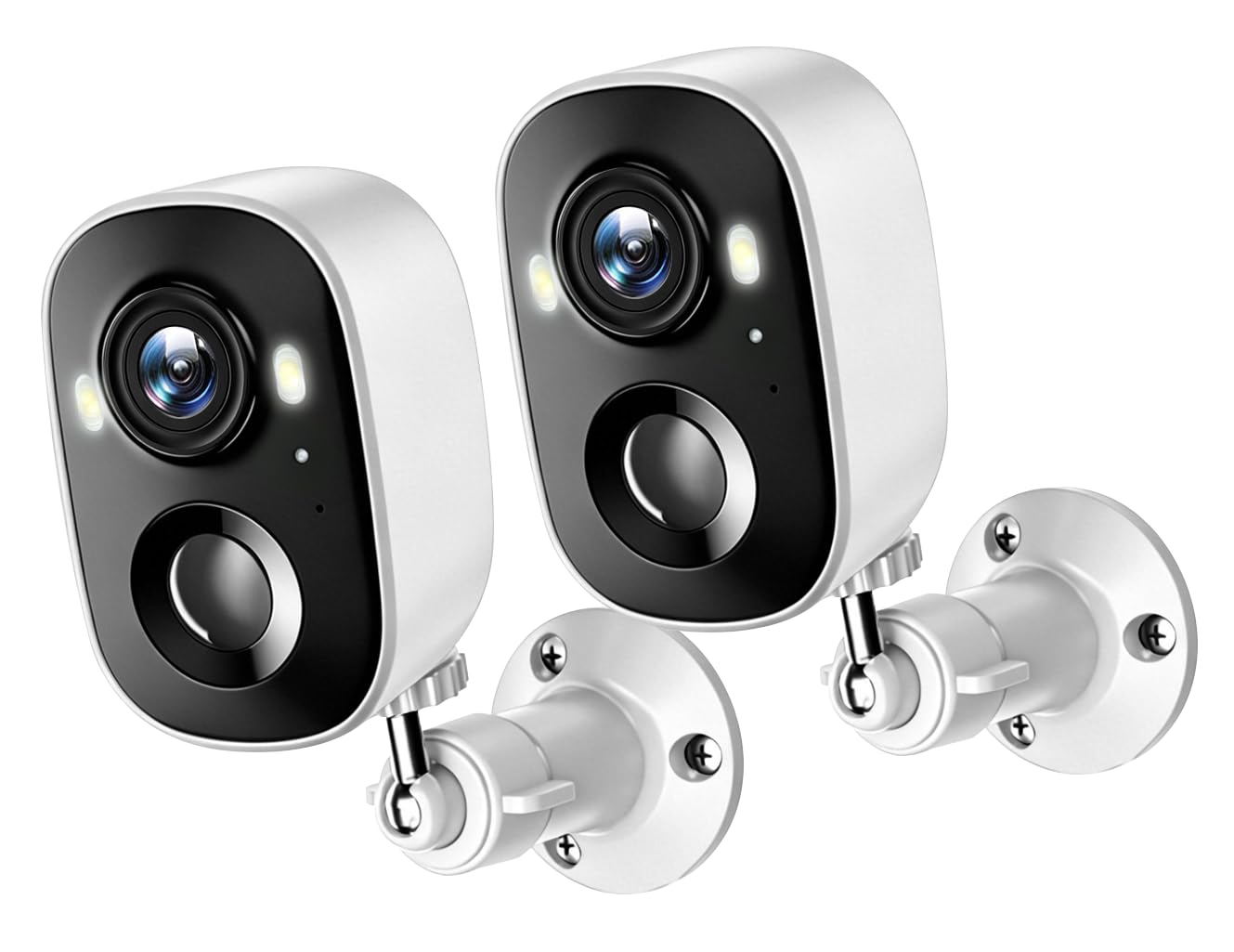
Two cameras arrive in one box here, and that is the pitch: 2K video, a rechargeable battery in each, PIR motion detection, IP65 sealing and two-way audio. The storage setup is unusual but sensible — a free rolling cloud window of a single day, plus microSD support up to 128 GB inside each camera, so nothing is locked behind a plan you have to keep paying for.

We are cautious rather than enthusiastic, and the caution is about how new this one is. There is not enough history yet to say how the batteries or the app behave past a year, so it suits a first setup, a shed, or a pair of cameras you want cheaply rather than a system you are leaning on for a decade. Everything else about it holds together: the one-day cloud covers checking what happened last night, the card covers anything older, and PIR is the right sensor for a battery camera because it does not sit there draining power every time a leaf moves.

Bottom line: We recommend it with a caveat: two 2K cameras and free storage for a garden or shed, on a model whose long-term reliability is still unknown.

How We Tested Subscription-Free Security Cameras

We started with a list of roughly 40 models sold as subscription-free or local-storage-friendly, then cut anything that locked basic recording behind a paid tier, anything that demanded an account just to watch a live feed, and anything that couldn't take a memory card or talk to a hub. That left 12 cameras across the price range, which we installed and lived with for eight months, weighing what each one cost against what it could actually do with no plan at all.

Setup was timed from the moment the box opened to the first live picture on a phone, working alone. I noted whether pairing took one try or five, and whether the app asked for a card before it would record anything. For connectivity, each camera ran for weeks at a stretch while I logged every dropout and scrolled the footage timeline for gaps after a router reboot or a power blip.

Motion detection got the most attention, because it's where cheap cameras embarrass themselves. I walked across the frame at 10, 20, and 30 feet, at noon and again at dusk, checking whether the alert fired and whether the clip began before I entered the frame or after I'd already left it. A week of ordinary life per camera — cars, swaying branches, a neighbor's cat — told me how much of the notification stream was junk. Picture quality came down to whether I could read a plate at the end of the driveway and recognize a face at the door after dark, with the porch light on and off.

Battery models ran at default sensitivity until they died, with charge dates scribbled in my phone, and the wired ones stayed up through heat, rain, and one ice storm to see which came back online on their own.

How to Choose Security Cameras Without a Subscription

Decide where the footage lives

Four options turn up in this group: a microSD card inside the camera, a base hub holding the card, a recorder or NAS fed over RTSP, and free cloud storage. The first three are the ones to trust for a real record, because they keep working whether or not the brand's servers do. Free cloud is usually a short rolling window — the Jooedi kit keeps a day — which is enough to check what happened last night and not enough to build a history of a repeated problem.

Check the card size each camera accepts before you buy, since support here ranges from 128 GB to 512 GB, and remember that the card is often sold separately. A card rated for dash cams or security cameras survives constant rewriting far better than a cheap phone card.

Match the power source to the mount

A plug-in camera can record continuously, all day, every day — that is the eufy C31's biggest advantage and the main reason it takes our top spot. Battery and solar cameras wake on motion, record a clip, then go back to sleep; they save power by missing the quiet minutes in between.

Plug-in also means an outlet within reach of the cable, which is a shorter distance than most people assume — the C31 comes with 6.5 feet. Battery suits a fence post or a shed with a recharge every few months, and solar suits the same spots when you would rather not carry the ladder at all, provided the panel sees direct sun for part of the day.

Detection is where the money hides

Person, vehicle, pet and package detection is increasingly handled on the camera itself, which means it keeps working without a plan — the Tapo C400 and eufy C31 both include it. Read the detection line specifically: some brands gate smart alerts behind a subscription and leave you with plain motion otherwise.

Plain motion is not useless, but it fires on headlights, insects and moving branches, and a camera that alerts you constantly becomes a camera you ignore. Draw activity zones over the path or the gate rather than the whole frame, and test the setting during the first week while you can still move the camera.

Resolution, night vision and how much you can see

2K is the sensible middle of this group. 1080p is fine for a doorway at close range and 4MP is more than most homes need; higher resolution also costs storage and bandwidth, which matters more when you are paying for the card yourself.

After dark, the lens matters more than the pixel count. Color night vision comes from either a spotlight or a very bright lens — the eufy C31 manages it without a light, the Tapo C400 uses spotlights, and the SensForge falls back to black-and-white infrared. If a face at the gate is what you need, a pan-tilt camera that can point at the gate beats a wider fixed lens.

Frequently Asked Questions

Final Verdict

Start with the eufy C31. It is the only camera here that records continuously to a card you own, and its RTSP output means the footage can live on a NAS instead of someone else's server — the closest thing here to a subscription-free camera that still behaves like a serious one.

If two cameras have to sit across a yard with no outlet, the aosu kit's hub and 166° views cover more ground wirelessly. For a single indoor room, the SensForge's included card makes it the simplest start.