Home Appliances & Robots

Best Smart Ceiling Fans of 2026

A ceiling fan is the one appliance you notice only when it's wrong: a wobble at high speed, a remote that has vanished, air that stirs the curtains but never reaches the sofa. Smart fans promise to fix that with app control, schedules, and voice commands, but first they ask for wiring, a downrod, a pairing process, and a blade span that suits the room. Get those right and the fan fades into the background; get them wrong and you've installed an expensive light fixture.

We've spent nine months with eight smart ceiling fans in bedrooms, a living room, and a home office. We noted how each looked from directly below, how much air it moved on low, whether the motor hummed at night, how long installation took with two people, whether the app still made sense a month in, and what the price actually bought. The biggest lesson for me was size: a fan that felt strong in a small bedroom barely registered in an open living room. The picks below are the ones that earned their spot overhead.

1

Sofucor 52 Low Profile

Top Pick
Sofucor 52 Low Profile

Standard-height rooms

Our Score 9.0/10
Check Price

Worth Noting

  • Remote control can be finicky
Airflow
5,500 CFM
Blade Span
52 in
Noise Level
30 dB
Smart Control
App, voice, remote

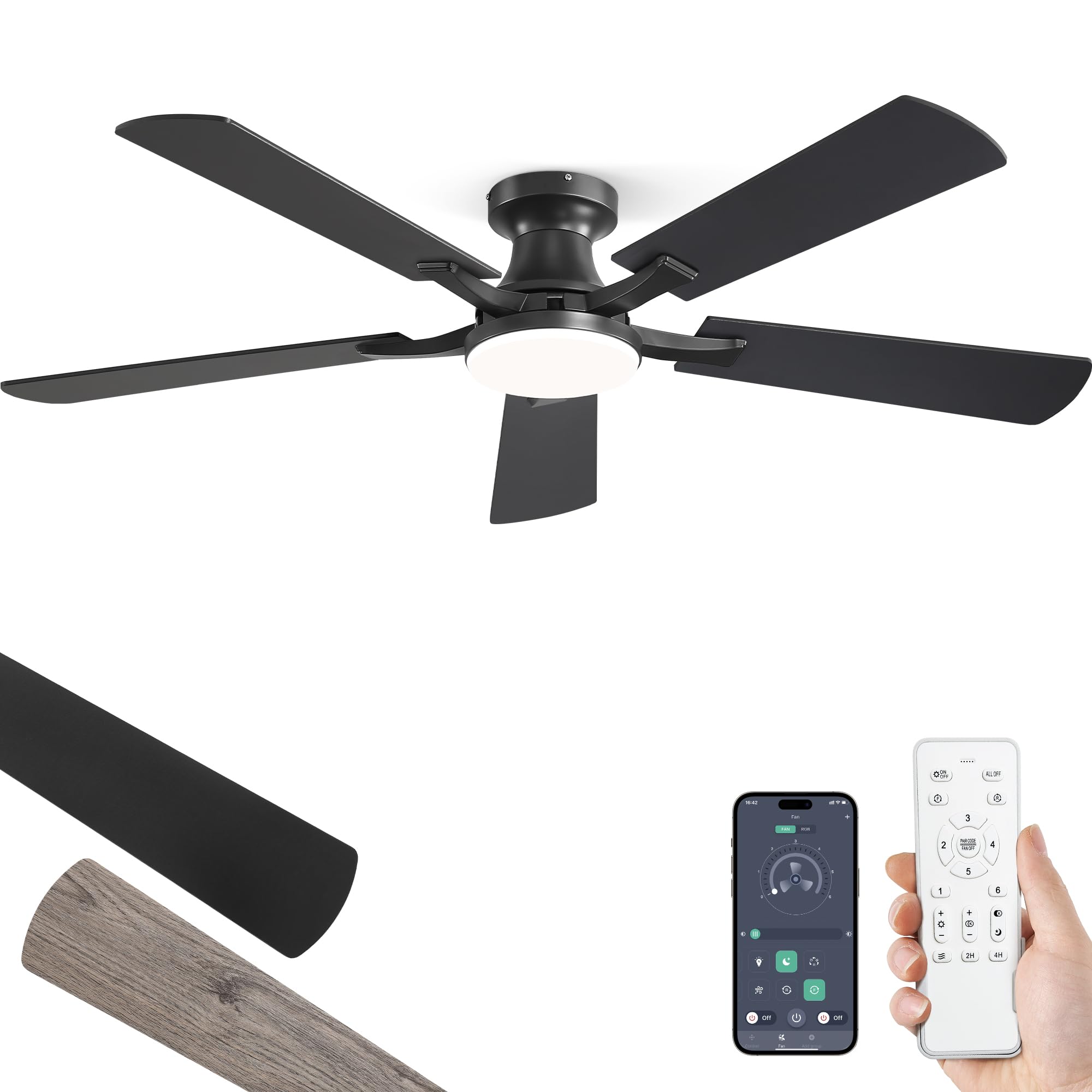
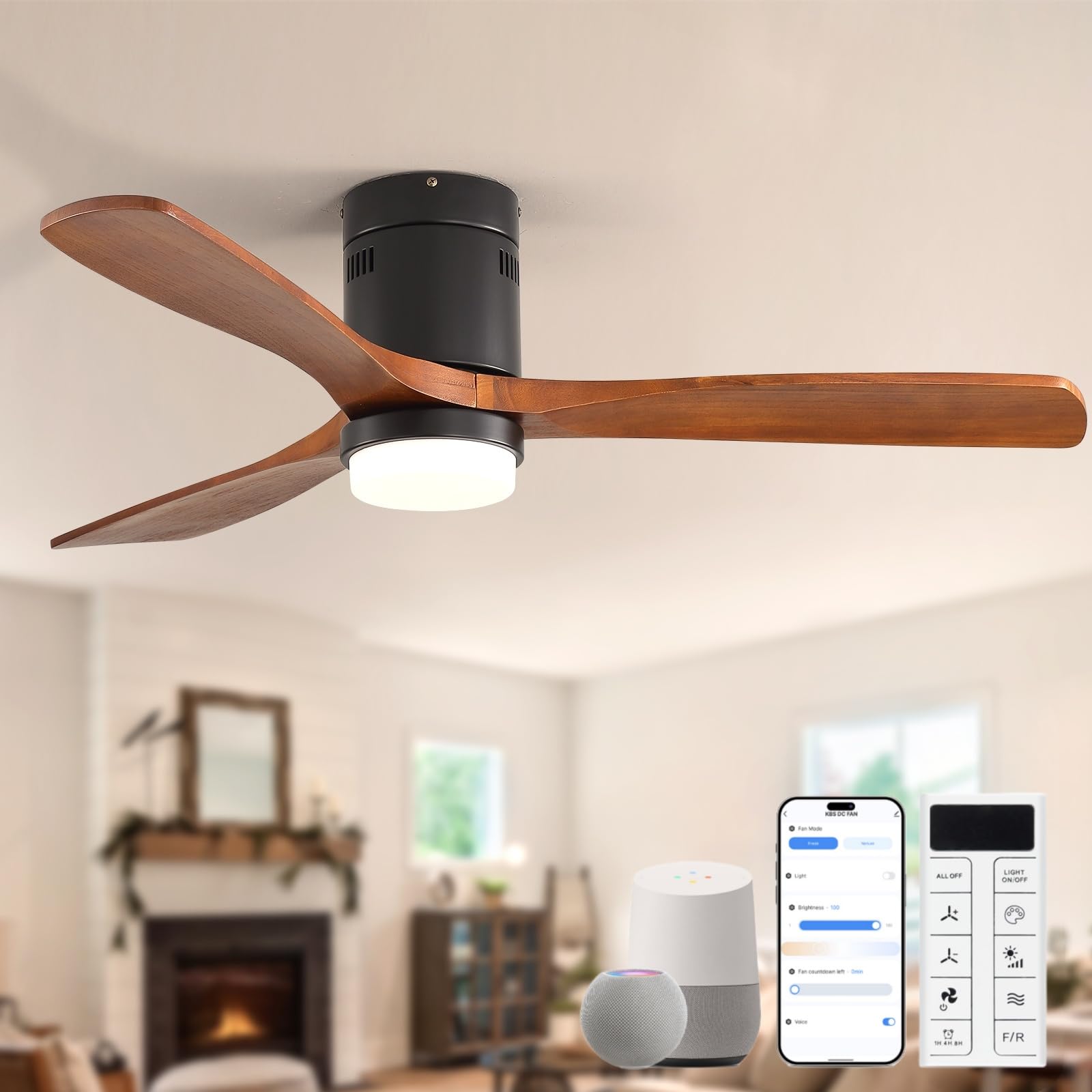
The Sofucor 52 Low Profile is the smart fan we recommend first for a standard-height living room or bedroom. A 52-inch span, 5,500 CFM, and a 30 dB rating give it the balance most people need: enough air for a real room, quiet enough to leave running overnight, and only 11.8 inches tall so it stays out of the way. App, voice, and remote control cover the ways most of us actually use a fan.

What sold us on the design is how complete it feels without getting fussy. The three wood blades give it a cleaner look than the usual five-blade budget fan, the light tunes across three color temperatures and dims smoothly, and the 1/4/8-hour timer becomes the feature you use every night. Reversible operation means it earns its ceiling space in winter, too.

The competition is close. DREO's 52-inch model moves a little more air on paper, but its own noise figure is 43 dB, so we give the Sofucor the edge for bedrooms and quiet living rooms. The flush body is the real differentiator: it suits an eight-foot ceiling in a way a downrod fan does not. Measure the 11.8-inch height against your ceiling and any nearby cabinet or door swing before you commit.

Bottom line: The Sofucor 52 Low Profile is our first choice for standard-height living rooms and bedrooms: 5,500 CFM, a quiet 30 dB rating, and app, voice, and remote control in a flush body.
2

DREO 52 Smart

DREO 52 Smart

Voice-control homes

Our Score 9.0/10
Check Price

Worth Noting

  • One-year limited warranty
Airflow
5,673 CFM
Blade Span
52 in
Noise Level
43 dB
Smart Control
Alexa, Google, app

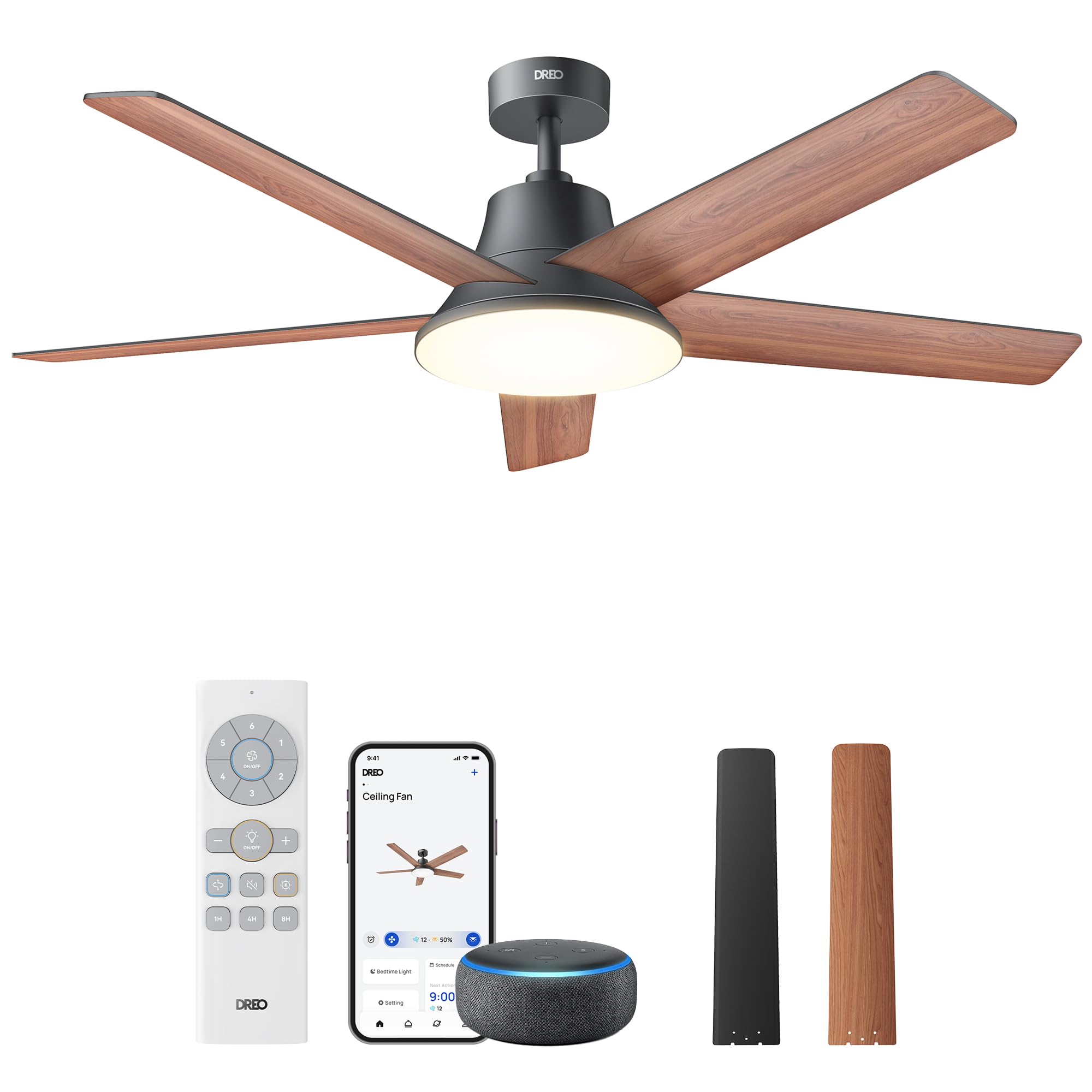
The DREO 52 is the pick we hand to a household that already runs its lights and thermostat through Alexa or Google. It names both assistants, along with the DREO app and a physical remote. That explicit support matters: some fans say 'voice control' without naming the assistant, and then you spend an evening discovering the answer.

On air movement, the 5,673 CFM rating is slightly above the Sofucor's 5,500, and the 24W LED gives you dimmable light across the usual color temperatures. Six speeds and a 1/4/8-hour timer cover the basics. The five-blade design is more conventional than wood, but the black finish and compact light kit keep it from looking busy.

We rank it as the alternative for voice-led homes rather than the default because the 43 dB noise rating is the highest among the 52-inch fans here. That is the listed figure, and it is enough to steer us toward the Sofucor for a bedroom. In a kitchen or open living space, where a little more air movement matters more than the last few decibels, the DREO's stronger smart-home support makes it the easier one to choose. The remote is a sensible fallback when a guest does not want to learn the app.

Bottom line: For a household built around Alexa or Google, the DREO 52 is the smart fan we point to, with 5,673 CFM and a dimmable LED; its 43 dB rating is the trade-off.

3

DREO 42 Bedroom

DREO 42 Bedroom

Bedrooms and offices

Our Score 9.2/10
Check Price

Worth Noting

  • Single 6-inch downrod limits high ceilings
Airflow
3,400 CFM
Blade Span
42 in
Noise Level
25 dB
Smart Control
Alexa, Google, app

The DREO 42 is the fan we choose when the room is a bedroom first and a showpiece second. The 42-inch span keeps the blades out of the way over a bed, the 25 dB rating is the lowest in this group, and the 8.6-pound body is easy to lift into place. It still has the smart controls—Alexa, Google, the DREO app, a remote, and a wall-switch option—so quiet does not mean dumb.

At 3,400 CFM it moves enough air for a bedroom, office, or small living room, but it is not the fan for a big open plan. The 12 speeds give you finer control than the six-speed fans here, and the 2,400-lumen light tunes from warm to cool with stepless dimming. The crystal cover and reversible black or wood blades are style choices; the performance comes from the small span and the slow, quiet speeds.

The 12 speeds are not just a spec-sheet boast: the low end is where this fan earns its bedroom role, and the wall-switch control means you can leave the remote on the nightstand and still turn the light on at the door.

Bottom line: We choose the DREO 42 for bedrooms and small rooms where quiet matters more than maximum airflow; 25 dB, 12 speeds, and wall-switch control make it easy to live with.

4

Fanbulous 72

Fanbulous 72

Large open spaces

Our Score 8.8/10
Check Price

Worth Noting

  • No voice-assistant control
  • Large span overwhelms small rooms
Airflow
7,499 CFM
Blade Span
72 in
Noise Level
35 dB
Smart Control
Bluetooth app, remote

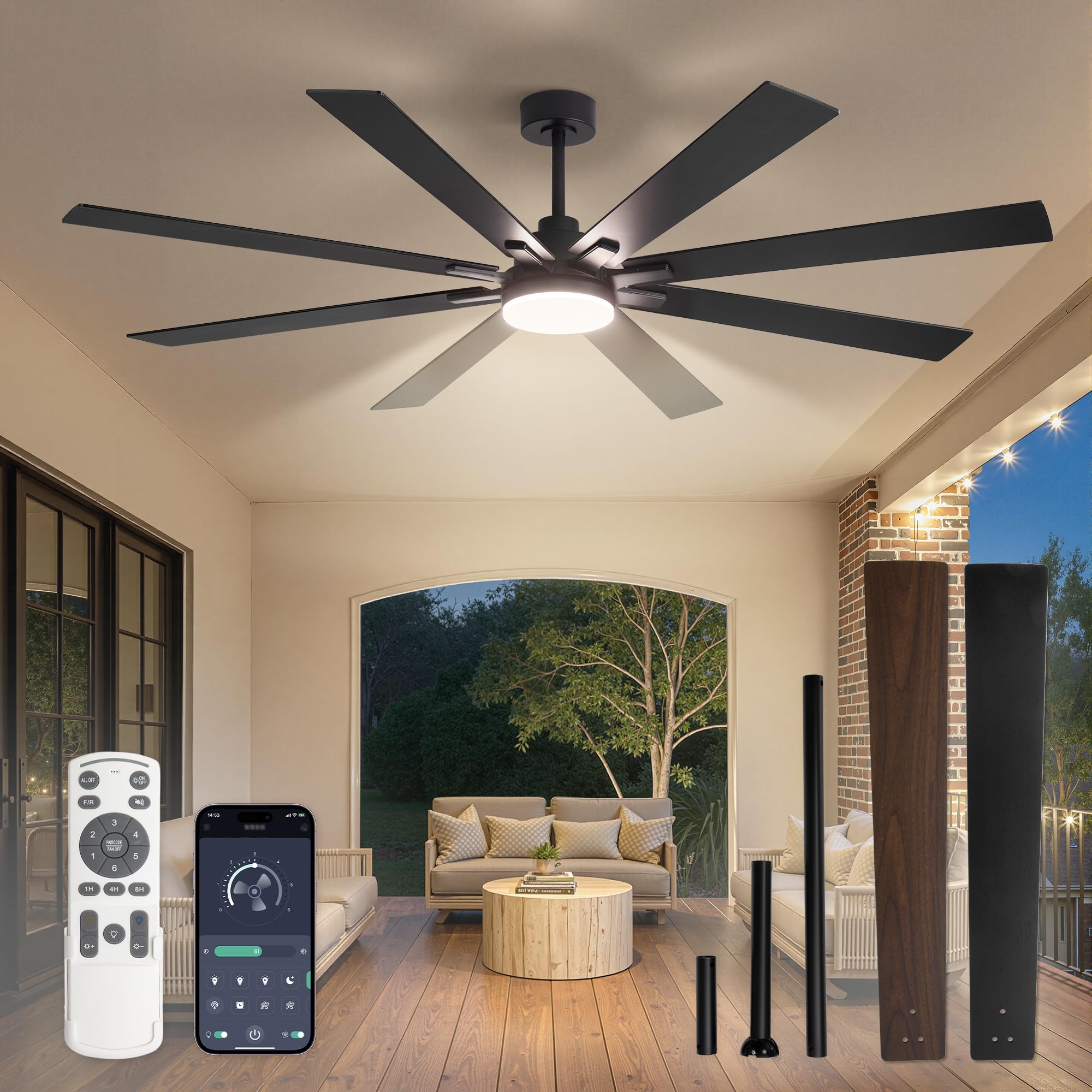
A 52-inch fan can look busy in a great room and still leave the far end stuffy. The Fanbulous 72 takes the opposite approach: a 72-inch sweep, eight warp-resistant wood blades, and a 7,499 CFM rating that is the highest airflow here. This is a fan you notice, in a room that can carry it.

We think it is the right choice for an open-plan living area, a vaulted ceiling, or a covered patio where the fan is part of the architecture. The three downrods—5, 10, and 20 inches—let you set the height for a standard or high ceiling, and the damp-rated build makes the outdoor setting more plausible. The reversible motor and six speeds are standard, but the scale is the point.

The smart side is narrower. The app uses a direct Bluetooth connection rather than Wi-Fi, so the remote stays the simplest control, and the fan is happiest when you are nearby. On a high ceiling, the 20-inch downrod is the detail that makes the fan look intentional; on an eight-foot ceiling, the long drop crowds the room.

Bottom line: The Fanbulous 72 is the large-room answer: 7,499 CFM, a 72-inch span, and three downrods for high ceilings, with no voice control as the compromise.

5

OJX 52

OJX 52

Budget full-size

Our Score 8.6/10
Check Price

Worth Noting

  • Remote can be finicky
Airflow
5,000 CFM
Blade Span
52 in
Noise Level
30 dB
Smart Control
App, remote

The OJX 52 is the full-size fan that makes the least sense to ignore when the budget is tight. It has a 52-inch span, 5,000 CFM, and a 30 dB rating, numbers that sit comfortably beside the midrange picks here. For a room that needs a standard-size fan, it covers the basics without asking for much.

The controls are app and remote only. Six speeds and an 18W LED cover the daily routine, with three color temperatures and dimming from the remote or phone. The five-blade design is conventional, and the black finish is inoffensive rather than striking. Reversible operation and a timer round out the useful parts.

Installation flexibility is better than we expect from a budget fan. It comes with two downrods and is rated for sloped ceilings up to 15 degrees, so it can work in more rooms than the flush-mount alternatives. The 10-year motor warranty and two-year parts coverage are also reassuring for the price.

We recommend the OJX as the budget full-size pick for anyone who wants strong airflow and can live without voice control. Its 5,000 CFM and 30 dB rating are the strongest combination of airflow and quiet in the budget group. The 15-degree slope limit is the installation number to check first; a steeper ceiling rules it out.

Bottom line: We see the OJX 52 as the budget full-size pick: 5,000 CFM and a 30 dB rating, with app and remote control but no voice assistant.

6

LEDIARY 20

LEDIARY 20

Small low ceilings

Our Score 9.0/10
Check Price

Worth Noting

  • Control failures can occur
Blade Span
20 in
Noise Level
30 dB
Light Output
2,500 lm
Smart Control
App, remote

A 20-inch fan is not a smaller version of a 52-inch one; it is a different tool. The LEDIARY is built for a bedroom, kitchen, or study where a full-size fan crowds the ceiling, and its 5.7-inch height lets it sit close to a standard ceiling. It still brings a 2,500-lumen light, six speeds, and app or remote control.

We recommend it for small rooms and low ceilings, not as a whole-house default. The 2,500-lumen light is the standout: it is bright enough to do real work in a small kitchen, and it dims down to a nightlight. The fan moves a useful breeze in a 12-by-12-foot room, but the 20-inch span will not reach the far corners of a living room.

At 30 dB it is quiet, though not the quietest fan here, and the seven blades give it a denser look than the three-blade fans. The low profile is the practical win: it stays out of the way over a bed or a kitchen island. For a guest room where the fan is mostly a light with a breeze, the smaller sweep makes more sense than forcing a 52-inch fan into the space.

Bottom line: Our small-room pick is the LEDIARY 20: a 5.7-inch flush body, a 2,500-lumen light, and 30 dB operation for tight ceilings.

7

ZMISHIBO 52

ZMISHIBO 52

Budget flush mounts

Our Score 8.4/10
Check Price

Worth Noting

  • Remote and app can be inconsistent
Airflow
3,057 CFM
Blade Span
52 in
Noise Level
30 dB
Smart Control
App, remote

The ZMISHIBO's app and remote are the whole control story: no voice assistant and no wall-switch speed control, just a 52-inch flush fixture with a 20W, 2,000-lumen light. That narrows the audience, but it also keeps the price in budget territory and the package focused.

On air, the 3,057 CFM rating is the lowest of the 52-inch fans here, so this is a bedroom or kitchen fan, not an open-plan air mover. The 30 dB rating is competitive, and the six speeds cover the useful range. The light is the better argument: 2,000 lumens, stepless dimming, and a 3,000K-to-6,500K range make it closer to a real ceiling light than a night-light.

It stays a secondary pick because the air movement is modest and the control package is narrow. If you want a flush 52-inch fan with a large light and do not need voice control, it is still a sensible budget choice. In a low-ceiling bedroom, the flush body is the practical advantage; a downrod fan eats the clearance.

Bottom line: For a budget flush-mount bedroom fan, we point to the ZMISHIBO 52, provided you can accept app-and-remote control and 3,057 CFM of airflow.

How We Tested Smart Ceiling Fans

We started by pulling together the smart ceiling fans that show up most often in reviews and retail aisles, then narrowed the list by blade span, smart-home protocol, downrod options, and price. We ruled out anything that required a proprietary hub or a ceiling height we don't have. That left eight fans, which we installed in bedrooms, a living room, and a home office and used for nine months, through cooling season, heating season, and the shoulder weeks when you only want a little air.

Installation was its own test. We timed how long each fan took with two people, noted whether the bracket lined up with an existing electrical box, and watched how the app handled pairing on the first try and after a router reset. We also checked the obvious things: whether the fan wobbled at high speed, how much air reached the far side of the room on low, and whether the motor was audible from bed.

Over the months, we paid attention to appearance from the sofa and from directly below, since a fan is a piece of furniture whether or not the manufacturer treats it that way. We tracked finish wear, remote and app response, schedule reliability, and whether the fan still felt worth its price after the novelty faded. Size got its own set of notes: the same fan that moved plenty of air in a 12-foot bedroom could disappear in an open-plan living room, so we matched blade span to square footage rather than trusting the box.

How to Choose Smart Ceiling Fans

Start With Blade Span and Room Size

A 20-inch fan is a small-room tool, not a compact substitute for a living-room fan; it suits a bedroom, kitchen, or study where a 52-inch sweep crowds the ceiling. We treat 42 inches as the bedroom or office size and 52 inches as the default for a living room or main bedroom. A 72-inch fan is for an open-plan space or a high-ceiling room that can carry the scale. A larger fan turning slowly is often quieter than a small fan pushed to its top speed, so buy for the room, not for the biggest number on the page.

Match the Smart Control to Your House

An app on the box is not enough. Check which assistants are named: the DREO fans explicitly support Alexa and Google Home, while several other models say voice control more generally. If you use Apple HomeKit, confirm it rather than assuming it. A remote is the fallback everyone in the house can use, and a wall-switch option is worth having in a guest room. Bluetooth apps can be local and simple, but they are not the same as a fan tied into whole-home routines. Choose the control style you will actually use every day.

Choose Flush Mount or Downrod Before You Buy

The mounting decides whether the fan fits the room before airflow ever matters. A flush fan sits close to the ceiling and is the right answer for a standard eight-foot room where headroom is tight; the Sofucor is the clearest example here. A downrod fan gives you more clearance on a high or vaulted ceiling, and the Fanbulous includes 5-, 10-, and 20-inch downrods. Most flush fans are intended for flat ceilings, so measure the ceiling height and pitch and check the slope rating before ordering. If the fan is going over a bed, keep the blades well above the mattress and out of the walking path.

Balance Airflow and Noise

CFM tells you how much air a fan can move at its highest setting; decibels tell you how noticeable it is, but neither number describes the whole experience. A high-CFM fan can be turned down, while a fan that is loud at low speed stays annoying in a bedroom. We look for a quiet low-speed setting first in bedrooms and maximum airflow in open rooms. The DREO 42 is rated 25 dB, while the DREO 52 is rated 43 dB; that gap is worth more than a small difference in CFM for a room where people sleep.

Look at the Light as a Separate Purchase

The ceiling fan is often the room's main light, so treat lumens and color temperature as buying decisions, not extras. A 2,500-lumen output can carry a small kitchen or bedroom; in a large living room it is ambient light, not task light. Look for stepless dimming down to a low level and a color range that includes a warm evening setting and a cooler working setting. A fan with separate fan and light controls is easier to live with than one that forces both on together. Check that the light can be dimmed from the remote or app, not just switched on and off.

Frequently Asked Questions

Final Verdict

Start with the Sofucor 52 Low Profile for a standard-height living room or bedroom. It is the best balance here of 5,500 CFM airflow, a 30 dB quiet rating, and app, voice, and remote control in a flush body. If Alexa and Google routines are non-negotiable, the DREO 52 is the alternative, though it is rated louder. For a large open room or high ceiling, the Fanbulous 72's 7,499 CFM and three downrods make more sense than forcing a 52-inch fan to cover the space.