Smart Home & Security

Best Solar Security Cameras of 2026

A security camera that goes dark in week three is worse than no camera at all. Solar models promise to take the charging chore off your list: a small panel tops the battery up daily, no ladder, no outlet, no electrician. The catch is that a panel only helps if it actually gets sun and the battery drains slower than it refills, which is why two cameras with nearly identical specs can behave completely differently on the same wall.

I once came back from a week away to a camera that had quietly died on day two, so I'm hard to impress on battery life. My team and I have spent eight months living with 11 solar cameras across the price range, through summer heat and the first cold snap. The surprise: panel placement matters far more than panel size, and no amount of megapixels rescues a camera that can't hold a Wi-Fi signal. The picks below are the ones that stayed awake, sent alerts worth acting on, and didn't charge a subscription to view your own footage.

1

SEHMUA 2K Solar Camera

Top Pick
SEHMUA 2K Solar Camera

One-camera coverage

Our Score 8.4/10
Check Price

Worth Noting

  • 2.4GHz Wi-Fi only; weak signal breaks setup
  • Motion alerts fire on moving foliage
Storage
MicroSD up to 128GB
Resolution
2K
Pan And Tilt
355° / 100°
Weather Rating
IP65

A camera that pans 355 degrees across and 100 degrees up and down covers ground that would otherwise take two fixed units, and that is the core case for this SEHMUA. It records 2K, sits in an IP65 housing, and takes a microSD card up to 128GB, so nothing about it depends on a subscription. Mount the bracket, connect the panel, and the app finds the camera.

What settled it for us is how little it asks after that. The panel kept the battery clear of empty without a manual charge, the color night footage was good enough to tell a person from a shrub, and setup took minutes rather than an afternoon. Panning from the phone is smooth, so you can sweep a driveway while standing in the kitchen. Of everything here, it is the camera we hand people first.

The radio is where it trips. It is 2.4GHz only, and a mount with a weak signal turns setup into a fight, so test the Wi-Fi at the drill site before you commit. Motion alerts also run hot out of the box, with moving foliage setting them off, though the sensitivity setting in the app quiets most of that.

Bottom line: If you want one camera to watch a yard, this is the one we point people to: it pans to cover what two fixed cameras would, and the solar panel kept it charged.

2

aosu D1 4-Cam Kit

aosu D1 4-Cam Kit

Whole-property coverage

Our Score 8.4/10
Check Price

Worth Noting

  • An individual camera can stop charging
  • Tracking favors people, skips animals
Storage
32GB base station
Resolution
2K (3MP)
Weather Rating
IP65
Cameras Included
4

The base station is the part that earns this kit its place. It holds 32GB of local storage, which aosu puts at roughly 120 days of looped recording, so all four cameras write to a box in your house instead of a cloud account. We like the architecture as much as the saving: the cameras talk to that base rather than to your router, which takes the flakiest part of a four-camera install out of the equation.

Setup is one Ethernet cable from the base to the router, and the cameras arrive pre-paired, so the app comes up with four live feeds on one screen. Each unit pans and tilts through a full circle and follows movement on its own, and the 2K footage is clear enough to identify a visitor at the door after dark.

Two things to know. Charging is the least even part of the package, and a camera that stops taking a charge needs swapping or a support call. Tracking is also tuned for people, so it will ignore the fox and next door's cat. Four separate cameras cost more and give you four apps; one system on a big property is worth the premium.

Bottom line: Buy this if you are covering a whole property at once: four cameras, one box, and a base station that keeps the footage without a monthly bill.

3

eufy 4G LTE Cam S330

eufy 4G LTE Cam S330

No Wi-Fi sites

Our Score 8.0/10
Check Price

Worth Noting

  • Cellular service is a monthly cost
  • IP55, the lightest weather sealing here
Battery
9,400 mAh
Connection
4G LTE or Wi-Fi
Resolution
4K
Weather Rating
IP55

Some properties have no workable Wi-Fi: a storage yard, a barn at the back of a field, a gate a long way from the router. The S330 takes a SIM — one is in the box, and it switches between the major US networks — and streams over cellular or your Wi-Fi, whichever is available.

The hardware is generous. A 9,400 mAh battery with its own solar panel, a 100-lumen spotlight for color night footage, 360 degrees of pan and tilt with AI tracking, and a 32GB card in the box so local recording works from day one. The 4K image is the sharpest in this group, and the spotlight is bright enough to be a deterrent on its own.

We recommend it for a narrow set of jobs, because it is the most expensive camera here and the costs do not stop at the box: the cellular line is a running bill. Tracking is also the least consistent part of its performance, following well when it locks on and missing when it doesn't. If there is Wi-Fi at the mount point, buy something else here.

Bottom line: For a gate, a barn, or a lot with no Wi-Fi, this is the only camera here that connects over cellular, and it earns the premium with 4K detail.

4

Oculview 2K 2-Pack

Oculview 2K 2-Pack

Two-camera value

Our Score 8.6/10
Check Price

Worth Noting

  • Auto-tracking is inconsistent
  • 2.4GHz Wi-Fi only
Connection
2.4GHz Wi-Fi only
Resolution
2K
Weather Rating
IP65
Cameras Included
2

Two cameras, two solar panels, one box. That is the pitch and it holds up: a pair of these on opposite corners covers the front and the back for not much more than a single mid-priced camera, and it is the cheapest way in this group to watch two sides of a house. The 2K video is the strong part — crisp in daylight, and the color night mode with the spotlights is genuinely usable.

Each unit pans and tilts from the app, records to a microSD card up to 128GB, and can fire a siren or a spotlight when something crosses the sensor. Mounting is a bracket and two screws per camera, and the panels are separate pieces, so they can face the sun while the lens faces the driveway.

The caveat is tracking. Follow-the-person is the feature that sells these, and it is the one that disappoints: the camera notices movement, then does not reliably swing to follow it. The radio is 2.4GHz only, so a mount far from the router is a gamble. Even so, at this price we trade polish for coverage without much regret.

Bottom line: Two panning 2K cameras and two solar panels in one box — the cheapest route here to watching both sides of a house.

5

eufy SoloCam S340

eufy SoloCam S340

Reading detail

Our Score 8.2/10
Check Price

Worth Noting

  • Charging can fall behind in poor sun
Zoom
8x hybrid
Battery
10,000 mAh
Resolution
3K dual-lens
Built-in Storage
8GB

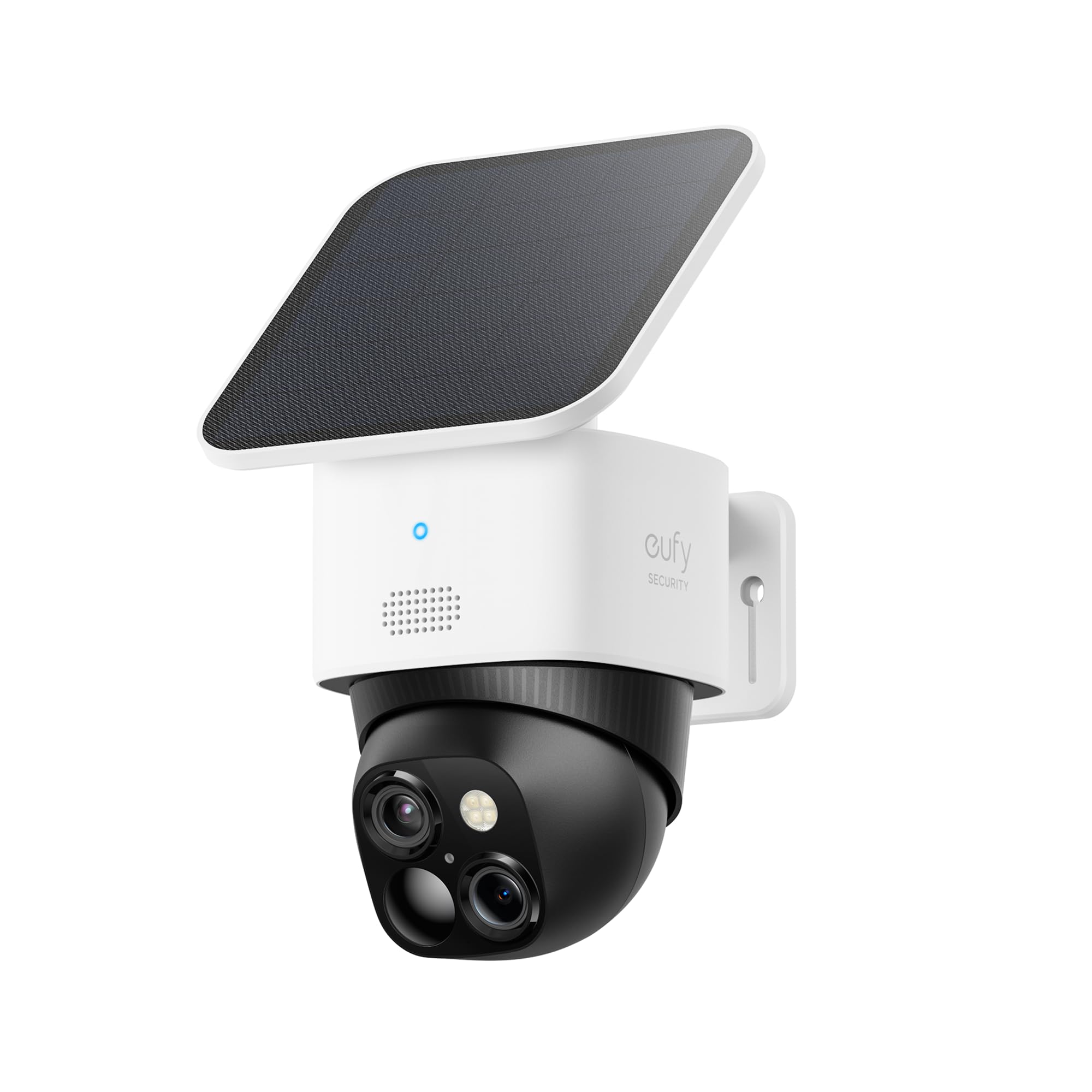
Two lenses in one body is the trick. A wide 3K view gives context and a second, longer lens combines with it for 8x hybrid zoom, so a car at the end of a driveway arrives with a readable plate instead of a blur. Nothing else here resolves detail at that distance. The body pans and tilts through a full circle and tracks people, vehicles, and pets on its own.

The rest of the hardware is sensible: a 10,000 mAh battery, a solar panel that detaches so you can angle it independently of the camera, 8GB of built-in storage so there is no monthly fee, and IP65 sealing. The detachable panel matters more than it sounds — the camera can look down a driveway while the panel faces the sun.

Charging is the weak point. In good sun the panel keeps up, but a unit that stops accepting a charge, or a mount that never gets enough light, leaves you taking the camera down to top it up, and that is the failure to plan around. The radio is 2.4GHz only, and setup is fussier on a crowded network than the simpler cameras here.

Buy it when identification is the job and you have real sun on the wall. For a camera you never want to think about, the SEHMUA does that for less, and the aosu kit spreads the same risk across four units with local storage behind them.

Bottom line: Identification, not just detection, is what the dual-lens S340 sells — the sharpest camera here, provided you can live with its charging record.

6

LITYMOL 2K Solar Camera

LITYMOL 2K Solar Camera

Tight budgets

Our Score 8.8/10
Check Price

Worth Noting

  • 2.4GHz Wi-Fi only
  • Basic app, phone only, no desktop
Battery
5,200 mAh
Storage
MicroSD up to 256GB
Resolution
2K
Pan And Tilt
355° / 120°

Most budget cameras give you a fixed lens and hope. This one pans 355 degrees and tilts 120, puts a 5,200 mAh battery behind a 3.2W solar panel, and takes a card up to 256GB — the largest card support in this group. The panel is built into the body, so there is one thing to mount and no cable to lose.

Charging is why we rate it. Standby is quoted at up to six months on the low-power setting, and in our time with it the panel kept the battery well clear of empty, which is exactly what you want from a camera this cheap: one you forget about. The app is the compromise — basic, phone-only, no desktop client.

Detection has a 10-level PIR sensitivity control, more adjustment than most here offer, and it needs it: wind and moving shrubs will trigger alerts until you turn it down. The spotlight and siren give it some deterrent value beyond recording, which is more than the price suggests.

Bottom line: Spend as little as possible and still get a camera that pans, tilts, and keeps itself charged: this is the one.

7

Gianteye 2K 4-Cam Kit

Gianteye 2K 4-Cam Kit

Crowded 2.4GHz networks

Our Score 8.6/10
Check Price

Worth Noting

  • No auto-tracking
  • Memory cards not included
Wi-Fi
2.4GHz and 5GHz
Resolution
2K
Night Vision
Color with spotlight
Cameras Included
4

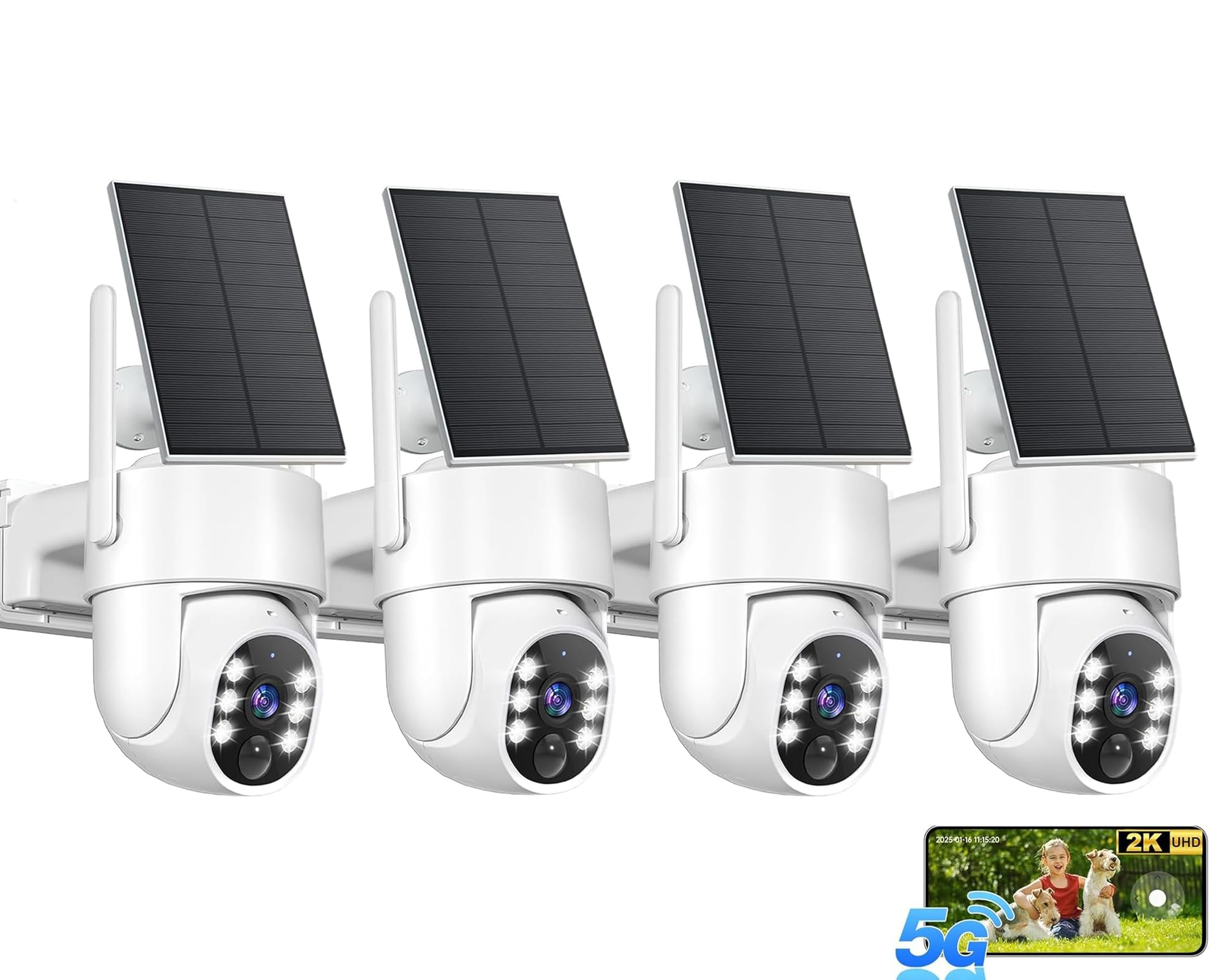
Almost every camera here is 2.4GHz-only, which is a real problem on a mesh network where that band already carries the doorbell, the bulbs, and everyone's phones. This Gianteye set connects on 5GHz or 2.4GHz, so four cameras can sit on the quieter band and stop competing for airtime.

You get four 2K cameras, each with pan and tilt and a spotlight for color night footage, plus human detection to cut alerts from branches and animals. They mount on screws, run from their own solar panels, and show up in one app.

Two things cost extra. Memory cards are not in the box, and the app keeps offering a cloud plan even though card recording works fine. Connectivity is the other soft spot: some units pair without fuss, others need a fight with the router before they settle.

We rate this the value play for four cameras, at well under what the aosu kit asks, and 5GHz support is a real differentiator rather than a spec-sheet line. What you give up is tracking — these pan on command but will not follow a person on their own — and the tidiness of a system with a base station holding the footage.

Bottom line: Your mesh network's 2.4GHz band is crowded; these four 2K cameras can use 5GHz instead.

8

AlkiVision Solar Camera

AlkiVision Solar Camera

Exposed locations

Our Score 9.2/10
Check Price

Worth Noting

  • Fixed view
Wi-Fi
2.4GHz
Battery
15 Wh
Night Vision
Color with spotlight
Weather Rating
IP67

IP67 is the highest weather rating in this group, and it is the reason to look at this AlkiVision. Most of these cameras are IP65 — fine in rain, not built for a soaking — and that difference matters on a fence post, a shed wall, or the weather side of a house.

The view is wide and the body turns through 120 degrees by hand, so one camera covers a garden or the corner of a drive without a motor. There is a solar panel and a rechargeable battery in the box, plus a spotlight, a siren, and two-way talk. Setup was quick and the app behaved in our time with it.

Buy it for a simple, exposed job where you aim once and leave it. The trade is remote pan: changing the view means climbing up and turning the body. For weatherproofing and wide coverage at the low end of this group, we rate it the strongest of the budget picks.

Bottom line: Weather is what this one is built for: IP67 sealing, a wide fixed view, and the camera we picture on a fence post.

How We Tested the Solar Security Cameras

We started with roughly 40 solar cameras on the market and cut the list by comparing panel wattage against battery capacity, resolution claims, weather sealing, whether footage could be stored locally without a subscription, and price. That left 11, which we bought ourselves and mounted where cameras actually go: over a driveway, above a back gate, and on a shaded side yard where the sun is gone by early afternoon.

Setup was timed with a stopwatch, from slicing the box open to the first push notification landing on a phone, and we noted every time an app made us fight with a 2.4GHz network or a stubborn QR code. Once mounted, we panned and tilted each camera through its full range daily, listening for a straining motor and checking whether it drifted back to the same home position. We also drained one battery to 20 percent and tracked how many days of decent sun it took the panel to recover, then logged battery percentage every Friday.

Motion detection got the most abuse. We walked, drove, and carried grocery bags past each camera at different hours, then counted the alerts worth getting up for versus the ones set off by a swaying branch, a passing car, or a moth on the lens. Night clips were reviewed side by side after dark to see whether a face at 30 feet read as a face or a pale smudge, and how far the color spotlight actually reached. Every subscription tier got priced out over two years, because a cheap camera with a mandatory plan isn't cheap.

How to Choose Solar Security Cameras

Panel placement comes before camera position

A detachable panel is the more useful design in a garden with awkward corners: the camera can face the gate while the panel faces the sun, which is exactly what the eufy S340 is set up to do. An all-in-one body like the LITYMOL is tidier and cheaper, but it ties the panel angle to the camera angle.

Battery capacity tells you how much slack you have. A 9,400 mAh pack rides out more gray days than a 5,200 mAh one. If the only sensible mount is on a north wall, no solar panel will earn its keep there, and a wired camera is the honest answer.

One camera that pans, or two that don't

A pan-and-tilt camera sweeps a wide arc from a single mount, which is why the SEHMUA can stand in for two fixed units. What it cannot do is watch two places at once: while it follows someone up the drive, the back gate is unobserved.

Auto-tracking adds to that risk, because it is the least consistent feature in this category — it follows when it locks on and misses when it doesn't. If two doorways matter equally, two inexpensive fixed cameras beat one clever panning one.

The radio is where installs fail

Almost every camera here is 2.4GHz-only, and that band is crowded in most homes. A camera on the far side of a garage can show full bars on your phone indoors and still struggle to hold a stream. There are two escape routes: a system with its own base station, like the aosu kit, where cameras talk to a box inside the house instead of the router, or cellular, like the eufy S330.

For everything else, test the signal at the mount before you drill. One bar means a bad install, not a bad camera.

Storage is a one-off cost or a monthly one

A microSD card is the cheapest way to keep footage: 128GB or 256GB holds weeks of event clips and costs nothing after purchase. A base station like the aosu's 32GB pool does the same job with less fiddling.

Cloud plans are optional on every camera here, though the app will keep offering one, and the cellular eufy adds a service line on top. If you want no recurring bill, confirm that the camera records to local storage on its own before you buy.

Alerts, spotlights, and what the footage has to prove

Motion detection is not one feature. A plain PIR sensor reacts to heat and movement, including foxes and windblown branches; human detection tries to filter for people. Neither is reliable enough to skip tuning, and most of these apps bury sensitivity a few menus deep.

A spotlight earns its place twice: better color footage at night, and an intruder who notices they are on camera. Buy for the job — recognizing a face wants resolution and zoom, deterring wants light and a siren.

Frequently Asked Questions

Final Verdict

Most people should buy the SEHMUA. It pans across a whole yard, keeps itself charged from the sun, and records to a card you own — the three things a solar camera has to get right, with no subscription attached.

If your property is bigger than one camera can cover, the aosu kit handles four cameras and local storage as a single system. If there is no Wi-Fi at the far end at all, the eufy S330 is the only camera here that will work.