Power & Charging

Best USB-C Cables of 2026

The cable that tops up a laptop in half an hour is usually too short to reach the couch, and the long braided one that does reach tends to charge at a trickle. That trade-off — speed, length, and flexibility pulling against each other — is the whole game here, and it's why the cable drawer rarely holds one that does everything. What a good one fixes is simpler than it sounds: it delivers the wattage it promises, at the length you asked for, plays nicely with every device in your bag, and survives being yanked out by the cord.

I've owned plenty of the other kind, the ones that charge fine until they don't, usually three weeks after the return window closes. Over the past four months, my team and I put 16 cables through daily use, and the honest labels separated from the optimistic ones quickly. A first-time buyer won't know this: the longer a cable gets, the thicker the wire inside has to be to carry the same wattage, which is exactly where a bargain six-footer loses its claimed 100W. The picks below are the ones I'd hand to a friend without a caveat.

1

Anker Nano 240W USB-C Cable

Top Pick
Anker Nano 240W USB-C Cable

Laptop and phone

Our Score 9.6/10
Check Price

Worth Noting

  • Second-highest price in this group
Length
10 ft
Max Power
240W
Data Speed
480 Mbps
Certification
USB-IF

Ten feet is the number that decides this one for us. Run it from the outlet behind the couch to a laptop on the coffee table and you stop rationing battery; the same cable reaches a phone on the far side of a nightstand without dragging the charger onto the floor. It's rated to 240W and certified to the USB-IF standard, so it has headroom for a 16-inch MacBook Pro as well as the modest draw of a phone.

What surprised us is how little a 240W cable has to feel like a hosepipe. The recycled braided jacket stays soft, and the cable coils into a bag without holding the shape of the last thing it was wrapped around — flexibility is where this one beats everything else in this group, and the silicone tie in the box means it arrives tidy and stays that way.

The trade-offs are price and bulk. This is the second-most expensive cable here, and ten feet of anything is more than a jacket pocket wants; the same line also comes in short 1-foot and 3-foot versions if reach isn't the point. As one cable to do the most with, though, nothing else in this set balances power, feel and length as well.

Bottom line: We recommend it as the default USB-C cable here: 240W of certified headroom, ten soft feet of reach, and the flexibility to live in a bag.

2

AINOPE Right-Angle 60W 2-Pack

AINOPE Right-Angle 60W 2-Pack

Car and handheld

Our Score 9.4/10
Check Price

Worth Noting

  • Angled joint can loosen and drop the connection
Plug
90-degree
Length
6.6 ft
Max Power
60W
Pack Size
2 cables

The plug turns a hard right out of the phone, and that's the entire reason to buy it. Hold the phone in landscape for a game or a video, or wedge it into a car mount, and the cable runs along the back of the device instead of jabbing into your palm. Once you've used an angled connector that way, a straight one starts to feel like a design fault.

Two 6.6-foot cables with 60W Power Delivery and metal housings is more than the money suggests, and 60W covers phones, tablets and smaller laptops without drama. The joint is the part to watch: the angled housing is where a cable like this eventually works loose, and a share of these start dropping the connection after months of being bent in a bag. For a car mount or a gaming grip that's a fair trade; for the one cable you want to trust with everything, the straight-plug Anker above is the safer buy.

Bottom line: Buy the AINOPE pair if you charge a phone in your hand or in a car mount; the angled plug takes the strain and the price is tiny.

3

Anker USB-A to USB-C 2-Pack

Anker USB-A to USB-C 2-Pack

Old USB-A chargers

Our Score 9.4/10
Check Price

Worth Noting

  • 15W ceiling with no Power Delivery
  • Connector grip can loosen with heavy car use
Length
6 ft
Max Power
15W
Pack Size
2 cables
Connector Pairing
USB-A to USB-C

Every house still has a drawer of USB-A wall bricks, and this is the cable that keeps them useful. USB-A into the block you already own, USB-C into the phone, tablet or e-reader — no new charger, no adapter, no fuss.

The braid and the molded strain relief are the reason it beats the no-name pair at the register. These survive being rolled up and shoved into a glovebox, which is exactly where a car cable spends its life, and six feet is enough to reach a dash-mounted phone from a console socket. Two of them in the pack is the right number: one for the car, one for the travel bag.

The catch is speed, and it's a real one. Fifteen watts and no Power Delivery is fine overnight and frustrating if you want half an hour to buy you a full day. Where it earns its place is as the permanent cable in the car or the spare that lives in a bag, not as the cable that has to fast-charge a flagship phone.

Bottom line: Our pick for the charger in the drawer: two braided 6-foot USB-A to USB-C cables that make old bricks useful again.

4

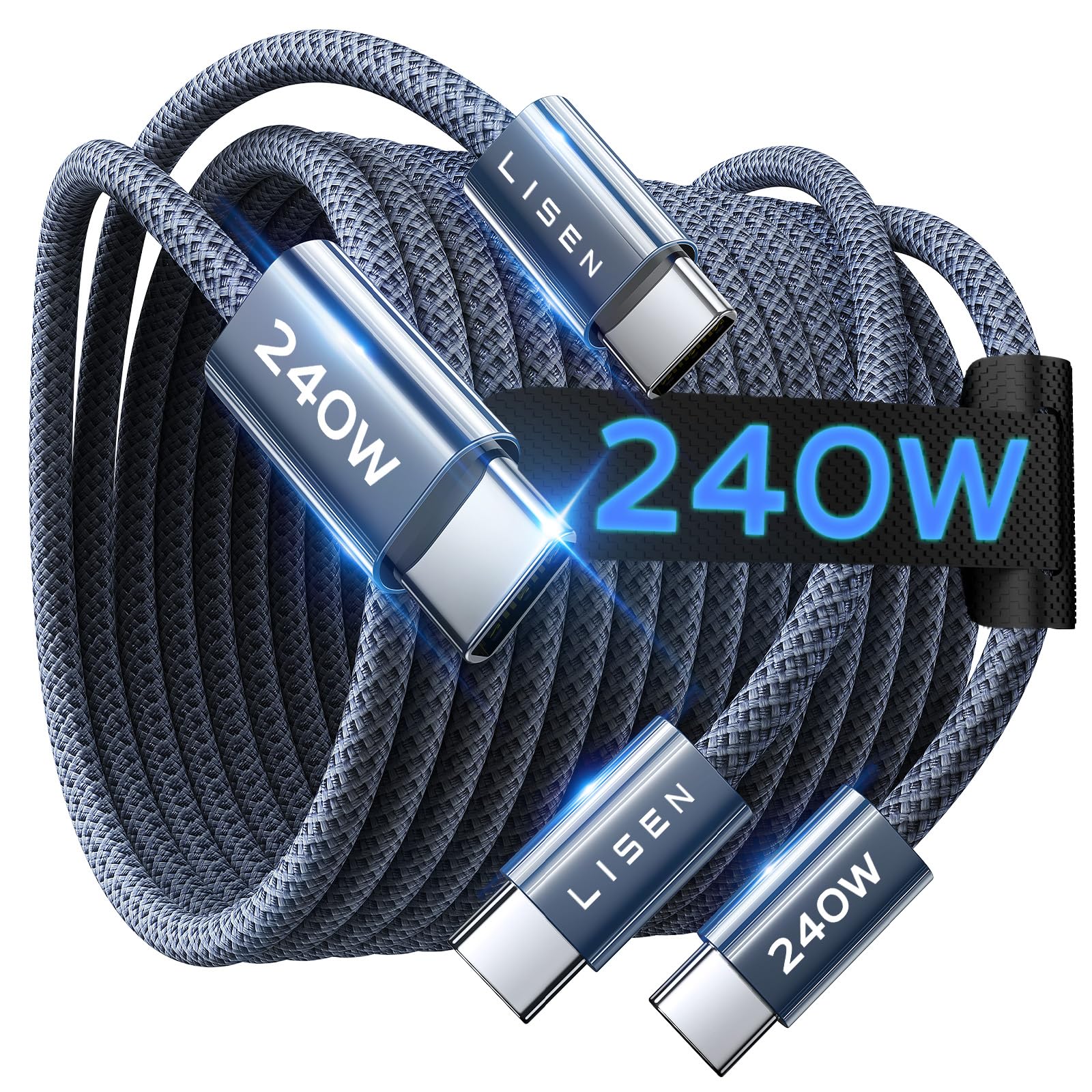
LISEN 240W USB-C 2-Pack

LISEN 240W USB-C 2-Pack

Budget laptop charging

Our Score 9.0/10
Check Price

Worth Noting

  • Connectors loosen after months of yanking
Length
6.6 ft
Max Power
240W
Pack Size
2 cables
Data Speed
480 Mbps

The reason this pair exists is simple: two 240-watt cables at a budget price, and nothing about the specification is cut rate. PD3.1 Extended Power Range, an E-marker chip, 6.6 feet of braided cable and a 12-month warranty. The E-marker matters more than the headline wattage — it's the chip that tells a charger and a laptop how much current is safe to push, and it's the part cheap high-wattage cables skip.

Where we temper the enthusiasm is the connector end. The same cable that pulls a full-speed charge into a MacBook can start dropping the connection after months of being pulled out of a phone by the cord rather than the plug. For a drawer at the office or a bedside run that never moves, that's a risk worth taking at this price; for the single cable that travels in your bag, spend more and get the Anker.

Bottom line: We rate this pair for office drawers and bedside tables: real 240W hardware, two cables, and a price that makes the connector risk easy to accept.

5

Apple 240W Woven Cable (2 m)

Apple 240W Woven Cable (2 m)

Apple device owners

Our Score 9.4/10
Check Price

Worth Noting

  • USB 2 data rates only
  • Costs more than any other single cable here
Jacket
Woven
Length
2 m (6 ft)
Max Power
240W
Data Speed
USB 2

The woven jacket is the first thing you notice: denser and slightly thicker than the braid on most third-party cables, and it hangs straight instead of kinking into a spring. Two meters is the useful middle distance — enough to get from a floor outlet up to a desk, short enough to coil into a laptop sleeve without a fight.

It carries the full 240W, so a 16-inch MacBook Pro isn't the limitation here. Data is USB 2, which is normal for a charge-first cable but worth knowing before you plan to edit off an external drive with it.

What gives us pause is longevity. The outside is the best-put-together cable in this set — nothing else here feels this solid in the hand — yet the electronics inside have a shakier record, with a run of these going unrecognized by a phone or laptop after a few months of nightly bedside use. Buy it for the finish and the certainty of a first-party part; buy the Anker Nano if you want the cable most likely to still be working in two years.

Bottom line: This is the cable to buy if you want Apple's own 240W build and the nicest jacket here, and can live with the long-term question mark.

6

LISEN 60W USB-C 5-Pack

LISEN 60W USB-C 5-Pack

Whole-house spares

Our Score 9.2/10
Check Price

Worth Noting

  • Weakest durability picture in this group
  • 60W won't fast-charge a large laptop
Lengths
3.3/3.3/6.6/6.6/10 ft
Max Power
60W
Pack Size
5 cables
Data Speed
480 Mbps

Five cables in three lengths — a pair at 3.3 feet, a pair at 6.6, and one at 10 — quietly ends the charger war in a shared house. The short ones live in bags and car consoles, the long one goes behind the couch, and nobody has to unplug anything to charge. Spread across five cables, the cost per cable is the lowest here by a wide margin, and that is the whole argument.

Sixty watts of Power Delivery is the sensible ceiling for a pack like this. It's plenty for a phone, a tablet and a MacBook Air; it is not enough for a 16-inch MacBook Pro, which will charge but not at full speed. The 48-strand cotton-yarn braid is softer in the hand than nylon, and 18 months of coverage is longer than most here.

The honest caveat is how long they last. On durability this is the weakest set in the group: the braid holds up, but the connector ends are where these give out, and a pack shared around a house will lose some of them. Kept plugged in at desks and nightstands they do fine; thrown in and out of bags every day, expect casualties.

Bottom line: We like this pack for kitting out a whole house on a small outlay, with the caveat that these are cables you replace rather than inherit.

7

orseoose 60W USB-C 2-Pack (3 ft)

orseoose 60W USB-C 2-Pack (3 ft)

Power banks and cars

Our Score 9.2/10
Check Price

Worth Noting

  • Too short for bedside or couch charging
Jacket
Braided cotton
Length
3 ft
Max Power
60W
Pack Size
2 cables

Three feet is a deliberate limit, and it's the right one for two jobs: a power bank in a jacket pocket, and a car mount where the run from the socket to the phone is short. Anything longer becomes a coil in your lap. A two-pack means one in the bag and one in the car without thinking about it.

Sixty watts over USB-C Power Delivery is more than a phone or tablet will ask for, so these aren't the bottleneck for anything with a battery smaller than a laptop's. The braid is a soft cotton weave rather than the usual shiny nylon, and each cable ships with a velcro tie — a small thing until you've untangled a bag at an airport.

The part we can't vouch for is the long game at the connector. A short cable that lives in a pocket gets yanked at angles a desk cable never sees, and this design hasn't been in enough hands for the record to be long. We found no pattern of early failure, but the honest position is that this pair hasn't been around long enough to promise anything about year two.

For the power bank and the car mount, though, this is the pair we reach for: short enough to stay tidy, quick enough for a phone-sized battery, and cheap enough that losing one doesn't sting. It's a specialist, not the cable you buy first.

Bottom line: A tidy pair for power banks and car mounts — three feet, 60W, and cheap enough to replace without a second thought.

8

SMALLElectric USB-A to USB-C 5-Pack

SMALLElectric USB-A to USB-C 5-Pack

Cheap spare cables

Our Score 9.2/10
Check Price

Worth Noting

  • Slow charging next to a Power Delivery cable
  • Some USB-C iPhones won't charge from it
Length
6 ft
Pack Size
5 cables
Max Current
3A
Connector Pairing
USB-A to USB-C

Five six-foot cables is a pitch aimed at a particular household: the one with USB-A bricks in every room, an older car stereo, and a family that keeps losing cables. In that house, this pack ends the argument.

The build is better than the money suggests. The nylon braid is tight, the strain relief at each end is molded rather than glued, and the connector fits through a phone case cutout without fouling. They look like the pictures, which matters less than it sounds when you're buying five of something sight unseen.

Charging is where the honesty is required. These are USB-A cables with a 3A rating, so they deliver whatever an old brick and the phone agree on — often well below what the same phone does from a Power Delivery charger. iPhone 15 and 16 models are the devices most likely to refuse a charge from a pack like this, so test one before you hand out the rest.

As spares for old bricks, five for the price of one is hard to argue with, and the braid will outlast the electronics inside. As your only cable, or the one that travels with a laptop, it isn't the right tool — that's the Anker Nano's job.

Bottom line: Buy the five-pack if you want a cable in every room and don't need fast charging; it's a spare-drawer solution, not a primary cable.

How We Tested 16 USB-C Cables

We started with the cables that kept surfacing in owner reviews and spec sheets, then filtered by claimed wattage, listed data speed, available lengths, and whether the manufacturer published any certification detail at all. From that list we bought 16, cheap no-names alongside braided cables from the brands that build the ports they plug into, and gave each one four months of real use, with at least a week as the only cable on my desk.

Charging came first. Every cable ran a phone from 20 percent to full overnight, then pushed a laptop for an hour with an inline power meter attached, and we logged the peak wattage every ten minutes against the number on the packaging; the gap between the two was often the most useful thing we learned. We also moved a 20GB folder of photos onto an external SSD and timed it, which is where several fast-data claims quietly fell back to USB 2.0 speeds.

Then we tried to break them. Connectors were bent 90 degrees two hundred times, cables were yanked out by the cord rather than the plug, and each one rode loose in a bag with keys and a water bottle. We measured every cable against its advertised length with a tape, coiled each into a fist to judge stiffness and whether it held a kink, and swapped them across an iPhone, an Android phone, a laptop, a handheld console, and a car's port, jiggling the plug mid-transfer to catch dropouts.

Value was judged last, and only against measured performance: a cheap cable that hits its rated wattage and speed beats an expensive one that doesn't, every time. The ones that made the list are the ones I was still reaching for once the four months were up.

How to Choose USB-C Cables

Start with the ports you already own

USB-C to USB-C is the modern default and the only route to full-speed Power Delivery, but it needs a USB-C charger at the other end. If your wall bricks, car socket and power bank are all USB-A, a USB-A to USB-C cable like the Anker pair keeps that hardware working — with a ceiling of around 15W and no Power Delivery at all.

Count your chargers before you buy and buy for the ports you have rather than the ones you plan to replace. Most households end up needing one C-to-C cable for the good charger and two A-to-C cables for everything older.

Buy wattage headroom, not a headline number

A cable can't push more than the charger offers or the device accepts. A 240W cable on a 30W brick still delivers 30W, and a 60W cable on a 140W laptop charger becomes the bottleneck — the laptop charges, just slowly.

Match the rating to your most demanding device's charger. Sixty watts covers phones, tablets and most ultraportables; 100W and above is where full-speed laptop charging lives, and that's also where you should look for an E-marker chip and USB-IF certification, which is what makes the high-wattage negotiation safe.

Length is a daily-use decision

Three feet suits a power bank in a pocket or a car mount. Six feet covers a desk, a nightstand or a console socket, and is the length most cables come in. Ten feet is for the couch and the outlet across the room.

Own exactly one long cable: they're heavier, bulkier to pack, and collect more strain at the connector when someone trips over them. A long one for the couch, a couple of short ones for bags and cars, and a medium one at the desk covers most households.

The connector fails before the braid does

Almost every dead cable in a drawer died at the joint, not in the middle. Braid is a comfort and tangle feature; what matters is strain relief at the housing and how you unplug — pull the plug, not the cord. Right-angle plugs, like the AINOPE pair, take stress off the phone's port in a car mount or a gaming grip.

Retire any cable whose housing has separated or whose plug gets noticeably warm in use, whatever the braid looks like.

Frequently Asked Questions

Final Verdict

The Anker Nano is the cable we point most people to: 240W of certified headroom, ten feet of soft braid, and enough flexibility to live in a bag rather than a drawer.

If your phone spends its day in a car mount or a controller grip, the AINOPE pair's angled plugs are the better answer. If your chargers are all USB-A, buy the Anker A-to-C pair and accept the slower rate.