Home Appliances & Robots

Best Water Leak Detectors of 2026

Water damage rarely announces itself. It starts as a drip under the kitchen sink, a puddle behind the washing machine, or a slow seep around the water heater—and by the time you notice, the drywall is already soft. A water leak detector is a small, unglamorous gadget that buys you time: it sits in the spot you can't watch and makes noise—or sends a message—when water shows up. The trick is finding one that actually does that reliably, without a frustrating app or a false alarm every time the basement gets humid.

Over the past eight months, I've lived with 14 detectors—some basic battery-powered pucks, some app-connected units—placing them under sinks, behind the laundry, and beside the water heater. I learned quickly that loudness matters more than specs suggest, that wireless connectivity is only as good as your basement's weakest corner, and that the best setup is one you can finish without a manual. A few models felt flimsy; a few felt worth it. The picks below reliably caught water first.

1

YoLink Leak Sensor 4 Kit

Top Pick
YoLink Leak Sensor 4 Kit

Whole-home coverage

Our Score 9.6/10
Check Price

Worth Noting

  • Remote alerts rely on hub and Wi-Fi
Range
Up to 2,034 ft LoRa
Alerts
App, email, SMS, 105 dB alarm
Battery
2 AAA, up to 5 years
Kit Contents
6 sensors + hub

A leak detector is only useful if it gets your attention in the room and on your phone, and this YoLink kit is the one here that does both without extra hardware. The box includes a hub and six Leak Sensor 4 units, each with a built-in 105 dB alarm, plus app, email, and SMS alerts when water is detected.

The LoRa radio is the practical part. YoLink rates it to 2,034 feet in open air, which gives you the headroom to put a sensor in a basement, garage, or back utility closet while the hub stays near the router. Each sensor runs on two AAA batteries with up to five years of typical life, so maintenance is mostly an annual check rather than a monthly chore.

What makes it our top pick is the balance: a loud local alarm at the leak and a phone alert when you are away. You get whole-home coverage without buying a separate siren or a shutoff valve.

The app's location names are the small detail that makes six sensors manageable: when one goes off, you know whether to grab a towel for the kitchen or boots for the basement.

Bottom line: For whole-home coverage, this is the kit we reach for: six sensors with a 105 dB local alarm, app/email/SMS alerts, long range, and long battery life.

2

Basement Watchdog BWD-HWA

Basement Watchdog BWD-HWA

Sump pits

Our Score 9.4/10
Check Price

Worth Noting

  • No remote alerts or app
  • Can false-alarm and need resetting
Alarm
110 dB
Power
9V alkaline battery
Sensor Reach
6 ft detachable wire
Water Sensitivity
1/32 in

The Basement Watchdog earns its place with a detachable sensor on a six-foot wire. That sounds basic, but it is the difference between an alarm that sits on the floor and one that can drop into a sump pit or reach behind a washer while the 110 dB horn stays where you can hear it. We like that practical reach more than a long feature list.

It reacts to as little as 1/32 inch of water, and the solid-state circuit is built for a quick response. You can add more than 100 feet of 24-gauge wire if the run is longer, which makes it useful for a crawlspace or a remote drain pan. A 9-volt battery powers it, so there is no outlet or network to worry about.

The sound is the point, and it is also the caveat. The 110 dB horn is piercing in the same room, but a closed cabinet or a floor between you and the unit can take the edge off. That is a placement problem, not a reason to skip it: put the horn where the sound can travel and the sensor where the water will reach.

Bottom line: We recommend this simple alarm when you want a loud, local warning at a sump pit or under a sink, without an app or hub in the way.

3

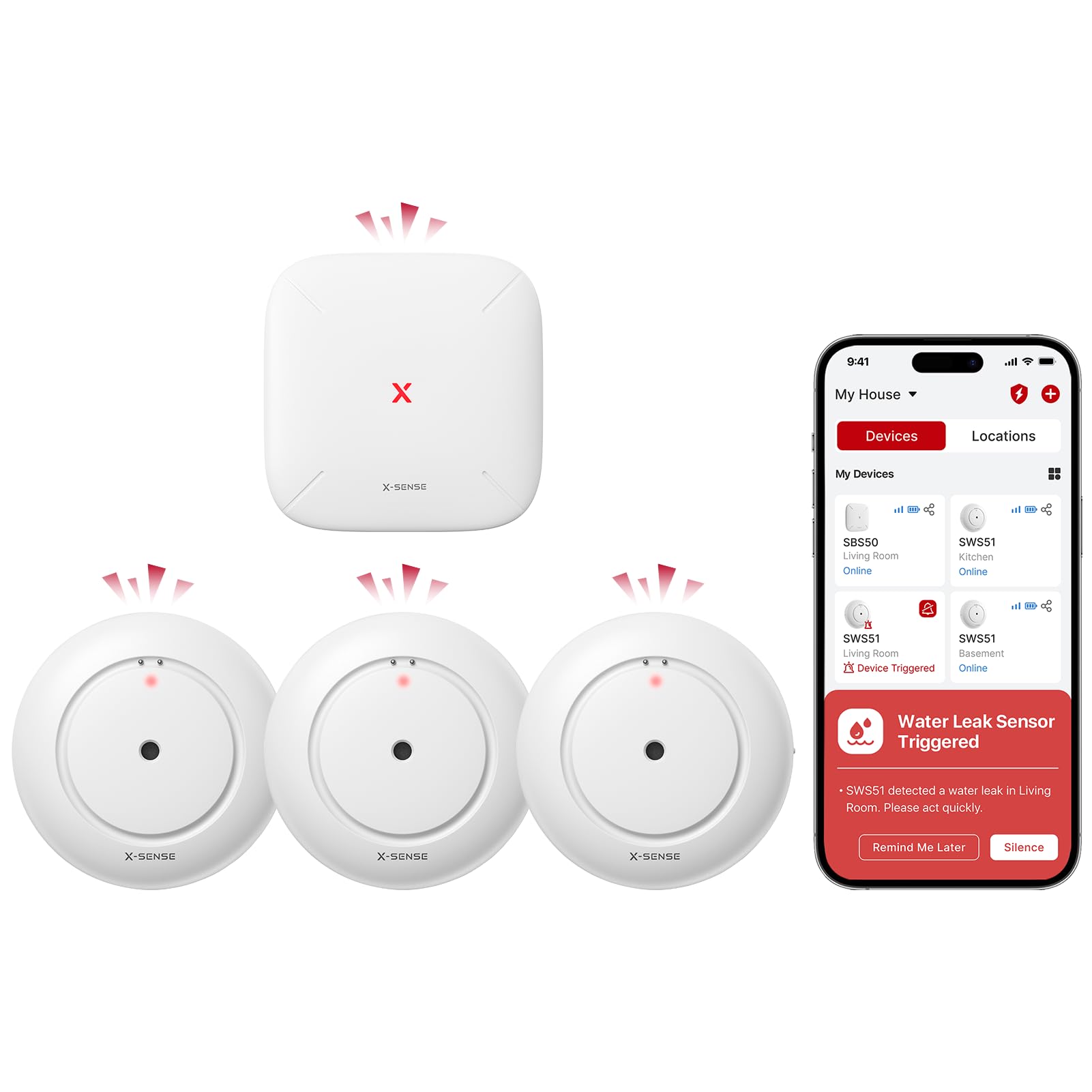
X-Sense SWS54 Kit

X-Sense SWS54 Kit

Midrange smart kit

Our Score 9.0/10
Check Price

Worth Noting

  • Wi-Fi setup can be finicky
Alarm
120 dB sensor and base
Range
Up to 1,804 ft
Kit Contents
3 sensors + base
Water Sensitivity
0.4 mm

The X-Sense SWS54 is a three-sensor kit with a base station, and the first thing you notice is the double alarm: the sensor and the base both sound when water is detected. The base is the part that makes a small system feel bigger, because the 120 dB siren is not stuck under a cabinet with the sensor.

Each sensor has two top probes for drips and four bottom probes for pooling water, with a claimed sensitivity down to 0.4 mm. The wireless range runs up to 1,804 feet in open areas, and the IP66 housing is meant for damp spots near water heaters, washers, and sinks. Setup is through the app, and you can share access with other people in the house.

We think this is the smart kit to pick if you want a strong local siren without the cost of a six-sensor system. The base station is the difference: it is louder and more central than a puck under a sink, and the app puts the alert on your phone. Three sensors cover the usual suspects without leaving you with spares in a drawer.

Bottom line: Our pick for a first smart setup is the X-Sense kit: a 120 dB base siren, three sensors, and phone alerts without six-sensor complexity.

4

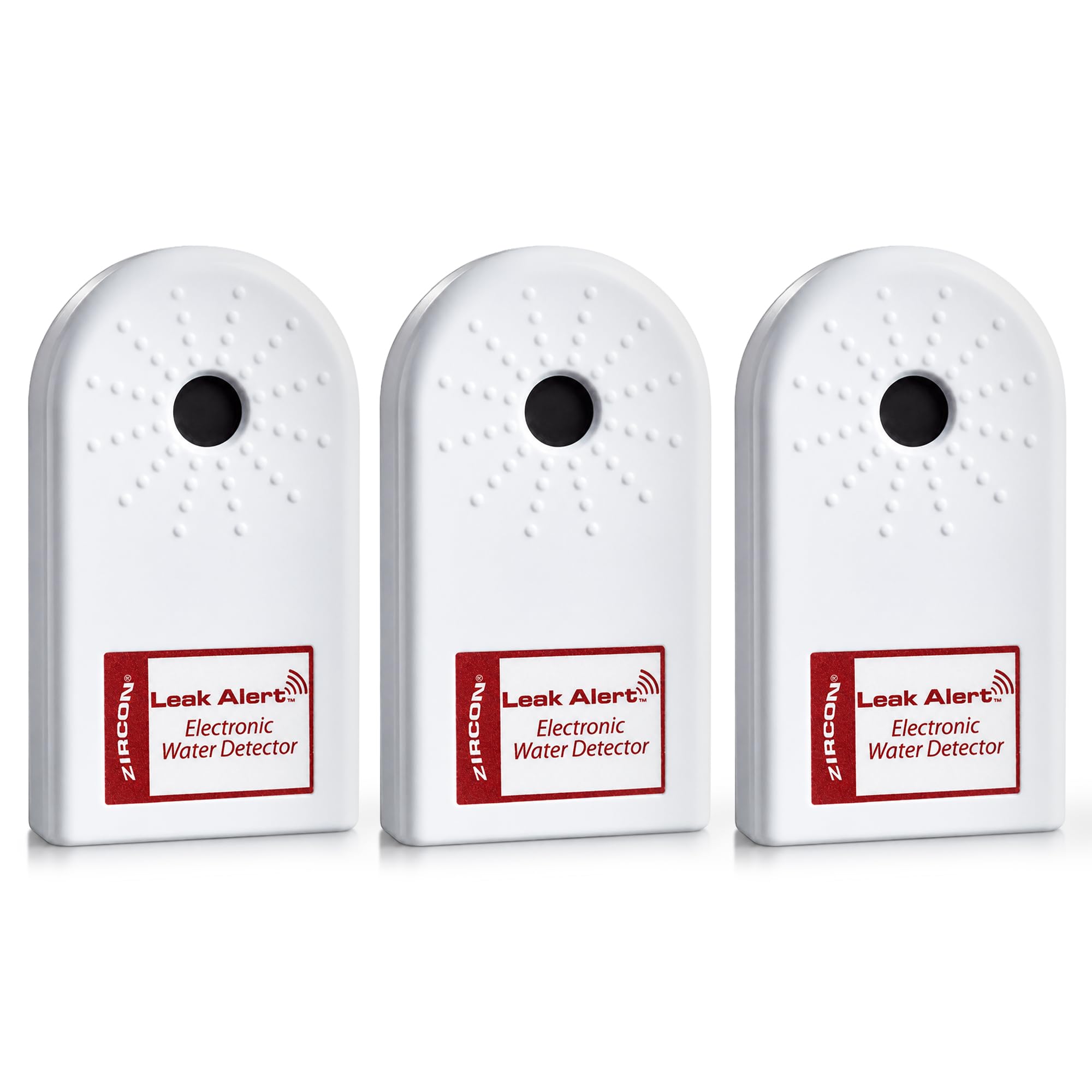
Zircon Leak Alert 3-Pack

Zircon Leak Alert 3-Pack

Flood-prone basements

Our Score 9.4/10
Check Price

Worth Noting

  • 9V battery not included
  • No remote alerts or app
Alarm
90 dB
Battery
9V alkaline, not included
Kit Contents
3 detectors
Flood Behavior
Floats up to 72 hours

Most leak alarms are designed for a puddle, not a flood. The Zircon Leak Alert is the exception: if water rises, the detector floats and keeps signaling for up to 72 hours. That is the feature that earns it a place here, and we like it for a basement, crawlspace, or low utility room where a sump failure can put inches of water on the floor.

The rest is deliberately simple. It runs on a 9-volt battery, sounds a 90 dB alarm on direct water contact, and comes in a three-pack. We think the lower decibel rating is the trade: it is the quietest alarm in this set, so it makes the most sense in a space where you will be nearby or where the floating alarm can be seen as well as heard. The three-pack makes it easy to put one at the sump, one at the floor drain, and keep a spare.

Bottom line: We choose the Zircon when flooding is the worry: it floats and keeps sounding for up to 72 hours, and the three-pack covers a basement without an app.

5

METAK 5-Pack

METAK 5-Pack

Budget multi-room

Our Score 9.2/10
Check Price

Worth Noting

  • No app or remote alerts
Alarm
100 dB
Power
2 AAA, 2-year standby
Kit Contents
5 detectors
Waterproofing
IP66

Five detectors for the price of a couple of smart sensors is the pitch, and the METAK kit delivers it without a hub. Each unit has two front probes for drips and four rear probes for floor moisture, a 100 dB alarm, and a mute button for when you are testing or the sound is too much. The IP66 shell is built for damp spots under sinks and near water heaters.

What we like is the coverage math: you can put one under the kitchen sink, one by the water heater, one behind the washing machine, one in the basement, and still have a spare. The two-year standby time on two AAA batteries means you are not chasing batteries every season, and the low-battery alert is a useful detail. For a rental, a cabin, or a house where you are around, that is often enough.

The trade is the alarm. At 100 dB it is loud in the same room, but it is a small puck and a closed cabinet can swallow some of that. We place these where the sound can escape, not tucked into a sealed corner. The mute button is genuinely useful during setup; just remember to unmute before you walk away.

Bottom line: We see this five-pack as the budget way to cover several water lines with simple 100 dB alarms, front and rear probes, and no hub to manage.

6

SwitchBot Water Leak Detector

SwitchBot Water Leak Detector

Sump level monitoring

Our Score 8.8/10
Check Price

Worth Noting

  • 2.4 GHz Wi-Fi only
  • App interface can be fiddly
Alarm
100 dB
Probe
1 m cable
Alerts
App and email, no hub
Waterproofing
IP67

The SwitchBot detector is a single sensor with a one-meter cable, which makes it the odd one out in a good way. You can set the body on a shelf or floor and drop the probe into a sump pit, bathtub, or tank, watching the water level rather than just waiting for a puddle to reach the electronics.

It connects directly to Wi-Fi without a hub, sends app and email notifications, and has a 100 dB alarm built in. The four probes on the body detect water as shallow as 0.5 mm, and the IP67 housing is sealed for damp areas. Battery life is listed at up to two years on one battery.

The alarm is best for nearby attention: at 100 dB it is loud in the same room, but it is not a base-station siren that will fill a house. And because it is a single sensor, it protects one spot well rather than several adequately. For a sump or tank, that focus is the point.

What we think: if you want one smart detector at a hard-to-reach spot, this is a useful specialist. It is not the pick for whole-home coverage, but it does a job the multi-packs do not.

Bottom line: For one hard-to-reach sump or tank, we like the SwitchBot's cable probe and no-hub app alerts; it is a useful specialist.

7

Geevon 2-Pack

Geevon 2-Pack

Cheap two-spot coverage

Our Score 9.0/10
Check Price

Worth Noting

  • Alarm won't carry through closed doors
Alarm
100 dB
Power
9V, about 12 months
Probes
3 metal prongs
Kit Contents
2 detectors

Two alarms for about the price of one is the reason this Geevon pair stays in the roundup. Each unit is a simple puck with three metal prongs on the bottom, a 100 dB alarm, and a 9-volt battery in the box. There is no app, no hub, and no setup beyond connecting the battery and putting it where water collects.

We like this pair for the two spots people forget: the back of the cabinet under the kitchen sink and the floor beside the washing machine. The 9-volt battery is listed at about 12 months of normal use, so put a reminder in your calendar. The simple prongs are sensitive to a small puddle, which is what you want behind a cabinet where a slow drip can hide for weeks.

Bottom line: We keep the Geevon pair as the cheap, no-app first step: two 100 dB alarms with batteries included for two close water lines.

8

METAK WD60

METAK WD60

Tight cabinets

Our Score 9.4/10
Check Price

Worth Noting

  • No app or remote alerts
  • Battery life is shorter than smart sensors
Alarm
100 dB
Power
2 AAA batteries
Probes
4 rear and 2 front
Waterproofing
IP66

The METAK WD60 is a compact single alarm with a useful trick: two front probes for a drip from a pipe or drain, plus four rear probes for water pooling on the floor. That two-way sensing is more thoughtful than the usual single pad, and it fits in tight cabinets where a larger puck will not.

It runs on two AAA batteries, has a 100 dB alarm with a mute button, and is rated IP66 for damp areas. Setup is just inserting batteries and placing it. The 100 dB alarm is loud enough to get attention in the same room, though the small body will not fill a large basement.

We use this one under a sink, beside a toilet, or in a cabinet where space is tight. The mute is welcome during setup, and the IP66 shell means a damp floor is not an immediate problem. It is the kind of alarm you forget about until it goes off, which is what you want.

What we think: it is a good single-purpose alarm, not a whole-home system. If you have one suspicious fitting and want a cheap early warning, it is an easy yes. If you have five water connections, the five-pack makes more sense.

Bottom line: We use the METAK WD60 as a compact single alarm for a tight cabinet, with front drip probes, rear floor probes, and an IP66 shell.

9

GoveeLife 6-Pack

GoveeLife 6-Pack

Smart-home integration

Our Score 8.8/10
Check Price

Worth Noting

  • Wi-Fi connectivity can be unreliable
Alarm
100 dB
Range
Up to 1,968 ft LoRa
Alerts
App, SMS, email
Kit Contents
6 sensors + gateway

GoveeLife's kit is the one to look at if your smart home already talks to Alexa or Google Assistant. Six sensors plus a gateway, app, email, and SMS alerts, and a 100 dB alarm in each sensor. The range is rated up to 1,968 feet over LoRa, so a basement or detached garage is within reach.

The sensors have two top probes for drips and four bottom probes for pooling water, and the IP66 housing is meant for damp spots. Each runs on AAA batteries with a listed five-year life. The gateway connects to Wi-Fi, and the app is where you name sensors and set notifications.

We like the voice-assistant angle more than we expected. If you already have an Echo or Google speaker, asking for a status check is easier than opening another app. The local alarm is also loud enough to be useful on its own, which is not true of every smart sensor.

The app is capable but busier than the simplest kits here, and the gateway is another box to keep powered and placed. You want it near the router, not in the basement with the sensors.

For a connected home, the GoveeLife kit is a strong alternative to our top pick. We still choose the YoLink for the simpler local-plus-remote balance. But the voice status check is the detail that makes this system feel like part of the house rather than another app.

Bottom line: We point smart-home users to GoveeLife: six sensors, app and SMS alerts, voice-assistant support, and a loud local alarm, with Wi-Fi fuss as the trade.

How We Tested Water Leak Detectors

We started by researching the models shoppers actually buy—battery-powered alarms, Wi-Fi units, and hub-based systems—and narrowed the list by sensor type, battery life, alarm volume, app requirements, and price. We cut anything with a sealed battery, a subscription fee for basic alerts, or a mounting design that required tools.

We tested 14 units for eight months in real homes. Each one went where leaks actually happen: under the kitchen sink, under a bathroom sink, behind the washing machine, beside the water heater, and in a basement near the sump pump. We didn't just wait for a leak—we poured a quarter cup of water on each sensor and timed how long the alarm took to sound, which told us whether the thing actually worked. We also stood in the next room with the door closed to judge loudness, and walked to the far end of the house to see how quickly a phone alert arrived.

For reliability, we left every unit in place for weeks, noting false alarms from humidity, condensation, and steam. We set up each detector without the manual first to see how intuitive it was, then timed a second setup with the manual in hand. We handed the app to a neighbor who had never used a leak detector and watched where they got stuck. We also checked the battery doors, mounting clips, and sensor contacts after repeated handling—the small quality details that separate a detector you trust from one you forget about. Value came down to what was in the box: batteries, mounting hardware, and whether a hub or subscription was required.

How to Choose Water Leak Detectors

Decide whether you need a shout or a text

A standalone alarm is the simplest thing that works: it sounds at the leak, needs no hub, and keeps working when the Wi-Fi is down. That is enough if someone is usually home. A smart kit adds app, email, or SMS alerts, which is what you want for a vacation house or a basement you rarely enter. The strongest setup does both: a local siren plus a phone alert. Our top pick is built that way, and the X-Sense kit gets close with a 120 dB base station.

Put the sensor where water collects

A detector cannot alarm on water that never reaches its probes. Set pucks on the floor beside the water heater, under the sink, and in the washing-machine pan, not on a shelf above them. If the leak starts in a sump pit or behind a panel, choose a detachable sensor or cable probe. The Basement Watchdog's six-foot sensor and the SwitchBot's one-meter cable exist for exactly that job. In a flood-prone basement, the Zircon's floating design is the unusual but useful exception.

Count the water connections, not the square footage

Coverage is about the number of places water can escape, not the size of the room. A kitchen sink, water heater, washing machine, dishwasher, refrigerator ice maker, and sump pit can each need their own detector. A multi-pack lowers the cost per spot and lets you cover the obvious risks at once. The METAK five-pack suits a first pass, the YoLink six-sensor kit covers a larger house, and the X-Sense three-sensor kit is a sensible middle.

Check the power and network budget

Battery type matters more than the number on the box. Replaceable 9V or AAA cells are easier to live with than a sealed battery, and a low-battery alert saves you from a silent detector. Smart kits add a hub and a 2.4 GHz Wi-Fi requirement; if your router uses one combined network name or a 5 GHz-only setup, sort that out before you place sensors. LoRa kits such as YoLink and GoveeLife trade Wi-Fi range at the sensor for a hub near the router.

Frequently Asked Questions

Final Verdict

The YoLink Leak Sensor 4 kit is the one we recommend first. Six sensors, a 105 dB alarm at the leak, and app, email, and SMS alerts cover the way water damage actually happens: quietly, in more than one place, often while you are away. The long LoRa range and five-year battery life make it practical for a basement, garage, and laundry room, not just the kitchen sink.

If you want the simplest possible alarm, choose the Basement Watchdog for a sump pit or under-sink spot. If you want a smaller smart kit, the X-Sense SWS54 gives you a 120 dB base siren and three sensors with less complexity. The right answer depends on whether you need a text or a shout.