Home Appliances & Robots

Best White Noise Machines of 2026

The first time you catch a cheap white noise machine's loop, you can't unhear it. The same rush of fan noise resets every 30 seconds, and by the third repeat your brain is lying there waiting for the seam. A machine that masks the hallway, the dog next door, and the 5 a.m. garbage truck only works if you can stop noticing it — that's the bar. I've kept one running on my nightstand for years, and over the last six months my team and I slept alongside 14 of them to find the ones that clear it.

Raw volume turned out to be the least interesting spec. A machine that only gets loud is no use two feet from a crib, and a bright blue display undoes its own good work at 2 a.m. What matters is how fine the control is at the quiet end, whether you're hearing a real fan or a digital loop, and whether the thing sounds the same in month six as it did on night one. The picks below are sorted by the noise problem each one solves, so start there.

1

Yogasleep Dohm Classic

Top Pick
Yogasleep Dohm Classic

Most bedrooms

Our Score 9.2/10
Check Price

Worth Noting

  • No timer, night light, or battery
  • Two speeds leave little fine-tuning
Power
Corded, 7-foot cable
Speeds
Two
Weight
1.6 lb
Sound Source
Real fan

There is a small fan inside the Dohm, and that is the entire argument for it. Moving air makes a broad, even sound with no beginning and no end, so there is nothing for a tired brain to latch onto at 3 a.m. No seam where a recording restarts, no pattern that starts to sound like speech. We have had ours running beside a bed for weeks and still cannot point to the moment the sound repeats, because it does not.

What you do not get is control. One switch, two speeds, a 7-foot cord, and a 1.6-pound body small enough to disappear behind a lamp. No timer, no night light, no battery, no app. If you want the machine to shut itself off after an hour, this is not the one. But if you want to plug something in and stop thinking about it, the missing features are the point.

It is a moderate, natural hiss rather than a wall of noise, which is enough for traffic, neighbors, and an apartment hallway. Against a loud snorer in the same bed, the top speed runs out sooner than some people want; if that is your household, the SNOOZ goes louder in finer steps.

Longevity is the uneven part. The Dohm's record runs from machines that quit inside a year to machines that have been running nightly for more than a decade, and nothing we can tell you predicts which one lands on your nightstand. What we can say is that there is very little in it to break, and that is why it is the one we hand to people who just want to sleep and stop shopping.

Bottom line: We recommend the Dohm to almost anyone who wants one sound done properly: a real fan, two speeds, and nothing to fiddle with at 2 a.m.

2

SNOOZ Original

SNOOZ Original

Scheduled sleep

Our Score 9.2/10
Check Price

Worth Noting

  • Most expensive machine in this set
  • One sound, and no battery
Weight
1.1 lb
Scheduling
App auto on/off
Sound Source
Real fan
Volume Levels
10

The SNOOZ is the most expensive machine here, and the case for it is not the sound. It is the schedule. It is the only one in this group that turns itself on and off at times you set in an app, so the noise is already running when you walk into the bedroom and stops after you have stopped needing it.

We ended up treating it as a remote control, starting it from the kitchen before bed and rarely touching the three buttons on top. Underneath, it is a real fan on the same principle as the Dohm, with ten volume steps and a tone adjustment that make it easy to find a pitch you can live with.

What the money buys is a bedroom that is already making noise when you get into it, which for a light sleeper can be the difference between lying there waiting and dropping off.

The trade is breadth. One sound, no battery, and scheduling that lives entirely in the app, so a household that does not want a phone in the bedroom is paying for a feature it will not use. If you want birdsong and a colored glow, the BrownNoise does all of that for a lot less.

Bottom line: The app scheduling is what sold us: the noise is already running when you get into bed and stops on its own. Pay for it if you are a light sleeper on a schedule.

3

Dreamegg D11 Max

Dreamegg D11 Max

Travel and outages

Our Score 9.0/10
Check Price

Worth Noting

  • Needs charging every few days
Sounds
21
Battery
1800 mAh rechargeable
Charging
USB
Dimensions
4 x 3.7 x 1.8 in

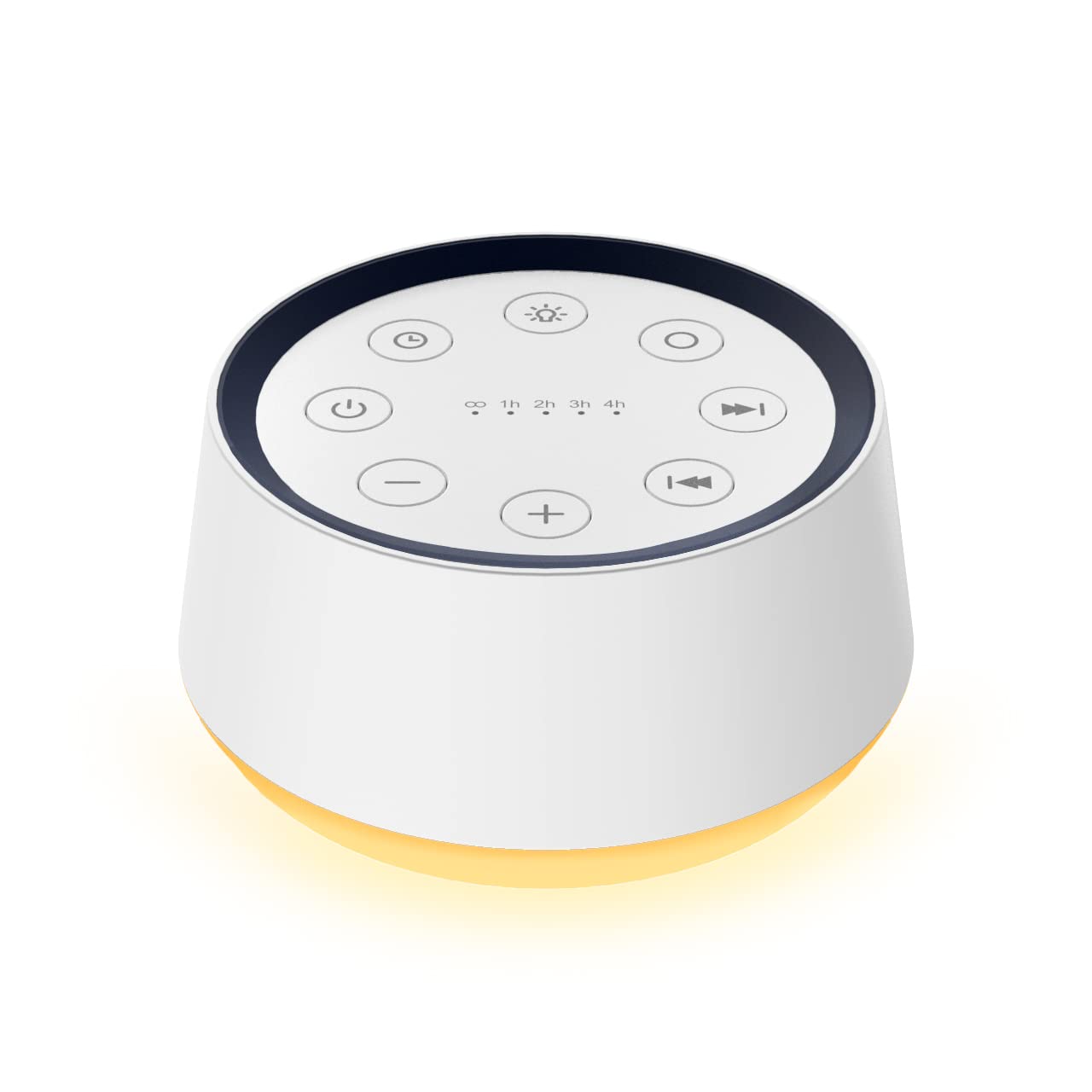
An 1800 mAh battery is why the D11 Max earns a place here. Everything else in this guide wants an outlet, which is fine until you are in a hotel room with the socket across the room, or camping, or sitting through the night after a storm has taken the power out. It charges over USB and runs cordless, which makes it the machine we pack first.

Twenty-one sounds is more than we need, and the useful ones are all in the first few: several white and brown noise variants, two fan settings, rain, ocean, and a heartbeat that parents reach for with newborns. Volume drops low enough to sit beside a bassinet, and there is a button lock so a toddler cannot change the setting mid-nap.

The catch is longevity. A share of these stop charging or stop turning on, sometimes inside the first month, and the one-year warranty is what makes that a fair trade rather than a gamble. If the machine never leaves a nightstand, the Dohm's simpler mechanism is the safer long-term bet; if it travels, this is the one you will actually take.

Bottom line: If the machine leaves the house, this is the one to take: the battery, the 21 sounds, and the price make it the easiest travel pick here.

4

Easysleep Sound Machine

Easysleep Sound Machine

Budget guest rooms

Our Score 9.2/10
Check Price

Worth Noting

  • Digital recordings, not a real fan
Sounds
25
Timers
5 settings
Night Light
4 warm levels
Volume Levels
32

Cheap sound machines die, and the Easysleep's answer is an 18-month warranty. That is an unusual thing to find at this price, and it is the main reason we rank it above the other low-cost boxes.

We liked the light more than expected. It is a warm, four-level glow rather than one of the colored mood lights, so it reads as a small bedside lamp at the top setting and barely registers at the bottom, and it switches off entirely when you want dark.

Around that: 25 sounds, 32 volume steps, five timers, and memory that returns it to your last setting. The sounds are digital rather than a fan, so we spent an evening clicking through the library before landing on one of the fan settings and staying there. For a guest room or a kid's room, it is an easy machine to hand over and forget.

Bottom line: Our budget pick: the Easysleep pairs a warm night light and five timers with an 18-month warranty, which is more cover than anything else at this price.

5

BrownNoise Sound Machine

BrownNoise Sound Machine

Kids' rooms

Our Score 9.2/10
Check Price

Worth Noting

  • Digital tracks rather than a real fan
  • No battery, so it stays near an outlet
Power
Plug-in only
Sounds
30
Night Light
12 colors
Volume Levels
36

Brown noise is the reason to start here. It sits lower than white noise, more waterfall than hiss, and it is the setting people who find white noise too sharp tend to settle on. This machine carries three brown-noise tracks alongside white, pink, and two fan settings, and the brown ones are the reason to pick it over the other budget boxes.

The other half is the light: twelve colors at ten brightness levels, controlled separately from the sound and switchable off entirely. In a kid's room that is two devices in one, and the thirty-six volume steps mean you can keep it quiet enough to sit beside a bed without it dropping out of hearing.

We think it is the best value here for a child's room and a slightly awkward fit for a grown-up's bedroom, mostly because the light is the star and the sound is the supporting act. For an adult's nightstand we still point people to the Dohm.

Bottom line: For a kid's room that needs a night light and a sound machine in one, this is the one we reach for.

6

Hatch Go

Hatch Go

Diaper bags

Our Score 9.4/10
Check Price

Worth Noting

  • Softer top volume than the corded machines
Sounds
10
Charging
USB-C
Attachment
Clip ring
Battery Life
Up to 15 hours

A ring on the back is what separates the Hatch Go from every other machine here. It clips to a stroller, a car-seat handle, or the strap of a diaper bag, and the body is built to survive being dropped and drooled on rather than set carefully on a nightstand. If the noise machine has to leave the house with a baby, this is the shape you want.

Ten sounds, three buttons, up to 15 hours on a charge over USB-C, and no app, WiFi, or Bluetooth anywhere in it. That last part is the appeal: there is nothing to pair at 2 a.m. and nothing that stops working when the hotel network does.

It is the best baby-bag machine in this guide and a middling bedroom one. Reliability is the mixed part of its record, and a unit that will not turn on even though the charging light says otherwise is the failure to watch for, which makes the one-year warranty part of what you are buying rather than a bonus. Register it the day the box arrives.

Bottom line: We keep it in the diaper-bag category for one reason: it is the only machine here that clips onto a stroller, and for a parent who needs noise on the move, that settles it.

How We Tested White Noise Machines, Night After Night

We started with a pool of roughly 40 machines from big retailers and specialty sleep shops, then narrowed it by the specs that actually matter: how many sound options there are, whether volume adjusts in fine steps or just low-medium-high, the timer and light controls, and how much nightstand space it eats. Low, middle, and upper price tiers were all represented. That left 14 machines, which came home with us for six months.

Each one ran nightly in a bedroom for at least a week, with several going into a nursery with a four-month-old and one spending its days on a desk during work calls. We measured loudness with a decibel meter at crib distance and at pillow distance, then turned each unit down to its lowest audible setting and counted how many steps sat between that and maximum. To test masking, we played a talk-radio clip at normal volume from the next room and listened from bed to see whether we could still follow the words. And we sat with each machine for 20 straight minutes listening for the point where a loop resets.

Sound quality came down to one question: would we choose this sound, not just tolerate it? We noted whether the fan settings sounded like moving air or a hissing digital file, whether the rain and ocean options had an audible repeating pattern, and whether a unit ran all night without a click, a whine, or a drift in volume. Durability got the boring treatment — months of nightly use, buttons pressed hundreds of times, a few knocks onto carpet, unplugging and replugging to see if the settings held, and a check in a fully dark room for any light bright enough to matter at 3 a.m. Two units developed a faint bearing rattle by month four, and neither made the list.

How to Choose White Noise Machines

A real fan or a recording

Two designs sit behind every pick here. A fan-based machine moves air, and moving air makes broadband noise that never repeats. A digital machine plays a file, and files loop. Most people never notice, but if a machine you owned before started sounding mechanical after a few weeks, that was the loop.

Our rule: if you have been irritated by a sound machine before, start with a fan, which means the Dohm or the SNOOZ. If you want a library to choose from, go digital and expect to audition a few tracks before you find one that disappears into the background.

Volume, and what you are masking

The loudest setting on a small machine is still a small-machine loud, and this is where buyers most often end up disappointed. Traffic, a hallway, or an upstairs neighbor takes very little volume. A snorer in the same bed takes more than most of these can give at close range.

Look at how the steps are spaced, not just how many there are. Thirty-six steps on the BrownNoise give you small increments to work with; the SNOOZ's ten are coarser but easier to count your way through in the dark.

Where it gets its power

Corded machines stay within reach of an outlet. The Dohm's cord is 7 feet, which usually covers a nightstand, and a corded unit never quits at 3 a.m. because you forgot to charge it. Battery machines go in a suitcase, a tent, or onto a stroller, and they ask for a charging routine in return.

Treat a stated runtime as a best case. Fifteen hours on the Hatch Go assumes a modest volume; charge it every few days rather than running it flat, because a battery that is always drained to zero ages faster.

Timers, lights, and controls you can find in the dark

A timer suits naps and people who do not want noise all night. Continuous play suits light sleepers who wake at 4 a.m. and need the room to sound the same as it did at midnight. Most machines here do both, and the longest timer in this group stops at four hours.

Night lights are the feature most likely to annoy you. Brightness matters more than color: a dimmer that goes low enough to see by without lighting the ceiling beats twelve colors that all glow like a landing light. Check that the light switches off while the sound keeps playing, which the BrownNoise and the Easysleep both allow.

Setting one up around a baby

Put the machine a few feet from the crib rather than beside your baby's head, and set the volume where you can hear it from the doorway but it is not loud in the room. Keep every cord well out of reach, behind furniture or across a wall the crib does not touch.

Clip-on models belong on your bag or the stroller frame, not on a crib rail where a child can reach the cable or the machine itself. None of these needs to be inside the crib, and none of them should be.

Frequently Asked Questions

Final Verdict

For most bedrooms, buy the Yogasleep Dohm Classic. It makes the one sound that is hardest to get tired of, it has nothing to configure at 2 a.m., and it asks for less money than the machine that schedules itself.

Choose the SNOOZ if you want the noise already running when you get into bed, the Dreamegg if the machine travels, and the Easysleep if the budget is tight. For a child's room where the light does double duty, the BrownNoise is the one.