Tools & DIY

Best Wire Strippers of 2026

A good pair of wire strippers does one thing that's harder than it looks: it scores the insulation and pulls it off without nicking the copper underneath. Do it wrong and you lose a strand or two, the connection weakens, and you find out months later at a flickering outlet. I've rewired lamps, swapped outlets, and spliced more low-voltage runs than I can count, and the gap between a pair that bites cleanly and one that mangles the wire shows up in the very first strip.

My team and I worked through 14 pairs over four months, from stamped-steel self-adjusting models to ratcheting tools with swappable dies, and the keepers all shared one habit: they grabbed the wire before the blade ever touched it. Two things nobody tells a first-time buyer — the gauge numbers stamped on the handle run optimistic more often than not, and the lock matters far more than it looks if the tool lives in a drawer instead of on a bench. Below are the pairs worth owning, sorted by what they're actually good at.

1

Klein 11063W Katapult

Top Pick
Klein 11063W Katapult

One-handed repeat work

Our Score 9.6/10
Check Price

Worth Noting

  • No solid wire below 20 AWG
Weight
12 oz
Strips Solid
8-20 AWG
Built-in Cutter
Up to 8 AWG solid
Strips Stranded
10-22 AWG

One squeeze does the whole job. The Katapult closes on the wire, bites the insulation and pulls the slug clear — up to an inch in a single step — and an internal spring pushes the handles back open for you. Of everything we recommend here, this is the mechanism that turns stripping into a rhythm instead of a series of small decisions.

The range is the other half of the argument. It handles 8 to 20 AWG solid and 10 to 22 AWG stranded, which takes in the 14 and 12 gauge cable in a wall, the 18 gauge control wire in a panel, and most of what falls between. The built-in cutter goes to 8 AWG solid, so cutting and stripping stop being two tools and two reaches.

What that performance costs you is weight. At 12 ounces it is as heavy as anything on this list, against roughly three ounces for a plain manual stripper, and it belongs on a bench or in a tool bag rather than a shirt pocket. We minded that less than expected once it became the only tool we picked up, but it is a real difference if you carry your tools all day.

Repetition is where it won us over. Twenty terminations into a panel, the spring doing the reopening means your free hand stays on the wire instead of prying the handles apart, and the strip comes off clean enough that you are not going back over it with a knife. That is a small gain per wire and a large one by mid-afternoon.

Bottom line: We reach for the Katapult first: one squeeze grips, strips and resets itself, which is what makes it the best pick for anyone terminating more than a few wires at a time.
2

Irwin Vise-Grip 2078300

Irwin Vise-Grip 2078300

Mixed unknown wire

Our Score 9.2/10
Check Price

Worth Noting

  • Heavy at 340 grams for a pouch
Crimps
Insulated, non-insulated, 7-9 mm ignition
Strips
10-24 AWG
Weight
12 oz
Strip Length
Adjustable stopper

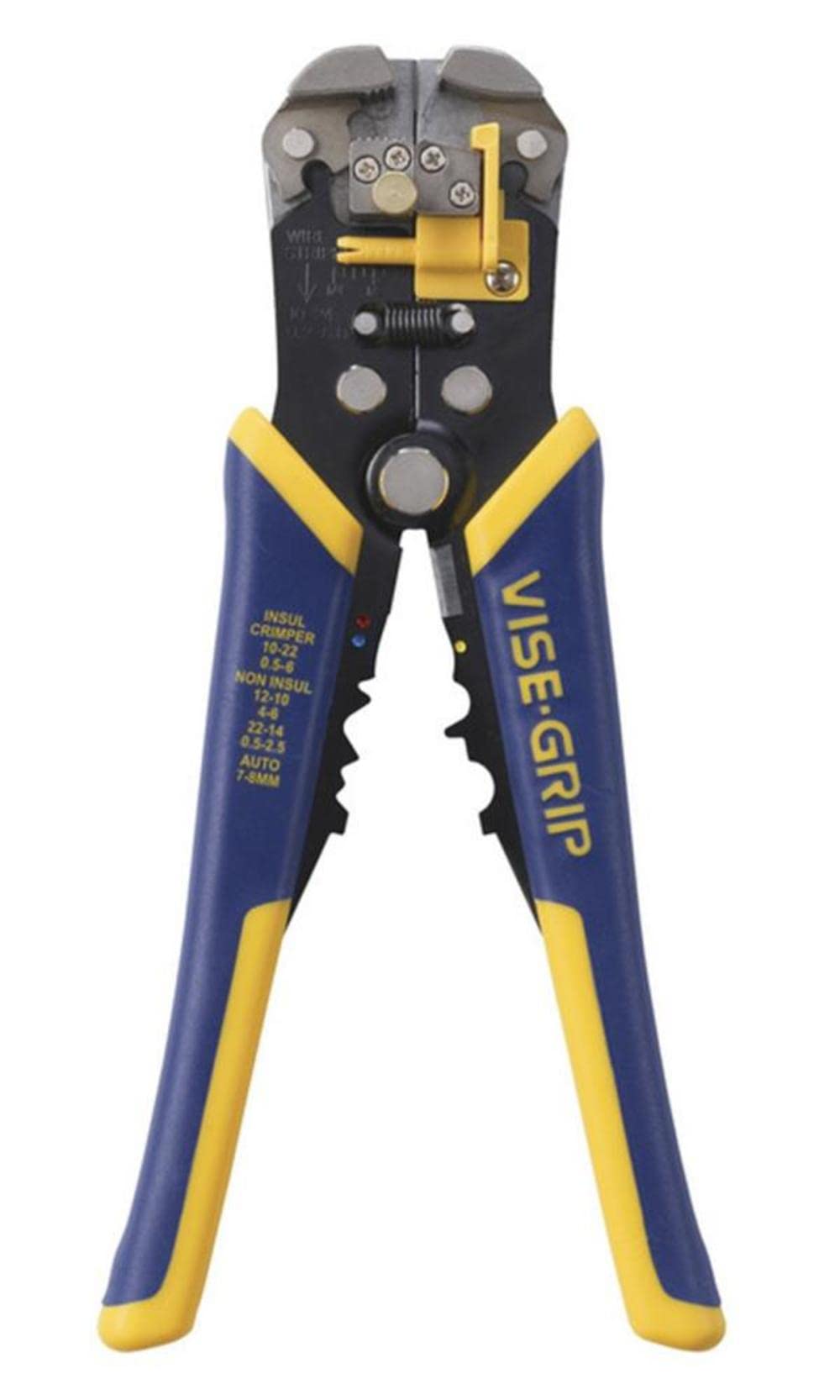
Picking the right hole is the step that slows a beginner down, and the Irwin removes it. A self-adjusting jaw swallows anything from 10 to 24 AWG, and a swivel knob micro-adjusts for the gauges below 20 that the jaw alone handles less confidently.

We found it the quickest way to strip a pile of mixed wire with cold hands or bad light, when reading stamped sizes is the last thing you want to be doing. What it does not do is decide how much insulation comes off: the adjustable stopper behind the jaw sets the strip length, and it is worth setting deliberately before a run of wires rather than after the first one comes out short.

The crimping side is broader than most: insulated and non-insulated terminals from 10 to 22 AWG, plus 7-9 mm ignition terminals, which is unusual in this group and makes the Irwin the obvious choice for automotive work rather than household. The limited lifetime warranty is the other reason it justifies its place beside a cheaper manual tool.

Bottom line: The self-adjusting jaw takes the gauge question out of the job, and the built-in crimper makes this the pick for anyone wiring a room, a car or a boat by feel rather than by chart.

3

Knipex 13 72 8

Knipex 13 72 8

Cable-heavy work

Our Score 9.6/10
Check Price

Worth Noting

  • Costs far more than anything else here
Cuts
Cable, NM-B, BX, MC
Strips
10-20 AWG solid and stranded
Weight
9.76 oz
Screw Cutting
6-32 and 8-32

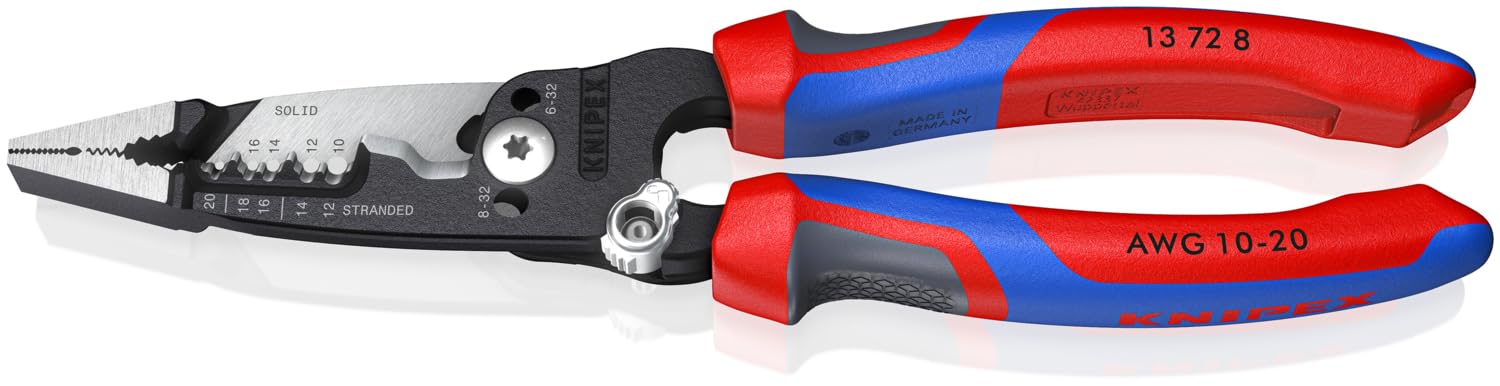
The Knipex is the best cutting tool of the group, and that is the whole case for it. Shear cutting blades take MC, NM-B, BX and ordinary cable, the screw cutters handle 6-32 and 8-32 without threading, and the tool feels forged rather than assembled. For an electrician whose day is half cable and half terminations, it removes the second pair of cutters from the bag.

Stripping is conventional but well executed: 10 to 20 AWG in both solid and stranded, with locating ridges beside the holes so you can find the right size by feel. We paid close attention to that detail, because it is the difference between a one-second strip and putting a headlamp on in a dark panel.

Where it asks for care is the cutting edge, which takes the hardest load of anything here. Heavy cable is worth cutting deliberately rather than by leaning on the handles, and the lifetime warranty covers defects in materials rather than abuse — worth knowing before you ask the blades to do something they were not built for.

Bottom line: Spend the extra if you cut MC, NM-B or BX as often as you strip — nothing else here goes through armored cable this cleanly.

4

Irwin Vise-Grip 2078309

Irwin Vise-Grip 2078309

First tool bag

Our Score 9.4/10
Check Price

Worth Noting

  • Crimp jaw sits between the handles
Crimps
Insulated and non-insulated terminals
Length
8 inch
Strips
10-22 AWG
Weight
3.04 oz

Three ounces and eight inches, with a plier nose and a yellow-edged handle that is easy to find in a dark bag. The Irwin disappears into a pocket in a way none of the automatics do, and it takes the handling a pair of pliers gets, because that is essentially what it is.

For the money, this is the most tool per dollar in the group. It strips and cuts 10 to 22 AWG, crimps insulated and non-insulated terminals, shears bolts to length and leaves a usable thread, and the plier nose pulls, bends and loops wire. We think of it as the first stripper to buy, because there is no mechanism to learn and nothing to set before a strip.

The compromises are in your hand. The grips are hard plastic with almost no give, and a long session leaves a mark; 22 AWG is at the edge of what the holes do well, so fine wire needs a careful squeeze. A homeowner notices none of that. Someone stripping a panel all day will.

Bottom line: Eight inches and three ounces of strip, cut, crimp and bolt-cut — the tool we hand someone starting out who wants one thing in the bag that does the whole job.

5

Klein 11057

Klein 11057

Fine gauge wiring

Our Score 9.6/10
Check Price

Worth Noting

  • No use on 12 or 14 gauge wire
Weight
5.1 oz
Also Does
Shears 6-32 and 8-32 screws
Strips Solid
20-30 AWG
Strips Stranded
22-32 AWG

Twenty to 30 AWG solid, 22 to 32 stranded: that is alarm and thermostat wire, model railroad feeders, and the silicone hookup wire that comes with hobby electronics. Most strippers treat those sizes as an afterthought at the bottom of the range. This one is built around them.

The rest is familiar Klein: precision-ground stripping holes, a serrated nose for bending and pulling, holes for looping wire around terminal screws, and clean shearing of 6-32 and 8-32 screws. At 5.1 ounces it is light enough to keep in a pocket, and it is made in the USA.

Where it earns its place is the quality of the strip at the small end. A 22 AWG hole on a general-purpose stripper is a compromise between a dozen sizes; here the hole is the size the tool was designed around, and the insulation comes off in one pull instead of in shreds that leave you counting strands.

Bottom line: For 22 to 30 gauge work — alarm contacts, thermostats, hobby electronics — this is the stripper we keep coming back to, and its holes are sized for wire you can barely see.

6

Milwaukee 48-22-3079

Milwaukee 48-22-3079

Electrician's daily carry

Our Score 9.6/10
Check Price

Worth Noting

  • Glued grips can work loose
  • No crimper at all
Reams
1/2 to 1 inch pipe
Weight
10.2 oz
Strips Solid
8-18 AWG
Strips Stranded
10-20 AWG

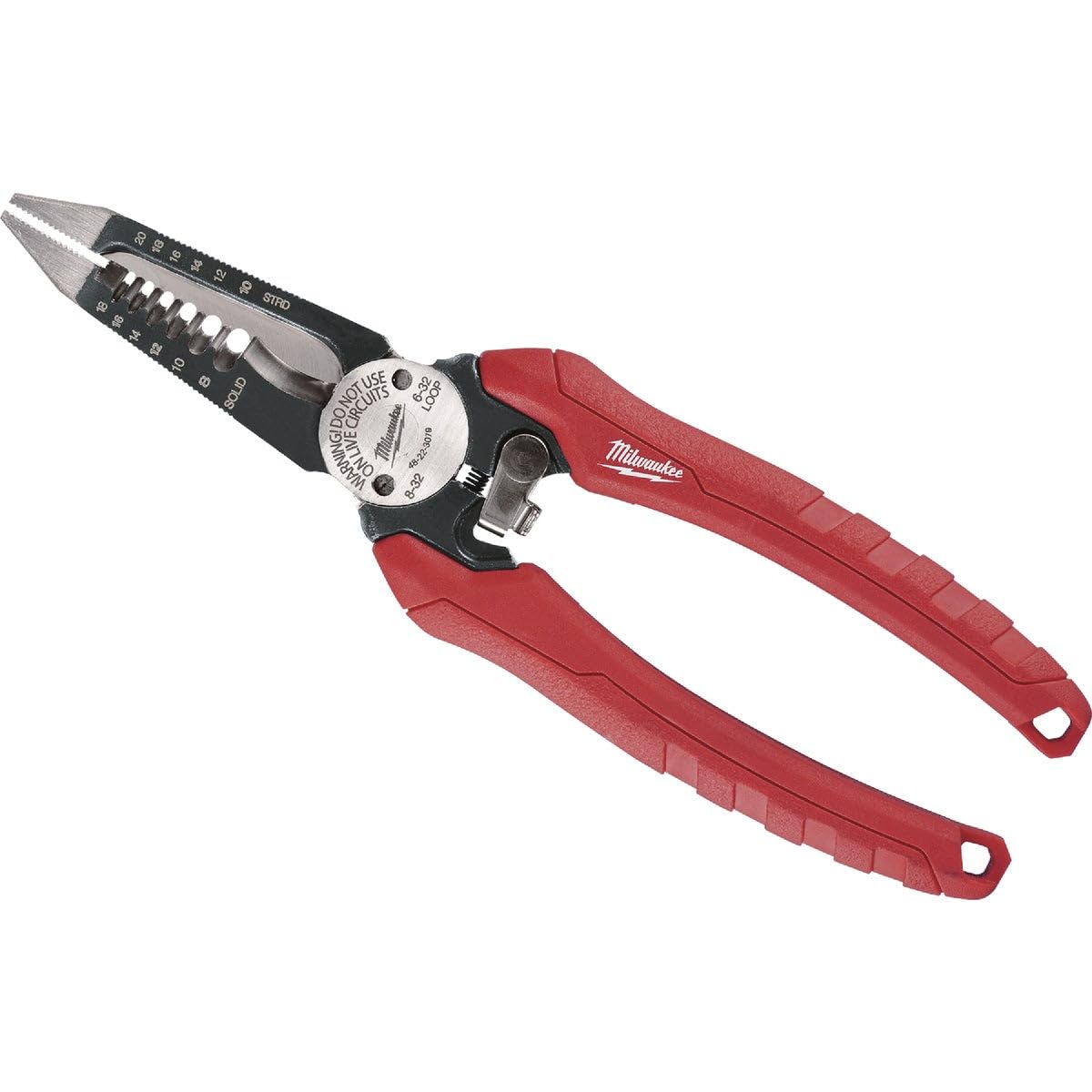
This is a pair of pliers that strips wire, not a stripper that happens to grip. The needle-nose tip pulls and twists conductors, the curved blade cuts larger cable than the stamped template allows, two holes in the middle form loops for 8-32 and 6-32 grounding screws, and the same tool reams pipe from 1/2 to 1 inch.

The stripping side covers 8, 10, 12, 14, 16 and 18 gauge solid and 10 to 20 gauge stranded, and it does the everyday job well. The gauge markings are small and stamped into a working surface, though, so reading them in a dim panel is a headlamp job.

It is a big tool — nearly ten inches and 290 grams — and the bolt cutter takes #6 and #8 screws through the center, which is the kind of thing you use twice a week and miss badly when it is not there. It is also the tool here most likely to replace the pliers you were already carrying.

As a stripper it is good rather than superb: everyday terminations come out clean, but a dedicated tool is quicker on the small gauges. Where it wins is the bag test — one pair that cuts, grips, reams and strips beats three that each do one thing, and if your day moves between tasks that trade is worth making.

Bottom line: A plier first and a stripper second, and that is the point: it strips, reams, loops and cuts bolts so an electrician can leave three tools in the van.

7

Neiko 02037A

Neiko 02037A

Tight spaces

Our Score 9.2/10
Check Price

Worth Noting

  • No return spring
  • Small crimp head for long terminals
Length
7 inch
Strips
12-20 AWG
Weight
2.47 oz
Functions
Strip, crimp, cut, grip

A junction box with four cables crowded into it, or a wiring harness above a pedal, is where full-size strippers stop being useful. The Neiko is a 7-inch, 70-gram tool with a narrow jaw that gets into those spaces, which is the reason it exists.

Four functions in one: it strips 12 to 20 AWG, crimps insulated and bare terminals, and the gripping nose pulls, holds, twists and bends wire ends. The blades are heat-treated and CNC machined, and the forged alloy body shrugs off being carried loose in a bag in a way the price does not promise.

It arrives stiff and stays stiff for the first few sessions, which is worth knowing before you conclude the tool is faulty. The cutter sits at the back of the jaw rather than in front of the pivot, so it takes a moment to find, and 12 gauge is the biggest wire it will strip — this is not the tool for a service panel.

Where it earns its keep is the pocket of a bag that already holds a full-size stripper. For the awkward job it is easy to justify: it costs little, it forgives being dropped, and it reaches places the Katapult simply cannot.

Bottom line: Small, stiff and inexpensive, this is the crimper-stripper we keep in a pocket for under-dash and junction-box work where full-size pliers will not fit.

8

WGGE WG-015

WGGE WG-015

Weekend DIY

Our Score 9.2/10
Check Price

Worth Noting

  • Center rivet can break under load
Crimps
Insulated and non-insulated terminals
Length
8 inch
Strips
10-22 AWG
Warranty
24 months

Eight inches of high-carbon alloy steel covering 10 to 22 AWG, with a cutter, looping holes and a crimper built in, and a 24-month warranty behind it. On paper this is the same job description as tools selling for several times as much.

It strips cleanly at the common household sizes, the curved handle keeps pressure off your palm, and the cutter deals with copper without much drama. The edge is not in the same class as the Klein or the Knipex, though, and forcing it through anything harder than copper is where the tool starts to feel its price.

Crimping is the weak spot: the jaws spread under a butt connector, so treat the crimper as a bonus rather than a reason to buy. Everything else is a decent impression of a more expensive tool, and for a homeowner rewiring a lamp or adding an outlet, that is a good trade.

Bottom line: The best value of the cheap strippers here: it strips and cuts cleanly for the money, and it suits the tool that comes out for a few weekend jobs a year.

How We Tested Wire Strippers

We started by gathering every pair we could find at electrical supply houses, hardware stores, and the tool aisles of big-box retailers, then cut the list down to models with a published gauge range, serviceable or replaceable blades, and a lock. Anything that was primarily a multi-tool got set aside. That left 14 pairs, which we used for four months across a garage bench, a kitchen circuit rewire, a closet light fixture swap, and a coffee table buried in lamp cord and thermostat wire.

Each pair stripped 10, 12, 14, 18, and 22 AWG wire, solid and stranded, 20 times per gauge. We counted the strands left intact after every pull, noted whether the insulation came off in one piece or shredded, and timed the strips so we'd catch the tools that needed two squeezes to get through. Gauge accuracy got checked with calipers — we compared the conductor that came out against the die the tool claimed to be using.

Grip and ease of use we judged the crude way: 30 strips back to back in nitrile gloves, watching for hand cramping and whether the handles rotated under pressure. We measured nose length, then tried to seat each tool on a terminal inside a packed single-gang box and slide it into a back pocket. The lock earned its own check — open and close one-handed, shake it around a tool bag, drop it on concrete.

For durability, every pair ran at least 200 strips, after which we inspected blade edges under a magnifier for nicks and checked the pivot for wobble. Value came down to whether a pair still cut cleanly at the end of four months. We're still using the top performers for everyday repairs and will update as the blades dull.

How to Choose Wire Strippers

Choose the mechanism before the gauge range

Manual gauged holes, a self-adjusting jaw and a one-squeeze automatic all strip wire; they suit different work. Manual tools are the lightest and the least expensive and ask you to match the hole to the gauge, which is fine for occasional jobs. A self-adjusting jaw takes that decision away and is the quickest route through mixed, unfamiliar wire. An automatic grips and pulls in a single squeeze and resets itself, which is what pays off across a long run of terminations.

The trap is assuming self-adjusting means self-setting. The jaw picks the gauge; strip length is usually a separate stopper you set by hand, and leaving it alone is how the first wire of a batch comes out short.

Match the range to the wire you actually touch

Household cable is 14 and 12 AWG, control and thermostat wire runs 18 to 22, and alarm, hobby and electronics work goes finer still. A tool covering 10 to 22 AWG handles most of a house; a 20 to 30 AWG stripper exists for the fine end and is useless on a receptacle circuit.

Read solid and stranded as two separate numbers, because they rarely match and the stranded range is usually the narrower one. If your work crosses that line, a second small stripper costs less than a conductor nicked by a hole one size off.

Decide how much cutting and crimping you need

Cutting is standard; usable crimping is not. On a combination tool, look at where the crimp jaw sits — between the handles is awkward inside a box, and a small head takes several bites at a long terminal. If you crimp terminals all day, a dedicated crimper beats any stripper's afterthought.

Cutting is where a premium tool separates itself. If armored or NM cable is a regular part of the job, a forged tool rated for BX, MC and NM-B replaces a separate pair of cable cutters, and that is the one upgrade here we think is worth carrying the extra weight for.

Think about the hand, not just the head

Two things decide whether you still like a stripper after a month: weight, and how it opens. A spring-return or self-opening tool lets your free hand stay on the wire; a stiff, un-sprung one has to be worked open every single time. Twelve ounces on a bench is nothing; twelve ounces in a pouch all day is a decision.

Check the gauge markings before you commit — stamped numbers on a dark handle are hard to read in a panel — and treat the pivot or rivet as the part that decides how long the tool stays accurate.

Frequently Asked Questions

Final Verdict

Our money goes on the Klein 11063W. It strips 8 to 20 AWG solid in one squeeze, cuts up to 8 AWG, and resets itself, which is the difference between a chore and a rhythm once a job runs long. Two requirements change the answer: if you cut armored or NM cable as often as you strip, the Knipex earns its premium, and if your wire is finer than 22 AWG, the Klein 11057 is the tool that actually fits it.