Phone & Tablet Accessories

Best High-Capacity Power Banks of 2026

The milliamp-hour figure on the front of a power bank is measured at the cells inside, before any of that energy is converted and pushed through a cable into your phone. What actually reaches your battery is smaller — sometimes a lot smaller, which is why a bank promising three charges can quit after two, usually at the worst possible moment. A good high-capacity bank fixes something simple: it keeps a phone, a tablet, and occasionally a laptop alive through a long day away from an outlet, without weighing down your bag or running hot enough that you start watching it.

We spent nine months with 12 of them, and the differences showed up in places a spec sheet never mentions — how quickly a phone actually hit 50 percent, how honest the battery display was at 11 p.m., whether the thing got uncomfortably warm halfway through a charge. The banks worth carrying tended to be a bit heavier than I'd like and a bit pricier than I hoped, and that's the honest trade at this capacity. What follows are the ones I'd hand to a friend before a flight.

1

Anker 20K 87W Power Bank

Top Pick
Anker 20K 87W Power Bank

Travel and laptops

Our Score 9.0/10
Check Price

Worth Noting

  • Long-term battery and cable life can fall short
  • Heavier than a phone in a pocket
Ports
3 ports + built-in USB-C cable
Weight
15.2 oz
Capacity
20,000 mAh
Max Output
87W total; 65W single device

The built-in USB-C cable is the first thing we show people when they ask why this Anker is our default. It lives in the pack, so there's no loose cord to forget, and the 87W total output gives a single device up to 65W—enough to top up a small laptop, not just a phone. With three ports and a 20,000mAh capacity, it covers a phone, earbuds, and a tablet on a weekend away without turning into a brick.

We like the size as much as the power. At 6.2 by 2.9 by 1.0 inches and 15.2 ounces, it slips into a backpack pocket and doesn't make us choose between the charger and a water bottle. That balance is why it beats the bigger Anker 25K for everyday carry: the 25K carries more capacity and dual cables, but it's a heavier pack for laptop-heavy days. If you mostly charge a phone and one accessory, this is the one we reach for.

If your trips involve a laptop plus a tablet and you want a bigger reserve, the Anker 25K is the better fit; for phone-first travel, the 20K is easier to live with. It's the pack we leave by the door because it covers the most common days without a packing debate.

Bottom line: For most travelers, this is the high-capacity pack we recommend: 20,000mAh, laptop-class 87W output, and a built-in USB-C cable that stays with the pack.

2

Anker 25K 165W Power Bank

Anker 25K 165W Power Bank

Laptop-heavy travel

Our Score 8.8/10
Check Price

Worth Noting

  • Mixed long-term reliability
  • Retractable cable adds a wear point
Ports
4 ports + two built-in cables
Capacity
25,000 mAh
Recharge
100% in 110 min
Max Output
165W total

Two built-in USB-C cables—one retractable to 2.3 feet—are the reason this Anker earns a spot above the 20K for laptop days. The pack pushes 165W total across three USB-C ports, with each port up to 100W, and it can charge four devices at once. We charged a laptop and phone together and appreciated not digging for a cable; the retractable one also doubles as a handle when you're carrying it between meetings.

The 25,000mAh capacity is the other draw. It's enough for a long-haul flight or a full workday away from an outlet, and Anker says it can refill to 100% in 110 minutes with a 100W-or-better charger. That's a faster turnaround than most big packs here, which matters if you're using it every day rather than just on vacation.

The trade-off is weight. At 6.18 by 2.12 by 1.92 inches, it's a bag pack, not a pocket pack, and you feel it when you're walking a lot. The price is premium, too. We think the built-in cables and output justify it for laptop users; phone-only travelers get more value from the 20K.

Bottom line: We recommend this Anker for laptop-heavy trips: 25,000mAh, 165W total output, and two built-in cables make it a one-pack travel kit, as long as you accept the bulk.

3

IAPOS 60,000mAh Power Bank

IAPOS 60,000mAh Power Bank

Road trips

Our Score 9.2/10
Check Price

Worth Noting

  • Not carry-on compliant
  • Slow to recharge itself
Ports
5 devices at once
Weight
15.5 oz
Capacity
60,000 mAh
Max Output
22.5W

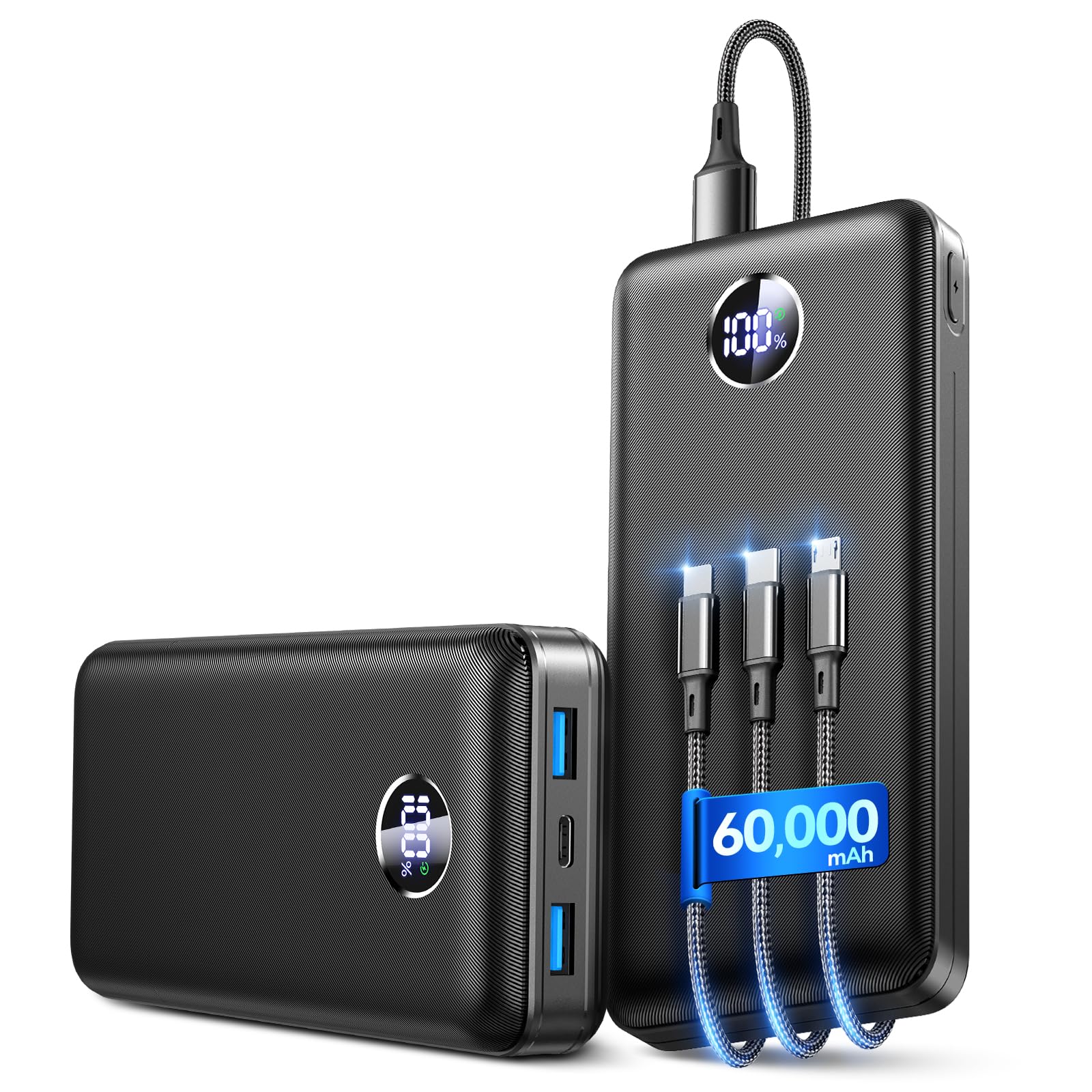
Five devices at once sounds like a spec-sheet boast, but the IAPOS has the ports to back it up: two USB-A, one USB-C, and a built-in 3-in-1 cable with USB-C, Lightning, and micro-USB ends. We used it as the family pack on a car trip, topping up phones, earbuds, and a tablet without swapping cables. The digital display is a small but welcome touch—you can see how much reserve is left before you commit it to a device.

The 60,000mAh capacity is the reason to choose it. It gives you multiple full phone charges and enough reserve for a tablet or a couple of small devices, which is exactly what you want when the nearest outlet is hours away. The 22.5W output is fine for phones and tablets, but it's not a laptop charger; if you need to run a MacBook, the Anker 25K is the better tool.

We like the IAPOS for what it is: a big, simple reserve for the car, the campsite, or a power outage. At 15.5 ounces and 5.9 by 2.95 by 1.1 inches, it's still backpackable, though it's not a pocket pack. It's the pack we leave in the trunk for a weekend.

Bottom line: We recommend the IAPOS for road trips and campsites where outlets are scarce: 60,000mAh, five-device charging, and a built-in 3-in-1 cable.

4

Amazon Basics 20,000mAh Power Bank

Amazon Basics 20,000mAh Power Bank

Everyday budget

Our Score 9.0/10
Check Price

Worth Noting

Ports
3 ports
Weight
11.9 oz
Capacity
20,000 mAh
Recharge
4.4 hours

At 11.9 ounces and 4.48 by 2.83 by 1.16 inches, the Amazon Basics is the easiest 20K here to drop into a daypack. We like that it gives you two USB-C ports and one USB-A, so a newer phone and an older accessory both have a home, and the 20,000mAh capacity is enough for a couple of phone charges plus a tablet top-up. It's the pack we hand to someone who wants a straightforward backup without paying for extras.

The 4.4-hour recharge is not fast, but it's predictable: plug it in overnight and it's ready for the next day. The LED indicators are basic, showing a rough level rather than a percentage, and there's no built-in cable, so you need to pack the included one-foot USB-C cable or your own. Those are small omissions at the budget end, and they keep the price down. If you want a display, a built-in cable, and faster output, the Anker 20K is the upgrade; if you want a simple reserve for the car or a drawer, this is the one.

Bottom line: For a no-frills 20,000mAh pack, the Amazon Basics is the value pick we point to: light, simple, and enough for phones, tablets, and a long day out.

5

UGREEN Nexode 25K 200W

UGREEN Nexode 25K 200W

Power monitoring

Our Score 8.6/10
Check Price

Worth Noting

  • Long-term battery life can fall short
  • Premium price for the capacity
Ports
3 ports
Display
TFT power display
Capacity
25,000 mAh
Max Output
200W total

The TFT display is the first thing you notice on the UGREEN. It shows battery level, remaining time, output and input wattage, voltage, and current—more information than most people need, but genuinely useful if you're troubleshooting a laptop that's charging slowly. The 200W total output is the other headline: USB-C1 can deliver up to 140W, USB-C2 up to 100W, and the pack can charge three devices at once.

We like this better than the Anker 25K for one specific buyer: someone who wants to see the watts and confirm a laptop is actually pulling power. The metal-bodied design feels substantial, and the display is bright enough to read at a glance. For everyone else, the Anker's built-in cables are more convenient, and the UGREEN's higher output doesn't matter if you're only charging phones.

The weight is the trade-off. At 0.51 kg and 6.1 by 2.1 by 1.9 inches, it's a bag pack, not a pocket pack. If you're carrying a laptop, that's fine; if you're phone-only, the Amazon Basics is easier to live with.

Bottom line: We recommend the UGREEN for the data-minded road warrior: 25,000mAh, 200W total output, and a TFT screen that shows exactly what the pack is doing.

6

Liahomco 80,000mAh Power Bank

Liahomco 80,000mAh Power Bank

Off-grid use

Our Score 8.8/10
Check Price

Worth Noting

  • Not carry-on compliant
  • Advertised capacity may be optimistic
Ports
5 outputs, 2 inputs
Weight
35.3 oz
Capacity
80,000 mAh
Max Output
30W

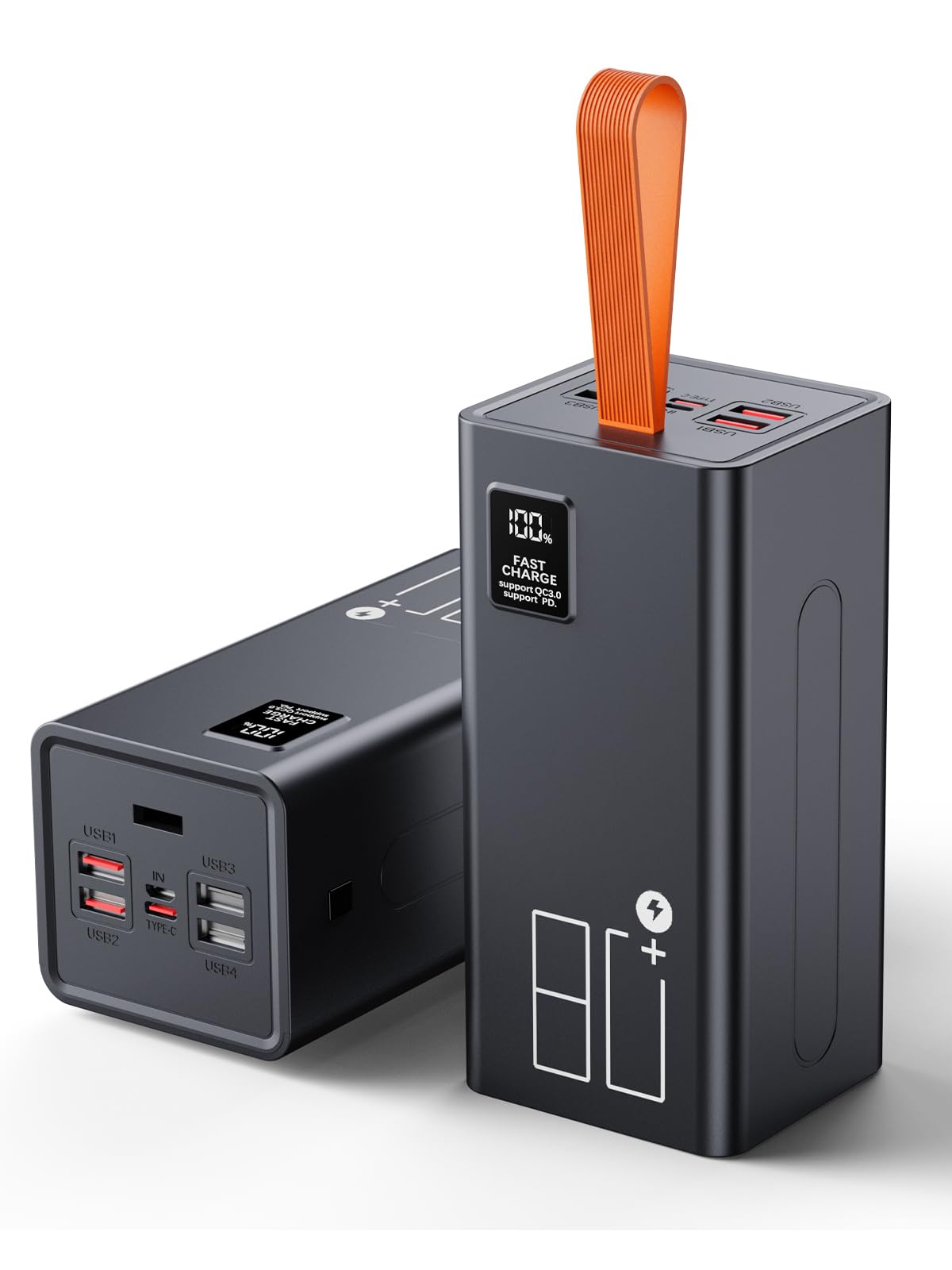
The 80,000mAh number is the whole reason to look at the Liahomco. It's built for the kind of trip where you're away from outlets for days—camping, a tailgate, a storm outage—and the capacity is meant to run phones, tablets, a camera, and small gear without rationing. The five outputs and two inputs give you flexibility, and the non-slip base and lanyard are practical touches for a pack that's going to sit on a table or in a tent.

The 30W output is modest for the size. It's fine for phones and tablets, but it won't fast-charge a laptop, and the pack itself takes a long time to refill—Liahomco lists a 10-hour charge time. That's a trade-off you accept for the capacity: this is a pack you plug in overnight and use as a basecamp battery, not something you top up between meetings.

At 1 kilogram and 2.56 by 2.56 by 5.91 inches, it's the heaviest pack here by a wide margin. We carried it in a backpack and felt it; it's not something you toss in a purse. The shape is more like a small brick than a phone, so plan your bag around it.

We think the Liahomco earns a place for the specific buyer who needs maximum reserve and doesn't care about pocketability. For everyone else, it's overkill: the IAPOS 60K is lighter and easier to live with, and the Anker 20K is the better travel pack. This one is for the car, the campsite, or the emergency shelf.

Bottom line: We recommend the Liahomco only for off-grid weekends: 80,000mAh and five outputs, in a one-kilogram pack you leave in the car.

7

OHOVIV 50,000mAh Power Bank

OHOVIV 50,000mAh Power Bank

Budget capacity

Our Score 8.6/10
Check Price

Worth Noting

  • Not carry-on compliant
  • Long-term reliability can fall short
Ports
4 ports
Weight
22.9 oz
Capacity
50,000 mAh
Max Output
22.5W

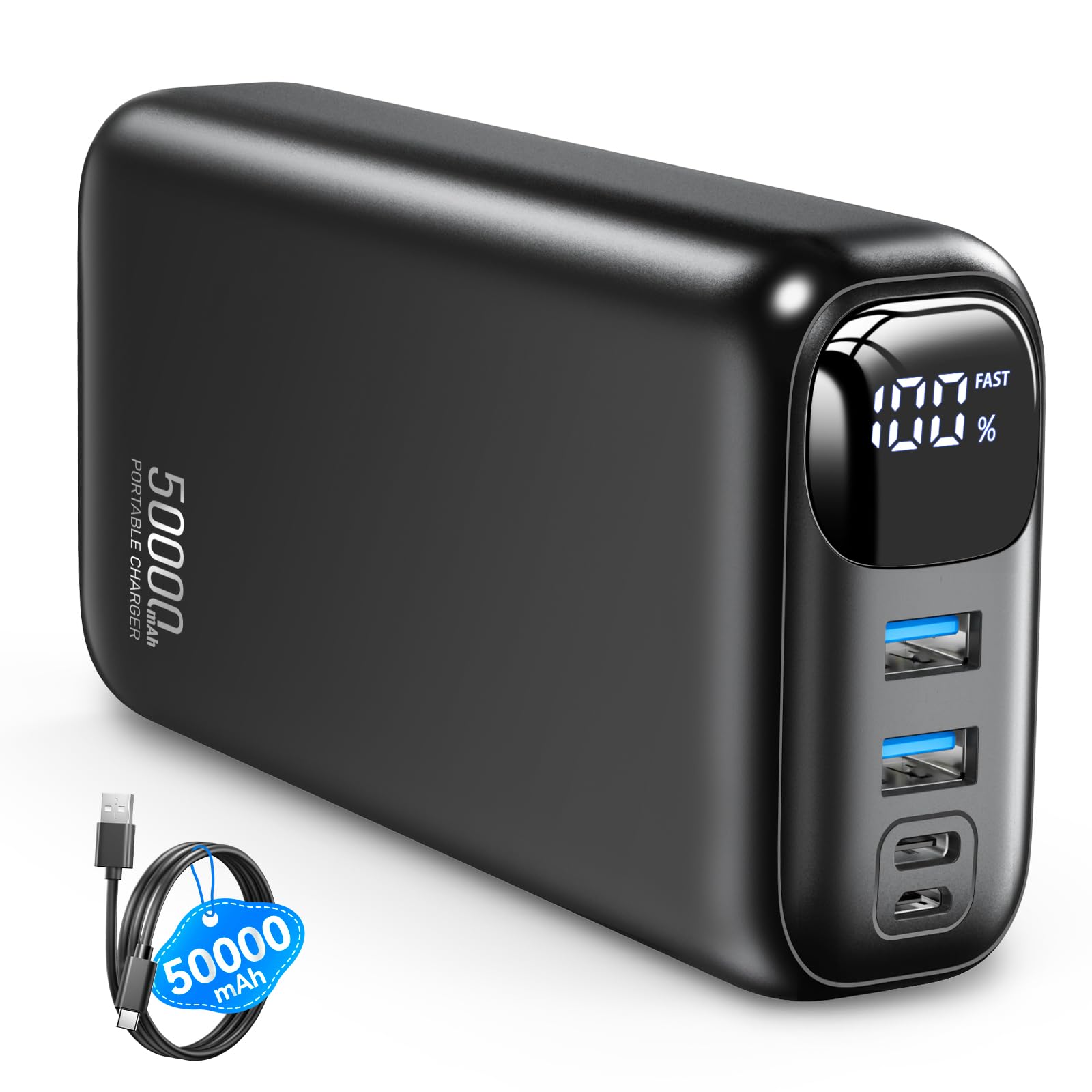
The OHOVIV gets you 50,000mAh for less than most of the 20K packs here, and that's the entire appeal. It has two USB-A ports and one USB-C port, a digital display, and built-in cables, so you can charge a phone, earbuds, and a tablet without bringing a pouch of cords. We used it as a car pack and appreciated the reserve; it kept devices topped up over a long day without hunting for an outlet.

We like it as a budget basecamp pack, not as a daily carry. At 0.65 kg and 5.38 by 2.75 by 1.6 inches, it's a chunky brick, but it's the kind of weight you leave in the car and forget until you need it. The 22.5W output is phone-and-tablet speed, not laptop speed; if you need laptop charging, the Anker 20K is the better tool. For a huge reserve on a budget, it makes sense.

Bottom line: We recommend the OHOVIV as the budget route to 50,000mAh: a heavy pack with three-device charging and a digital display, best kept in a bag or car.

8

LanLuk 40,800mAh Power Bank

LanLuk 40,800mAh Power Bank

Multi-device trips

Our Score 8.6/10
Check Price

Worth Noting

  • Not carry-on compliant
Cables
Built-in
Outputs
5
Capacity
40,800 mAh
Max Output
25W

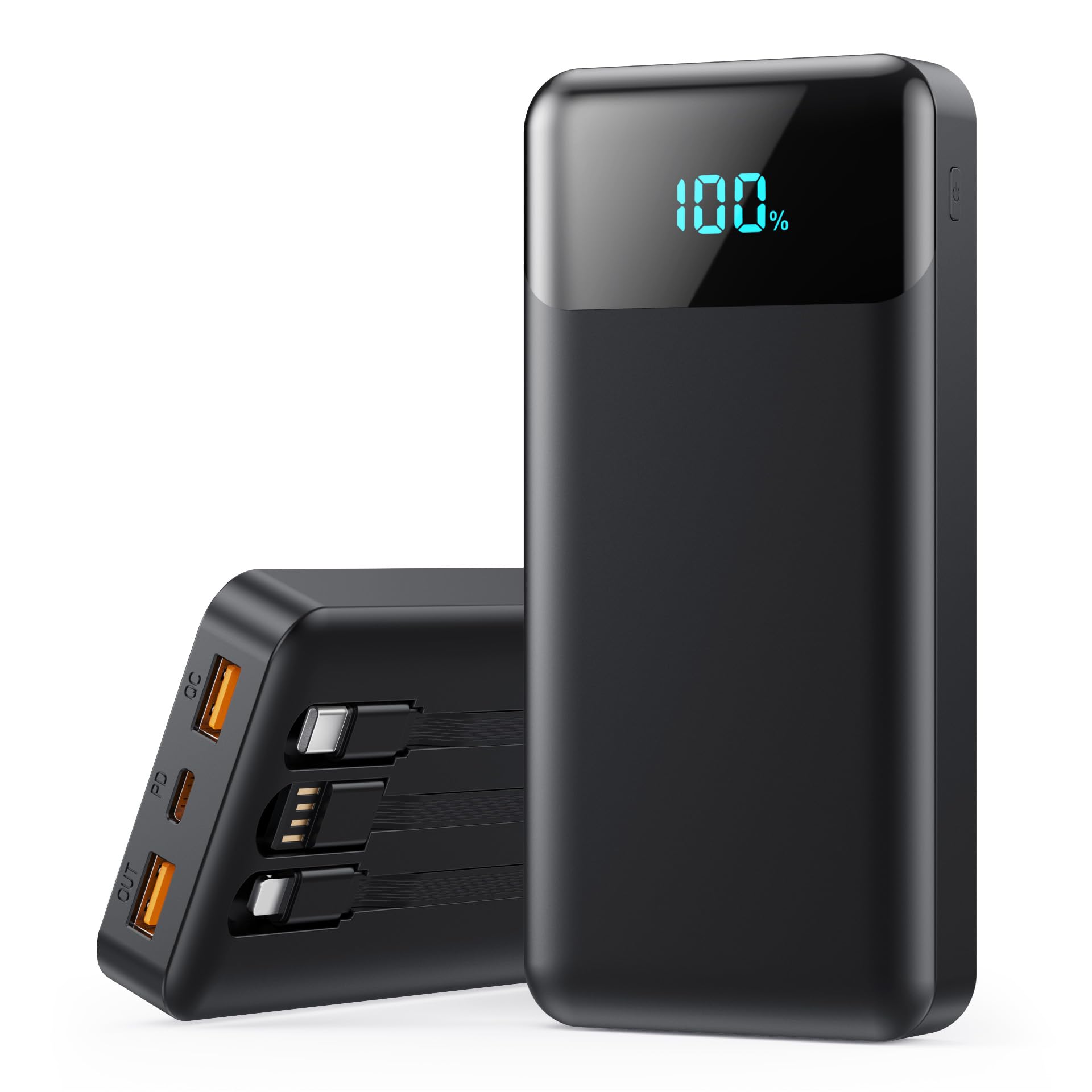
Built-in cables and five outputs are the reason the LanLuk stands out from the other big packs. It has USB-C and iOS cables built in, plus multiple ports, so a family can charge several devices without a tangle of cords. We used it on a long day out and appreciated not digging through a bag for the right cable.

The 40,800mAh capacity is generous for phones and tablets, and the 25W output is quicker than the 22.5W packs here. It won't match a 65W laptop charger, but it's enough to top up a tablet or a phone quickly. The built-in cables are tested for 30,000 bends, which is reassuring if you're rough on gear.

The size is the catch. At 5.90 by 2.67 by 1.18 inches, it's a thick pack that takes up real space, and the weight is noticeable in a backpack. The 10+ protection systems are welcome, but the pack is still a bag item, not a pocket item.

We think the LanLuk makes sense for road trips, camping, and families who need to keep several devices going, especially if you like built-in cables. It's not the pack for a light day bag; the weight and size make it a trunk pack. If you want a big reserve with fewer cables, it's a good value; if you want something you can carry every day, the Anker 20K is the better fit.

Bottom line: We recommend the LanLuk for multi-device road trips: 40,800mAh, five outputs, and built-in cables, in a pack that's too heavy and too big for a flight.

How We Tested High-Capacity Power Banks

I built the shortlist from brands that have been making battery cells for years, then filtered on the things that decide whether a bank is useful: rated capacity, USB-C Power Delivery wattage, how many ports can run at full speed at once, and whether the output is high enough to charge a laptop rather than just a phone. Anything advertising a big milliamp-hour figure with no wattage beside it got cut. That left 12 banks, and I've lived with them for nine months — on flights, on a long drive, on a weekend camping with no outlet in sight, and through ordinary weeks where I kept forgetting to charge my phone overnight.

Charging speed and battery life were timed, not estimated. I drained each bank to zero, then clocked how long it took to bring a dead phone to 50 percent and then to full, and ran a laptop off each one until it quit. Then I counted how many full phone charges each bank actually delivered and set that against what the box promised — the size of that gap told me more than any spec ever could.

Weight and durability got handled the unglamorous way. I weighed every bank on a kitchen scale and carried it in a tote or backpack for a week to see when it started to feel like a nuisance, then dropped each one from waist height onto concrete and let it rattle around in a bag with keys. I noted whether the display gave a real percentage or four vague dots, checked each bank by hand for heat after 30 minutes of hard charging, and flagged the ones that slowed down or shut off. Value came down to price per usable charge, not price per milliamp-hour.

How to Choose High-Capacity Power Banks

Capacity Is Not the Same as Charges

The headline milliamp-hour figure is the cell capacity, not the number of phone charges you get. Conversion losses, cable resistance, and your phone's battery size all eat into it. In practice, a 20,000mAh pack is a weekend phone pack; 40,000mAh and up is a basecamp reserve. We treat 20,000mAh as the sweet spot for travel because it is enough for a couple of days without becoming a brick. If you need a week off-grid, step up to 50,000mAh or more and accept the weight.

Check Watt-Hours Before You Board

The number that matters at security is watt-hours, not milliamp-hours. Multiply mAh by nominal voltage and divide by 1,000. A 20,000mAh pack is roughly 74Wh, a 25,000mAh pack about 93Wh, and a 40,800mAh pack about 151Wh. The common carry-on ceiling is 100Wh, with some airlines allowing up to 160Wh only with approval. That makes 20,000–25,000mAh the travel-safe zone and 40,000mAh and up a road-trip purchase. Check your airline's rule before you pack the big one.

Match Output to the Device

Output wattage decides what a pack can actually charge. 22.5W is phone speed, 45W is tablet or small-laptop territory, and 65W and up is where a full laptop starts to make sense. Ports matter too: two USB-C ports are more future-proof than a pile of USB-A, and a built-in cable is one less thing to lose. We like the Anker 20K for laptop travel because 87W total output and a built-in USB-C cable cover both needs; the IAPOS 60K is phone-and-tablet speed despite its huge capacity. Don't buy 60,000mAh for a laptop unless the output is there.

Weight and Recharge Time Are the Daily Tax

High capacity always costs weight. A 20,000mAh pack lands around 12–16 ounces; a 50,000mAh pack is closer to 1.5 pounds; an 80,000mAh pack can hit 1 kilogram. The other tax is refill time: a 20,000mAh pack can take 4–5 hours on a standard charger, a 25,000mAh high-input pack can refill in about two hours, and an 80,000mAh pack can take 10 hours. If you're carrying the pack every day, the lighter 20K is worth more than the extra capacity. If it lives in the car, the big pack's weight matters less.

Treat Cables and Battery Life as Wear Items

Built-in cables are convenient, but they're also the first thing to fail: a yanked connector or a worn retractable mechanism can take the whole pack out of service. Battery cells age too, and a pack that stops holding a charge after a year and a half is a real risk in this category. We look for an 18-month or longer warranty and a seller with a clear return path. Keep a spare cable in your bag even if the pack has one built in, and don't rely on a single built-in cable as your only charging option.

Frequently Asked Questions

Final Verdict

For most people, the Anker 20K 87W is the high-capacity power bank we recommend. It has enough reserve for a weekend, the output to charge a small laptop, and a built-in USB-C cable that removes the most common travel annoyance. If your trips are laptop-heavy, the Anker 25K buys more capacity and two cables for the extra weight. If you need the biggest reserve for a campsite or power outage, the IAPOS 60K is the one to pack.